Some turns in Middle-earth happen with trumpets.
A king returns. A tower falls. A dark lord is unmade.
And then there are turns that happen in a forest—soft-footed, almost easy to miss—where the world changes not because a sword is drawn, but because a boundary is lowered.
Gimli’s passage through Lothlórien is one of those.
At first, it looks like a minor discomfort.
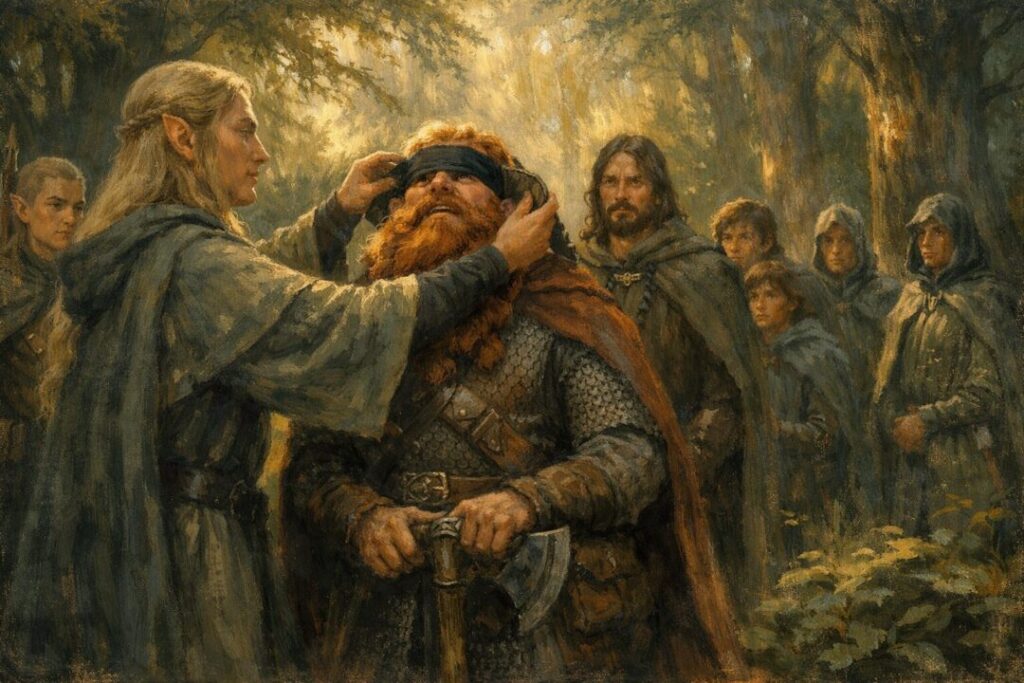
The Company has barely crossed into the Naith before the Elves insist on an old restriction: the Dwarf must be blindfolded. Gimli refuses to be singled out, and Aragorn settles it by choosing equal treatment: all will go blindfolded.
So far, the world is still the world: suspicion is normal, and old history still governs the present.
Then a message arrives.
Haldir reports word from the Lord and Lady of the Galadhrim: “You are all to walk free, even the dwarf Gimli.”
It is easy to read that as courtesy. Or strategy. Or simply confidence: the Lady knows who has entered her land.
But the text itself presses on a more revealing point: “It seems that the Lady knows who and what is each member of your Company.”
In other words, Gimli is not freed from the blindfold because the Elves become suddenly relaxed.
He is freed because Galadriel chooses to see him clearly—and to have her people see him clearly too.
That choice matters, because Lothlórien is not just any realm. It is a place held together against time, guarded by memory, and shaped by a power that does not belong to the ordinary Third Age.
When Galadriel alters how her borders treat a Dwarf, she is not merely being kind.
She is changing what Lórien means.
The gift that is not “just a gift”
The better-known moment comes later, when the Company is departing and Galadriel brings out the parting gifts.
She speaks as one who knows separation is final: “We have drunk the cup of parting… and the shadows fall between us.”
Then she turns to Gimli.
“And what gift would a Dwarf ask of the Elves?”
Gimli answers the safe answer first: none. It is enough to have seen her and heard her words.
But Galadriel will not allow him to remain the only guest without a gift. The scene publicly honors him—openly, before Elves who did not want him unblindfolded in the first place.
And then Gimli does something astonishingly restrained.
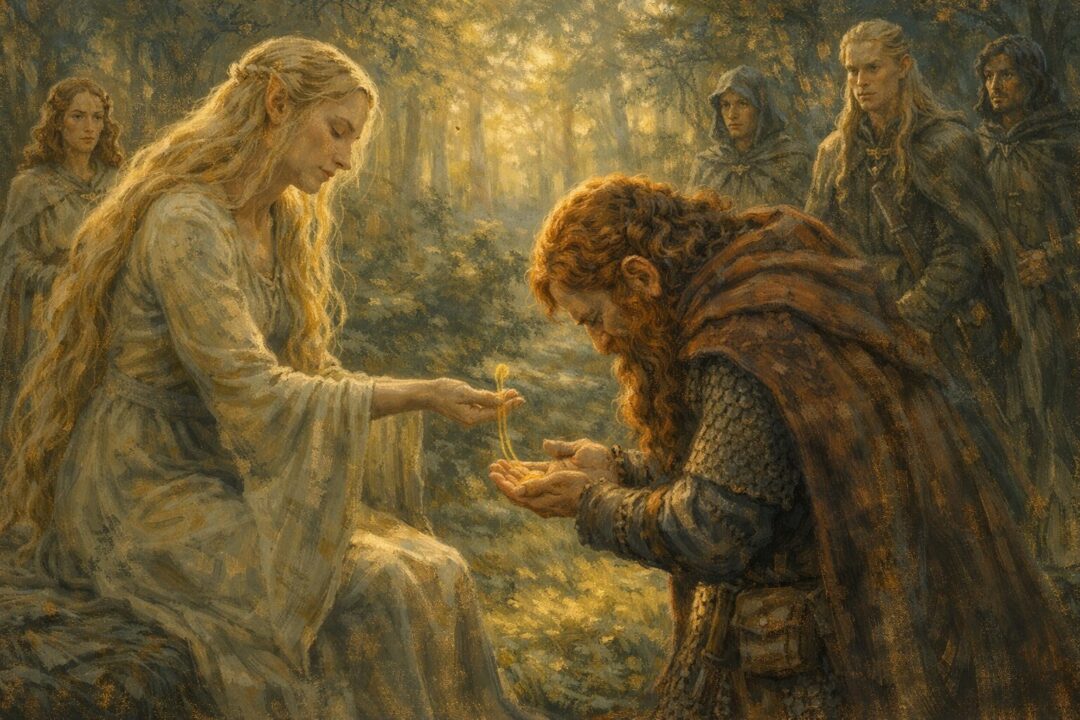
He asks—if it is permitted to name it—for a single strand of her hair, surpassing the gold of the earth as starlight surpasses gems.
And he immediately frames it not as possession, but as remembrance and reconciliation:
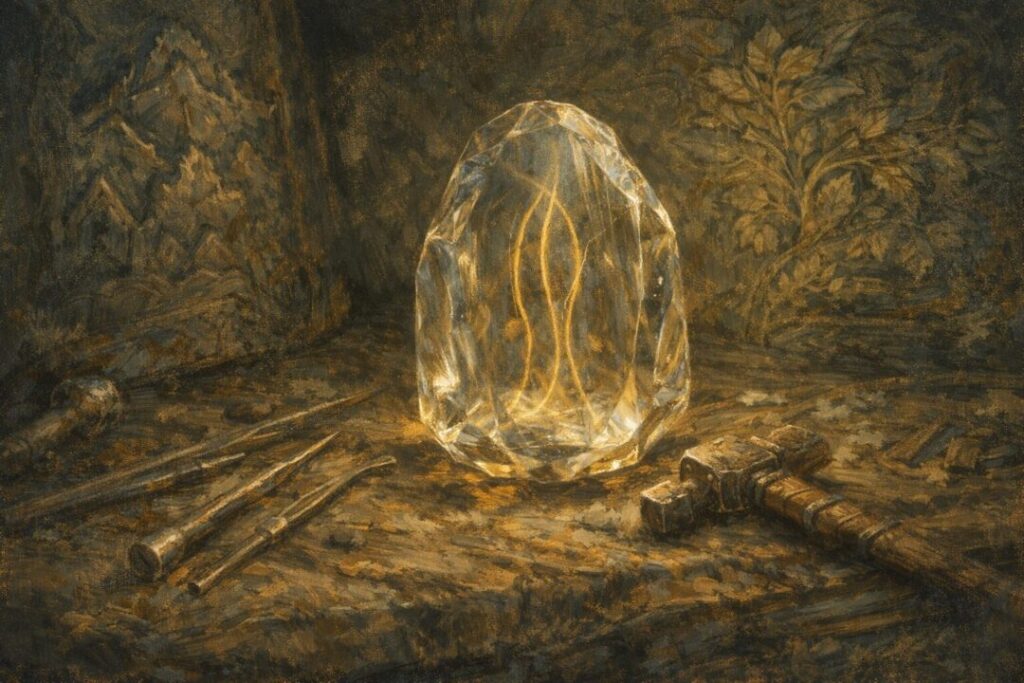
If he returns to the smithies of his home, it will be set in imperishable crystal as an heirloom, “and a pledge of good will between the Mountain and the Wood until the end of days.”
Then Galadriel unbraids a tress and gives him three golden hairs.
And she adds words that land like a prophecy and a correction at once:
“your hands shall flow with gold, and yet over you gold shall have no dominion.”
That line matters because it is not just a compliment.
It is a recognition that Gimli’s desire is not the desire that ruins Dwarves in other tales. Not greed. Not hoarding. Not hunger for dominion.
It is reverence—disciplined by humility.
And that is precisely why this moment echoes older history.
The older echo behind “three”
In Unfinished Tales, a later text preserves a striking detail: long ago, Fëanor beheld Galadriel’s hair “with wonder and delight,” and begged three times for a tress—but she would not give him even one hair.
We should be careful with what we claim from this.
The published Lord of the Rings does not stop and explain this resonance. The narrative does not say, “this is why three matters.” It simply gives the number and moves on.
So we cannot prove an explicit in-world “rule” that Galadriel was consciously reenacting that earlier refusal.
But we can say something solid: the texts preserve two scenes with the same striking pattern—three requests refused in the Elder Days, and three hairs freely given at the end of the Third Age.
And we can say this with confidence: the second scene is framed as a turning toward humility and healing.
Because Gimli does not ask as a conqueror. He asks as someone who knows the request is bold—yet refuses to demand it.
And Galadriel responds in a way that surprises those around her.
“Let none say again…”
Galadriel’s most important act here may not be the hair at all.
It is the public re-naming of what Dwarves are allowed to be.
She calls on the hearing of the Elves and rejects the old stereotype—“Let none say again that Dwarves are grasping and ungracious!”
That is not a private kindness.
It is cultural.
It is Galadriel using the authority of her realm to correct the story her people tell about another people. And she does it at the exact moment when the world is about to pass into an Age where the Elves will diminish and depart.
That timing is part of why this “small” act becomes large.
The end of the Third Age is not only a political transition; it is a moral one. The old powers are fading. The guardians who kept certain beauties unbroken are stepping aside.
And one of the last clear acts we see from the greatest of those guardians is: make room for reconciliation.
How it reaches into the Fourth Age
If we only stay inside Lórien, the scene feels like a jewel-box moment: beautiful, contained, complete.
But the Appendices quietly show that it did not end there.
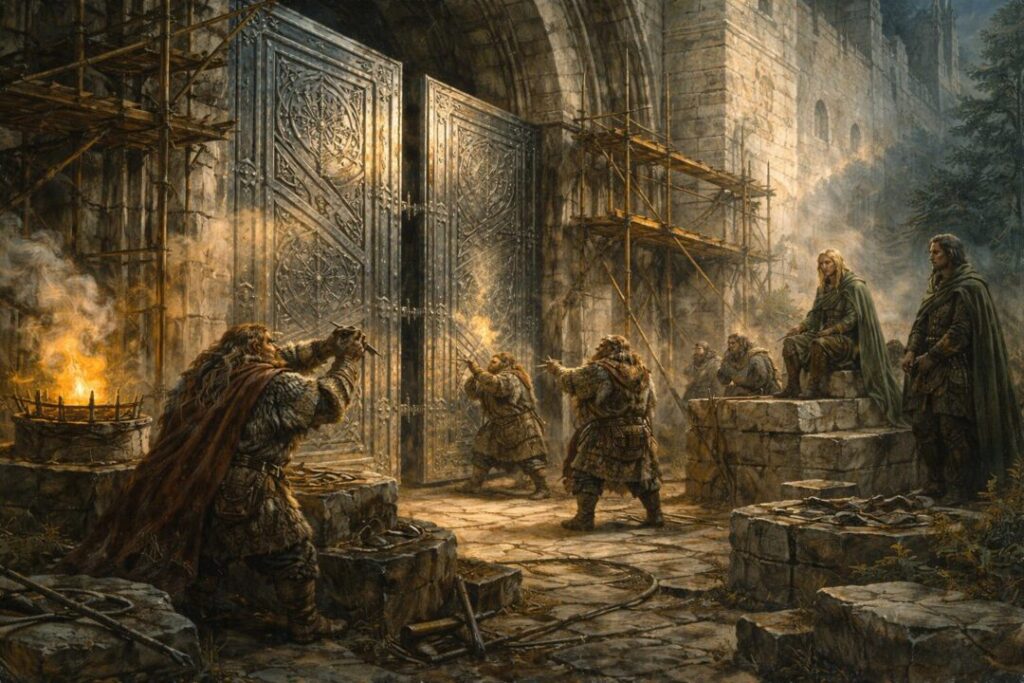
After Sauron’s fall, Gimli brings south a part of Durin’s folk from Erebor and becomes Lord of the Glittering Caves.
His people do great works in Gondor and Rohan, and for Minas Tirith they forge gates of mithril and steel to replace those broken by the Witch-king.
That is not a small footnote. It is a Dwarf-lord working openly with Men in the restored kingdom, building not a hoard but a healing.
And the same passage places Legolas beside him as a parallel: Legolas brings Elves out of Greenwood to dwell in Ithilien.
So in the Fourth Age we see something rare: an Elf-settlement and a Dwarf-settlement moving south in friendship within the Reunited Kingdom’s sphere, each doing works of restoration.
Is that only because of Galadriel’s gift?
The texts do not state that as a direct chain of cause and effect, and we should not pretend they do.
But the texts do show a pattern: the friendship between Legolas and Gimli becomes one of the few places where the ancient division between Elf and Dwarf is visibly undone, and it begins to flower in Lórien—precisely where Gimli is first publicly honored and trusted.
And the final reach goes further still.
In the Tale of Years, after the passing of King Elessar, Legolas builds a grey ship in Ithilien and sails over Sea—and “with him, it is said, went Gimli the Dwarf.”
The text is cautious: “it is said.” We are not given an eyewitness narrative, and we are not told exactly what that meant for Gimli beyond the Sea.
But the mere fact recorded—Gimli going with Legolas—sits like a final seal on what began in the Golden Wood.
A Dwarf is trusted in Lórien.
A Dwarf is honored by the Lady of the Galadhrim.
A Dwarf becomes a builder in the Reunited Kingdom.
And at the very end of the Fellowship’s tale, a Dwarf does something no Dwarf is elsewhere recorded doing: departing the Hither Lands in an Elf’s ship.
Why this changes the Age
The Fourth Age is often described as the Age of Men.
That is true in the large sense: the great Elf-realms fade, the Rings lose their power, and the dominion of the West passes to mortal hands.
But the text also shows a subtler question underneath: what kind of Age of Men will it be?
An Age built only on victory still carries old hatreds forward. An Age built on healing has a different foundation.
Galadriel’s choice to let Gimli walk free—and then to give him a gift that is explicitly named a pledge between Mountain and Wood—belongs to that second kind of foundation.
It does not rewrite all the grief of history.
It does something quieter.
It makes it possible for a Dwarf to leave an Elven realm not as a tolerated outsider, but as an honored guest—and to carry that honor outward into the world that comes after.
Which means the moment is not only about Gimli.
It is about what the Elves leave behind when they depart: not merely ruins and laments, but at least one living bridge that endures beyond them.
And that is why a blindfold removed in a forest can matter as much as a battle won on a field.
Sources & Notes
- J.R.R. Tolkien, The Lord of the Rings, Book II, Chapter 6, “Lothlórien” — covers the Company’s entry into the Golden Wood, the blindfolding dispute, and the order that all may walk free, “even the dwarf Gimli.”
- J.R.R. Tolkien, The Lord of the Rings, Book II, Chapter 8, “Farewell to Lórien” — gives Galadriel’s public gift to Gimli, his request for one strand of hair, her gift of three, and the pledge of goodwill between Mountain and Wood.
- J.R.R. Tolkien, Unfinished Tales, “The History of Galadriel and Celeborn” — preserves the tradition that Fëanor asked Galadriel three times for a tress of her hair and was refused, sharpening the later contrast with Gimli’s humble request.
- J.R.R. Tolkien, The Lord of the Rings, Appendix A, “Durin’s Folk” — records Gimli bringing Durin’s folk south, becoming Lord of the Glittering Caves, and his people’s great works in Gondor and Rohan after the War.
- J.R.R. Tolkien, The Lord of the Rings, Appendix B, “The Tale of Years” — notes Legolas bringing Elves to Ithilien and later sailing over Sea, with Gimli said to have gone with him, completing the Elf-Dwarf friendship arc.