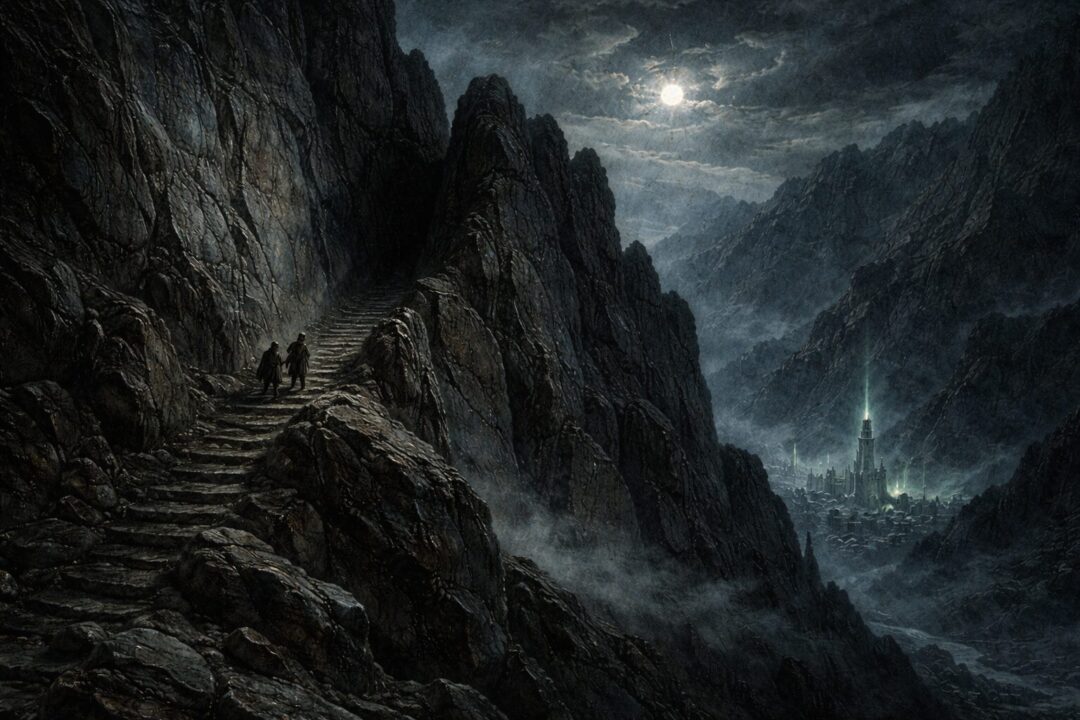
Cirith Ungol is one of those places that feels like pure nightmare geography: stairs carved into cliff-shadow, a narrow pass pressed between high rock, and then a tunnel where the air itself seems wrong.
It would be easy to treat Shelob as part of the scenery—an infestation. A horror that happens to be there.
But the narrative doesn’t frame it that way.
It pauses, briefly, to explain her history. It tells you she has endured “agelong.” It makes a point of where she lives, how long she has lived there, and—most importantly—why she is permitted to remain.
Shelob is not simply a monster encountered on the road.
She is a decision—hers, and someone else’s.
And Cirith Ungol is the clearest clue that she is more than appetite.
Not just a lair, but a choke point
The first reason is almost embarrassingly practical.
Cirith Ungol is a pass: a forced route over the western fence of Mordor, the Ephel Dúath. It is narrow, steep, and difficult. Travelers cannot move quickly through it, cannot spread out, and cannot easily turn aside once committed.
That matters because Shelob’s hunting does not depend on speed. It depends on inevitability.
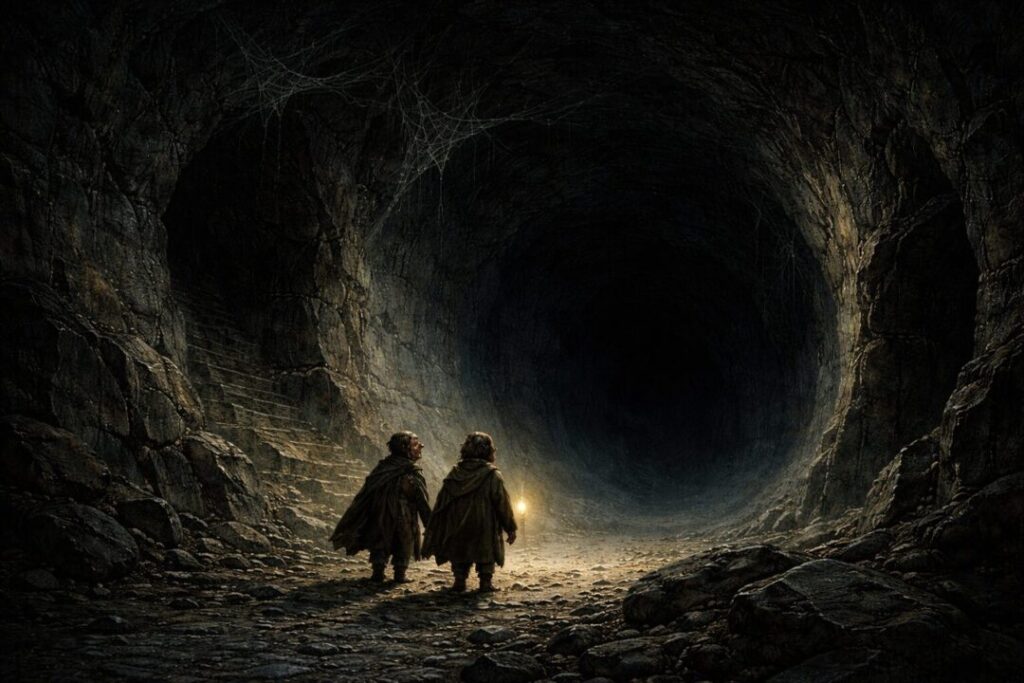
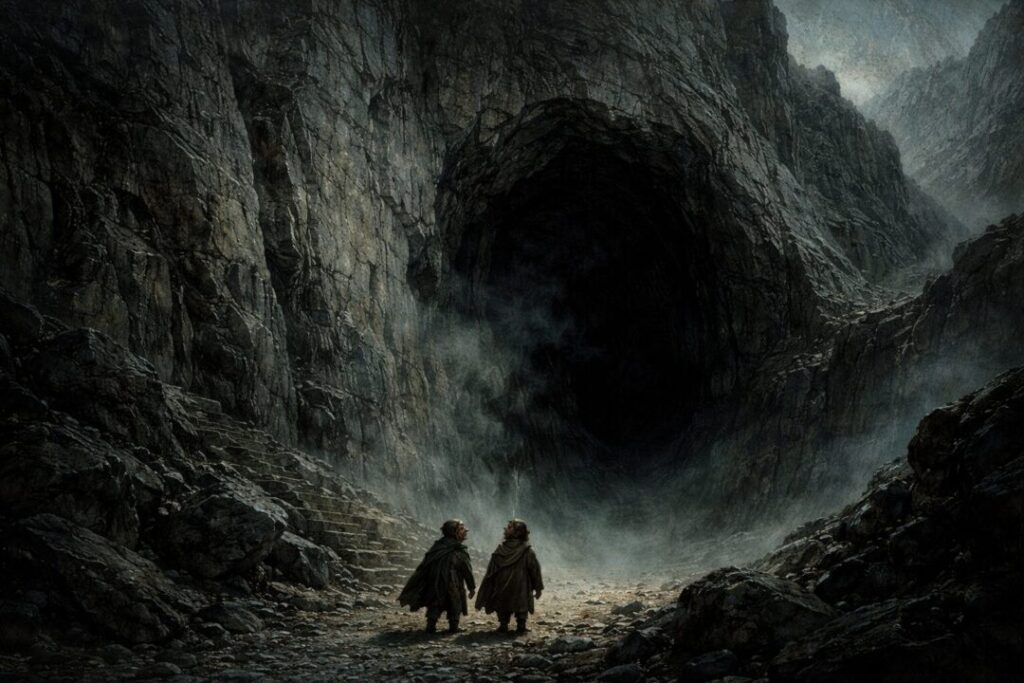
Her lair sits before the top of the pass on the west side: a cave-mouth at the base of a grey wall, breathing out a “foul reek.” Inside, the air is “still, stagnant, and heavy,” and sound is deadened—an environment that favors ambush and confusion over pursuit.
Even if you strip away every supernatural implication, it is simply good predator design:
- a single, predictable approach
- darkness that hides movement
- passages wide enough to draw prey in, yet branching enough to lose them
- webs near the inner ways where escape becomes a struggle rather than a run
If Shelob wanted a place that converts travelers into trapped meat, Cirith Ungol is as close as the world offers.
And the text hints that this is not new convenience. Tolkien Gateway, drawing from the internal chronology and citations to The Lord of the Rings, notes that Shelob had established her lair in the Ephel Dúath long before Sauron openly claimed Mordor and began building Barad-dûr around the year S.A. 1000. (This is a secondary reference, but it reflects a commonly cited timeline point.)
In other words: she did not move into a famous wartime corridor.
The corridor became famous, in part, because she was there.
A reliable food supply—because Mordor creates traffic
A “perfect cave” means little if nothing comes near it.
The story notes a shift: as the power of Mordor grows, “Elves and Men no longer came near” her borders, and Shelob has to hunt Orcs instead—food she considers poor.
That detail is easy to miss, but it reveals the second reason Cirith Ungol matters.
Mordor is not wilderness. It is an engine. It moves soldiers, messengers, captains, spies, and prisoners. Even when the outside world avoids the Mountains of Shadow, Mordor’s own needs keep bodies flowing near the pass.
Shelob doesn’t need a land of peaceful travelers.
She needs a land that can’t stop feeding the machine.
Cirith Ungol gives her that: a place close enough to Mordor’s working roads and garrisons that prey keeps appearing, even if the “better meat” becomes rare.
And she doesn’t merely kill when she can.
The text implies a long-term feeding strategy. Her sting does not necessarily kill. It is described (in narrative commentary echoed by Tolkien Gateway’s summary) as rendering victims unconscious so they can be kept “fresh.”
That is not the behavior of a beast that eats whatever falls into its mouth.
It is storage. Husbandry, in the grimest sense: keeping meat for later, because hunger is constant and opportunities must be harvested.
The “arrangement” with Sauron
Here the chapter gives you its most startling line:
Sauron knows where she lurks.
And it pleases him.
Not because Shelob is loyal—but because she is useful. The passage says he is glad she should dwell there “hungry but unabated in malice,” a more certain watch on that ancient path into his land than any other device he could have made.
That is already strange: a Dark Lord accepting an uncontrollable predator on his own border because it performs better than his own guards.
Then comes the sharper phrasing.
Sauron calls her his “cat”—but the text immediately adds the correction: “but she owns him not.”
This is not domination.
It is a mutual exploitation that neither side romanticizes.
- Shelob benefits because Mordor’s presence creates prey—and sometimes delivers it.
- Sauron benefits because a living terror makes the pass more secure than Orcs alone.
- The Orcs suffer, because they are the disposable part of the equation.
The narrative even says Sauron would sometimes send prisoners to her, have them driven to her hole, and receive reports of “the play she made.”
Again: this is not service. It is convenience.
But it is convenience built on a stable, long-term choice of location.
Cirith Ungol is where that choice pays off.
What the Orcs tell you—without meaning to
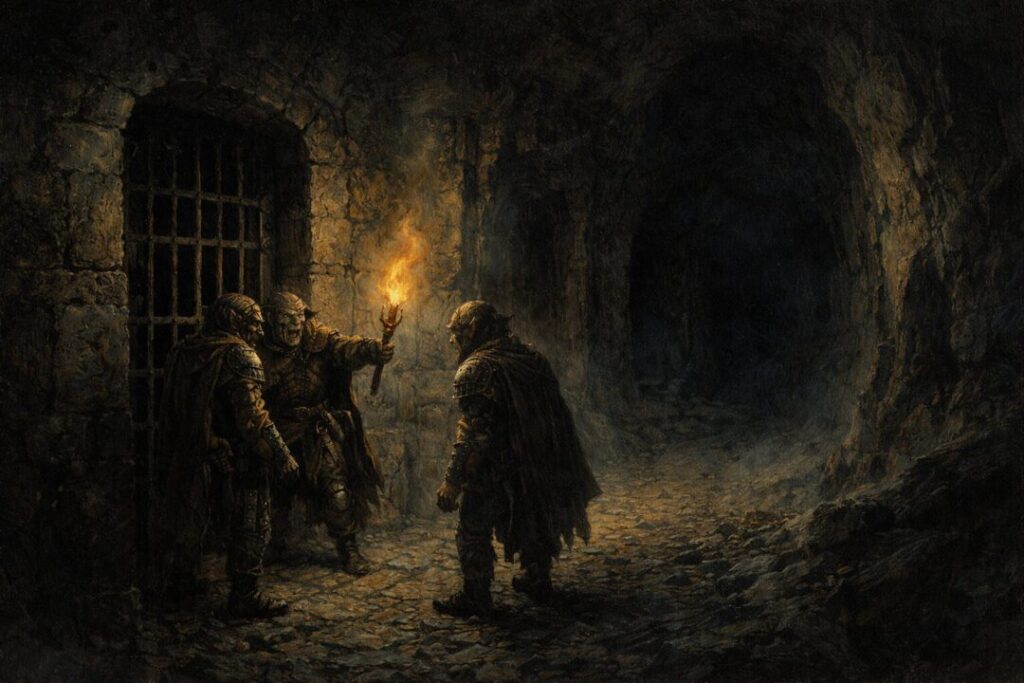
One of the best windows into Shelob’s “territory” is the Orc dialogue later, when they discover something has gone wrong.
They don’t speak of her like a wild animal.
They speak of her like a dangerous neighbor you do not offend.
They call her “Her Ladyship,” and they call Gollum “Her Sneak,” and they describe leaving him alone because he seems to have “some understanding” with her.
Notice what that implies:
- Shelob is not merely feared; she is socially accounted for.
- The Tower’s Orcs have procedures about when not to interfere.
- “Word from High Up” can order them to let someone pass—and yet they still assume Shelob will do what she wants.
That last point matters.
If she were a tool, “High Up” would control her.
But the Orcs talk as if control is impossible—and negotiation is the only safety.
Cirith Ungol, then, is not just a passage.
It is a border-zone where Mordor’s authority becomes oddly thin.
And Shelob is the reason.
Why this suggests intelligence (without turning her into a person)
“Intelligence” can be a loaded word. The text does not give Shelob dialogue, or politics, or a clear moral psychology. It describes her as an evil thing in spider-form, ancient, malicious, and driven by hunger.
So what can we say—safely—without inventing motives?
We can say this:
- She chooses a place that maximizes advantage.
Cirith Ungol is all leverage: narrow approaches, deadened sound, confusing ways, and darkness that favors her senses over her prey. - She persists there for ages.
Secondary lore references (grounded in citations back to The Lord of the Rings) treat her presence in the pass as long-established, potentially predating major Second Age fortifications. Even without exact dating, the narrative stresses her long habitation. - She functions within an ecosystem of power without being absorbed by it.
Sauron uses her, but does not rule her; she benefits from Mordor, but does not serve Mordor. “She owns him not” is the key phrase here. - She inspires “rules” among Orcs.
The Tower’s soldiers treat her as a constant political factor: they don’t interfere when she is “playing,” and they interpret events through her habits.
None of that requires us to claim she has human reasoning.
But it does justify a careful conclusion: Shelob is not random.
She is adapted—by instinct, malice, and long experience—to pick the one place where her hunger can be reliably satisfied and her danger can be maximally amplified.
The deeper irony of Cirith Ungol
There is one final twist that makes her choice feel even sharper.
Cirith Ungol is meant to be a guarded entrance into Mordor. It has a tower. It has captains. It has orders “from High Up.”
And yet the most effective guard on that pass is not an Orc host or a clever piece of engineering.
It is an ancient predator who cannot be commanded.
Sauron’s dominion is so vast that he can afford this risk—can spare Orcs “now and again” to keep the watch living and hungry.
Shelob’s “intelligence,” then, is not merely personal cunning.
It is the cold logic of choosing the right place in the right world.
She does not need to conquer Mordor.
She only needs to plant herself at the throat of a road Mordor cannot stop using.
That is what Cirith Ungol says about her.
Not that she is a mastermind in the dark—but that she understands, as predators understand, where the world will keep bringing meat.
And in Middle-earth, that kind of understanding can be as terrifying as any spell.
Sources & Notes
- J.R.R. Tolkien, The Lord of the Rings, Book IV, Chapter 8, “The Stairs of Cirith Ungol” — establishes Cirith Ungol as the steep pass over the Mountains of Shadow and the route Gollum leads Frodo and Sam toward.
- J.R.R. Tolkien, The Lord of the Rings, Book IV, Chapter 9, “Shelob’s Lair” — gives Shelob’s age, her tunnel, her hunger, Sauron’s knowledge of her, and the “cat” passage that shows mutual use rather than obedience.
- J.R.R. Tolkien, The Lord of the Rings, Book IV, Chapter 10, “The Choices of Master Samwise” — shows her sting, webs, and ambush tactics in action, supporting the article’s point about predatory adaptation rather than random violence.
- J.R.R. Tolkien, The Lord of the Rings, Book VI, Chapter 1, “The Tower of Cirith Ungol” — the Orcs’ talk of “Her Ladyship” and “Her Sneak” shows Shelob treated as a dangerous local power with habits Mordor’s servants must work around.
- J.R.R. Tolkien, The Silmarillion, “Of the Darkening of Valinor” — gives the wider background of Ungoliant, Shelob’s ancient spider-line, without turning Shelob herself into a servant of Sauron.