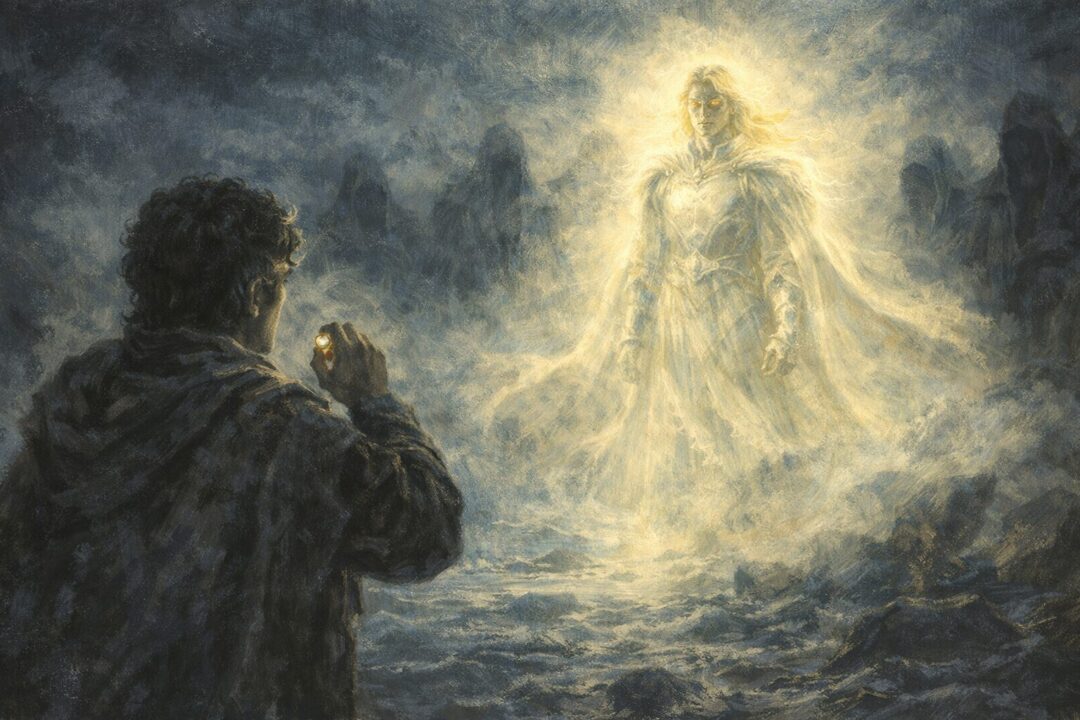
Glorfindel is one of the most powerful characters who ever appears on the page in The Lord of the Rings—and one of the most quietly removed.
When readers first meet him in The Fellowship of the Ring, he is unmistakably extraordinary. Frodo sees him shining with an inner light, revealed fully when the Ring is on his finger. The Nazgûl fear him. Gandalf trusts him completely. And at the Ford of Bruinen, Glorfindel rides openly against the Witch-king of Angmar and survives—an act that very few beings in Middle-earth could accomplish without consequence.
And then, just as suddenly as he appears, Glorfindel is gone.
Once the Fellowship leaves Rivendell, he plays no visible role in the rest of the story.
No mention at the Council’s final decision.
No place among the Nine Walkers.
No heroic death.
No farewell scene.
For many readers, this absence feels strange. If Glorfindel is truly so mighty, why would Elrond not send him with the Ring? Why would Tolkien introduce such a powerful figure only to quietly remove him from the narrative?
At first glance, it can feel like something went “wrong.” But Tolkien’s own writings—especially his letters and later notes—show that Glorfindel’s disappearance was not an oversight. It was intentional, carefully considered, and deeply tied to the moral and thematic core of Middle-earth.
Glorfindel Was Never “Just Another Elf”
To understand why Glorfindel steps out of the narrative, we first need to understand who he actually is.
In the main text of The Lord of the Rings, Glorfindel is presented as an Elf-lord of Rivendell, ancient and powerful, but without much explanation. It is only through The Silmarillion and later clarifications—especially in Unfinished Tales and Tolkien’s letters—that his true nature becomes clear.
Glorfindel originally lived in Gondolin during the First Age. When that hidden city fell to Morgoth’s forces, he died defending the refugees escaping through the mountain passes, slaying a Balrog in single combat at the cost of his own life. This alone places him among the great heroes of the Elder Days.
But Glorfindel’s story does not end there.
Unlike most Elves who die, Glorfindel was rehoused—his spirit was restored to a new body by the Valar and sent back to Middle-earth. By the Third Age, he is not simply an Elf who has lived a long time. He is a being who has passed through death, been judged, purified, and returned with enhanced spiritual authority.
Tolkien himself describes Glorfindel as one of the few remaining figures in Middle-earth who still carries something of the light and power of the Elder Days.
This explains several things that otherwise seem exaggerated.
This is why Frodo sees him shining in the unseen world.
This is why the Nazgûl recoil from him in fear.
This is why Gandalf treats him with a respect bordering on equality.
Glorfindel is not “high level.” He is ontologically different from most characters in the story.
And that difference is precisely the problem.
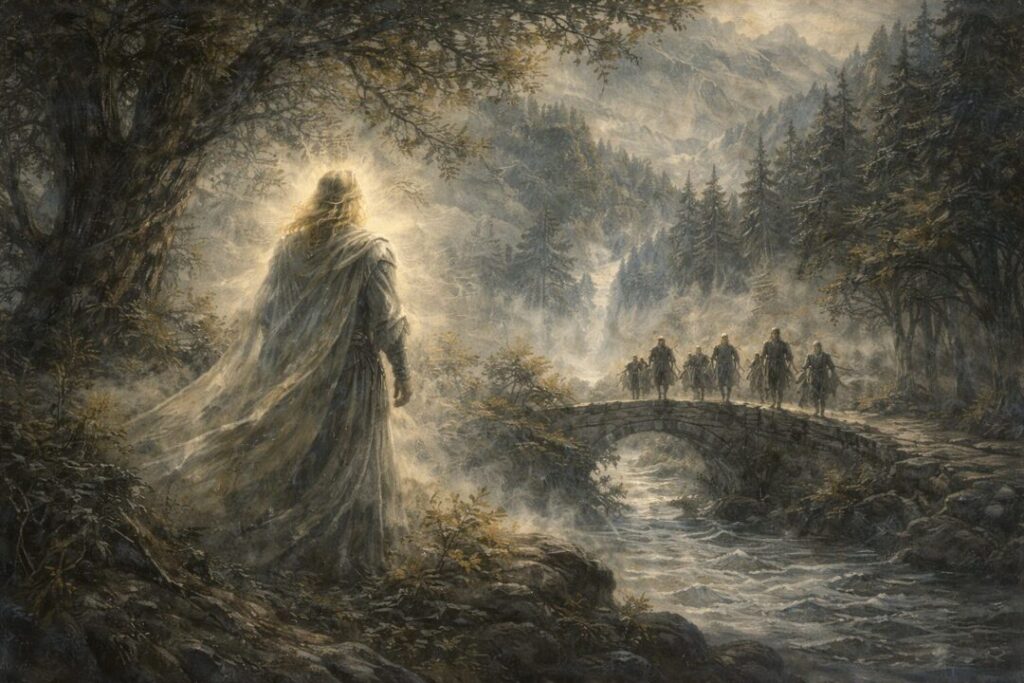
Tolkien’s Own Explanation: Why Glorfindel Didn’t Join the Fellowship
Tolkien directly addressed the question of why figures like Glorfindel were not sent on the Ring-quest in his letters—most notably Letter 144—and in related notes preserved in Unfinished Tales.
The reason has nothing to do with numbers, strategy, or physical danger.
It is about spiritual visibility.
Glorfindel exists on a level of being that would immediately draw the attention of Sauron. His presence would blaze in the unseen world like a torch. While he could defeat enemies in open battle, he would make secrecy impossible.
The success of the Fellowship depends not on power, but on smallness.
The Ring cannot be destroyed by force. It must be carried quietly, by those who are least likely to be noticed, least likely to inspire fear or awe, and least likely to draw the Eye of the Enemy.
Sending Glorfindel with the Ring would be like lighting a beacon in the dark.
Tolkien makes this principle clear across his legendarium. Beings of great spiritual power—whether Elves of the Elder Days, Wizards, or lords like Galadriel and Elrond—are paradoxically less suited to this kind of mission. Their strength makes them visible. Their presence reshapes the battlefield simply by existing.
This is why Gandalf hesitates to take the Ring.
This is why Galadriel refuses it.
This is why Elrond does not march east himself.
The Ring-quest is not a war of strength. It is a test of endurance, humility, and moral resistance.
Glorfindel, for all his nobility, does not belong in that kind of story.
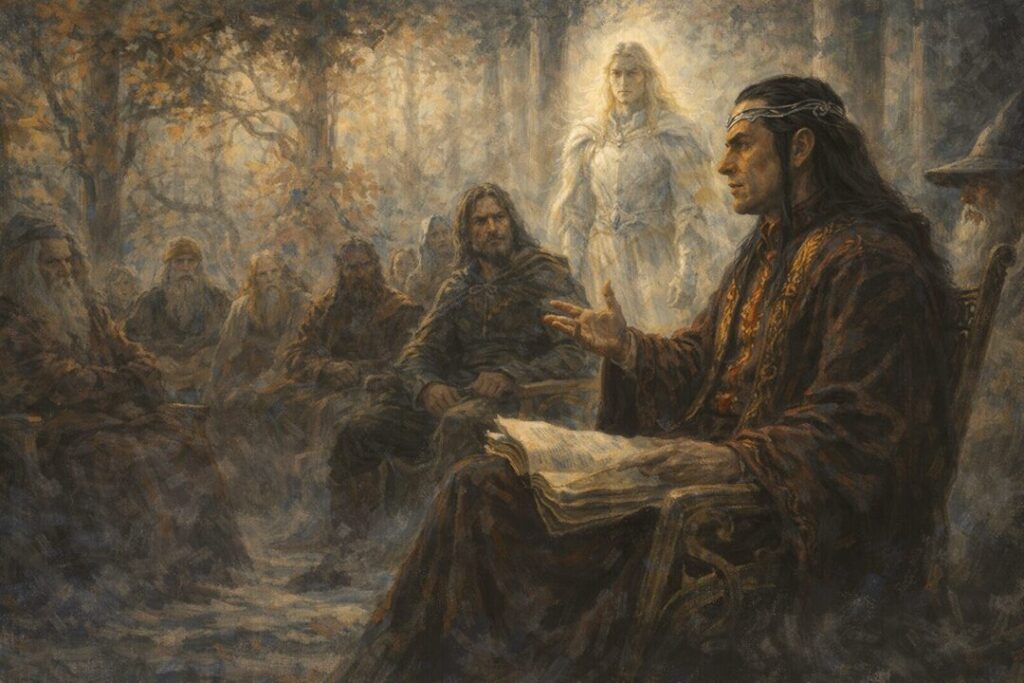
Why Tolkien Lets Glorfindel Fade Instead of Explaining
One of Tolkien’s most deliberate narrative choices is that he does not stop the story to justify Glorfindel’s absence.
There is no speech where Elrond explains why Glorfindel stays behind. No footnote in the main text clarifying his role. Tolkien simply allows him to pass out of view.
Why?
Because The Lord of the Rings is not written as a complete historical record. It is presented as a story largely filtered through the experiences of Hobbits—small people with limited knowledge, limited perspective, and limited understanding of the deeper forces shaping their world.
From that perspective, Glorfindel belongs to a different scale of history.
He represents the Elder Days: the age of Balrogs, Silmarils, and world-shaping battles. That world has not vanished, but it is fading. Its great figures still exist, but they no longer stand at the center of events.
Glorfindel does not disappear because he is irrelevant.
He disappears because his role is no longer direct.
He returns to where such beings increasingly belong—to the margins of the story, influencing events indirectly, guarding, guiding, and preserving, rather than acting as protagonists.
Thematic Consistency, Not a Missing Character
Glorfindel’s absence reinforces one of Tolkien’s central themes: that evil is not defeated by overwhelming force.
If Glorfindel walked beside Frodo into Mordor, the story would become something else entirely. The tension would collapse. The moral weight would shift from endurance to spectacle.
Instead, Tolkien entrusts the fate of the world to Hobbits.
To Frodo’s fragile will.
To Sam’s loyalty.
To courage that looks insignificant against the darkness it faces.
By removing figures like Glorfindel from the foreground, Tolkien ensures that the story remains focused on the kind of heroism he values most—not power, but persistence; not glory, but faithfulness.
Glorfindel’s quiet withdrawal mirrors the larger fading of the Elves themselves. They are not defeated. They are passing on.
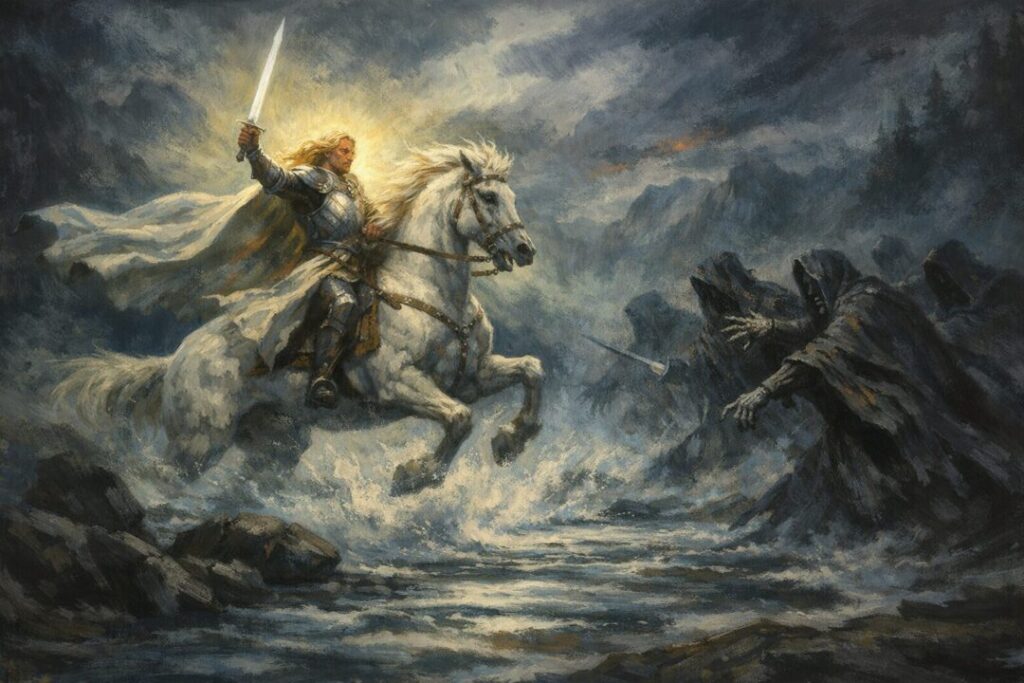
Why This Still Matters
Modern fantasy often struggles with “power creep.” Stories escalate by introducing ever-stronger characters, bigger threats, and louder displays of force.
Tolkien solved this problem differently.
He did not weaken his strongest characters.
He simply chose not to center them.
Glorfindel is not removed because he breaks the world.
He is removed because the world is no longer about him.
And once you see that, his disappearance is no longer puzzling. It becomes one of the most subtle—and most deeply Tolkienian—choices in the entire legendarium.
Sources & Notes
- J.R.R. Tolkien, The Lord of the Rings, Book I, Chapter 12, “Flight to the Ford” — Glorfindel’s rescue of Frodo and the fear he inspires in the Ringwraiths show why he is not an ordinary travelling companion.
- J.R.R. Tolkien, The Lord of the Rings, Book II, Chapter 1, “Many Meetings” — Frodo’s vision of Glorfindel shining in the unseen world supports the article’s point about his dangerous spiritual visibility.
- J.R.R. Tolkien, The Lord of the Rings, Book II, Chapter 2, “The Council of Elrond” — the choice of the Nine Walkers stresses secrecy, humility, and smallness over sending the greatest available powers against Mordor.
- J.R.R. Tolkien, The Silmarillion, “Of Tuor and the Fall of Gondolin” — Glorfindel’s death while slaying a Balrog grounds his status as one of the heroic figures of the Elder Days.
- J.R.R. Tolkien, The Peoples of Middle-earth, “Last Writings: Glorfindel” — Tolkien’s late notes identify the Rivendell Glorfindel with the lord of Gondolin and explain his return from death with heightened authority.
- J.R.R. Tolkien, The Letters of J.R.R. Tolkien, Letter 144 — Tolkien directly answers why Glorfindel was not sent with the Ring, emphasizing that the quest depended on secrecy rather than overwhelming power.