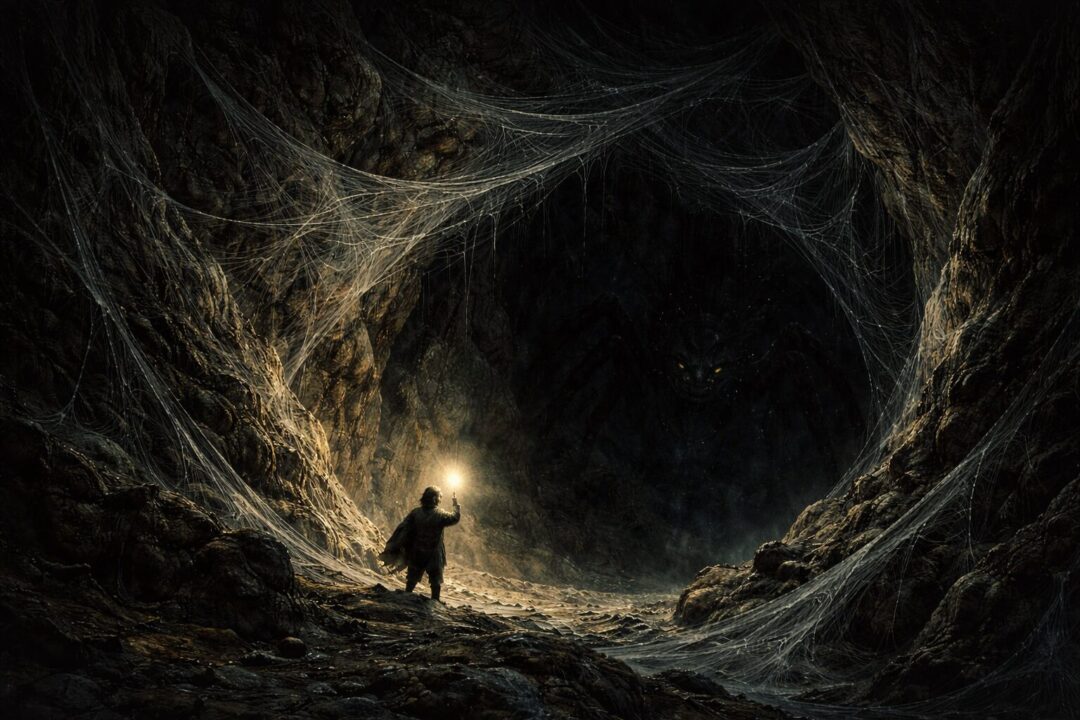
If you try to trace the “great spiders” of Middle-earth like a family tree, the line refuses to stay straight.
Ungoliant feels like the obvious root: the oldest terror, the living hunger that drinks light and spins darkness into nets.
And Shelob feels like the obvious continuation: the monster in the pass, the last horror crawling out of a First Age nightmare.
But the closer you read, the less certain the lineage becomes.
Not because the story contradicts itself.
Because it keeps a careful distance—offering strong hints, then withholding the final sentence that would make the hints into a rule.
1) What we can say with confidence: Ungoliant leaves spawn behind
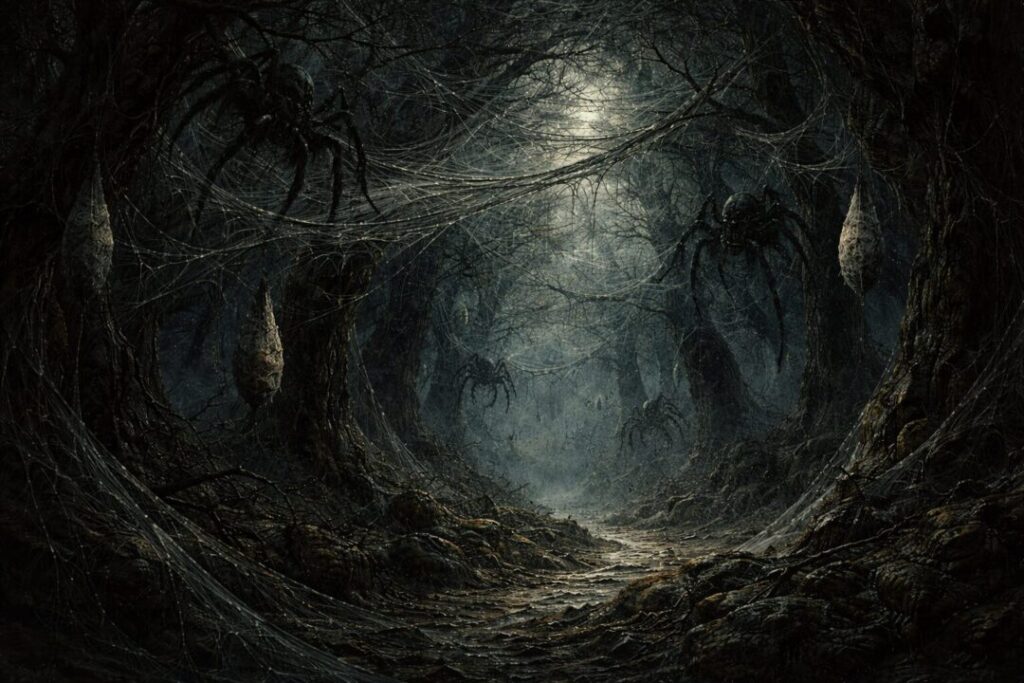
Ungoliant is associated with spider-shape and webbed darkness early, long before Shelob ever appears in the narrative tradition. Reputable lore summaries tie this to the descriptions of her taking monstrous spider-form and spinning “black webs,” swallowing light and producing strangling gloom.
More important for our question is what follows her flight into Middle-earth:
The northern lands become “infested” with her offspring—spiders connected to her by descent.
That much is the baseline.
Ungoliant is not simply a solitary horror; she is a source of horrors.
And the First Age landscape reflects that. Nan Dungortheb and the Mountains of Terror become a place people do not speak of lightly, and Beren’s crossing is remembered as a trauma he refuses to recount.
So yes: there are “Ungoliant-descended” spiders in the tradition, and they matter.
2) The line everyone quotes: Shelob as the “last child”
When Frodo and Sam approach Cirith Ungol, the text frames Shelob as ancient—older than Sauron’s building of Barad-dûr, older than the War of the Ring’s immediate evil.
And then it gives the famous label:
Shelob is “the last child of Ungoliant to trouble the unhappy world.”
That sounds final.
It sounds like a closing of a line: Ungoliant’s line ends in Shelob.
But “last child” can do more than one job in this legendarium. Sometimes it means the last survivor still active in the world. Sometimes it signals the last notable remnant of something older.
The passage itself nudges you toward that second meaning—because it immediately widens the frame.
3) The detail that complicates everything: Shelob has “lesser broods”
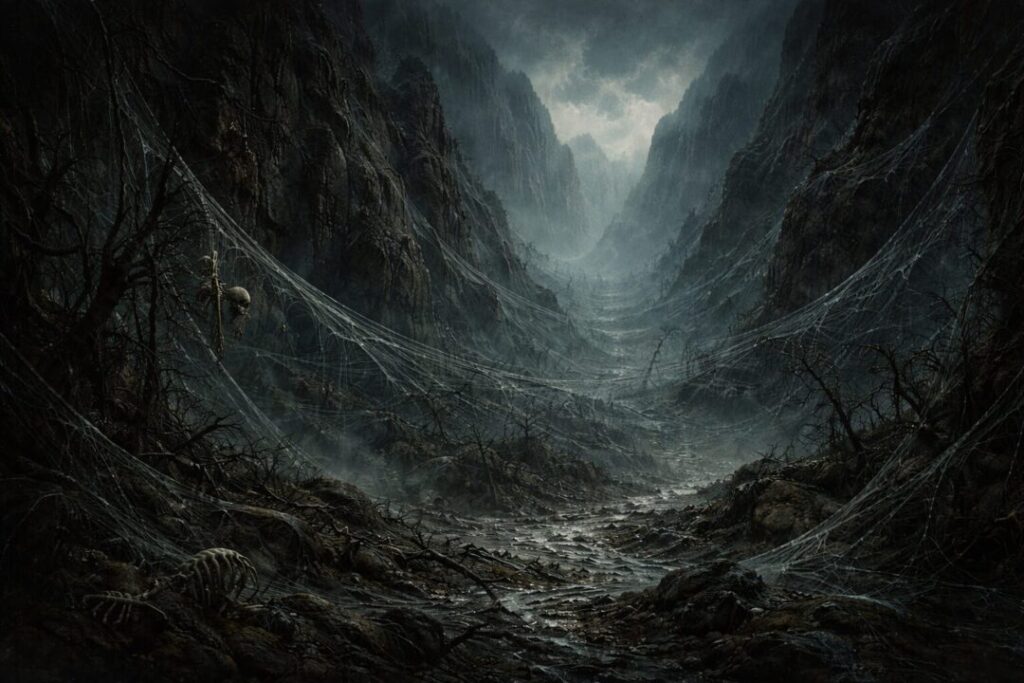
In the same stretch of text, we’re told Shelob had offspring—lesser broods—who spread outward:
They move “from glen to glen,” from the Ephel Dúath toward the eastern hills, and as far as Dol Guldur and the fastnesses of Mirkwood.
That matters, because it places spider-horror on a map.
Not just in Mordor.
Not just in one tunnel.
But across the shadowed reaches of the Third Age.
And it tempts a simple conclusion:
The great spiders of Mirkwood are her descendants.
The text doesn’t quite say that sentence.
But it points hard enough in that direction that most readers feel it.
4) The sentence that breaks the “simple conclusion”
Here is the sentence that ruins the neat family tree:
“There other great spiders already dwelt.”
This is the quiet escape hatch.
It means “great spiders” are not automatically a single bloodline whose origin is Ungoliant.
Some great spiders predate her arrival in Middle-earth’s lands.
So when you meet “great spiders” later—Mirkwood, dark forests, deep places—you cannot prove they must be from her line.
They could be.
But the texts have already told you the category exists beyond her.
This is why the question never settles.
Because Middle-earth contains two overlapping truths at once:
- Ungoliant leaves offspring behind, and spider-horrors clearly persist.
- Great spiders existed even before Ungoliant’s influence reaches those lands.
So “great spider” is not a genealogical certificate.
It’s a description.
And descriptions are slippery.
5) What about Bilbo’s spiders in Mirkwood?
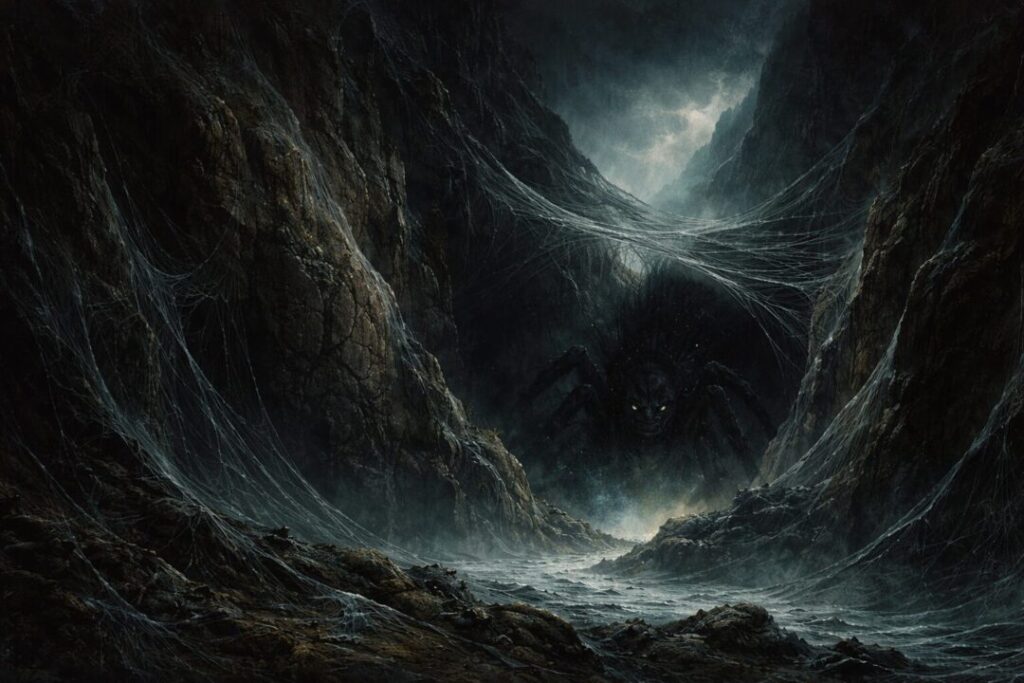
In The Hobbit, Bilbo faces “great spiders” in the forest—intelligent enough to talk among themselves, cruel enough to toy with prey.
Later lore summaries connect that outbreak of spiders in Mirkwood with the wider shadow that grows around Dol Guldur, and they place Shelob’s lesser broods as spreading as far as Mirkwood.
Put those together, and the implication is strong.
But implication is not confirmation.
Because that earlier sentence—other great spiders already dwelt—keeps the door open to a second possibility:
The Mirkwood spiders could be “native” great spiders, emboldened by the return of darkness, rather than direct descendants of Shelob.
Or the population could be mixed: some descended from Ungoliant’s line, some not.
The texts do not close the case.
6) Why the texts keep it unconfirmed: the “no tale tells” pattern
When the story wants you to feel the age of a creature, it sometimes refuses to give you the connective tissue.
With Shelob, it explicitly says:
How she came there, “no tale tells,” because few tales come out of the Dark Years.
That is more than atmosphere.
It’s a deliberate boundary.
It tells you: there is history here, but you do not get the whole record.
And once the record is incomplete in one place, it becomes incomplete everywhere that depends on it.
If Shelob’s own movements are not recorded, then tracing her broods with certainty becomes impossible.
You can point to the spread.
You can point to the regions named.
But you cannot reconstruct the exact chain of descent as if you had a chronicle.
The story is not written like a taxonomy.
It’s written like memory.
7) So were there other “great spiders” after Ungoliant?
Yes—in at least two senses that remain compatible with the texts:
- Ungoliant’s line continues in the world through Shelob and through lesser broods spreading outward.
- There are also great spiders not necessarily tied to her line, because “other great spiders already dwelt” even before her.
That means “after Ungoliant” doesn’t automatically mean “descended from Ungoliant.”
It can mean “existing in the world that Ungoliant helped corrupt.”
Or “existing alongside the horrors she produced.”
And that’s why the question keeps coming back.
Because readers want the clean rule:
- Ungoliant is the origin.
- Shelob is the heir.
- Mirkwood spiders are the grandchildren.
The texts give you enough to suspect something close to that.
But they also preserve a deeper, older truth about Middle-earth:
Evil does not always have one lineage.
Some shadows breed new shadows.
Some shadows were already there.
8) The most careful conclusion
If you want to stay lore-accurate, the safest ending is conservative:
- Shelob is explicitly tied to Ungoliant as her “last child” still troubling the world.
- Shelob had lesser broods that spread toward Dol Guldur and Mirkwood.
- Great spiders existed in Middle-earth independent of Ungoliant’s arrival, so not every great spider must be her descendant.
- The record is intentionally incomplete (“no tale tells”), so absolute genealogical certainty is not available.
That is the real answer to “why it won’t confirm it.”
Because the world is built to feel old—and old worlds don’t come with perfect paperwork.
They come with named terrors, half-lit trails, and a sentence that keeps the dark from being fully mapped.
And in this case, that sentence is the one that says the spiders were there even before Ungoliant.
Once you notice it, you can’t unsee it.
Sources & Notes
- J.R.R. Tolkien, The Silmarillion, “Of the Flight of the Noldor” — Ungoliant’s spider-shape, webs of darkness, flight into Beleriand, and the later horror of Nan Dungortheb ground the First Age side of the question.
- J.R.R. Tolkien, The Lord of the Rings, Book IV, Chapter 9, “Shelob’s Lair” — names Shelob as “the last child of Ungoliant to trouble the unhappy world” and says how she came there “no tale tells.”
- J.R.R. Tolkien, The Lord of the Rings, Book IV, Chapter 9, “Shelob’s Lair” — describes Shelob’s lesser broods spreading toward Dol Guldur, Mirkwood, and the eastern hills, while noting other great spiders already dwelt there.
- J.R.R. Tolkien, The Hobbit, Chapter 8, “Flies and Spiders” — gives the direct Mirkwood example of talking, predatory “great spiders” without making their genealogy explicit.
- J.R.R. Tolkien, The Silmarillion, “Of Beleriand and Its Realms” — places Nan Dungortheb and Ered Gorgoroth in the geography of Beleriand, preserving the older spider-haunted landscape behind the later echoes.