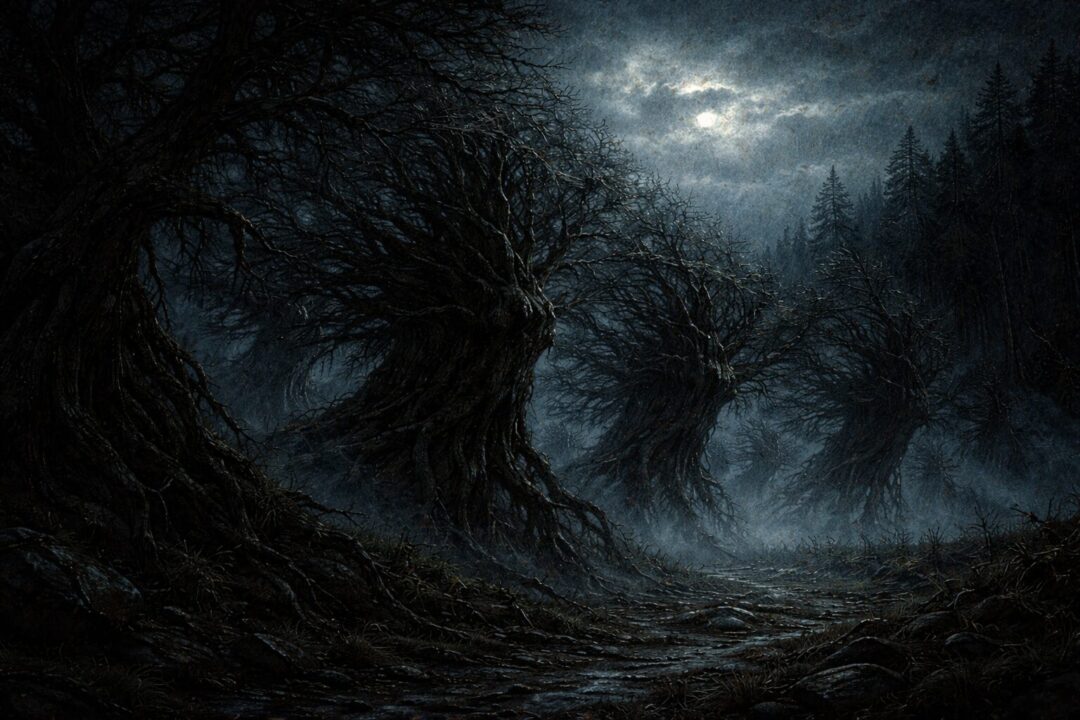
Huorns are one of those Middle-earth mysteries that only become unsettling after the battle is over.
Not during the clash of swords at the Hornburg. Not during the desperate defense of the Deeping Wall. Not even when dawn breaks and salvation rides down from the ridge.
After.
Because the strangest thing at Helm’s Deep is not how the battle is won.
It’s how the enemy vanishes.
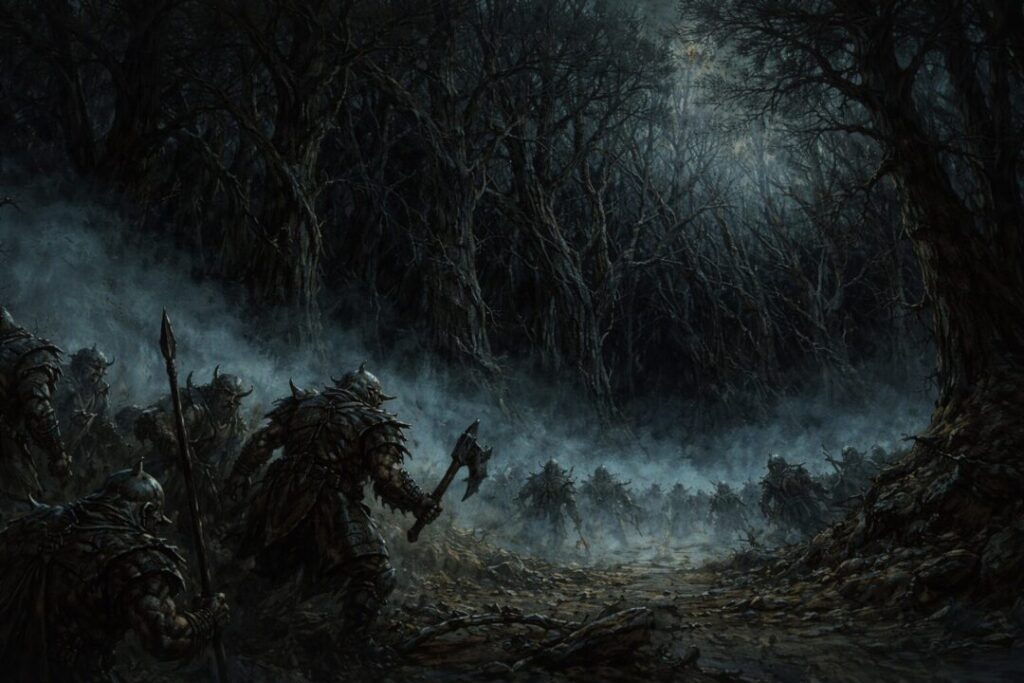
When Saruman’s host finally breaks, the Orcs do what Orcs always do when courage fails: they run. The valley should fill with the wreckage of flight—bodies, gear, wounded stragglers, prisoners.
Instead, the narrative gives you a different image: a “forest” standing where no forest stood before, blocking the coomb like a gate made of living wood.
And then, later, it gives you something even colder.
No one finds the Orcs again.
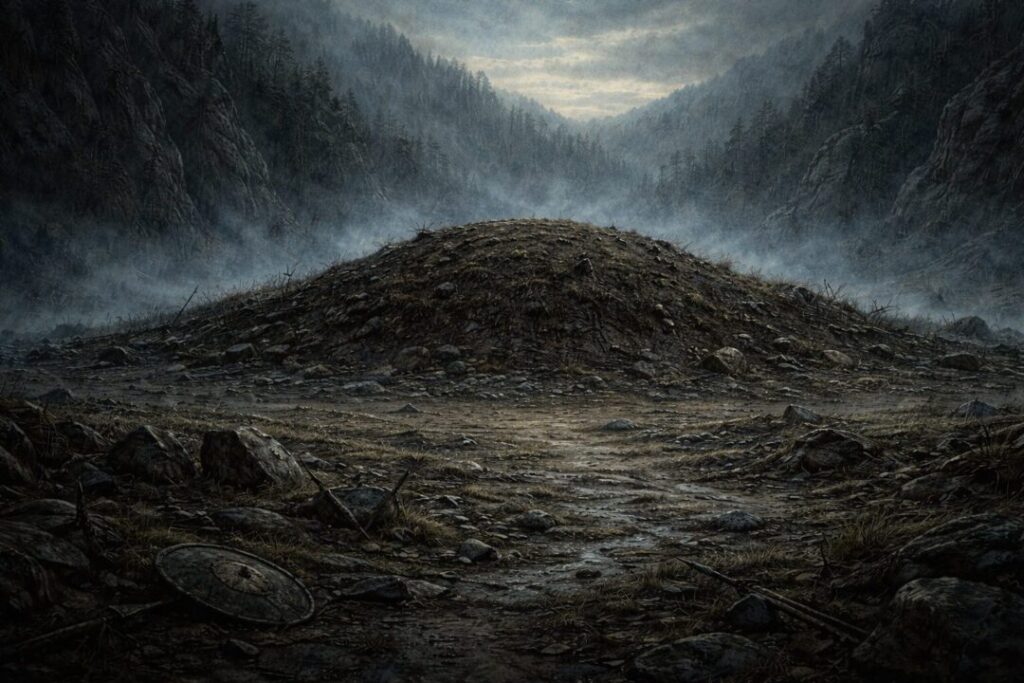
The dead are gone into a mound afterward called the Death Down, feared enough that “no man ever set foot upon that hill,” and even the grass refuses to grow there.
That is the footprint Huorns leave on history: not a trophy. Not a victory song. A taboo place.
So the question almost asks itself.
If Fangorn’s Huorns could move in secret, close a valley overnight, and erase an entire retreating army so completely that even the winners won’t walk the ground afterward…
Did they do this kind of thing before?
Or is Helm’s Deep truly the only time Huorns ever fought?
To answer that, you have to be strict about what the texts actually confirm—and equally strict about what they refuse to say.
What the texts plainly show the Huorns can do
The safest place to begin is with the most conservative claim possible: Huorns participated in the War of the Ring.
Not as a vague rumor. Not as a legend told afterward. They appear in the immediate aftermath of Helm’s Deep, and they also appear as part of the Ents’ movement against Isengard.
One of the cleanest textual summaries preserved in a lore reference is simple: Huorns were roused by Treebeard and involved in the destruction of Nan Curunír (the Wizard’s Vale), and they helped at the Battle of the Hornburg.
But what matters more than “they were there” is how they were there.
The Huorns are not described as a marching army with banners.
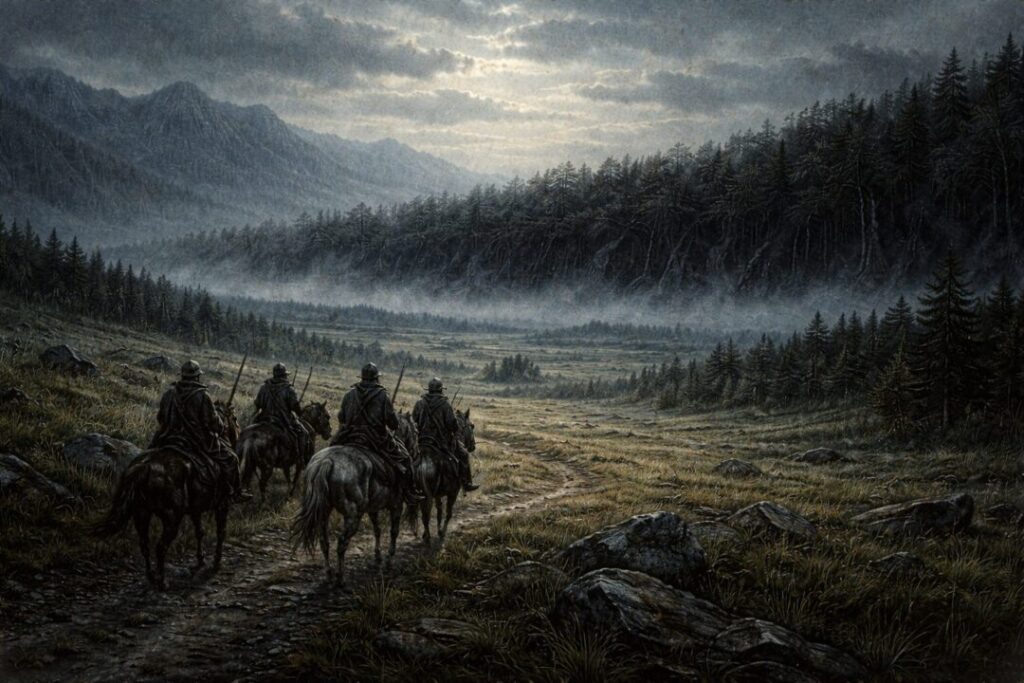
They are described as something that can become indistinguishable from darkness and woodland—something you notice late, if you notice it at all. Gandalf and Théoden’s company see the moving shade of trees far away as they ride, a “veiling shadow” that is not smoke, not storm, and not Mordor’s gloom—because it is alive.
And once they arrive at Helm’s Deep, that living shadow is already in place.
The trees do not merely stand nearby. They take position. The battle turns, in part, because escape routes stop existing.
The important thing here is not whether Huorns “fight” like soldiers.
It is that Huorns can act strategically without looking strategic. A forest that moves does not need tactics; it simply needs to be where you must go next.
And when the Orcs run into it, the text refuses to describe a pitched fight in detail.
It simply tells you the result: the Orcs are destroyed, and their remains are swallowed into the Death Down, after which the strange trees depart at night and return to Fangorn.
That combination—silent movement, sudden enclosure, total cleanup—is the core of the Huorns’ menace.
Not rage.
Not strength.
A kind of erase-and-leave.
What Huorns are (and why that matters for “other wars”)
If you’re hoping for a tidy category—Huorns are “X,” therefore they would behave like “X”—the texts won’t give it to you.
Even a careful lore summary has to admit the origin is unknown. It is not clear whether Huorns are Ents that became more tree-like, trees that became more Entish, or whether both kinds exist.
That uncertainty is not a throwaway.
It tells you why Huorns are hard to track historically: you can’t always tell when a tree is only a tree.
But the texts do give you one reliable anchor: Huorns are “part way between trees and Ents.”
They are sentient enough to perceive and respond. Not fully “sapient” in the way Ents are, but not mindless either.
And crucially, when they are not tended by Ents, they become “queer and wild”—a danger even to the Free Peoples.
This matters because it frames the Helm’s Deep appearance in a particular light.
The Huorns are not described as morally complex political actors.
They are described as a kind of old, half-awakened power that can be guided—or left to run feral.
So if you’re asking, “Would they fight in other wars?” you shouldn’t imagine them weighing alliances like Men.
You should imagine them doing what forests do when they are wronged: closing, swallowing, and letting nothing pass.
The only war we can prove they fought
Here is the hard limit.
In the surviving narratives, Huorns are explicitly involved in the War of the Ring—at Isengard and at Helm’s Deep.
That is the canon ground.
Anything beyond that—Second Age wars, older conflicts, forgotten battles in the dark—moves from confirmed history into interpretation.
So if someone says, “Yes, Huorns fought in other wars Tolkien never described,” that is already too strong.
What you can say, safely, is narrower and more interesting:
The texts show the Huorns are capable of a kind of warfare that would rarely be recorded.
And that opens the door to a particular kind of possibility.
Why other Huorn “battles” would leave almost no record
Most wars in Middle-earth are remembered because survivors tell the tale.
That’s obvious, but it’s easy to forget what it implies.
Helm’s Deep is not remembered because Huorns fought there.
It’s remembered because Men fought there—because kings and captains lived to count the cost and name the place.
The Huorns’ role is revealed almost incidentally, as a chilling after-note: the Orcs ran into the forest and were never seen again; the Death Down became a warning; the trees left in the night.
If you imagine the same pattern happening elsewhere—on the edge of Fangorn, in some nameless vale, along a dark stream where Orcs slipped through at night—what would a chronicle even say?
“Patrol vanished.”
“Tracks ended in trees.”
“A place no one goes now.”
And then the story ends, because there is no story to tell.
The Huorns are, by nature, anti-narrative. They don’t take prisoners. They don’t leave trophies. They don’t stay to be questioned.
Even their greatest mark on the land—the Death Down—is defined by absence: no grass, no footsteps, no bodies to bury.
So the strongest argument for the possibility of other Huorn violence is not “I know it happened.”
It’s: if it happened, it would look like nothing happened—until you noticed what was missing.
That is interpretation, but it is interpretation tightly bounded by what we see them do once on-page.
The counterweight: why “other wars” may be the wrong frame entirely
There’s another check you have to apply, because speculation can easily run away.
Huorns do not appear as a roaming force in the histories of the Second Age. They do not appear at the great set-piece wars. They are not named as participants in the Last Alliance, or in any recorded campaign beyond the War of the Ring.
And the lore summaries are blunt: their origin is unknown, their category uncertain, their “history” effectively anchored in one late emergence.
That silence can mean more than one thing, and you should resist the urge to turn it into secret canon.
One possibility is simply that Huorns, as distinct beings worth naming, are a late-recognized phenomenon—noticed because the War of the Ring brings the world’s powers into Fangorn’s shadow.
Another is that they existed earlier but remained hidden and unnamed because no one who wrote histories was close enough to see them clearly.
The texts do not choose between those.
So if you want a responsible conclusion, it has to sound like this:
- Confirmed: Huorns act in the War of the Ring, connected to Fangorn, Isengard, and Helm’s Deep.
- Unconfirmed: Any involvement in earlier wars is not stated in the surviving narratives.
- Reasonable interpretation: Their confirmed behavior is exactly the kind that would erase evidence and therefore erase stories.
The real answer hidden in the Death Down
So—did Fangorn’s Huorns fight in other wars “never described”?
If you mean “can we state as fact that they did?”
No. The texts don’t give that.
But if you mean something subtler—something more like the feeling you get when you read the aftermath and realize how unnatural it is—
Then the Death Down becomes a kind of clue.
Not a clue that points to a specific forgotten battle.
A clue that points to a pattern:
When Huorns move, history loses its witnesses.
That is why Helm’s Deep contains one of the eeriest victories in the whole War: because it’s a victory that ends in silence, and the silence looks intentional.
A forest can’t write a chronicle.
But it can make sure no one else does either.
And that may be the most “Huorn” answer the texts ever give us: not proof of other wars—just the unsettling sense that if there were others, they would already be gone from memory, buried under a hill no one steps on.
Sources & Notes
- J.R.R. Tolkien, The Lord of the Rings, Book III, Chapter 7, “Helm’s Deep” — the strange forest appears in the Deeping-coomb after the battle and receives the fleeing Orcs, who are never seen again.
- J.R.R. Tolkien, The Lord of the Rings, Book III, Chapter 8, “The Road to Isengard” — explains the Huorns’ role after the Hornburg, including the Death Down and their return to Fangorn.
- J.R.R. Tolkien, The Lord of the Rings, Book III, Chapter 9, “Flotsam and Jetsam” — Merry and Pippin’s account of Huorns as dark, watchful tree-like beings, dangerous when roused and guided by the Ents.
- J.R.R. Tolkien, The Lord of the Rings, Book III, Chapter 4, “Treebeard” — gives the broader Entish context for trees becoming Entish, Ents becoming tree-like, and Fangorn’s ancient half-wild consciousness.