There is a version of the War of the Ring that feels clean.
An enemy appears. The enemy is defeated. The story ends.
Harad often gets filed into that version. Southrons in scarlet, mûmakil on the Pelennor, a dramatic collapse, and then Middle-earth turns the page.
But the text does not treat the Men of Harad as a neat category that can be erased with a victory. It gives you only a handful of direct touches—and that scarcity is exactly why those touches matter. They are carefully placed, and they do quiet work.
If you want to know what happens to the Men of Harad after the War, you have to begin with what the book is willing to show you at all: not their councils, not their kings, not their maps—but the moment when one of them lies dead in Ithilien, and the story dares to pause.
The Ithilien crack in the story
Frodo and Sam do not meet a Haradrim ambassador. They do not hear a Southron explain why he has marched north.
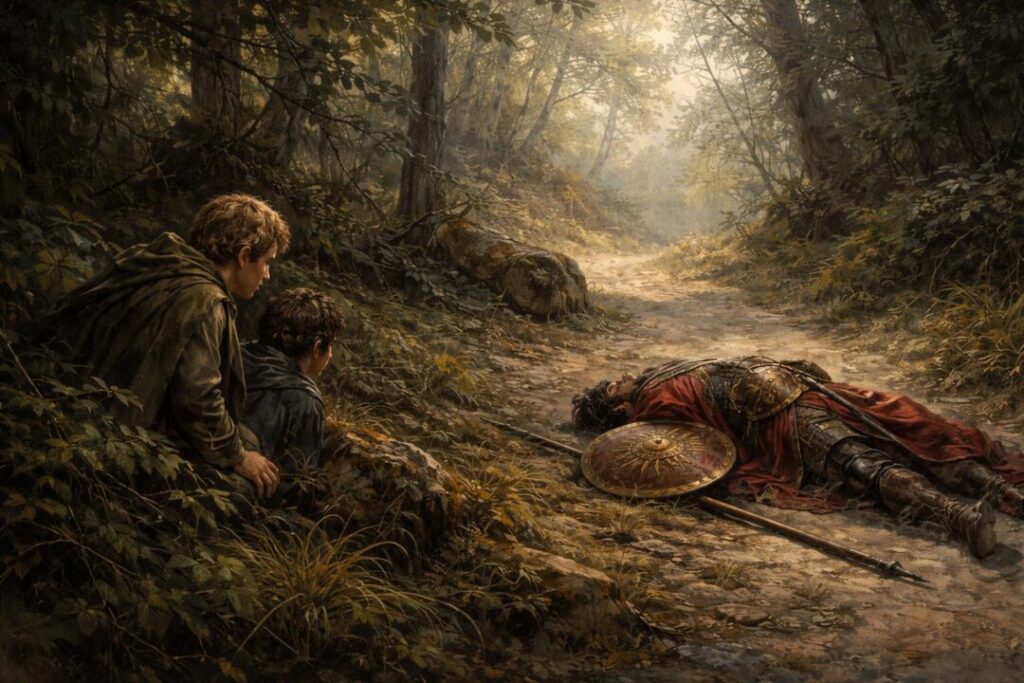
They see a body.
In The Two Towers, during the ambush in Ithilien, a Southron falls near them, and Sam has a thought that is almost shocking for how out of place it seems in a war narrative. He wonders where the man came from, and whether he was truly evil at heart—whether he was “really” there for his own reasons, or driven by lies and fear.
The text never answers Sam’s questions. That is the point.
It does not suddenly deliver a sympathetic speech from the fallen warrior. It does not reveal a hidden goodness or a secret plot. It simply forces the reader to acknowledge the missing information: a whole human life reduced to a uniform, and a war that makes it easy to stop asking what that uniform cost.
That single pause does not tell you “Harad is innocent.” The book is not doing that.
It tells you something subtler and more unsettling: Harad is not a single will. The men who fight for Sauron are still men—capable of being coerced, deceived, pressured, bound by oaths, ruled by fear, or swept into wars they did not choose. The narrative does not insist this is true in every case. It insists only that you cannot assume the opposite.
And once the book opens that crack, you are meant to remember it later—when the War ends and judgment begins.
What “after the War” actually looks like on the page
When the Ring is destroyed and the crowning has taken place, the story does not immediately fade to black.
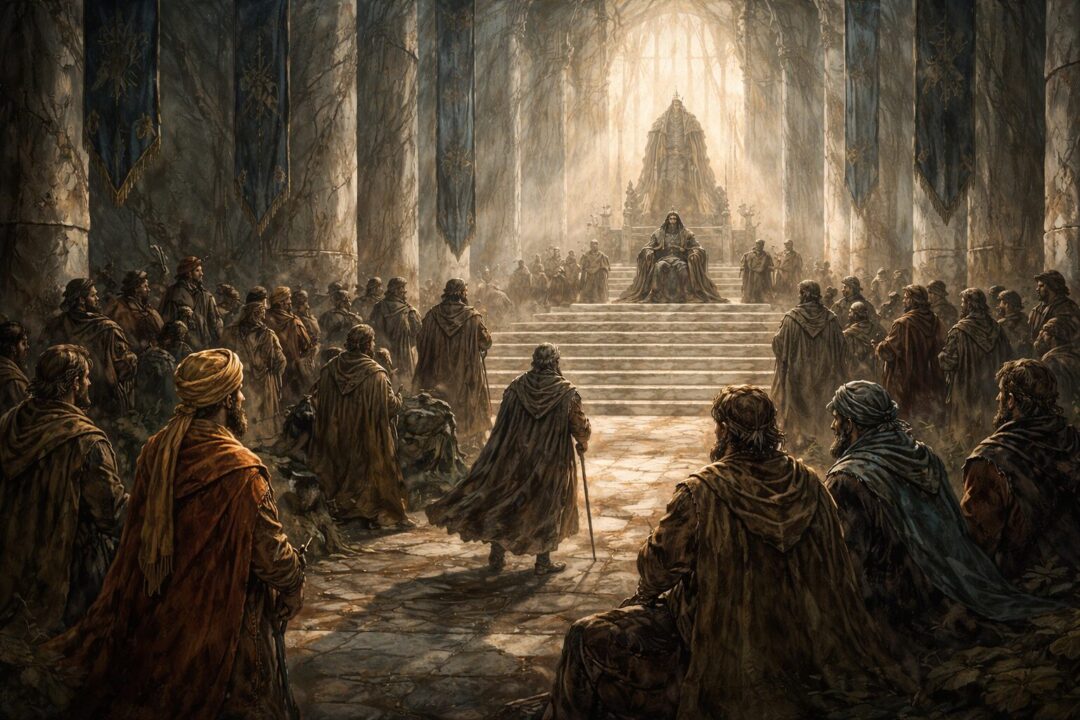
It shows the King sitting in judgment in the Hall of the Kings. Envoys come “from many lands and peoples,” and several decisions are recorded in a compact sequence. Among them is a line that is easy to glide past if you’re expecting only celebration:
The King “made peace with the peoples of Harad.”
That is, in plain terms, the most direct statement the narrative gives you about Harad after Sauron’s fall.
And it matters because it defines the tone of the settlement.
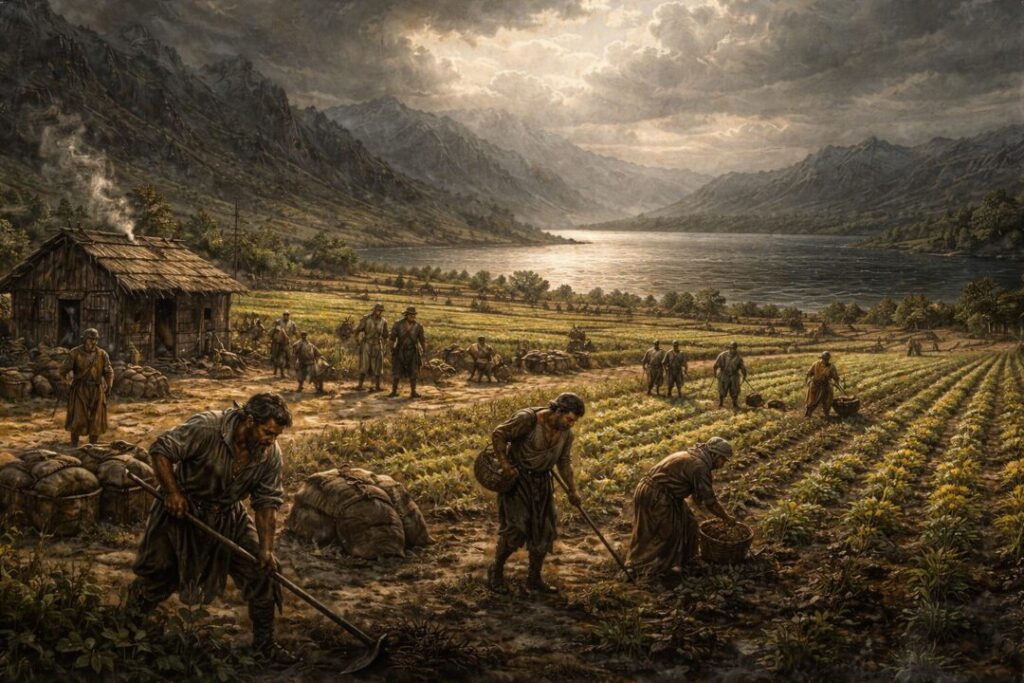
The same passage also says the King pardoned Easterlings who had given themselves up and sent them away free, and that the slaves of Mordor were released and given the lands about Lake Núrnen to be their own. In other words, the end of the War is not treated as a moment for endless punitive conquest. It is treated as a moment for disentangling.
Pardon for surrendered enemies. Freedom for the enslaved. Peace with peoples who had marched under the Shadow.
That does not mean there was no conflict in the South afterward. The text does not promise a magically healed continent. But it does tell you what the restored kingship is trying to be: not merely victorious, but just.
And if you are used to the movie-shaped idea that “the good side wins, the bad side is wiped out,” this single line is a correction.
Not because it’s sentimental—because it’s political.
Peace is not the same thing as forgetting
Notice what the text does not say.
It does not say the King “forgave everything” in a blanket emotional way. It does not say Harad suddenly becomes an ally out of pure admiration. It does not describe weddings between royal houses or a united parliament of Men.
It says he made peace.
Peace, in the world of Middle-earth, can be as practical as it is moral. It can mean borders recognized, raids ended, tribute refused or renegotiated, prisoners exchanged, captains sent home, and the long work of breaking Sauron’s influence where it had been strongest.
And the wording is important: not peace with “Harad” as a monolith, but with “the peoples of Harad.” Plural.
That small grammatical choice matches the larger implication Sam stumbled into in Ithilien. Harad is not one face. It is peoples—multiple cultures, rulers, regions, and interests. Some may have been deeply entangled with Sauron’s power; some may have been dragged into it; some may have hated Gondor for reasons older than the War; some may simply have feared what would happen if they refused the Shadow.
The text doesn’t map those differences. It doesn’t need to. It signals that the settlement had to be made with more than one “Harad,” because more than one existed.
What about Umbar and the Corsairs?
If you want the other major canonical anchor for “Harad after the War,” it sits not in the main narrative but in the historical texture of the Appendices.
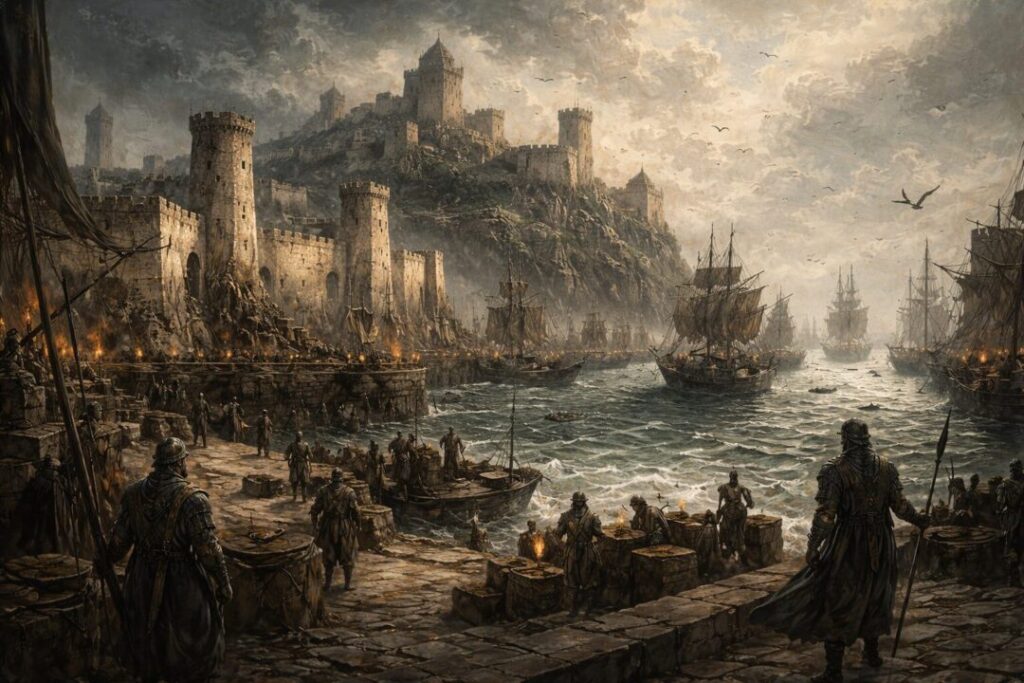
Umbar had been a wound for Gondor for a very long time—sometimes held, often lost, repeatedly a base of sea-raiding and southern pressure. The Appendices describe Umbar as a threat that “was never again completely subdued until the days of Elessar.”
That is a separate statement from “peace with the peoples of Harad,” but they belong together. One tells you the South was not simply left unattended. The other tells you the King’s policy was not simply conquest.
Together they suggest a settlement with two faces:
- Peace with peoples—ending a war between nations.
- Subduing a strategic stronghold that had functioned as a weapon against Gondor for generations.
Those are not contradictions. They are what real endings often look like: mercy where surrender is offered, firmness where a continuing threat remains.
But the text stays conservative. It does not give you a campaign diary. It does not describe how the Corsairs were broken, what treaties were signed, which chieftains bent the knee, or what Harad thought of the new King.
It gives only the outline—and the outline is enough to correct the movie-shaped assumption that the South simply vanishes.
The moral thread the text is pulling
If you step back, you can see the pattern.
The book repeatedly draws a line between enemies and evil.
Orcs serve evil. They are shaped by it, bred for it, and the narrative does not invite you to imagine their peaceful retirement in a freed land.
Men are different.
Men can be corrupted, bribed, threatened, deceived. Men can also repent, surrender, seek peace, and be released. That is why the King’s judgments include pardon and freedom.
And that is why Sam’s moment in Ithilien is not random sentimentality. It’s a thematic seed.
When you reach the post-war settlement, you are meant to remember that the fallen Southron was not a monster in a costume. He was a man who had been brought into a terrible war—by whatever chain of motives, pressures, and lies had reached his life.
“Peace with the peoples of Harad” is the state-level version of that recognition.
It is Middle-earth admitting that victory does not automatically grant moral permission to crush everyone who stood on the other side.
What we can say—and what we can’t
So what does the text actually let us claim about the Men of Harad after the War?
With confidence, it allows at least this:
- The restored King explicitly made peace with the peoples of Harad in the days after his crowning (stated directly in the narrative).
- Umbar, long a southern stronghold and threat, was not “completely subdued” again until the days of Elessar (stated in the Appendices).
- The tone of the settlement includes pardon for surrendered enemies and the freeing of enslaved peoples in Mordor’s southern lands (stated directly alongside the Harad line).
What it does not allow us to claim as fact:
- That Harad became a loyal ally.
- That Gondor conquered all of Harad.
- That every Southron soldier was coerced.
- That every Southron soldier was guilty.
- That the King personally traveled deep into Far Harad, reformed its politics, or imposed a single unified rule.
Those things may be imagined in adaptations or fan speculation. The canonical text doesn’t give them.
And that restraint is part of the point. Middle-earth is wide, and the War of the Ring—however world-shaking—does not turn the whole map into a tidy epilogue.
The ending the text prefers
In the movies, the Men of Harad are part of spectacle.
In the book, they are part of aftermath.
A dead man in Ithilien, reminding you you don’t know the whole story.
A line of judgment after the crowning, reminding you that victory does not have to mean extermination.
And a quiet shift from war to rule: not merely defeating enemies, but deciding what kind of peace will replace the Shadow.
If you’ve always wondered what became of the Southrons after the War, the answer is not a dramatic montage. It is a single phrase—easy to miss, impossible to unsee once you catch it:
Peace with the peoples of Harad.
And once you take that seriously, the War of the Ring ends in a different key.
Not triumph.
Repair.
Sources & Notes
- J.R.R. Tolkien, The Lord of the Rings, Book IV, Chapter 4, “Of Herbs and Stewed Rabbit” — Sam’s brief reflection over the fallen Southron keeps Harad’s soldiers human rather than faceless enemies.
- J.R.R. Tolkien, The Lord of the Rings, Book VI, Chapter 5, “The Steward and the King” — Aragorn’s early judgments include pardon for surrendered enemies, freedom for Mordor’s slaves, and peace with the peoples of Harad.
- J.R.R. Tolkien, The Lord of the Rings, Appendix A, “Gondor and the Heirs of Anárion” — the long history of Umbar and its final subduing in Elessar’s days supplies the southern political background.
- J.R.R. Tolkien, The Lord of the Rings, Appendix B, “The Tale of Years” — the Fourth Age chronology frames Aragorn/Elessar’s reign as a period of renewed order after Sauron’s fall.