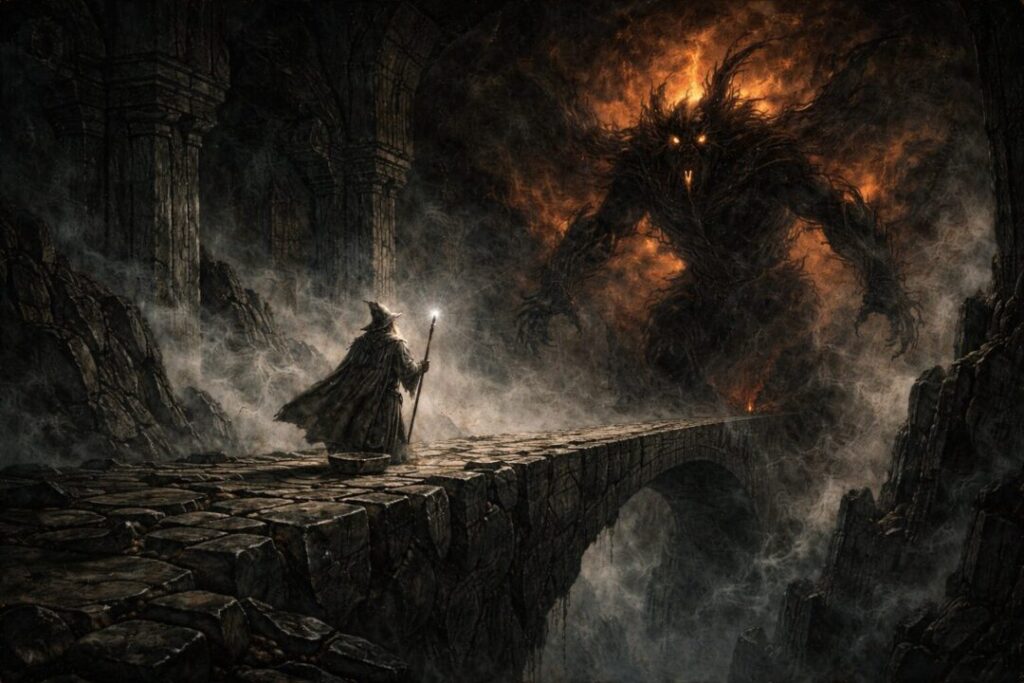
Balrogs are usually remembered in motion.
They stride through smoke. They lash with whips. They break ranks and scatter kings. They are the kind of horror that belongs to open war—visible, loud, and catastrophic.
But Tolkien gives us a second image, quieter and more unsettling:
A Balrog that is not marching at all.
A Balrog that is waiting.
Because in the aftermath of Morgoth’s final defeat, the texts do not say every Balrog was slain. They say most were destroyed—and then they add a line that carries enormous weight:
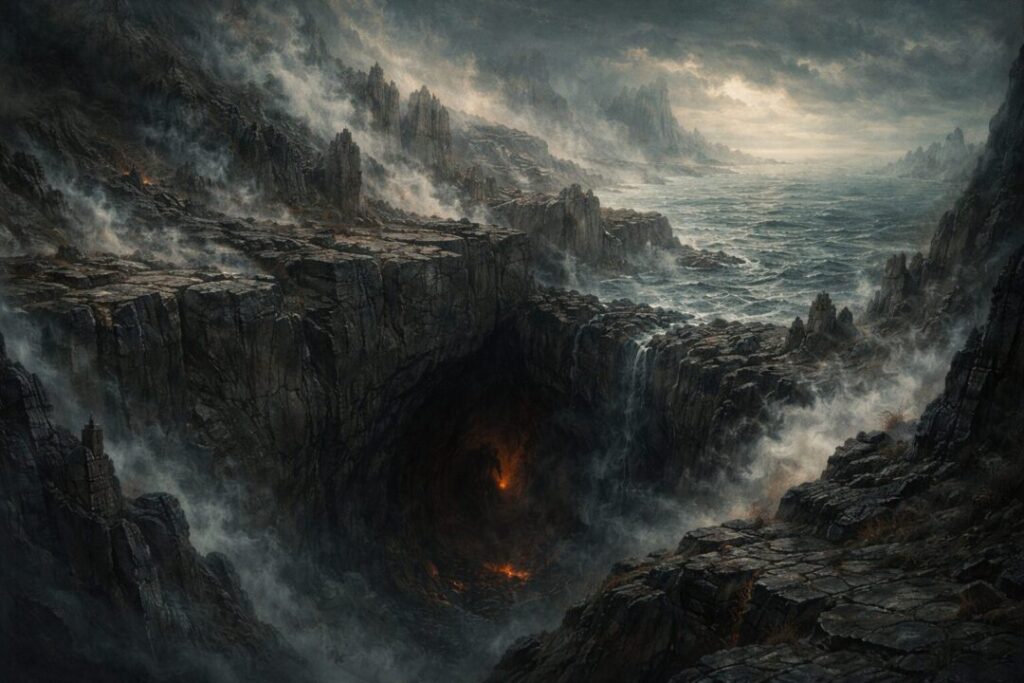
Some few fled and hid themselves “in caverns inaccessible at the roots of the earth.”
If that is true, then the world Tolkien built contains a particular kind of terror: the surviving remnants of the First Age, not ruling and not conquering, but buried—present in Middle-earth like buried fire.
And that leads to the real question.
If a Balrog can hide, can it do so completely?
Or is a Balrog the kind of being that the Wise would always notice—like a shadow you cannot keep out of the mind?
The answer is not a simple yes or no, because Tolkien’s Balrogs are not simple creatures. They are spirits in a physical world. And Tolkien is careful about what that means.
What a Balrog is (and why that matters)
Balrogs are not described as a separate “race” with an origin like Elves, Men, or Dwarves.
They belong to the order of beings that Tolkien calls the Maiar—lesser Ainur, spirits who entered the world and could take form within it. In other words: a Balrog is not merely a body.
It is a spirit that has taken on a dreadful raiment.
That point matters because it changes what “hiding” could mean.
A wolf hides by moving into brush.
A man hides by taking a road at night.
But a Maia hides differently. Even when it has a body, it is not defined by the body alone.
So when Tolkien says a few Balrogs hid in “caverns inaccessible,” we should be careful not to imagine only physical concealment—as if they were simply large monsters wedged into tunnels.
The text is telling us something about survival after ruin:
They escaped. They withdrew. They endured.
The clearest example is the Balrog later known as Durin’s Bane.
Durin’s Bane: the Balrog who proves hiding is possible
If Balrogs were always obvious—always blazing to the sight of the Wise—then the story of Moria becomes difficult to explain.
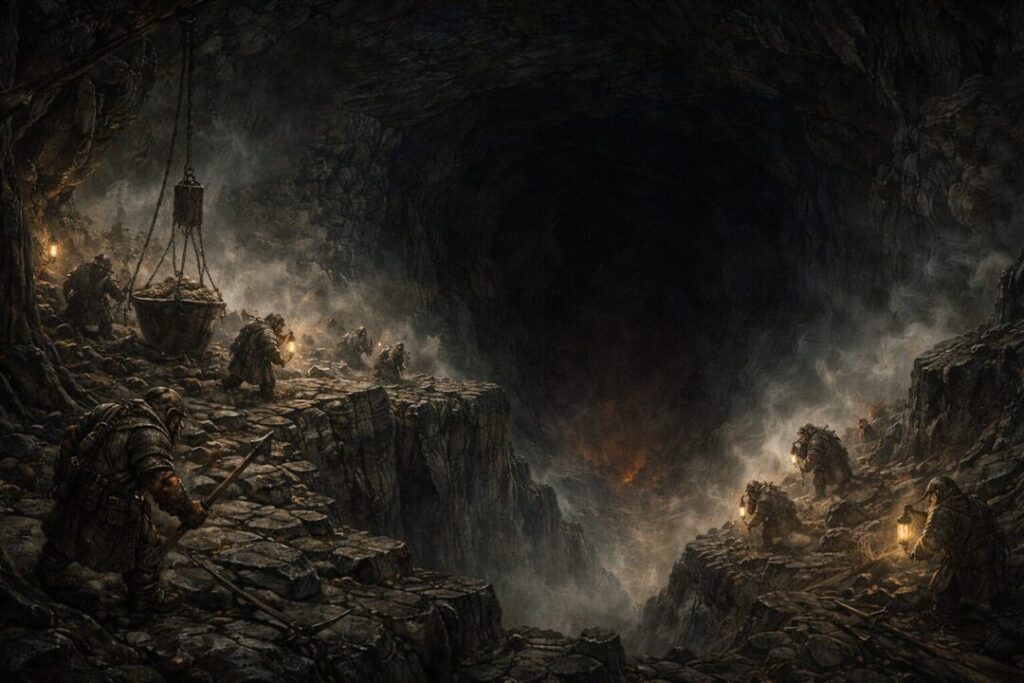
Khazad-dûm was not a forgotten hole. It was a great Dwarven realm with long memory, deep craft, and wide dealings.
And yet the Balrog beneath it is not treated as a known threat that the Dwarves foolishly ignored.
The tradition preserved in the Appendices points the other way: the Dwarves delved too deep, and “thus they roused from sleep a thing of terror… that had lain hidden at the foundation of the earth.”
Whatever exactly the Balrog was doing down there—whether sleeping, brooding, or simply remaining out of sight—the story’s shape is clear:
It was hidden.
Not just “unseen,” but unknown.
That already answers half the question.
Yes: a Balrog can hide without Morgoth.
It can exist in Middle-earth for a very long time without openly moving in the world.
But the second half of the question remains.
If it was hidden, why does it still feel present when the Fellowship enters Moria?
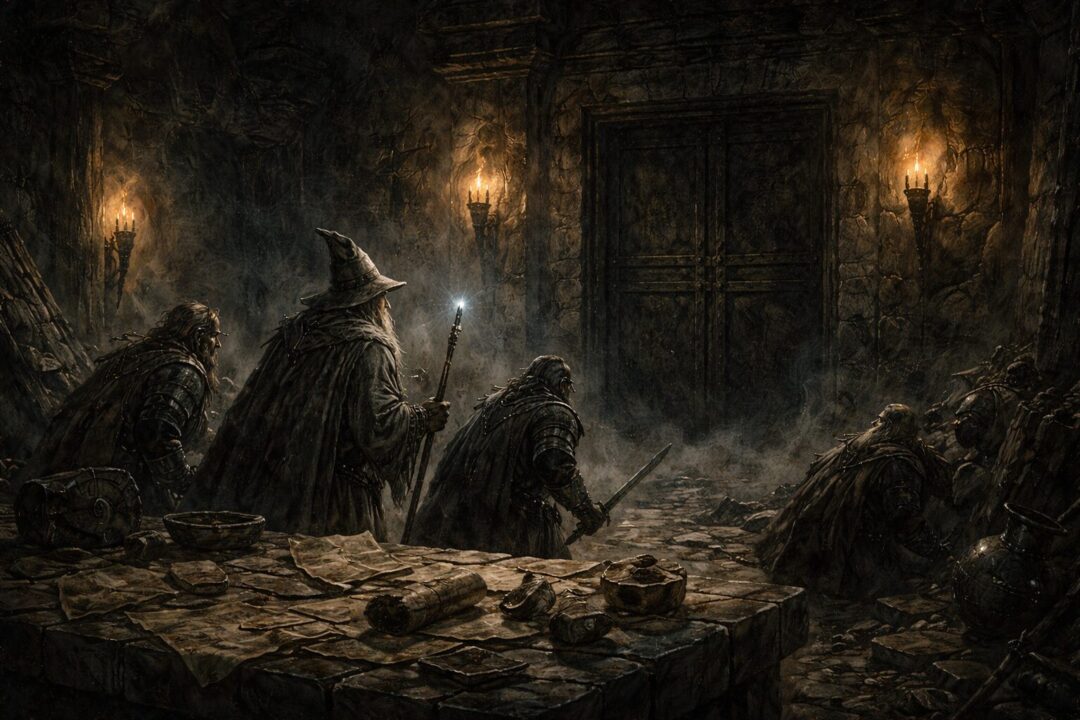
The Chamber of Mazarbul: presence behind a door
When the Fellowship reaches the Chamber of Mazarbul, the first wave is physical: Orcs, drums, pressure, the sense of being hunted.
Then Tolkien shifts the atmosphere.
Gandalf speaks afterward of something coming into the chamber, something he felt through the door. The Orcs themselves are afraid and fall silent.
And this is the critical detail: fear moves before the Balrog is seen.
So hiding is real—but so is leakage.
How can both be true?
Tolkien does not give us a technical system, but he gives us enough to speak carefully.
A Balrog is a Maia in a fixed, terrible form. It is not a vague ghost. It is not a purely invisible spirit.
And yet it is not merely a physical animal either.
So it can be concealed in the deep—its movements contained, its location unknown to the kingdoms above.
But when it approaches, when it acts, something of it can be felt—especially by those who have a kind of spiritual awareness, and even by Orcs whose fear is tuned to power.
In Tolkien’s world, “presence” is not only about sight.
“Detectable to the Wise” is not the same as “impossible to hide”
There is a temptation to treat the Wise as if they have a permanent alarm bell: Balrog within fifty miles.
But Tolkien does not show that.
If the Wise could always detect Balrogs at distance, then the surviving Balrogs of the First Age could never truly vanish into the earth. Their hiding would be pointless. They would be tracked and destroyed.
Yet Tolkien explicitly tells us that some survived by hiding “inaccessible” in the deeps.
So we should avoid overstating what the Wise can do.
What the texts support more strongly is this:
- A Balrog can remain hidden for ages, physically removed from the world above.
- But when it draws near and exerts will—when it becomes active—its presence can be felt.
That is not a contradiction. It is exactly the kind of layered reality Tolkien likes: the seen world and the deeper world overlapping, with certain beings casting shadows that are not only visual.
Why hiding worked: the Balrog’s best defense was silence
There is another reason hiding makes sense after Morgoth’s fall.
The Balrogs who escaped were remnants of a defeated power.
They had no kingdom. No armies. No Dark Lord to gather them.
And Tolkien’s history suggests that isolated remnants often survive not by open war, but by withdrawal.
Durin’s Bane is not commanding Mordor. It is not building a new Angband.
It is simply there.
That kind of survival fits Tolkien’s pattern: the long defeat, the fading of great beings, and the persistence of ancient evils in forgotten places.
A Balrog hidden in the roots of the earth is the First Age refusing to be fully buried.
So were Balrogs always “detectable”?
Only in a limited, situational sense.
The texts do not support the idea that Balrogs broadcast their location at all times to any mind that is sufficiently wise.
They do support the idea that Balrogs are beings whose presence can register—through fear, through pressure, through a sense of something more than flesh—when they move close enough, or when they act.
That is why Moria can hold both truths at once:
- The Balrog lay hidden so long that a great realm above did not name it until the moment it woke.
- Yet when it comes, even Orcs fall silent, and Gandalf can feel it before he sees it.
A Balrog can hide without Morgoth.
But it cannot become harmless.
It cannot become merely a rumor of stone.
It is still a Maia in terror’s clothing—and when it stirs, Middle-earth stirs with it.
And that leads to the final twist in the question.
Because if Balrogs can hide for ages, then Middle-earth is not only a world of maps and kingdoms.
It is a world with depth.
Not just depth of history, but depth of literal darkness—places where the ancient powers of the First Age can persist, waiting, until someone breaks the wrong wall or strikes the wrong vein of mithril.
Moria is not frightening only because of what happens on the Bridge.
It is frightening because it suggests that the world can carry secrets for millennia—and still be surprised by them.
So the question is not only whether the Wise could detect a Balrog.
It is whether the Wise were willing to admit what that implies:
That the war against Morgoth did not remove every ember.
Some embers were buried.
And sometimes, buried fire is the most dangerous kind—because no one thinks to fear it… until it moves.
Sources & Notes
- J.R.R. Tolkien, The Silmarillion, ‘Valaquenta’: the Balrogs (Valaraukar) are Maiar, spirits of fire who followed Melkor.
- J.R.R. Tolkien, The Silmarillion, ‘Of the Voyage of Eärendil and the War of Wrath’: after Morgoth’s overthrow, some Balrogs escaped and hid ‘in caverns inaccessible at the roots of the earth.’
- J.R.R. Tolkien, The Lord of the Rings, Appendix A, ‘Durin’s Folk’: the Dwarves delved too deep in Moria and roused Durin’s Bane, a terror long hidden beneath the mountains.
- J.R.R. Tolkien, The Lord of the Rings, Book II, Ch. 5, ‘The Bridge of Khazad-dûm’: Gandalf senses and resists the power behind the door before the Balrog is fully revealed.