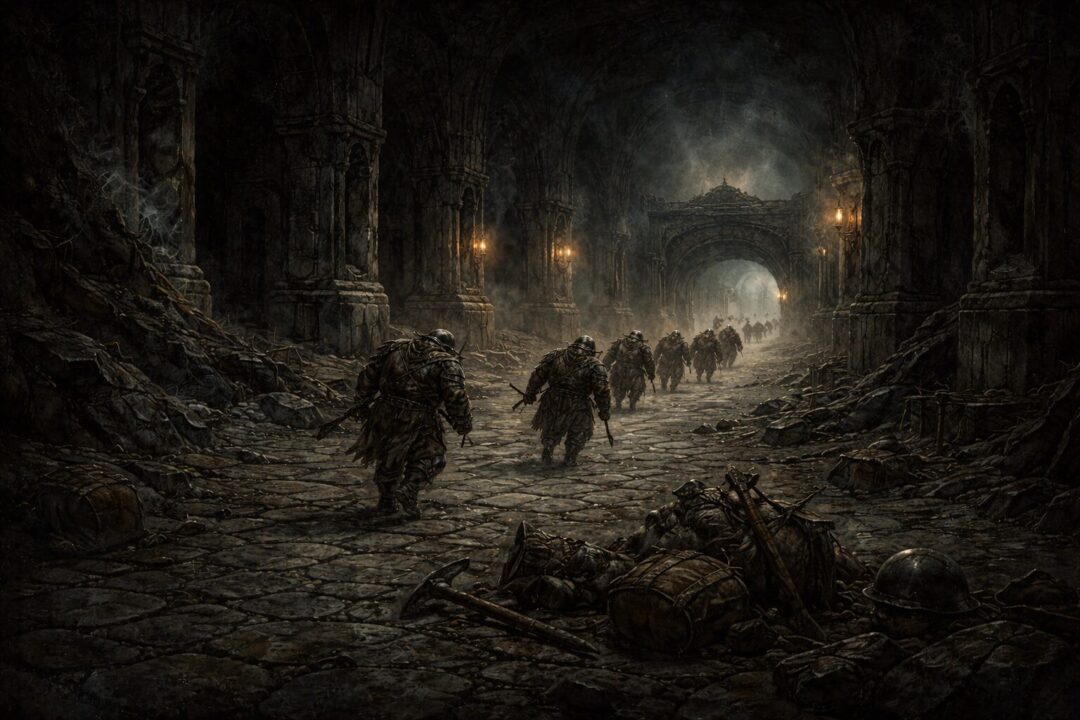
Khazad-dûm does not fall like a city in a siege.
It falls like a lamp being snuffed.
One year it is the greatest of the Dwarven mansions, rich beyond any other house of the Longbeards.
The next, it is a name people fear to speak—Moria, the Black Pit.
And the creature at the center of the ruin is older than the kingdom it destroys.
Durin’s Bane is a Balrog: a terror of the Elder Days that survived the overthrow of Morgoth’s power and fled into hiding. The texts place it deep—beneath the roots of the Misty Mountains, under Barazinbar, far below the known halls.
Then they do something more unsettling.
They let it stay there.
Not for a generation.
Not for a few centuries.
But through the whole of the Second Age, and well into the Third—until T.A. 1980, when it “appears” in Moria and slays Durin VI.
So why does it sleep so long?
And what changes?
To answer that, you have to separate what the texts state plainly from what they leave deliberately shadowed.
What the texts actually say about the “sleep”
The wording is consistent in spirit even when it is brief: the Balrog lay hidden deep in the Mountains and remained undisturbed for a very long time.
Nothing in the primary narrative gives you a biological explanation for how a Balrog “sleeps,” or what sleep means for a being of that order. The language is descriptive, not clinical—more like the “watching” of a mountain or the “brooding” of a ruin.
So the safest reading is the simplest:
It is not active in the world above.
It is concealed.
It does not come forth.
That matters, because it means the question “why didn’t it wake?” is also “why wasn’t it disturbed?”
And the texts give you a direct answer to that.
The Dwarven kingdom was vast—but its deepest danger was lower still
Khazad-dûm is not a small realm that accidentally digs into a monster’s lair.
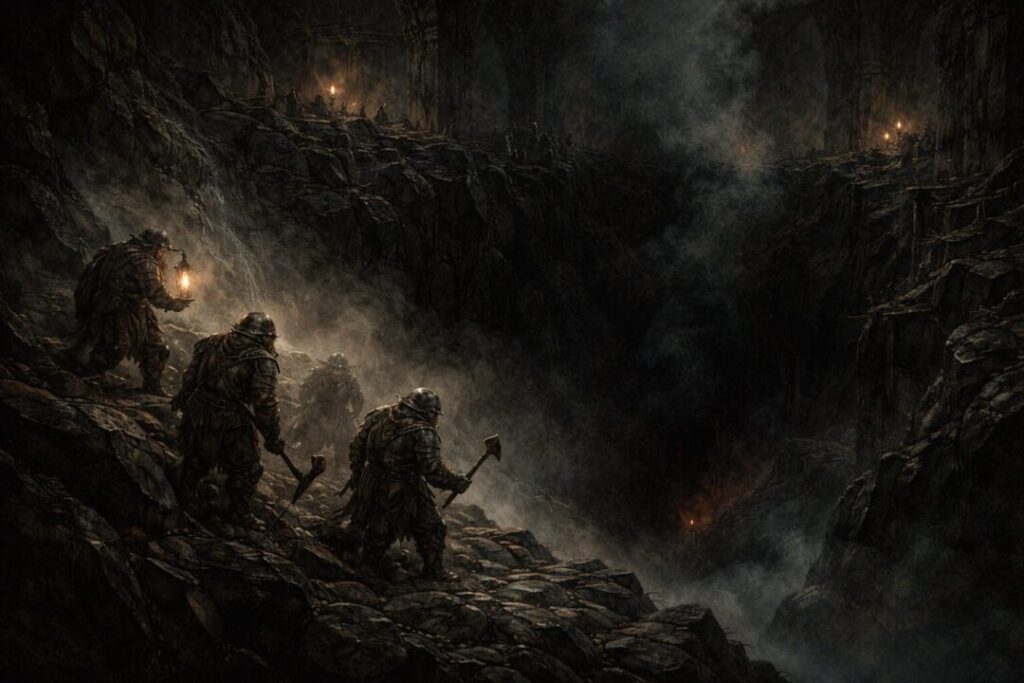
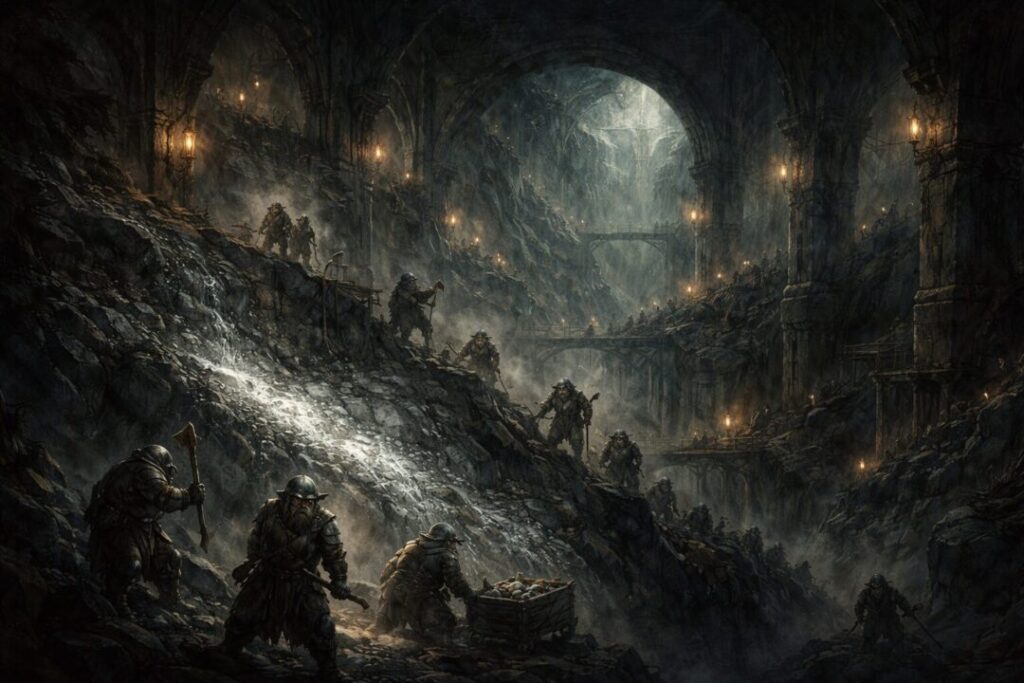
It is described as an enormous mansion under the Mountains, expanding across centuries. Its wealth is tied to a single substance: mithril, found in its mines, rare beyond price.
And as the centuries pass, the Dwarves mine “deeper and deeper” for it.
This is the key point.
Mithril exists in the upper and middle delvings long before it becomes fatal. The Dwarves can grow wealthy on it for ages without reaching the depth where the Balrog lies hidden.
So the Balrog’s long silence does not require a complicated explanation.
It requires only distance.
The horror is not perched behind a door in the Second Age, waiting to be noticed.
It is buried far below the life of the city—until the life of the city reaches down to it.
That is why the story is framed the way it is framed in the appendices: the Dwarves “tell no tale,” but mithril is both foundation and destruction; they delved “too greedily and too deep,” and disturbed what they fled.
This is not presented as a moral lecture delivered from outside.
It is a fact of history pressed into a single sentence: their greatness drove them downward.
And then they broke into something that had been left alone since the Elder Days.
Why T.A. 1980 matters more than most readers notice
The Tale of Years gives you an eerie pairing.
In T.A. 1980, the Witch-king comes to Mordor and gathers the Nazgûl.
In that same year, a Balrog appears in Moria and slays Durin VI.
The next year, T.A. 1981, Náin I is slain and the Longbeards flee.
This does not prove a direct connection.
The texts do not state that Sauron commands the Balrog, or that the Nazgûl awaken it, or that the Witch-king even knows it is there.
But the alignment of dates is real, and it matters because it shows what kind of age this is.
By the late Third Age, the world’s old evils are not merely surviving.
They are returning.
The Nazgûl gather again. Shadows lengthen in the East. Orcs multiply in the Mountains. Places long quiet become dangerous.
Against that backdrop, the fall of Moria looks less like a random mining accident and more like a symptom: the deep places of the world are stirring.
Some readers take this further and suggest that Sauron’s growing shadow may have helped rouse “fell things” in general.
That is a reasonable interpretive atmosphere—the world is clearly darkening—but it must remain interpretation unless a text explicitly makes the causal link.
What the texts do let you say with confidence is narrower, and sharper:
Whatever else is happening in Middle-earth, the Dwarves’ delving is what finally reaches the Balrog’s depth.
And once it is disturbed, it does not merely frighten them.
It ends a dynasty.
The fall is immediate—and almost wordless
Durin VI is slain, and the creature gains its name: Durin’s Bane.
Náin I is slain the following year.
Then the Dwarves abandon the city.
This is one of the starkest “ends” in the appendices because it refuses to become a heroic saga. There is no long description of a last stand. No catalogue of champions. No account of battle lines in the deep halls.
There is only outcome.
The Dwarves tried to hold their mansions against something too great for them, and failed.
After that, Khazad-dûm becomes Moria—not merely abandoned, but dreaded.
And the Balrog remains.
What happens after: a clue to the Balrog’s nature
For nearly five hundred years after the Dwarves flee, the Balrog is said to lurk in Moria.
Then, later in the Third Age, Orcs begin to enter and occupy the place.
The texts make two things clear at once:
- Orcs infest Moria in strength later.
- They fear the Balrog.
That combination is important.
It suggests the Balrog is not simply a beast that “woke” and rampaged mindlessly and then vanished. It is a continuing presence—one that can be feared, endured, and existed beside (at a distance) by lesser evils.
But again, the texts do not give you a political relationship. They do not say the Balrog serves Sauron, or that it receives commands, or that it marches out as a general.
They only show that Moria becomes a kind of shadowed ecosystem:
A great terror at the root.
And lesser terrors creeping into the upper halls.
That is why later Dwarves who win victories outside the Gate still refuse to enter.
At the Battle of Azanulbizar, Dáin Ironfoot comes to the threshold—slays Azog—and then senses a terror within that stops the conquest cold.
Moria is not merely “occupied.”
It is claimed by something older than Orcs.
What “finally woke it”—and what “woke” might mean twice
The simplest answer to the headline question is the one the texts actually give:
The Dwarves’ delving for mithril disturbed it.
That is the primary-text foundation. Without it, you cannot build anything else.
But the deeper answer is the one most people miss:
The Balrog does not “wake” in 1980 so much as it enters history in 1980.
It can remain hidden for millennia because it is far below the world that remembers dates. Khazad-dûm can be a wonder of stone and light because the Dwarves have not yet reached the root where the terror lies.
Then the boundary is crossed—by pick and hammer, by ambition, by depth.
And once the boundary is crossed, the Balrog does what it has always been capable of doing.
It destroys.
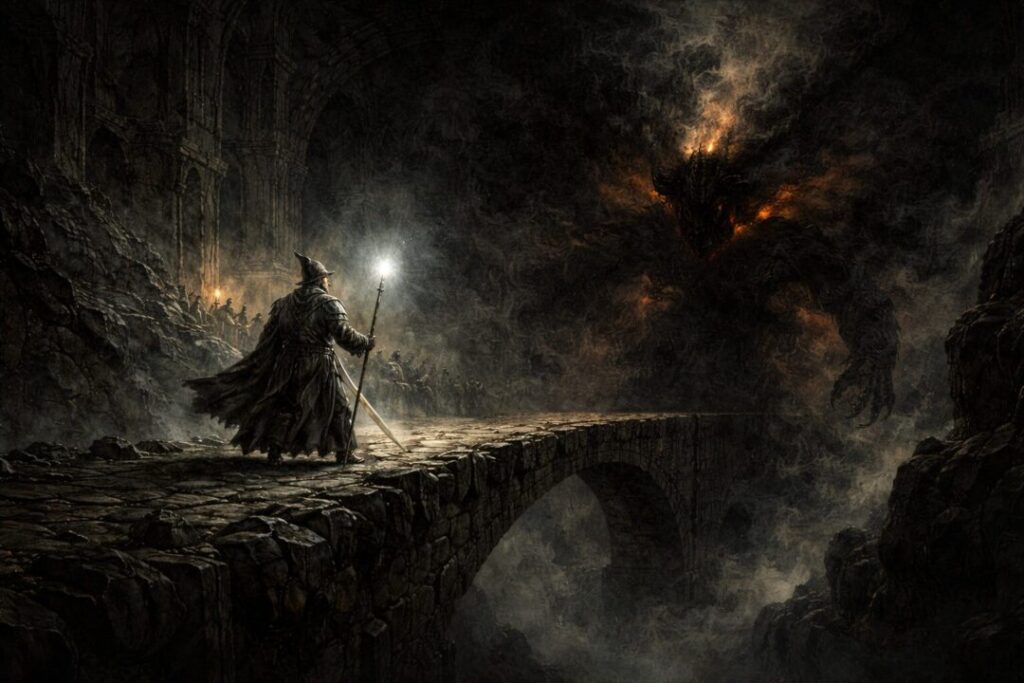
Later, in 3019, the Balrog is “woken” again in a different sense: not from ancient sleep, but from lurking isolation. When the Fellowship passes through Moria, the Orcs are roused, drums beat in the deep, and at last the Balrog comes forth to confront the intruders on the Bridge of Khazad-dûm.
That moment feels like the creature’s true arrival in the story.
But it is only possible because of the earlier one—the first disturbance, the first ruin, the first sealing of the Black Pit.
So why did Durin’s Bane stay sleeping so long?
Because it was buried deeper than the living kingdom—until the kingdom dug down to it.
And what finally woke it?
The thing that made Khazad-dûm great in the first place:
Mithril.
A foundation you can build a wonder on.
And, if you go far enough down, a door you should never open.
Sources & Notes
- J.R.R. Tolkien, The Silmarillion, ‘Of the Voyage of Eärendil and the War of Wrath’ — after Morgoth’s overthrow, some Balrogs fled and hid in inaccessible caverns at the roots of the earth.
- J.R.R. Tolkien, The Lord of the Rings, Appendix A, ‘Durin’s Folk’ — Khazad-dûm’s mithril wealth, the Dwarves delving too greedily and too deep, and the awakening of Durin’s Bane are given together.
- J.R.R. Tolkien, The Lord of the Rings, Appendix B, ‘The Tale of Years’ — T.A. 1980 records both the Witch-king’s return to Mordor and the Balrog’s appearance in Moria; T.A. 1981 records Náin I’s death and the flight of the Longbeards.
- J.R.R. Tolkien, The Lord of the Rings, Book II, Chapter 4, ‘A Journey in the Dark’ — Gandalf’s account of Moria, mithril, Orcs, and the feared name Durin’s Bane supports the article’s setting and caution about what is known.
- J.R.R. Tolkien, The Lord of the Rings, Book II, Chapter 5, ‘The Bridge of Khazad-dûm’ — the Balrog’s emergence before the Fellowship shows the later ‘waking’ or coming-forth discussed here.