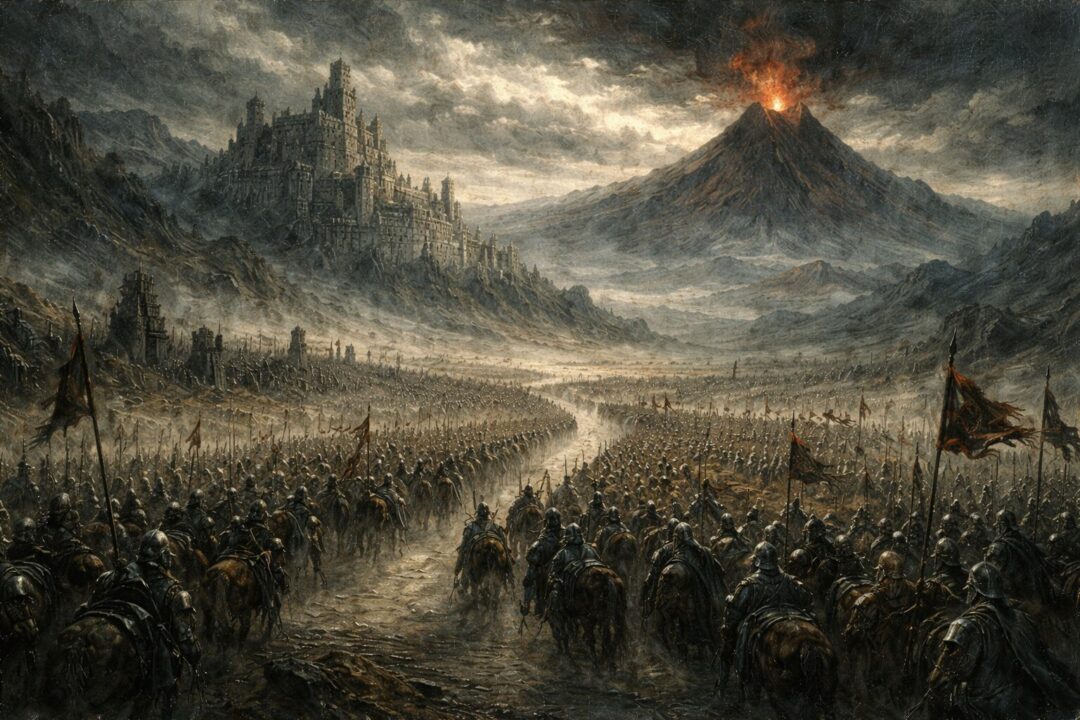
When readers look closely at the timeline of Middle-earth, one question comes up again and again: why does Sauron wait so long to act?
The One Ring is cut from his hand at the end of the Second Age. The War of the Ring does not erupt until the final years of the Third Age—nearly three thousand years later. During that immense span of time, Sauron never truly disappears. His shadow lingers, his servants endure, and his will remains bent toward domination.
So why the delay?
Why does Sauron not rise earlier, while Gondor is still strong, while Arnor still stands, while the Elves are numerous and vigilant?
The answer lies not in weakness alone, but in strategy, decay, and certainty. Sauron’s long silence is not hesitation. It is calculation.
Sauron’s Power Was Broken—But Not Destroyed
At the end of the Second Age, Sauron suffers his greatest defeat. The Last Alliance of Elves and Men marches on Mordor, Barad-dûr is overthrown, and Sauron himself is brought low. His physical form is destroyed, and One Ring is cut from his hand by Isildur.
This moment is often misunderstood. Sauron is not “killed” in the mortal sense, but Tolkien is explicit that the loss of the Ring is catastrophic. Much of Sauron’s native power—power he poured into the Ring to dominate others—is now separated from him. Without it, he is gravely diminished.
He survives, but survival is not the same as readiness.
For centuries, Sauron is unable to take shape or act openly. His will endures, but he lacks the strength to challenge the Free Peoples directly. Any attempt at open war during this period would invite the same unified resistance that destroyed him before.
And Sauron remembers.
Unlike Morgoth, who relied on overwhelming force and burned himself out in the process, Sauron learns from defeat. He adapts. He waits. He understands that timing matters more than speed.
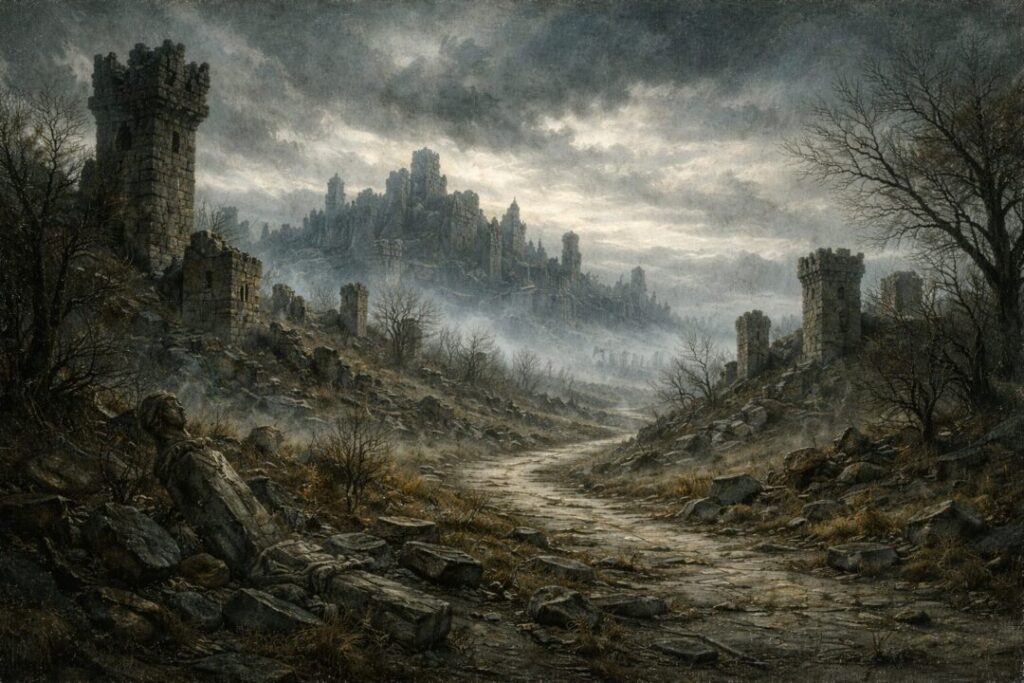
Retreat Into Shadow Is Not Inaction
When Sauron finally begins to stir again, he does not announce himself. He operates under masks and false names. By the Third Age, he has taken refuge in Dol Guldur, presenting himself only as the “Necromancer.”
This is not weakness—it is concealment.
From Dol Guldur, Sauron probes the world. He tests borders. He watches how the Free Peoples respond. He measures their vigilance and their fear. And crucially, he allows them to debate what he truly is.
Is he a lesser evil?
A remnant?
A threat that can be ignored for now?
This uncertainty is a weapon. As long as Sauron remains undefined, his enemies hesitate. And hesitation is exactly what he needs while he regathers strength.
He Lets the World Decay Without Him
Perhaps Sauron’s most devastating weapon is time.
During his long withdrawal, the world weakens without his direct interference. The great northern kingdom of Arnor fractures into smaller realms and is eventually destroyed altogether. Gondor endures, but it is slowly diminished—by civil war, plague, kin-strife, and the gradual thinning of Númenórean blood.
The Elves, weary of Middle-earth, begin to depart westward. Their numbers dwindle. Their power fades. The Dwarves retreat deeper into their halls, becoming increasingly isolated. Even alliances between the Free Peoples weaken, as old friendships are forgotten and distrust grows.
Sauron does not need to destroy these realms himself.
He simply waits for them to fall apart.
By the time he is ready to move openly, there is no High King of Men, no united front, and no shared leadership capable of coordinating resistance on a grand scale. The world Sauron returns to is far more vulnerable than the one that defeated him.

The Watchful Peace Was Part of the Trap
When the White Council finally acts and drives Sauron from Dol Guldur in 2941, many believe a victory has been won. What follows is known as the Watchful Peace—a period in which Sauron appears absent and the shadow seems to recede.
But this peace is deceptive.
In reality, Sauron has already achieved what he needs. He withdraws not because he is beaten, but because he has outgrown Dol Guldur. He moves openly to Mordor, rebuilding Barad-dûr and preparing for war on a scale far greater than before.
Meanwhile, the Wise argue. Some believe the danger has passed. Others sense the truth but cannot persuade the rest to act decisively. The Free Peoples remain reactive rather than proactive, always responding to threats rather than anticipating them.
By the time Sauron reveals himself openly, his foundations are already laid. His enemies realize the truth only after it is too late to prevent his rise.
Sauron’s Fatal Certainty About the Ring
One of the most important reasons Sauron waits is also the reason he ultimately loses.
Sauron is certain that no one will ever destroy the Ring.
To him, power exists to be claimed and wielded. He cannot conceive of a being—especially a powerful one—choosing to unmake the ultimate source of domination. He assumes that if the Ring reappears, it will be used against him, not erased.
This belief shapes everything.
It allows Sauron to delay open war, confident that the Ring will eventually betray its bearer and return to him. It leads him to focus on great lords and mighty figures, while overlooking the small and the humble. And it blinds him to the possibility that his enemies might reject power rather than seek it.
In Tolkien’s own words, this is Sauron’s deepest flaw: he cannot imagine self-denial.
Open War Begins Only When the Board Is Set
Sauron declares himself openly only when every condition favors him:
- The Free Peoples are divided and weakened
- Their strength is spent guarding borders and old grudges
- Mordor is fully armed and fortified
- The Ring has not been revealed, but he believes it soon will be
At this stage, war serves a specific purpose. It draws every eye, every army, and every fear toward Minas Tirith and away from the true danger.
While the world marches east to meet his armies, Sauron never imagines that anyone would dare march into the heart of Mordor for any reason other than conquest.
That is the final irony of his patience.
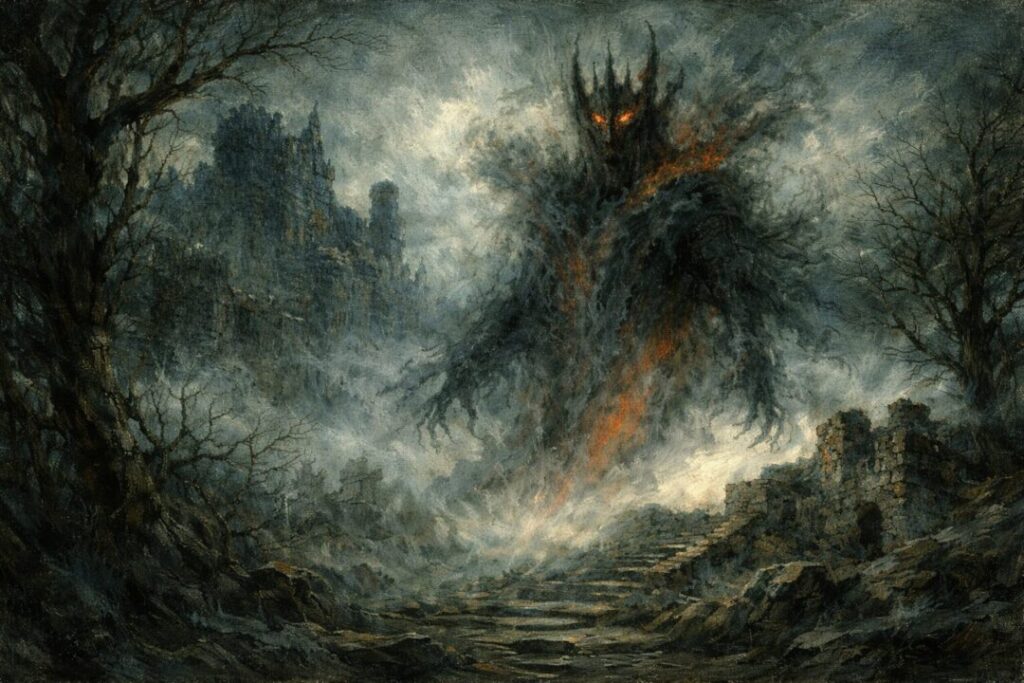
Final Thought
Sauron does not lose because he waits too long.
He loses because he waits too well—for a world that will always act according to his expectations.
But Middle-earth does something he never planned for.
It chooses mercy over power.
Endurance over domination.
Destruction of the Ring over mastery of it.
And that choice—small, quiet, and unthinkable to Sauron—is what finally ends him
Sources & Notes
- J.R.R. Tolkien, The Silmarillion, “Of the Rings of Power and the Third Age” — covers the Last Alliance, Isildur’s cutting of the Ring from Sauron’s hand, and Sauron’s long survival after defeat.
- J.R.R. Tolkien, The Lord of the Rings, Appendix B, “The Tale of Years” — gives the long Third Age chronology: Sauron at Dol Guldur, the Watchful Peace, his return to Mordor, and the final war.
- J.R.R. Tolkien, The Lord of the Rings, Book II, Chapter 2, “The Council of Elrond” — Gandalf and Elrond frame Sauron’s recovery, the Ring’s loss, and why the enemy’s timing depends on regaining strength and certainty.
- J.R.R. Tolkien, The Lord of the Rings, Appendix A, “Gondor and the Heirs of Anárion” — supports the article’s point that Arnor and Gondor declined through division, plague, war, and fading Númenórean strength before Sauron moved openly.
- J.R.R. Tolkien, The Letters of J.R.R. Tolkien, Letter 131 — Tolkien describes Sauron’s drive toward order, planning, and domination, matching the strategic patience emphasized here.