Denethor is one of those Middle-earth figures who gets reduced too quickly.
People remember the pyre. The shouting. The cruelty toward Faramir. The final refusal of counsel. And once that memory hardens, it becomes easy to flatten him into a single idea: the mad steward.
But the text does not really let you do that. What it gives instead is much more uncomfortable.
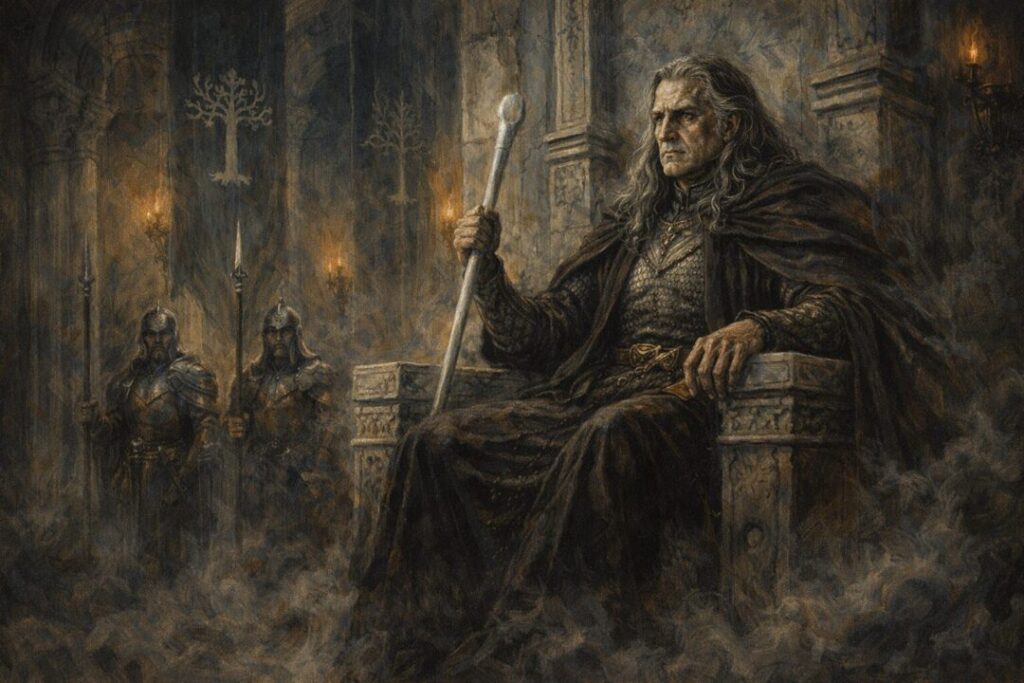
Denethor is not presented as a weak man collapsing under pressure. He is presented as an unusually great one. In Minas Tirith, Pippin sees at once that Denethor looks “more like a great wizard” than Gandalf does: older, more powerful, more lordly in bearing. Elsewhere he is described as proud, tall, valiant, wise, and far-sighted—more kingly than Gondor had seen in many lives of Men. Before his fall, he is not a fool on a throne. He is a capable and formidable ruler.
That matters, because Denethor’s tragedy only works if he is strong.
A lesser man broken by fear is sad, but simple. Denethor is worse than that. He is a ruler of real intelligence who understands the scale of the threat facing Gondor better than almost anyone around him. He is grim, yes. Proud, certainly. Hard, often cruelly so. But he is not merely irrational. The books make clear that his fall is tied to knowledge—especially the knowledge he gains through the palantír of Minas Tirith.
And here the story becomes sharper.
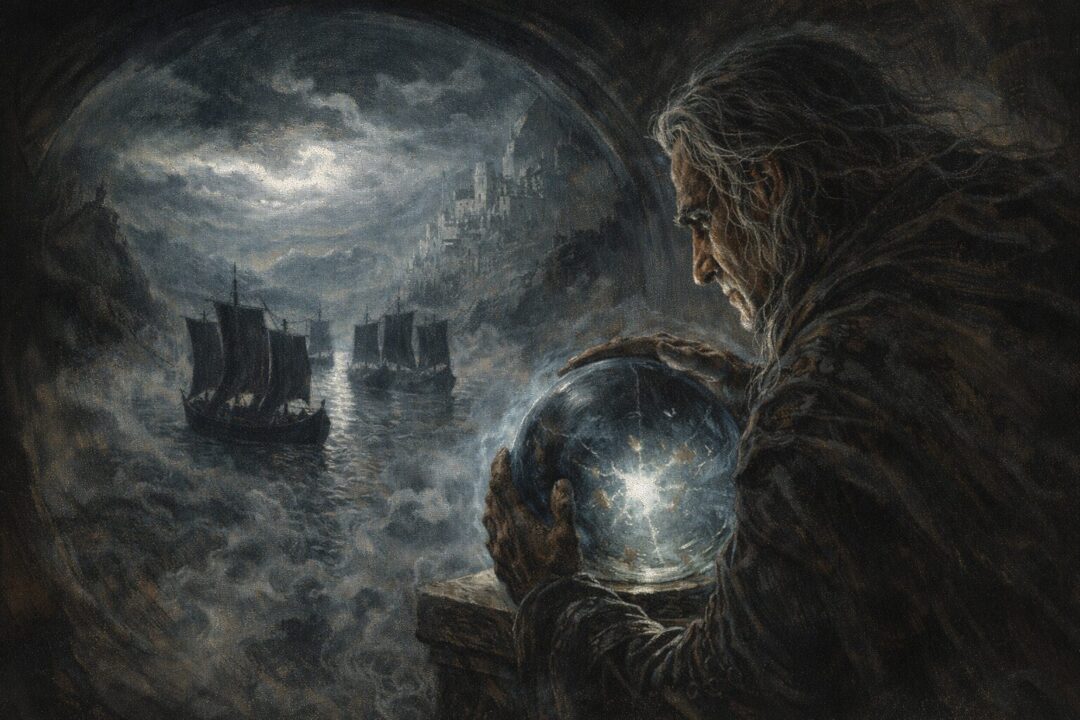
Denethor does not use the Stone as Saruman does. Saruman is effectively ensnared. Denethor is not described that way. Tolkien Gateway’s summary of the primary material notes that Sauron attempted to bend the Anor-stone to his will, but failed because of Denethor’s strength, integrity, and right to use it as Steward. The same tradition survives in Gandalf’s explanation after Denethor’s death: Denethor was too great to be simply subdued, but he saw only those things that Sauron allowed him to see.
That distinction is everything.
Denethor is not conquered in the crude sense. His mind is not replaced. He is not turned into a puppet. What happens is more subtle, and much more intelligent. He sees genuine things, but not the whole truth in proper proportion. The palantír does not lie to him. Rather, the enemy controls the frame. Denethor is shown power, numbers, threat, movement, danger, and apparent inevitability. He is shown the real might of Mordor—and that is enough.
This is why calling him “just mad” misses the point.
Madness suggests confusion, delirium, a break from reality. Denethor’s problem is almost the reverse. He is attached to reality in a way that becomes spiritually fatal. He sees too much of the war as measurable power: armies, fleets, siege, attrition, the exhaustion of Gondor, the gathering of the East. If you look only at those things, despair becomes rational.
The text in the Appendix says something devastating about him: his pride increased together with despair, until he saw in all the deeds of that time only one contest—the struggle between the Lord of the White Tower and the Lord of Barad-dûr—and he mistrusted all others who opposed Sauron unless they served him alone. That is one of the clearest diagnoses Tolkien gives any character. Denethor’s mind narrows. The war becomes personalized. He cannot properly value help he does not control.
So the tragedy is not that Denethor stops thinking.
It is that he thinks within a prison.
Everything is reinterpreted through pride, stewardship, rivalry, and possession. Gandalf becomes suspect. Aragorn becomes threatening. Hope looks like naivety. Secrecy looks like manipulation. Counsel looks like encroachment. By the time the crisis comes, Denethor is still highly perceptive in some ways, but his perceptions are ordered by despair.
That also helps explain one of the most painful details in his character: Faramir.
Denethor clearly loves his sons, but he does not love them equally or healthily. Boromir is the son he understands instinctively: martial, direct, publicly admirable, easy to imagine as the extension of Gondor’s military strength. Faramir is more difficult for him—not because Faramir is lesser, but because he resembles qualities Denethor has trained himself to distrust: subtlety, inwardness, gentleness, closeness to Gandalf, and a mind that is not ruled by power alone. The books do not say Denethor feels this in exactly those terms, so this part is interpretation. But the textual pattern is clear: Boromir draws his preference; Faramir often receives his disappointment.
Then Boromir dies.
That loss matters more than readers sometimes allow. Denethor is already burdened by rule, by grief, and by the long strain of using the Stone. Boromir’s death removes not only his elder son, but the future he had emotionally invested in. When Faramir is later brought back from battle seemingly beyond recovery, the emotional architecture of Denethor’s life collapses almost all at once.
Still, even here, the text keeps him frighteningly coherent.
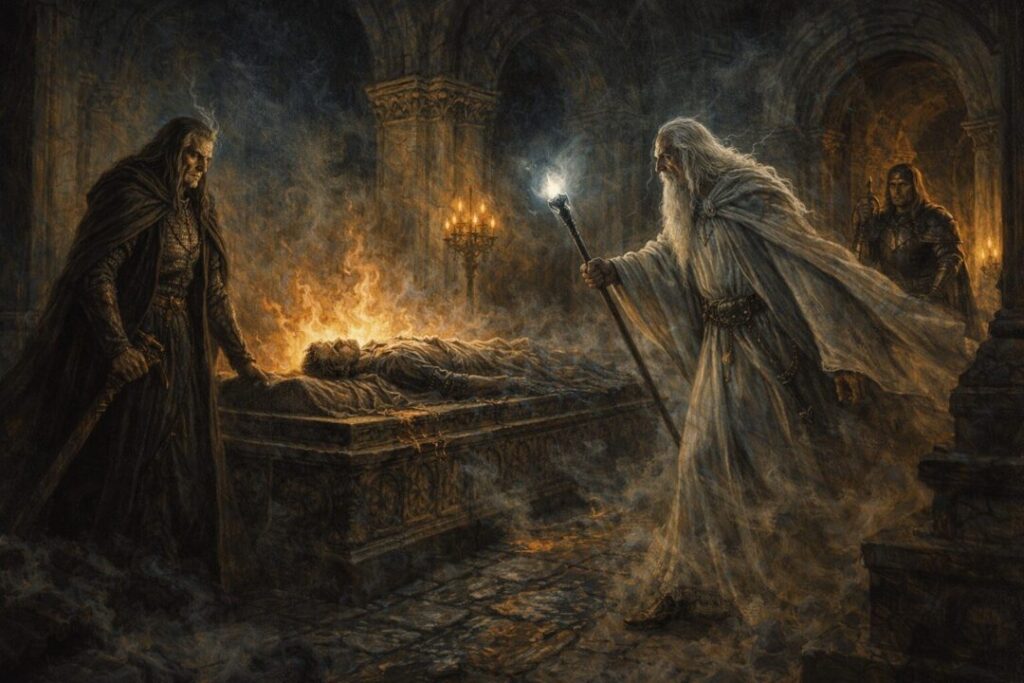
In “The Pyre of Denethor,” he does not babble aimlessly. He argues. He accuses. He produces the palantír. He points to the black ships and interprets them as proof that all is lost. He resists Gandalf’s authority in explicitly political terms. He speaks as a man making conclusions—even terrible ones—not as a man who has fallen into nonsense.

And those conclusions are fed by one final cruelty of the Stone.
The black ships are real. The threat is real. What Denethor cannot see is the hidden turn: that Aragorn has taken the Corsair fleet and is coming not as conqueror, but as aid. This is classic palantír logic. The image is true; the meaning drawn from it is false because the viewer is denied the larger context. Denethor perishes on the edge of rescue.
That is why the book version is worse than “madness.”
He is not reduced to a caricature of insanity. He is a proud and intelligent ruler gradually brought to a state where despair feels like clear sight. He mistakes partial truth for total truth. He mistakes strategic realism for final wisdom. He mistakes his inability to see hope for proof that hope does not exist.
In Tolkien’s moral world, that is a deep failure—but not a stupid one.
Denethor’s opposite in these chapters is not a more informed character. It is a more humble one. Gandalf does not know every outcome. Aragorn does not command every variable. The captains of the West do not possess certainty. What they refuse is not ignorance, but despair. Gandalf even says he gives no counsel to those who despair. The line is not anti-reason. It is anti-finality. Denethor believes he has seen enough to close the case. The wise continue acting because they know they have not.
So was Denethor mad?
By the end, the text certainly allows the language of a mind overthrown. Gandalf says the vision shown to him fed the despair of his heart until it overthrew his mind. But that overthrow comes at the end of a much more complex process. Denethor is not “just mad.” He is spiritually and intellectually cornered by pride, grief, selective truth, and the inability to imagine victory except on his own terms.
That is what makes him one of the darkest figures in The Lord of the Rings.
Not because he sees nothing.
Because he sees enough to lose hope—and not enough to be saved by it.
Sources & Notes
- J.R.R. Tolkien, The Lord of the Rings, Book V, Chapter 1, “Minas Tirith” — Pippin’s first sight of Denethor stresses his lordly, almost wizard-like presence, supporting the article’s point that his fall is tragic because he is formidable, not foolish.
- J.R.R. Tolkien, The Lord of the Rings, Appendix A, “Gondor and the Heirs of Anárion” — gives Tolkien’s clearest summary of Denethor’s pride, wisdom, far-sight, use of the palantír, and the way despair narrowed his judgment.
- J.R.R. Tolkien, Unfinished Tales, “The Palantíri” — explains why Denethor, as lawful Steward and a man of great will, was not simply dominated by Sauron, though the Stone could still be used to show him selective truths.
- J.R.R. Tolkien, The Lord of the Rings, Book V, Chapter 4, “The Siege of Gondor” — shows Denethor’s grief, harshness toward Faramir, and increasingly despairing political reading of Gondor’s situation before the final collapse.
- J.R.R. Tolkien, The Lord of the Rings, Book V, Chapter 7, “The Pyre of Denethor” — the palantír, the black ships, Gandalf’s judgment, and Denethor’s own arguments make the end a case of despair fed by partial truth rather than simple madness.