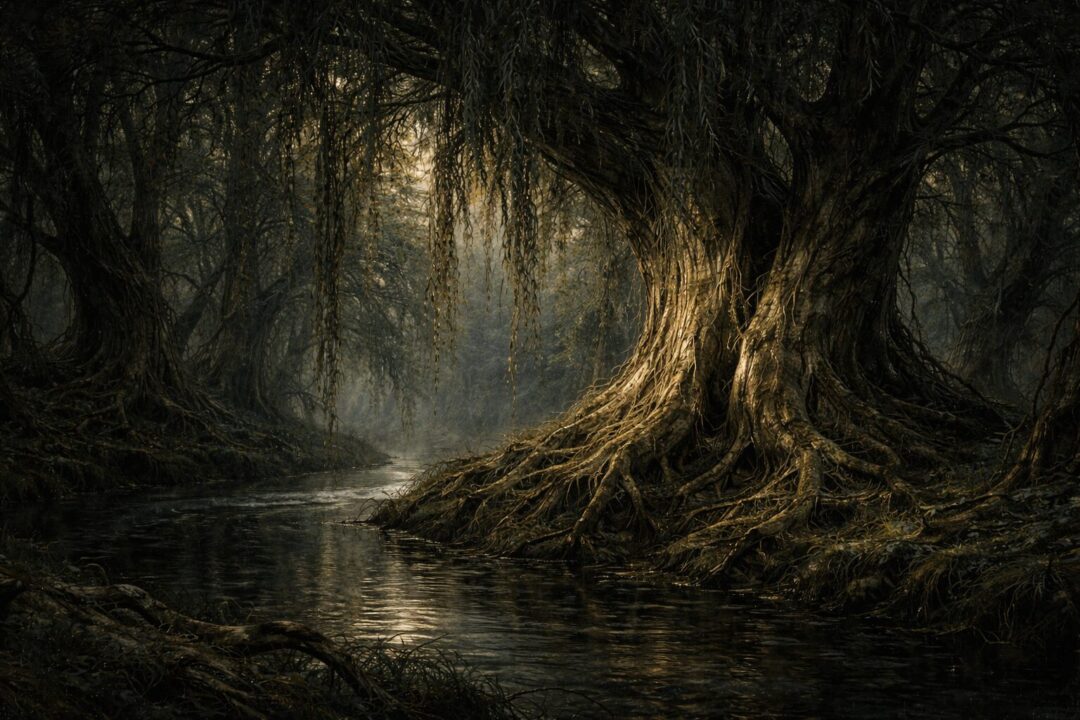
The Old Forest feels small when you first hear about it.
A dark wood on the edge of Buckland. A place Hobbits avoid. A dangerous shortcut that Frodo and his companions should never have taken.
But that first impression shrinks it too much.
Because the Old Forest is not important merely as a scary patch of trees near the Shire. It matters because the texts present it as a surviving remnant of something far older: the ancient forests that once covered much of Eriador before the land was cut back, settled, and divided.
That changes the scale at once.
The Old Forest is not simply near Hobbit-country. It is older than Hobbit-country. Older than the Shire itself. Older, in practical terms, than all the domestic order Hobbits later built around it.
And that creates the real puzzle.
If the Forest was already old, uncanny, and openly feared, why did Hobbits settle nearby anyway?
The Old Forest was once part of something much larger
The clearest starting point is size.
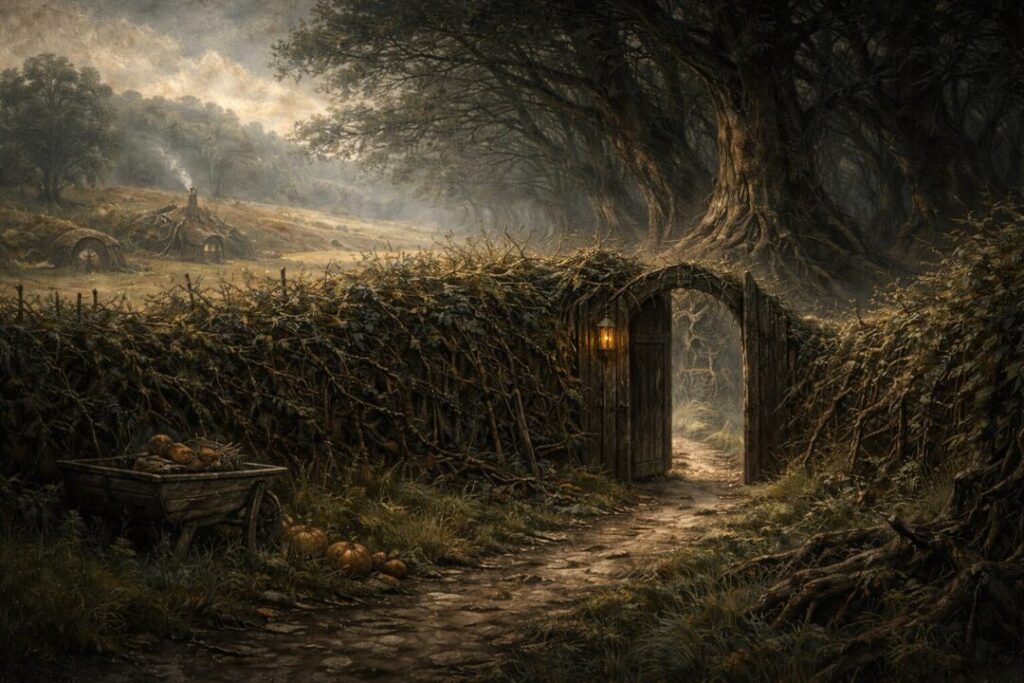
By the late Third Age, the Old Forest is only a remnant. The narrative and supporting material make plain that it is what survived of far more extensive woods that had once spread across the region. In other words, before the Shire existed, before Hobbits crossed into that land and organized it into fars, fields, and villages, this part of Eriador was much more heavily wooded.
The Old Forest is therefore “old” in more than one sense.
It is old because the trees are ancient. But it is also old because it belongs to an earlier landscape, one not yet reduced into the quieter, managed geography readers usually associate with the Shire.
That matters because it explains why the Forest feels so different from ordinary woodland.
It is not described as a place recently grown wild. It feels leftover.
A survival.
Something that remained when the rest had been cut away.
Before the Shire, it was a borderless piece of the old world
When readers imagine the Old Forest, they often picture the later map: Buckland to the east of the Shire, the Brandywine River, the Hedge, the Hay Gate, and the Forest pressed into a defined corner.
But that order comes late.
Before the Shire was founded, there was no Hobbit border here. No Buckland. No protective hedge. No settled Hobbit communities treating the trees as a dangerous neighbor.
What we can say with confidence is simpler and stronger: the Forest existed before Hobbit settlement imposed that neat frontier.
That means the Old Forest was not originally “the wood beyond Buckland.” It only became that later.
Before then, it was just part of the land itself—an older, darker continuation of the natural world that Hobbits would eventually try to contain.
This is one reason the later hostility of the Forest matters so much. The trees are not reacting to an ancient, neutral landscape. They are reacting within a place that has been pushed back.
The Forest, by the time Hobbits know it, has already lost ground.
The texts present the Forest as hostile—and unusually aware
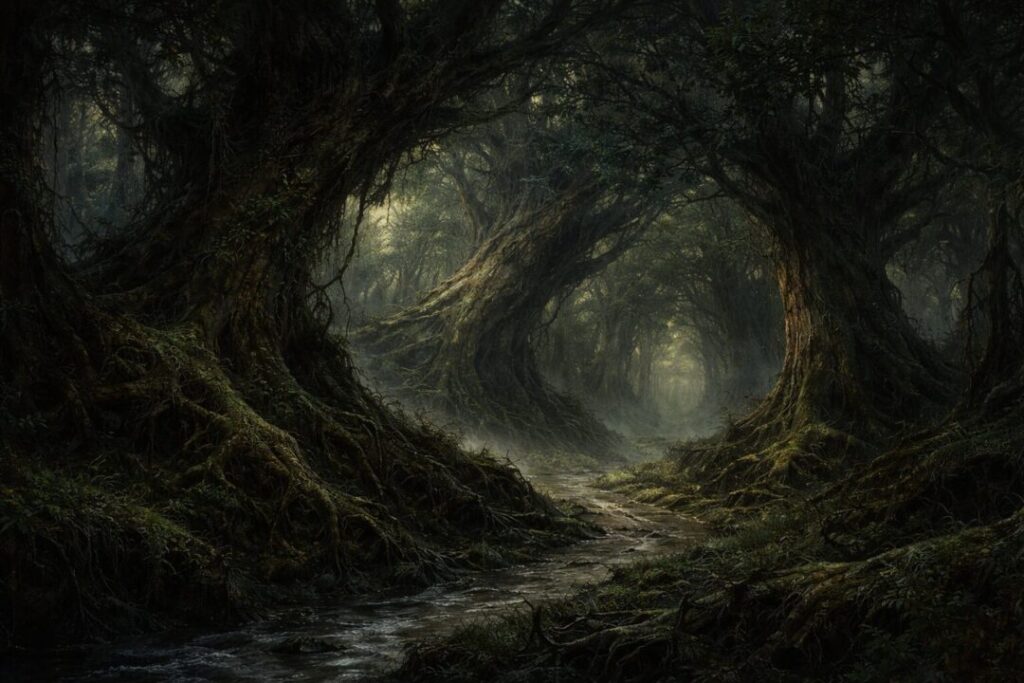
The Old Forest is not merely gloomy. The text of The Fellowship of the Ring presents it as active.
Trees seem to lean over the path. Trails do not behave helpfully. The wood appears to work against travelers rather than merely confuse them. Most strikingly, Bucklanders believe the trees are hostile, and the narrative quickly gives readers enough evidence to see that this is not just rustic superstition.
The best-known sign of that hostility is Old Man Willow, but he should not be reduced to the whole meaning of the place.
Old Man Willow is important because he embodies the deeper strangeness of the Forest. He is not introduced as a random monster living there. He feels native to it, deeply rooted in its mood and memory. The text suggests he is ancient, and that he has a malign power over much of the wood around him. Yet even here the writing is careful. We are not given a full origin story, nor a complete explanation of what kind of being he is.
That restraint matters.
The Old Forest is stranger because it is not fully explained.
The text gives presence, hostility, memory, and age—but not a tidy system.
Why the Forest hated Buckland
One of the most important details in the whole discussion is easy to miss.
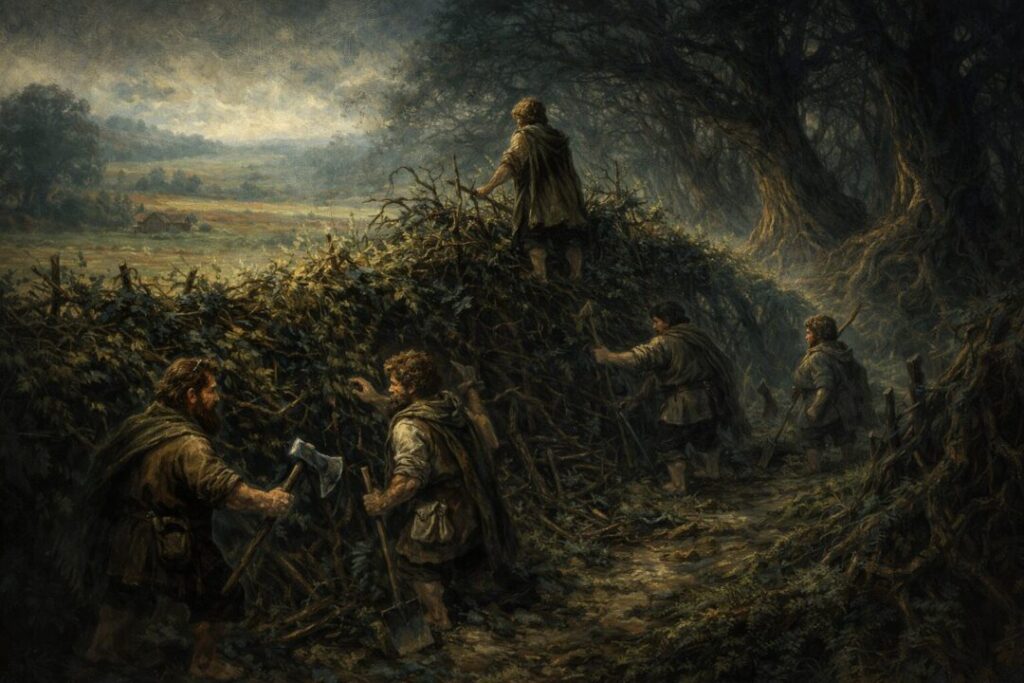
The Forest’s hostility is not presented as arbitrary. The Bucklanders believe the trees dislike them because Hobbits cut many down and burned others long ago. Whether one calls that a folk explanation or a real explanation, the narrative strongly supports the idea that there is a history of conflict between settlement and forest.
That makes the later Hedge suddenly much more meaningful.
The hedge was not ornamental. It was defensive. Bucklanders planted and maintained it to keep the Forest from encroaching. A gate remained in it, but the existence of the barrier itself tells you everything about the relationship.
This was not a peaceful boundary between farmland and woodland.
It was a line held against something regarded as threatening.
And from the Forest’s side, if the Bucklanders were right, the hostility had memory behind it. The trees did not merely stand near Hobbit-settlement. They remembered being attacked, reduced, and fenced out.
That does not make the Forest morally simple. But it does make it historically interesting.
So why settle there anyway?
This is the central question, and the safest answer is also the best one.
Hobbits did not settle near the Old Forest because they trusted it. They settled there because Buckland was still good land.
Buckland lies east of the Brandywine, and the land was fertile enough to support habitation. The Hobbits who moved there were notably more adventurous than most of their kin, which matters a great deal. The settlement of Buckland is linked with a bolder strain of Hobbit character, especially in the Brandybuck line.
In other words, the people who settled nearest the Forest were not average Shire-hobbits in temperament.
They were the sort most willing to live at an edge.
That helps explain the apparent contradiction. The Old Forest was dangerous, but danger did not cancel the value of the land beside it. Instead, Hobbits answered danger with boundaries, watchfulness, and local custom. They built the Hedge. They limited contact. They kept the Forest on the wrong side of a line.
So the question is not really “Why would anyone live there?”
It is “Why would these Hobbits live there?”
And the answer seems to be: because the land was worth having, and because some Hobbits were bold enough to take it if they could make it safe enough.
Buckland was never quite the same as the rest of the Shire
Once you see that, Buckland changes.
It is not simply another pleasant district of Hobbit-country. It is the Shire’s edge-country. It is settled, domestic, and recognizably Hobbit, but it remains closer than most of the Shire to the older, stranger landscape beyond.
That is why Bucklanders have a slightly different reputation. They are still Hobbits, but they are portrayed as more accustomed to odd borders, river-crossings, and local dangers. The very existence of the Hay Gate tells you that, unlike most Hobbits, they had a regular named point of relation with a hostile wilderness.
The Forest was part of life there, even when avoided.
That also helps explain why the Old Forest matters narratively. Frodo’s passage through it is not a random fantasy detour. It is the moment when the comfortable world of Hobbit domesticity gives way to something much older—something the Shire has bordered for generations without mastering.
The Old Forest shows that the Shire was never as separate as it seemed
Readers often treat the Shire as a kind of sealed world, cut off from the deeper and darker patterns of Middle-earth until the War of the Ring breaks in.
But the Old Forest complicates that.
The ancient world was already there.
Not far away. Not in Mordor. Not across the Misty Mountains.
Right beside Hobbit-settlement.
That is one reason the Forest is so effective. It reveals that the peace of the Shire is real, but it is also local. It has been made, guarded, and bordered. It exists next to places that do not share its order at all.
The Old Forest is one of the clearest examples of that truth.
It is not evil in the same way Sauron is evil. The text does not flatten it into that kind of enemy. But it is deeply unfriendly to ordinary Hobbit life, and it belongs to an older mode of Middle-earth—less settled, less legible, and more resistant to control.
What the Old Forest was before the Shire
So what was the Old Forest like before the Shire?
The most careful answer is this: it was likely not yet “the Old Forest” in the later Hobbit sense, because that name reflects its later position beside settled land. But it was already an ancient surviving woodland, part of the old forests of Eriador, long before Hobbits organized the region into the Shire.
It was older, broader in context, and not yet forced into the role of a hostile border-wood.
And yet, the later texts imply that even as a remnant it retained something ancient in mood and nature: memory, rootedness, resistance, and an unsettling will of its own.
That is as far as the evidence safely goes.
We should not invent a lost kingdom of sentient trees or pretend the texts give a full natural history of the Forest before Hobbit settlement. They do not.
What they do give is more suggestive than that.
They show us an old wood surviving into a later age, wounded by reduction, hostile to intruders, and pressed up against one of the most carefully domesticated societies in Middle-earth.
That is exactly why Hobbits settling nearby matters.
They did not conquer the Old Forest. They did not tame it. They did not understand it.
They simply built beside it anyway.
And perhaps that is the most revealing part of all.
The Shire is often remembered as a place apart from the ancient world. But Buckland proves otherwise. One of the oldest and strangest remnants of Eriador stood at its edge the whole time, just beyond a hedge, waiting like a memory that had never agreed to fade.
Sources & Notes
- J.R.R. Tolkien, The Lord of the Rings, Book I, Chapter 6, “The Old Forest” — presents the Forest as an active, hostile borderland beside Buckland, with shifting paths, oppressive trees, and Old Man Willow at its heart.
- J.R.R. Tolkien, The Lord of the Rings, Book I, Chapter 6, “The Old Forest” — gives Merry’s Buckland tradition that the trees hated Hobbits after earlier cutting and burning near the Hedge, grounding the article’s settlement-versus-forest conflict.
- J.R.R. Tolkien, The Lord of the Rings, Book I, Chapter 7, “In the House of Tom Bombadil” — frames the Old Forest as an ancient survival of older, wider woods, full of memory and not fully explained by ordinary Hobbit categories.
- J.R.R. Tolkien, The Lord of the Rings, Prologue, “Concerning Hobbits” — establishes the Shire’s settlement history and the later, distinctive position of Buckland east of the Brandywine under the Brandybucks.
- J.R.R. Tolkien, The Lord of the Rings, Book I, Chapter 5, “A Conspiracy Unmasked” — supplies the immediate Buckland setting, including Crickhollow near the High Hay and the sense that Bucklanders live on a more exposed edge than most Shire-hobbits.