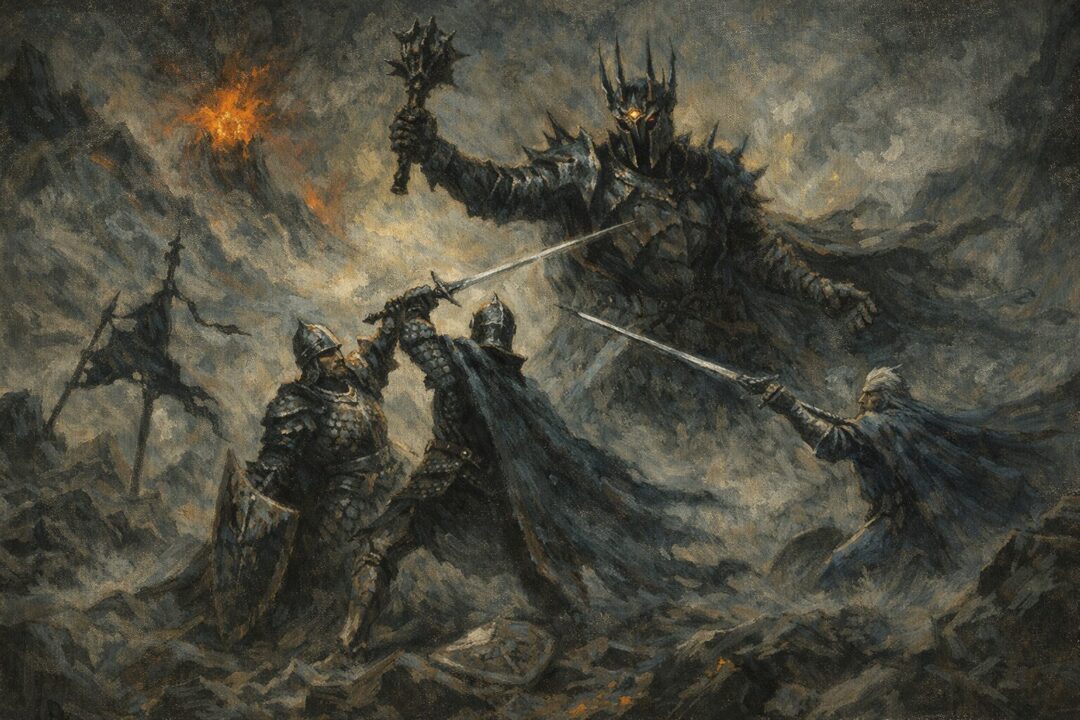
At first glance, Sauron’s absence from the battlefield during the War of the Ring feels almost disappointing. Earlier ages of Middle-earth present him as a being who fought openly and directly: a Dark Lord who stood against kings, shattered alliances, and personally slew some of the greatest heroes the world had ever known. In the Second Age, Sauron walked openly among Elves and Men, and at the war’s end he came forth himself to battle Elendil and Gil-galad on the slopes of Orodruin.
Yet in The Lord of the Rings, Sauron never appears in person. His presence is everywhere—looming, oppressive, and terrifying—but his body is nowhere to be seen.
This was not an oversight, a limitation of the story, or a missing scene. It was a deliberate and deeply meaningful choice, fully aligned with Tolkien’s philosophy of power, corruption, and evil.
Sauron Had a Physical Body—and It Was a Risk
One of the most persistent misconceptions about Sauron is that he had no physical form during the War of the Ring, existing only as a disembodied “Eye.” Tolkien himself corrected this idea.
By the late Third Age, Sauron did possess a body—one that was hideous, terrifying, and marked by his long corruption. Gollum confirms this after his capture in Mordor, describing Sauron’s hand as having only four fingers, missing the one severed along with the One Ring at the end of the Second Age.
But having a body meant something crucial: vulnerability.
Every time Sauron had committed himself physically in the past, disaster followed. When Númenor was destroyed, his body perished in the cataclysm. When he faced Elendil and Gil-galad, he won the duel—but lost the Ring, the very foundation of his power in Middle-earth. That single loss crippled him for an entire age.
By the Third Age, Sauron had learned restraint.

Experience Had Taught Him the Cost of Exposure
Sauron was not reckless. He was ancient, patient, and deeply shaped by failure. Unlike Morgoth, whose pride drove him to constant personal confrontation, Sauron adapted.
Tolkien makes clear that Sauron’s strength lay not in heroic combat but in organization, control, and domination. He was a master of systems: armies, hierarchies, fortresses, fear. Each time he exposed himself as an individual combatant, he risked everything on a single outcome. And once again, he would be risking the Ring itself.
To Sauron, the War of the Ring was not a duel to be won—it was a process to be managed.
Power in Tolkien Is Not About Duels
One of the central themes of Tolkien’s legendarium is that true power is not found in physical dominance alone. Strength of arms matters, but it is always secondary to will, influence, and moral choice.
Sauron embodied this principle in a twisted form. His greatest strengths were not his ability to swing a weapon, but:
- His command of vast, disciplined armies
- His mastery of fear and despair
- His manipulation of allies and enemies alike
- His domination through the One Ring
By remaining in Mordor, Sauron could direct the war like a vast machine. His forces moved on multiple fronts. His lieutenants—Nazgûl, captains, and corrupted servants—executed his will without hesitation. No single battle could undo him.
Stepping onto the battlefield would have reduced Sauron to a single point of failure. If he fell, everything would fall with him.
Barad-dûr as the Center of Control
Sauron’s power was bound to Barad-dûr and to the land of Mordor itself. From there, he could exert constant pressure across Middle-earth, shaping events through terror, deception, and sheer inevitability.
Leaving Mordor would have meant abandoning the position of maximum leverage. It would have invited risks with no meaningful reward. From Sauron’s perspective, there was no reason to fight personally when victory already appeared assured.

The Palantíri and the Illusion of Omniscience
One of Sauron’s most effective tools was psychological rather than military: the palantíri.
Through his mastery of the seeing-stones, especially in his contest of wills with Saruman, Sauron cultivated the illusion that he saw everything. This illusion crushed resistance before swords were even drawn. Many believed opposition was pointless, because the Enemy already knew their plans.
Ironically, this illusion also blinded Sauron himself.
Believing his vision to be nearly complete, he never questioned its assumptions.
Why Sauron Misjudged His Enemies
Sauron believed that all meaningful resistance would follow familiar patterns:
- A great lord would claim the Ring
- A rival power would challenge him directly
- Armies would clash in a final confrontation
These assumptions were logical—because they were exactly what he would have done.
But Sauron could not imagine a strategy built on humility, self-denial, and destruction rather than domination. His worldview made such a plan literally unthinkable.
Why He Never Expected the Ring to Be Destroyed
This is the single most important reason Sauron never left Mordor.
Tolkien explicitly states that Sauron could not conceive of anyone willingly destroying the Ring. Power, once obtained, must be used. That belief was foundational to his identity.
Thus, he watched the wrong places:
- He feared Minas Tirith
- He feared a rival Ring-lord
- He feared open military challenge
He did not fear Hobbits.
He did not fear smallness.
He did not fear mercy.
The Fatal Certainty
From a strategic standpoint, Sauron’s choices were sound. Remaining in Mordor minimized risk, maximized control, and aligned perfectly with every historical lesson he had learned.
His downfall was not cowardice, nor passivity, nor weakness.
It was certainty.
He was so confident in his understanding of power that he never considered another way. While his Eye searched the battlefield and the halls of kings, Frodo Baggins and Samwise Gamgee walked unnoticed toward the place where his power could be unmade.
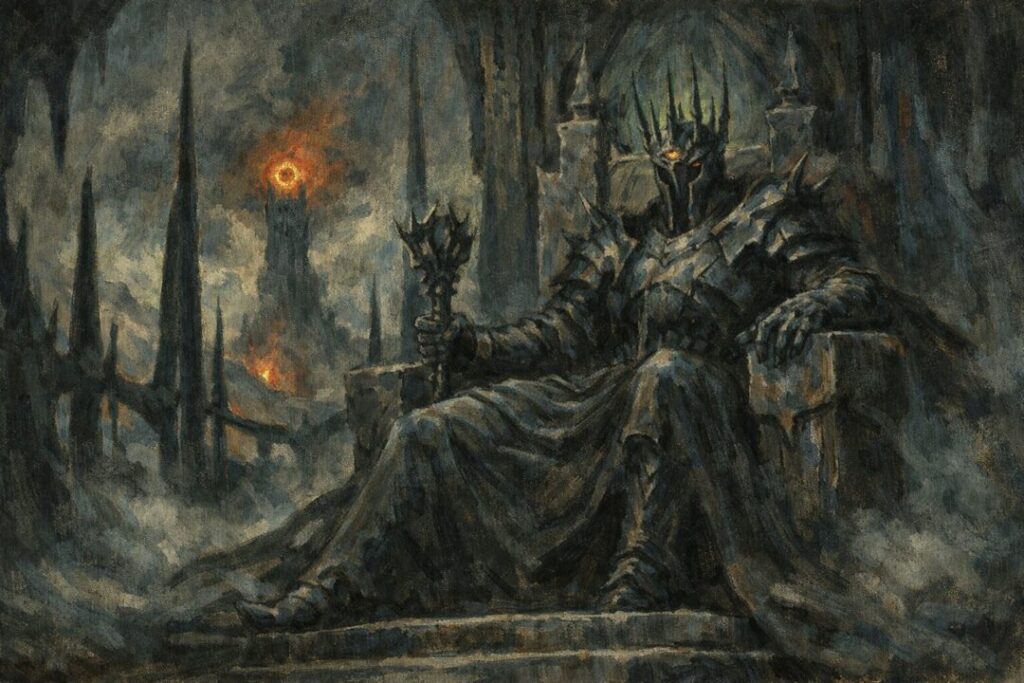
Why Sauron Never Marched Out to Fight
Sauron never appeared on the battlefield because he believed he didn’t need to.
From his perspective, the war was already won. The only remaining task was consolidation. Leaving Barad-dûr would have been unnecessary, even foolish.
And in that belief lay his undoing.
That is why Sauron never marched out to fight.
And that is why he lost.
Sources & Notes
- J.R.R. Tolkien, The Lord of the Rings, Book IV, Chapter 3, “The Black Gate is Closed” — Gollum’s memory of Sauron’s four-fingered black hand supports the point that Sauron still had a physical form, not merely an abstract Eye.
- J.R.R. Tolkien, The Silmarillion, “Of the Rings of Power and the Third Age” — Sauron personally comes forth against Gil-galad and Elendil, wins at terrible cost, and loses the One Ring when Isildur cuts it from his hand.
- J.R.R. Tolkien, The Silmarillion, “Akallabêth” — the Downfall of Númenor destroys Sauron’s fair bodily form, giving background for why open self-exposure had repeatedly proved costly.
- J.R.R. Tolkien, The Lord of the Rings, Book V, Chapter 9, “The Last Debate” — Gandalf explains that Sauron expects a rival Ring-lord and cannot imagine the West trying to destroy the Ring.
- J.R.R. Tolkien, The Letters of J.R.R. Tolkien, Letter 131 — Tolkien describes Sauron’s evil as order, planning, and domination, matching the article’s emphasis on control rather than battlefield heroics.