Aragorn is one of the clearest examples of how a familiar version of a character can quietly replace the one actually on the page.
Many readers come to him expecting a hero defined by hesitation: a man burdened by lineage, doubtful of the throne, uncertain whether he should become king at all.
But that is not quite how the book presents him.
In The Lord of the Rings, Aragorn’s tension is not built around rejecting kingship. It is built around bearing it long before the world is ready to receive it. The difference matters, because it changes his entire arc from one of personal acceptance into one of restraint, timing, and proof.
Aragorn is not fleeing his inheritance
The first thing the text makes clear is that Aragorn already knows exactly who he is.
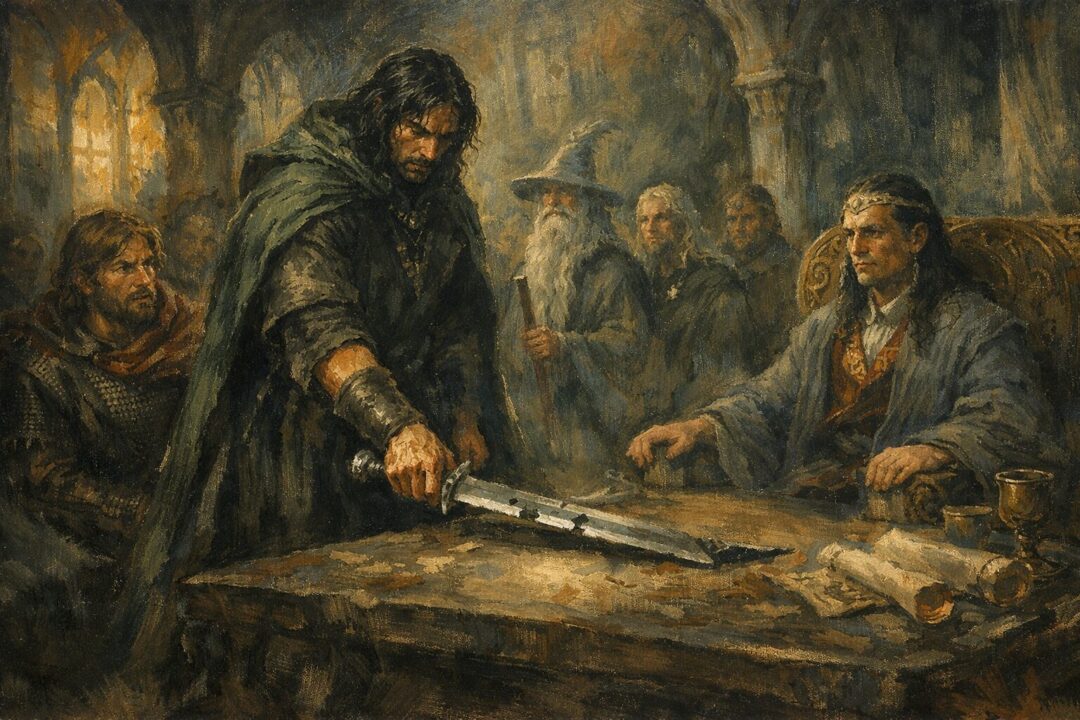
At the Council of Elrond, he does not hide forever behind “Strider.” When Boromir speaks of the dream about the Sword that was Broken, Aragorn stands and casts that sword before the council. He identifies himself through the heirloom of Elendil’s house, and the whole moment is framed as revelation, not avoidance.
Appendix A pushes this even further. Aragorn’s love for Arwen is explicitly tied to restored kingship. Elrond tells him that Arwen shall not be the bride of any Man less than the King of both Gondor and Arnor. That does not create a last-minute ambition in Aragorn. It confirms that kingship has stood before him for years as both burden and hope.
So when people call book-Aragorn “reluctant,” the word needs care.
He is not reluctant in the sense of refusing the role. The texts do not show a man trying to escape his bloodline or deny his right. They show a man who has accepted it so completely that he is willing to labor for it in obscurity, danger, and long delay.
His kingship begins long before the crown
One reason this gets missed is that Aragorn spends so much of the story without a throne.
But the absence of a crown is not the absence of a royal arc.
Appendix A describes years of service, wandering, and hidden labor. Aragorn fights for the Rohirrim and for the Lord of Gondor. He goes in many guises, wins renown under many names, and spends years opposing Sauron beyond the sight of most of the West. The point is not that he is avoiding his destiny. The point is that he is preparing for it in the only way possible: through endurance, knowledge, and tested leadership.
That history matters because it prevents his rise from feeling sudden.
By the time the War of the Ring begins, Aragorn is already the kind of man who can be king. He has command, lineage, memory, discipline, and the loyalty of others. What he does not yet have is the right moment.
That is a different kind of tension altogether.
“I must go down also to Minas Tirith”
One of the most revealing lines comes in The Passing of the Grey Company.
Aragorn says, “I must go down also to Minas Tirith, but I do not yet see the road.” That sentence is often treated as uncertainty. But the uncertainty is very specific. He does not question whether he is meant to go. He questions how he is to get there, and what path that calling will require.
The chapter reinforces that reading.
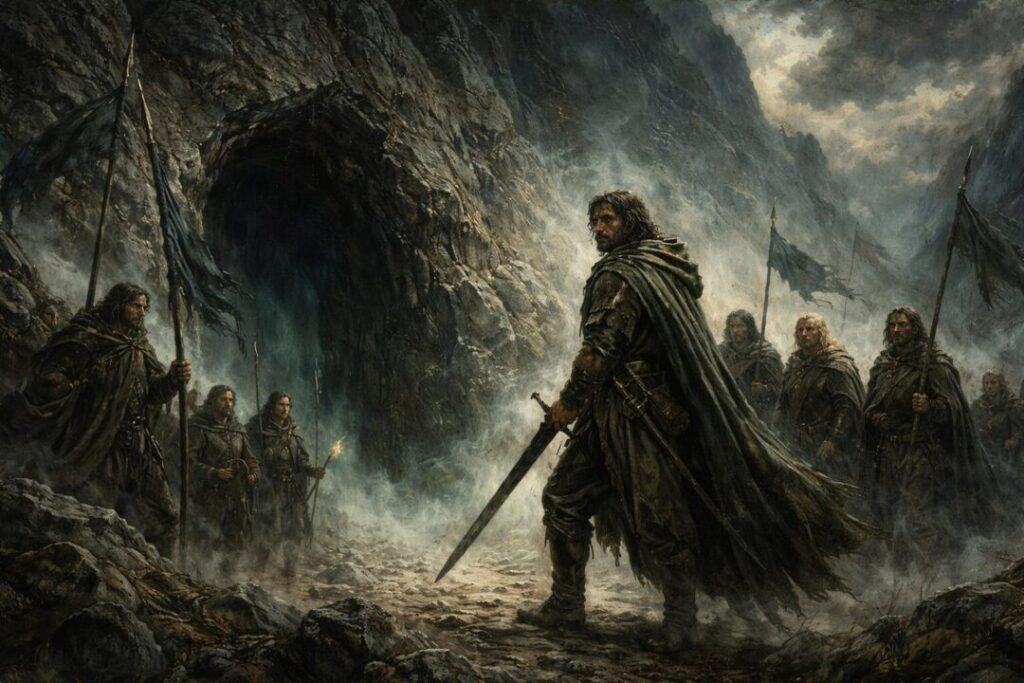
After using the palantír, Aragorn understands that a grave peril is coming against Gondor from the South. He does not retreat from that knowledge. He says, in effect, that because he has no help to send, he must go himself. Soon after, he chooses the Paths of the Dead, not because he is finally discovering courage, but because he is acting decisively as Isildur’s heir.
This is why the book version feels so different.
His road is dark, but his purpose is not.
The real “reluctance” is political and moral
The deepest misunderstanding of Aragorn comes later, when he reaches Minas Tirith.
If his story were simply about claiming what is his, this would be the obvious moment to enter the city, raise his banner, and take command. But that is exactly what he does not do.
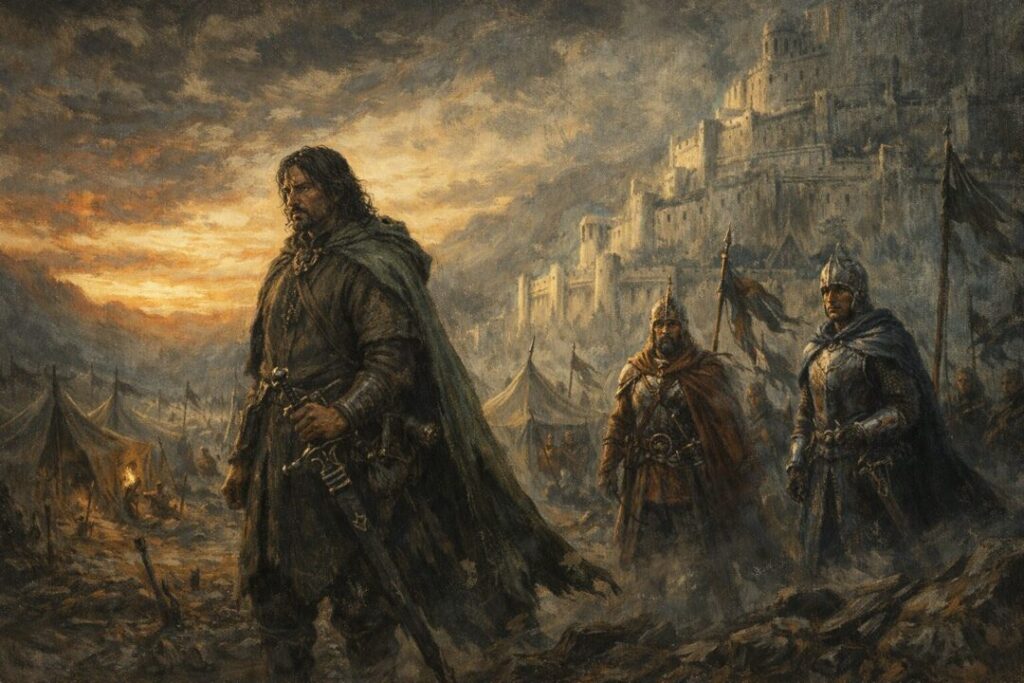
After the Battle of the Pelennor Fields, Aragorn says that the City and realm have long rested in the charge of the Stewards, and that if he enters unbidden, doubt and debate may arise at the very hour when the war is not yet ended. He says plainly that he will not enter the City or make any claim until it is seen whether the West or Mordor shall prevail.
That is not fear of kingship.
It is respect for Gondor’s order, its memory, and its political reality.
Aragorn knows that a rightful claim can still be mishandled. He knows Denethor is still Steward in all but name at that moment, that Faramir lies near death, and that public conflict over rule would be disastrous. So he does something more kingly than immediate possession: he refuses to turn necessity into opportunism.
This is where book-Aragorn becomes more interesting than a simpler “reluctant heir” pattern.
He is not shrinking from power. He is governing himself before he governs anyone else.
He is recognized before he is crowned
The Houses of Healing complete this pattern.
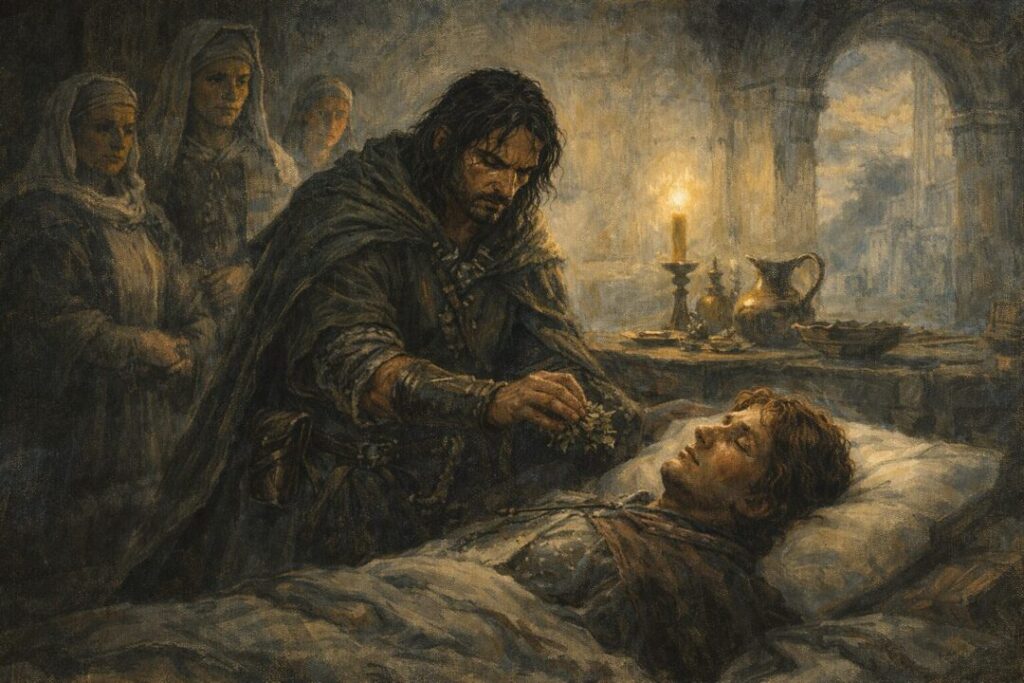
Aragorn enters the city quietly and in the guise of a Ranger. Then, before the formal crowning, the old lore of Gondor begins to work in his favor. Ioreth recalls that “the hands of the king are the hands of a healer,” and Aragorn’s healing of Faramir, Éowyn, and Merry turns rumor into recognition. The city begins speaking of the return of the king before the crown ever touches his head.
That sequence is important.
The text does not make kingship merely hereditary, nor merely military. Aragorn arrives by right of lineage, proves himself by leadership in war, and is recognized by restoration and healing. In other words, the book makes his kingship legible through service before ceremony.
That is why his delay at Minas Tirith is not a narrative pause. It is part of the proof.
He must not only be the heir of Elendil. He must appear as the kind of king Gondor has long lacked.
Why this changes his whole arc
Once you see this, Aragorn’s story stops being “Will he accept the throne?” and becomes “How does a rightful king return without becoming a usurper?”
That is a much richer question.
It explains why so much of his arc is built on patience. It explains why he can reveal himself boldly at Rivendell, yet hold back outside Minas Tirith. It explains why the prophecy of the Sword that was Broken matters, why the standard of Arwen matters, why the Paths of the Dead matter, and why healing matters. None of these are random heroic flourishes. They are stages in the restoration of a kingship that must be shown as just, timely, and beneficial to others.
It also changes the emotional shape of Aragorn’s character.
He is not waiting to become brave enough to be king. He is waiting for the world to reach the hour for which he has long prepared. That gives him a different kind of gravity. The sadness around him is real, the burden is real, and the cost is real, but none of that amounts to refusal. It is closer to disciplined endurance.
Aragorn’s restraint is part of his royalty
In the end, the book’s version of Aragorn is not less heroic than the more obviously conflicted one. He is, in some ways, more difficult and more impressive.
He has accepted his destiny long before the triumphant moments begin. He does not need the war to convince him who he is. What the war does is reveal whether he can carry that identity rightly.
And the answer the text gives is not found only in battle.
It is found in the man who goes where he must go, dares what only the heir of Elendil can dare, refuses to grasp the city before its hour, and lets Gondor begin to recognize its king through healing before enthronement.
That is why Aragorn’s “reluctance” works differently in the book.
It is not reluctance toward kingship.
It is reluctance to claim kingship wrongly.
And that changes everything.
Sources & Notes
- J.R.R. Tolkien, The Lord of the Rings, Book II, Chapter 2, “The Council of Elrond” — Aragorn openly identifies himself with the Sword that was Broken and the house of Elendil, making the scene a revelation of accepted identity rather than refusal.
- J.R.R. Tolkien, The Lord of the Rings, Appendix A, “The Tale of Aragorn and Arwen” — sets Aragorn’s long preparation, hidden service, and Elrond’s condition that Arwen may wed no Man less than the King of Gondor and Arnor.
- J.R.R. Tolkien, The Lord of the Rings, Book V, Chapter 2, “The Passing of the Grey Company” — “I must go down also to Minas Tirith” frames Aragorn’s uncertainty as a question of road and timing, not whether he should claim his inheritance.
- J.R.R. Tolkien, The Lord of the Rings, Book V, Chapter 8, “The Houses of Healing” — Aragorn refuses to enter Minas Tirith as claimant before the war is decided, then is recognized through healing and the lore of the king’s hands.
- J.R.R. Tolkien, The Lord of the Rings, Book VI, Chapter 5, “The Steward and the King” — Faramir and the people formally receive Aragorn, completing the article’s distinction between rightful kingship and grasping at rule too soon.