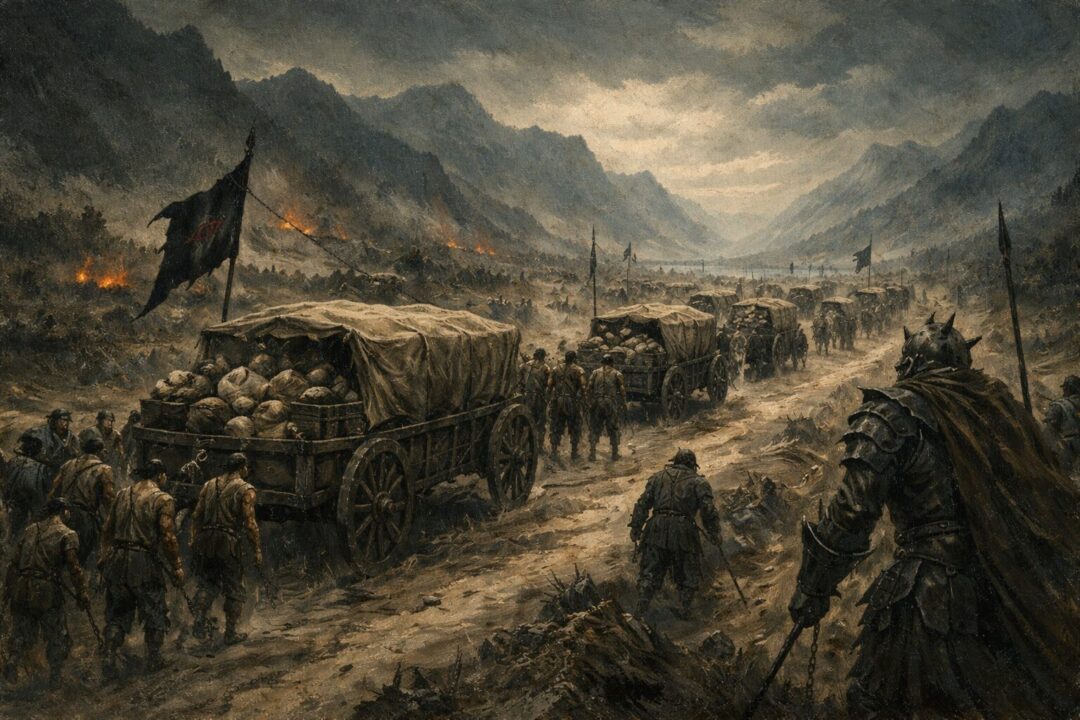
Mordor is easy to imagine in extremes.
Fire. Ash. Black rock. Fumes. Iron. Orcs.
It is the most visibly hostile landscape in The Lord of the Rings, and that visual force can make one detail easy to miss: an army the size of Sauron’s cannot exist on terror alone.
It has to eat.
That is what makes one brief passage in The Return of the King so important. It does not merely add a bit of background to Mordor. It quietly reveals that the Black Land is not just a hellish battlefield, but a functioning system of production, transport, and coercion. And once you see that, Mordor becomes stranger than before.
Mordor is not all the same land
Readers often remember Mordor as if it were one uniform wasteland.
That is understandable. Frodo and Sam’s journey is dominated by exhaustion, choking dust, and the sense that the land itself has been bent toward death. In the north especially, the text emphasizes the war-making face of Mordor: mines, forges, troop movements, and roads built for command and transport.
But the crucial passage in “The Land of Shadow” distinguishes between regions.
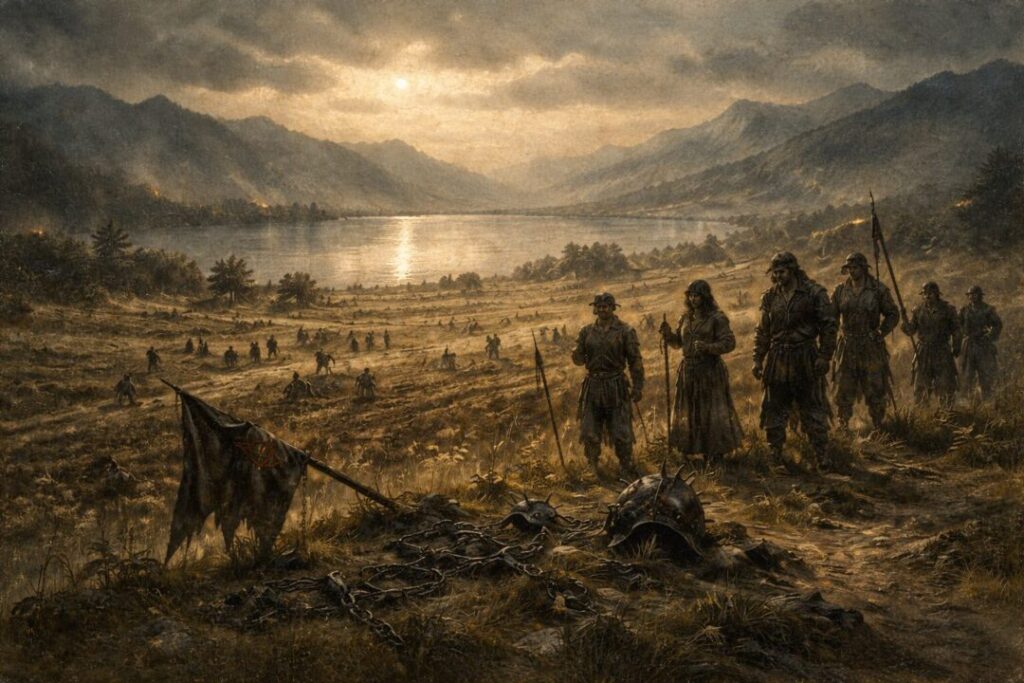
Frodo and Sam, we are told, know nothing of “the great slave-worked fields away south in this wide realm, beyond the fumes of the Mountain by the dark sad waters of Lake Núrnen.” They also know nothing of “the great roads that ran away east and south to tributary lands,” from which soldiers brought “long waggon-trains of goods and booty and fresh slaves.” Then the text contrasts this with the northward regions, where were “the mines and forges, and the musterings of long-planned war.”
That contrast matters.
North Mordor is the military-industrial zone.
South Mordor includes productive land.
The realm is not one texture repeated forever.
And that means the familiar image of Mordor—though true in part—is incomplete.
The canon answer is simpler than many readers expect
The strangest thing about Mordor’s army is not that there is some hidden magical explanation for how it was fed.
The text gives a practical one.
There were fields.
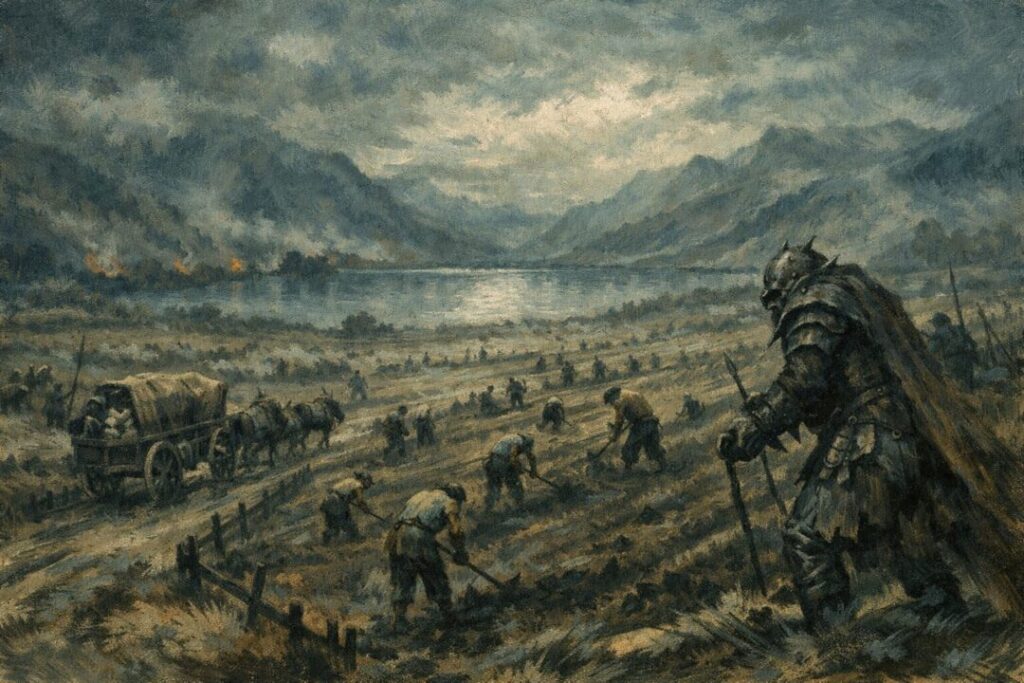
Not metaphorical fields. Not speculative fields. Not something fans inferred from maps alone. The narrative explicitly says there were great slave-worked fields in the south of Mordor.
That single detail does a great deal of work.
It explains how Mordor could support a large internal population.
It explains why the south mattered.
It explains why the realm required roads.
And it helps explain why the destruction of Sauron did not mean the land around Núrnen was worthless afterward.
In fact, the ending confirms the reality of those lands. In “The Steward and the King,” Elessar releases the slaves of Mordor and gives them all the lands about Lake Núrnen to be their own. This is not presented as giving them barren punishment-ground. It is the release of a laboring population into possession of the land they had been forced to work.
So if the question is, “How did Mordor stay fed at all?”
The first answer is: because Mordor was not feeding itself from Gorgoroth alone.
Núrnen changes how Mordor works
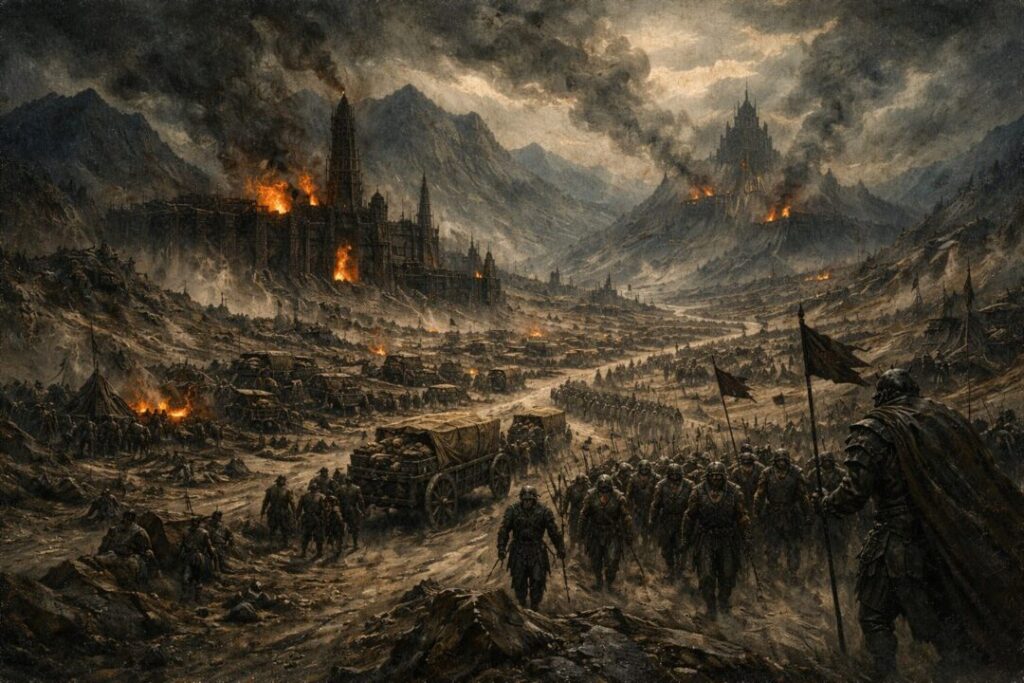
The common mental picture of Mordor is dominated by Barad-dûr, Orodruin, Cirith Gorgor, and the Morannon.
All of that belongs to the threatening northwestern face of the realm.
But Núrnen changes the scale of what Mordor is. It shows that Sauron’s power was not only concentrated in towers and armies. It extended into managed land, compelled labor, and internal provisioning. Tolkien Gateway’s summary, drawing on the Return of the King material, likewise identifies Nurn as the more fertile region of Mordor and notes that slaves worked there to feed Sauron’s armies.
That makes Mordor more than a fortress-state.
It is something closer to an extraction empire.
And that phrase fits the canon carefully, because the same passage that gives us the fields also gives us the roads to tributary lands. Goods, booty, and fresh slaves are being brought in along organized routes. So Sauron is not simply relying on whatever his own land can produce. He is drawing from subject regions beyond Mordor as well.
This is the part many readers do not expect.
The terror of Mordor is bureaucratic.
The real horror is logistical
Fantasy often presents evil armies as if they materialize fully armed out of darkness.
Mordor does not quite work that way.
The text makes room for the mundane structures that make mass violence possible: agriculture, roads, transport, labor, and command. Sauron moves armies “like pieces on the board,” but pieces on a board do not need bread. Real armies do. And the world of The Lord of the Rings, for all its grandeur, repeatedly remembers the burden of travel, food, distance, and supply.
That is why the Núrnen passage is so chilling.
It reveals that Sauron’s evil is not merely explosive or theatrical. It is organized over time.
Someone has to work those fields.
Someone has to guard the roads.
Someone has to move the wagon-trains.
Someone has to keep conquered lands paying into the center.
And the text tells us exactly who bears much of that burden: slaves.
Not willing subjects.
Not abstract labor.
Slaves.
So the army of Mordor is fed by a structure of domination that stretches well beyond the battlefield. That is a darker thought than simply imagining Orcs pouring out of black gates.
What the text does not say
This is also where restraint matters.
The passage does not tell us exactly what crops were grown around Núrnen.
It does not give production figures.
It does not lay out a tax code for Harad or Rhûn.
It does not describe a full administrative manual for Mordor.
So any attempt to reconstruct precise agricultural output goes beyond the text.
But we do not need those extra inventions to understand the main point. The canon gives us enough.
There were slave-worked fields in the south.
There were tributary lands connected by great roads.
There were wagon-trains carrying goods, booty, and fresh slaves.
There were mines, forges, and troop musterings in the north.
And after Sauron’s fall, the freed slaves received the lands about Lake Núrnen.
That is already a complete skeleton of explanation.
The details beyond that are best treated as inference, not certainty.
Why readers find this so surprising
Part of the surprise comes from perspective.
We mostly see Mordor through Frodo and Sam, and they experience its most desolate face. They are small, starving, hunted figures moving through the upper machinery of war. They do not tour the south. The narrative itself says they know nothing of those distant fields and roads.
So the reader naturally inherits their narrowed view.
That is a powerful narrative choice. It keeps the journey claustrophobic. But it also means the larger reality of Mordor is withheld until the text briefly opens outward and reminds us that this realm is wider than the two hobbits can see.
And that wider view is deeply unsettling.
Because the most frightening thing about Sauron’s strength may not be the Ringwraiths, or the Black Gate, or even the armies themselves.
It may be that behind all of them stands a durable system.
The ending proves the point
One of the strongest confirmations comes after the war.
If Núrnen were merely an incidental detail, it would vanish when Sauron does. Instead, the text returns to it indirectly through Elessar’s settlement. The slaves of Mordor are released and given the lands about Lake Núrnen.
That tells us two things.
First, those people were numerous and real enough to matter in the reordering after the war.
Second, the lands they worked were valuable enough to become the basis of their freedom.
So Núrnen is not just a footnote to Mordor’s geography. It is the place where the text reveals what sustained the Black Land—and, after Sauron’s fall, the place where one part of that machinery is broken and reversed.
The slaves do not simply disappear from the story.
They inherit the ground that fed their master’s armies.
Mordor was fed the way empires are fed
In the end, the strangest thing about Mordor’s army is not that it had food.
It is that the text quietly shows us how ordinary the mechanism is.
Fields.
Roads.
Wagons.
Tribute.
Forced labor.
That does not make Mordor less frightening.
It makes it more believable, and therefore worse.
Because the Black Land is not sustained by fire alone. It is sustained by system. The north makes war; the south feeds it; the roads connect them; and people under domination are consumed in the process.
Once you notice that, Mordor changes.
It stops being only a nightmare landscape.
And becomes what the text had already made it:
a realm built to turn land, goods, and lives into war.
Sources & Notes
- J.R.R. Tolkien, The Lord of the Rings, Book VI, Chapter 2, “The Land of Shadow” — explicitly contrasts northern Mordor’s mines, forges, and musterings with the slave-worked fields near Lake Núrnen and roads bringing goods, booty, and fresh slaves from tributary lands.
- J.R.R. Tolkien, The Lord of the Rings, Book VI, Chapter 5, “The Steward and the King” — after Sauron’s fall, Aragorn frees the slaves of Mordor and gives them the lands about Lake Núrnen, confirming the region’s real agricultural and social importance.
- J.R.R. Tolkien, The Lord of the Rings, map of Middle-earth and Book V, Chapter 10, “The Black Gate Opens” — Mordor’s position beside Khand, Rhûn, Harad, and the routes east and south fits the article’s point that Sauron drew on lands and peoples beyond Gorgoroth.
- J.R.R. Tolkien, Letter 131 — describes Sauron’s evil in terms of rule, ordering, and domination, supporting the reading of Mordor as a coercive system rather than merely a fiery battlefield.