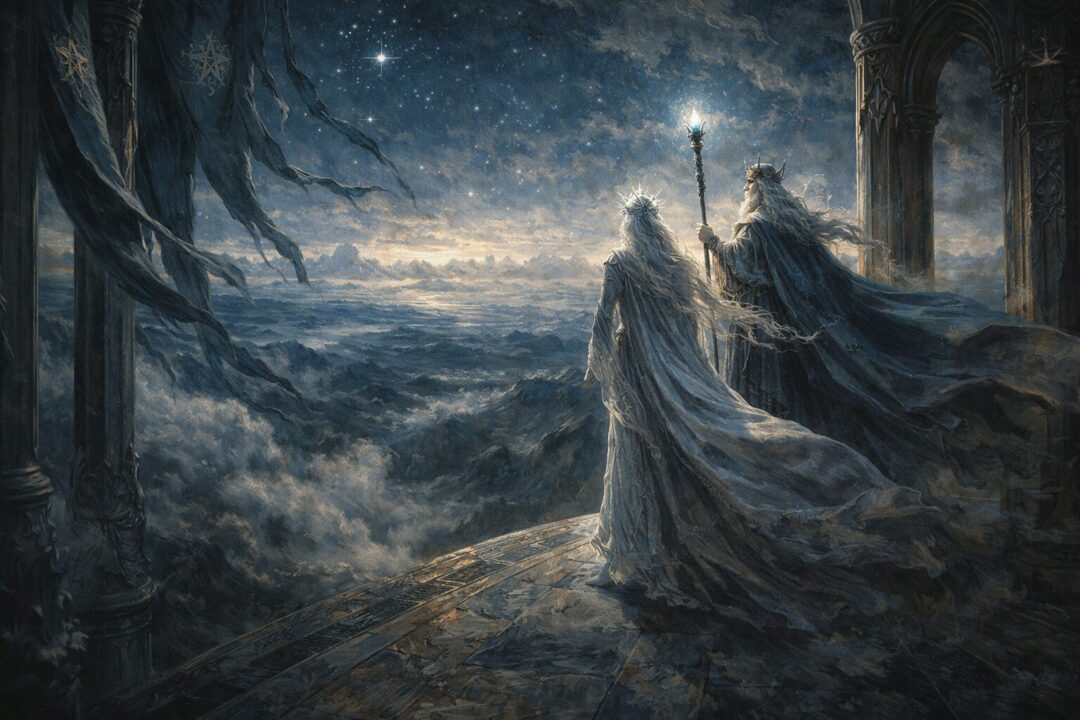
When readers first encounter the great powers behind the world of Middle-earth, Manwë can seem easy to classify.
He is the chief of the Valar. He dwells on Taniquetil with Varda. He commands the airs and winds. He is called the Elder King, the High King of Arda, and in some texts simply the King of the world.
And yet it is not.
Because the moment the title “King of Arda” is taken too literally, the whole structure of the legendarium starts to bend out of shape. Manwë is not the creator of Arda. He is not equivalent to Ilúvatar. He is not a god in the simple mythic sense of owning the world and all who live in it. The texts give him astonishing authority, but they also place that authority inside a larger order. Makes him so interesting.
Manwë Is the Chief of the Valar, Not the Source of the World
The first thing to understand is that Manwë belongs to the Ainur, the great spirits who existed before the making of the world.
Among those who entered Eä, he stands at the summit of rightful authority. The tradition preserved in the texts describes him as the one dearest to Ilúvatar in understanding, the one who knew most clearly the divine purpose, and the one appointed to rule Arda in the fullness of time. He is therefore called the Elder King.
Manwë is king because he is given kingship.
He does not seize it.
He does not generate it from himself.
And he certainly does not stand above the One who made the world.
That means the title “King of Arda” is already more limited than it sounds. It describes delegated rule within creation, not ultimate sovereignty over existence itself. In that sense, Manwë is best understood as the highest rightful governor within Arda, not as its absolute owner.
The title can also mislead readers into imagining that Manwë rules in the same way a mortal king rules a kingdom.
But the texts present something broader and stranger.
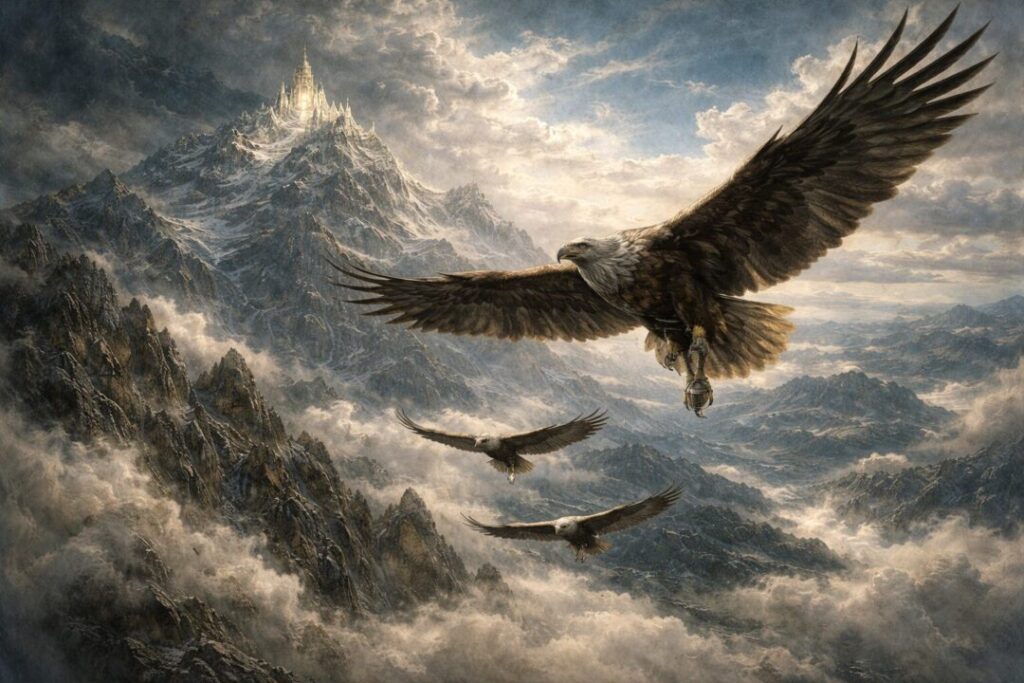
Manwë is lord of the airs and winds of Arda. He dwells with Varda in Ilmarin upon Taniquetil, the highest mountain in the world, and from there news comes to him by spirits in the forms of eagles and hawks. The image is not merely regal. It is cosmic. His authority is bound up with the ordering, watching, and guardianship of the world itself. “King of Arda” is not just a decorative title.
It means that among the Valar, Manwë is the chief center of lawful order against disorder. Melkor seeks domination. Manwë is appointed rule. One tries to possess the world by force; the other holds it in trust. That contrast is fundamental to how the Elder Days are structured. the title has boundaries.
Arda includes the world that the Valar entered and shaped, but the Children of Ilúvatar are not merely pieces inside their administration.
That distinction is easy to miss—and essential.
He Is King, but Not Master of Elves and Men
One of the most important lines in the tradition explains that the Valar are to Elves and Men “rather their elders and their chieftains than their masters.” That single statement changes the whole meaning of Manwë’s kingship. They are not masters of the Children, then Manwë’s rule cannot mean ownership over them in the crude sense many readers imagine.
He stands above them in wisdom, majesty, and authority within the world. He may summon, warn, judge, protect, and oppose the great evils that threaten Arda. But Elves and Men are not his to dominate. They belong to Ilúvatar in a way even the Valar do not override. quiet theological foundations of the legendarium.
The powers of the world are real.
Their hierarchy is real.
Manwë’s kingship is real.
But it is not unlimited.
The Children are never reduced to possessions of the Elder King. In fact, the same passage warns that when the Ainur try to force Elves and Men where they will not be guided, that seldom turns to good, even if the intent is good. So Manwë’s kingship is inherently restrained by the moral order of creation itself. Very different kind of king from Morgoth.
The Difference Between Manwë and Morgoth
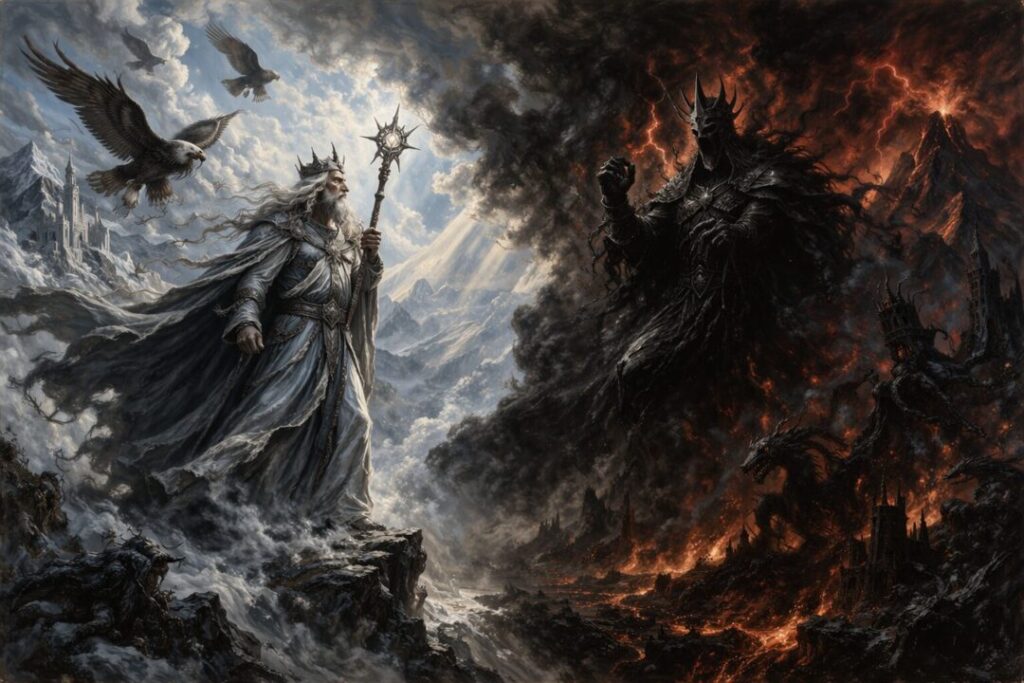
If Manwë represents rightful kingship, Morgoth represents its corruption.
This is not just a clash of powerful beings. It is a clash between two ideas of rule.
Manwë is appointed.
Morgoth usurps.
Manwë governs within the design of Arda.
Morgoth seeks to bend Arda into an extension of himself.
That distinction becomes clearer when later texts describe Manwë as the chief of the Valar and the Elder King, while Morgoth is the one who strives to become lord by domination and marring. Some traditions even preserve Morgoth’s attempt to claim the title of Elder King for himself, which only sharpens the contrast. Manwë “King of Arda,” they are not saying he is simply the strongest being in the world.
They are saying that his authority is rightful.
He is the legitimate ruler under the will of Ilúvatar, whereas Morgoth is the rebel who mistakes might for kingship.
That difference runs through the whole history of the Elder Days.
Why Manwë Often Feels Distant
There is another reason people misunderstand him.
Manwë does not usually appear in the direct, active way readers expect from a supreme ruler. He is not constantly riding into Middle-earth to settle crises by force. Even when his power is immense, his presence in the narrative often feels remote. He rules from Taniquetil. He sees broadly. He receives tidings. He governs at the level of world-order, not local episode. The Eagles themselves often function less like random miracle-creatures and more like signs of Manwë’s far-off but watchful authority.
The texts explicitly say that Manwë was free from evil and could not fully comprehend it, which helps explain one of his greatest errors: accepting Melkor’s apparent repentance too readily after his imprisonment. That detail matters because it shows that even the Elder King is not omniscient in the divine sense. He is exalted, but still a created being acting within limits.
It is part of what his office is.
He is not written as a constantly intervening despot. He is written as a high ruler whose task is to preserve order under a will greater than his own.
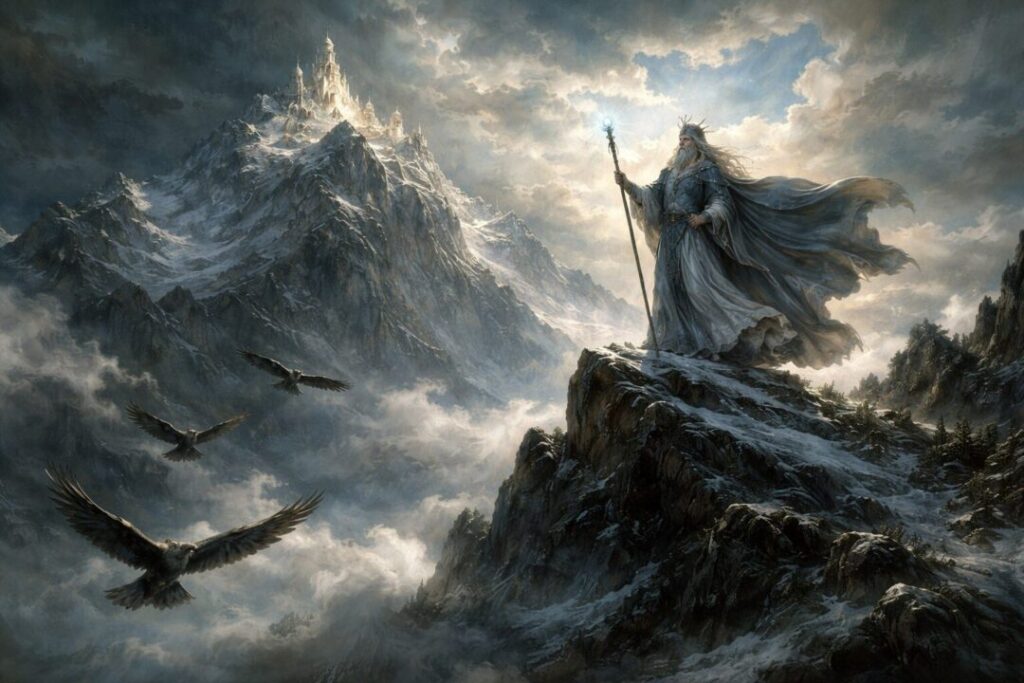
“King of Arda” Means Stewardship Under a Higher Throne
Once all of this is put together, the title becomes much clearer.
Manwë is truly king in Arda.
He is the chief of the Valar.
He is the highest lawful authority within the world.
He is the appointed ruler set against the rebellion of Melkor.
He is the Elder King. In the sense of ultimate possession.
His kingship is derivative.
Delegated.
Ordered.
Bounded.
It exists under Ilúvatar, and it does not cancel the unique status of Elves and Men as the Children. That is why the title sounds grander than it is if read carelessly, and deeper than it first seems if read closely.
He stands at the top of created authority within Arda.
That may sound like a small distinction, but it changes everything.
Why This Matters for Reading Middle-earth
The title “King of Arda” matters because it reveals how Middle-earth understands power.
True rule is not domination.
It is not possession.
It is not the right of the strongest to seize the world.
Manwë’s kingship is legitimate precisely because it is aligned with order beyond himself. Morgoth fails because he tries to make himself the center. Manwë remains king because he is not the center. Should not be flattened into something merely mythic and flashy.
It is one of the clearest signs that the structure of Arda is hierarchical without being arbitrary, majestic without being absolute, and ordered without collapsing into tyranny.
Manwë is not just “the god in charge.”
He is the Elder King because he is the highest servant of the world’s true order.
And once that is understood, the title stops sounding simple.
It starts sounding exact.
Sources & Notes
- J.R.R. Tolkien, The Silmarillion, "Valaquenta" — for Manwë as chief of the Valar, dearest to Ilúvatar, lord of the airs, and the Elder King dwelling on Taniquetil with Varda.
- J.R.R. Tolkien, The Silmarillion, "Of the Beginning of Days" — for the Valar’s delegated rule within Arda and their role as guardians and governors of the world rather than its creators.
- J.R.R. Tolkien, The Silmarillion, "Of Fëanor and the Unchaining of Melkor" — for Manwë’s freedom from evil, his inability fully to comprehend it, and the release of Melkor after his feigned repentance.
- J.R.R. Tolkien, The Silmarillion, "Of the Silmarils and the Unrest of the Noldor" — for Melkor’s corrupting, possessive rule contrasted with Manwë’s legitimate authority.
- J.R.R. Tolkien, Letter 131 — for Tolkien’s broader distinction between rightful sub-creative order and evil as domination, possession, and the will to make all things serve the self.