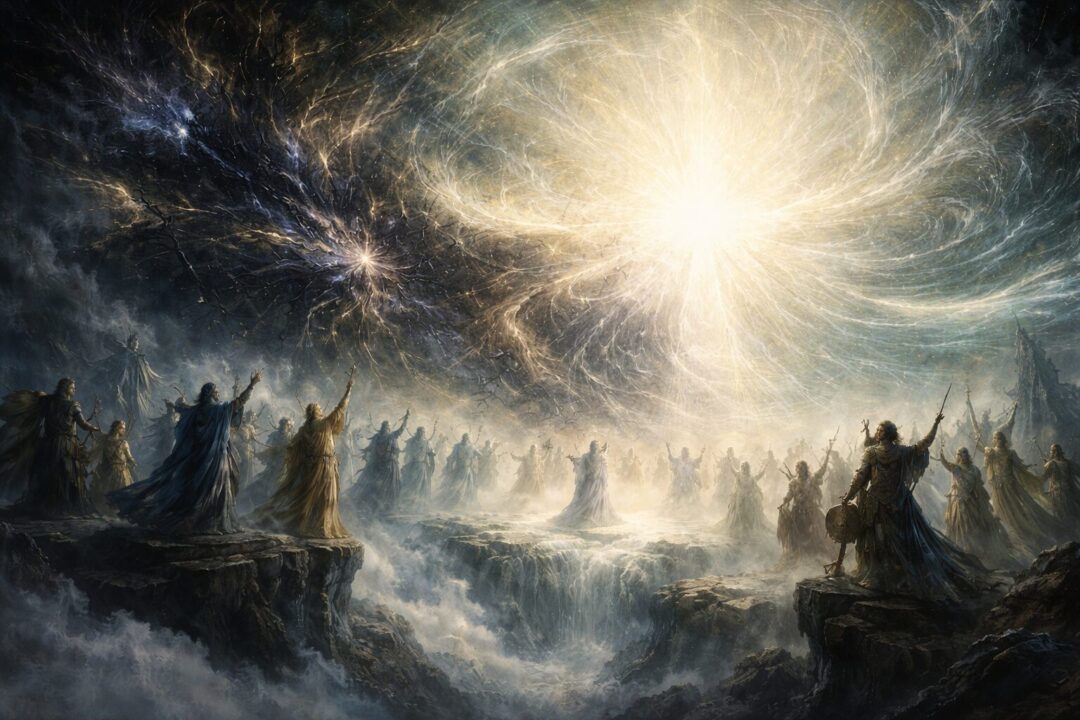
Many readers come away from Middle-earth with the same uneasy question.
If Eru Ilúvatar is truly above all things, why does He so rarely act in plain sight?
Why allow Morgoth to mar the world?
Why allow Sauron to rise?
Why leave Elves, Men, and Hobbits to endure grief that seems far beyond their strength?
At first glance, the silence can feel strange.
Middle-earth contains a creator, but not the kind who constantly steps into the tale to correct every disaster. When evil grows, the answer is almost never a visible act from above. Instead, the world is left in the hands of the Valar, the Wise, the kings, the humble, the fearful, and the small. That pattern is not accidental. In the mythology, most action within Arda is delegated. The Valar shape and govern the world beneath Eru, while the Children of Ilúvatar must live, choose, fail, endure, and act within it.
That is the first key to the question.
Eru is not absent from Middle-earth. But He is usually not direct.
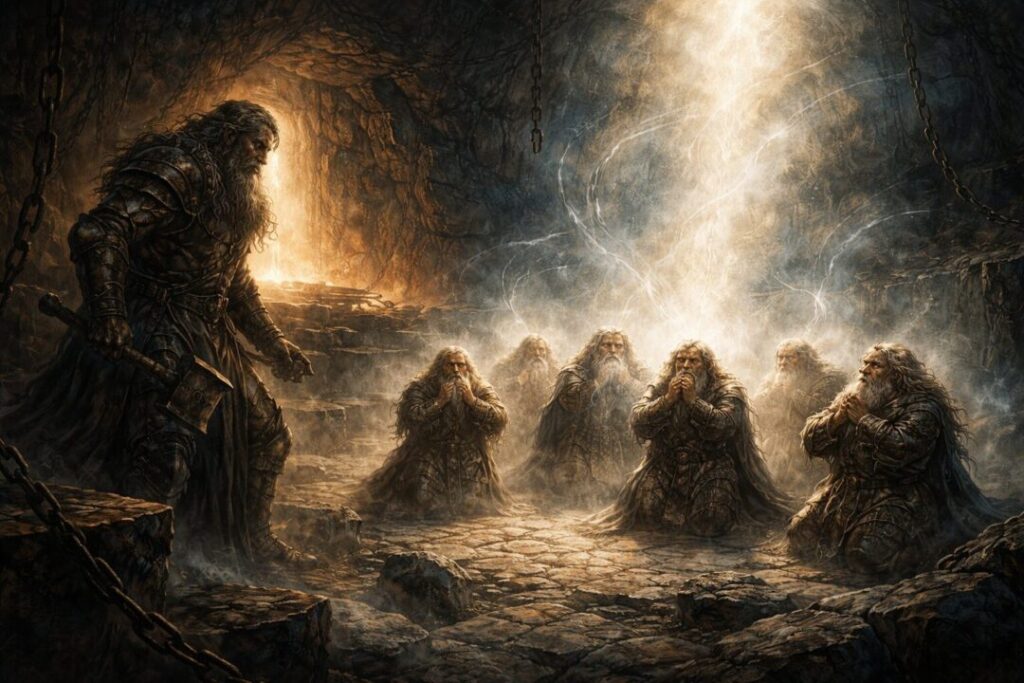
The world is meant to be lived in, not constantly overridden
One of the deepest structures in the legendarium is that created beings are allowed real action.
The Valar are mighty, but they are not Eru. Even they do not fully understand all of His design. The Children of Ilúvatar, especially Men and Elves, are not puppets being moved through a scripted pageant. Their choices matter. Mercy matters. Pride matters. Refusal matters. Pity matters. The story repeatedly insists that moral action has genuine weight.
That is why Eru’s government of the world does not usually look like constant interruption. A world in which every great danger is immediately crushed from above would leave little room for courage, faithfulness, repentance, or sacrifice. Middle-earth is built so that even the highest powers beneath Eru must act within limits. Gandalf is sent to awaken resistance, not to dominate by force. The Valar themselves govern Arda under bounds. The free peoples must answer evil with their own choices, however frail those choices may be.
So Eru’s distance is not a sign of indifference.
It is part of the order.
Direct intervention is rare because delegated authority is the norm
The clearest statement of the pattern is simple: Eru delegated most direct action within Eä to the Ainur. That means Middle-earth is ordinarily governed through secondary powers, not by constant immediate acts from the One. Manwë stands as Eru’s vicegerent in Arda. The Valar shape the world. The Maiar serve within it. History unfolds through real created wills, not by perpetual divine correction.
That framework explains why Eru’s direct acts are so few and so weighty.
They are not random miracles scattered whenever the plot becomes difficult. They appear at moments that touch the structure of the world itself, or where no lesser authority can rightly do what must be done.
That distinction matters.
Because not every providential turn in Middle-earth is described as an open intervention.
Sometimes the text gives something quieter.
When Eru clearly does act directly
Some moments are straightforward.
The Children of Ilúvatar, Elves and Men, are directly His. They are not the work of the Valar. Likewise, when Aulë in impatience made the Dwarves, they did not possess true independent life until Ilúvatar addressed Aulë and accepted them into His design. That is one of the clearest examples of direct divine action within the history of Arda: a created power can fashion, but only Ilúvatar can give true being in that sense.
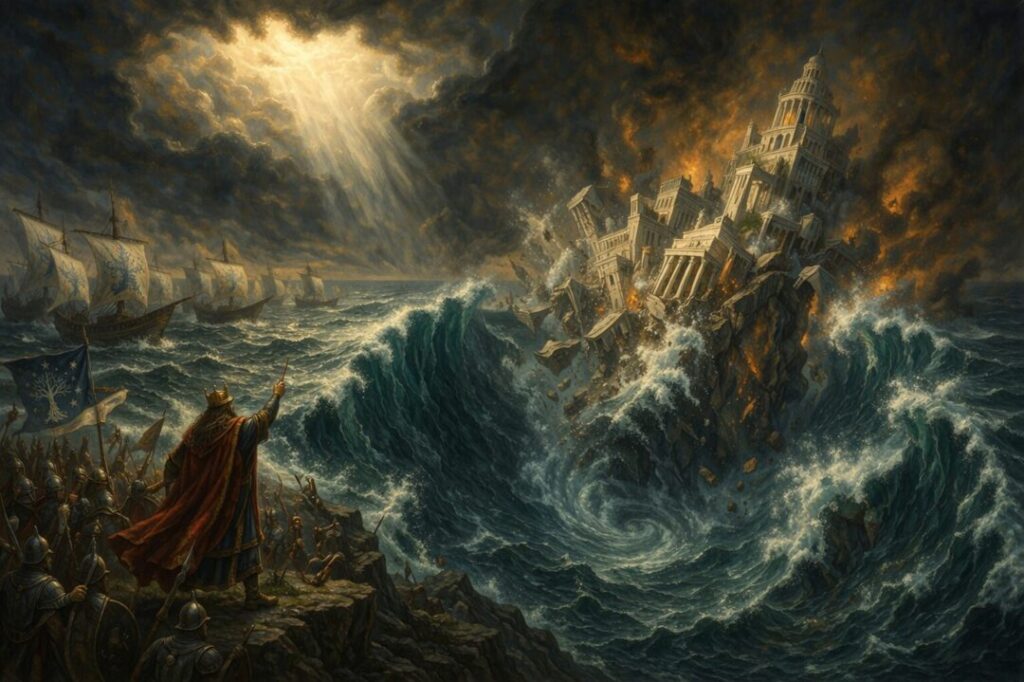
The most dramatic intervention is the Downfall of Númenor.
When Ar-Pharazôn sailed against Aman, the crisis passed beyond ordinary governance. The Valar did not meet the Númenóreans in war. Instead, they laid down their rule and called upon Ilúvatar. Then the fashion of the world was changed: Númenor was swallowed, Aman was removed from the circles of the world, and the world itself was bent into a new form. This is not subtle providence. It is direct, world-altering intervention at the highest level.
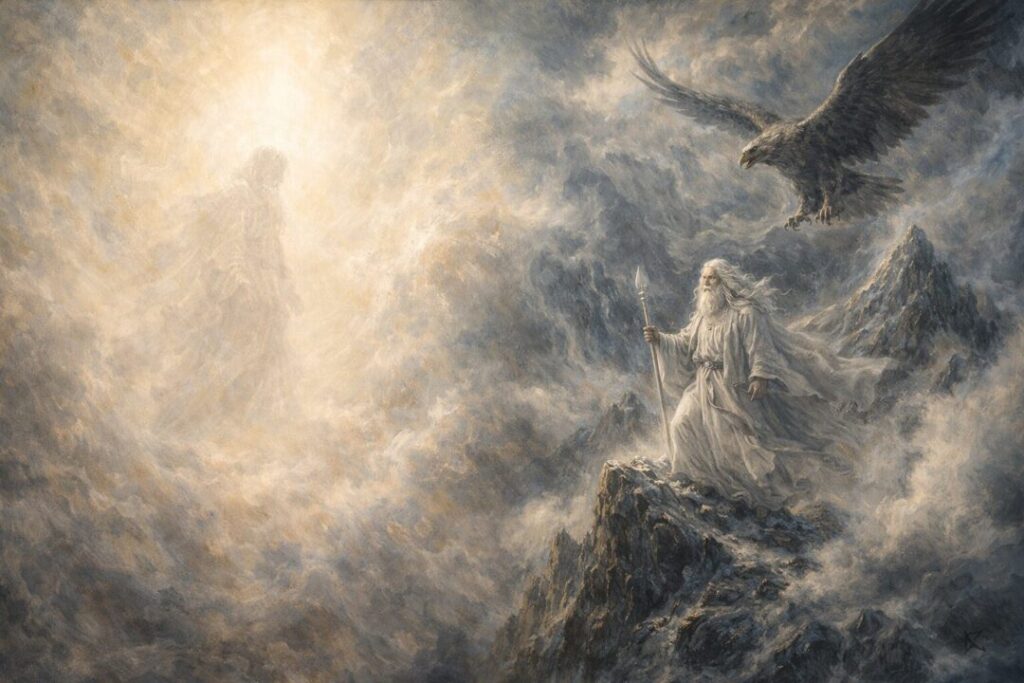
Gandalf’s return belongs in the same category, though on a different scale.
After the fight with the Balrog, Gandalf does not merely recover. In the letters, the point is made that he truly died and was sent back by “Authority,” language that places the act above the Valar. Gandalf’s return is therefore not just a mysterious recovery scene. It is an exceptional act tied to his mission, his sacrifice, and the fact that he alone among the Istari remained faithful to his task.
These moments stand out because they are exceptional.
They are not the ordinary mode of rule in Middle-earth.
Providence is not the same as visible intervention
This is where many readings become too simple.
Readers often notice that Bilbo was “meant” to find the Ring, or that Frodo’s quest succeeds even after Frodo cannot destroy it by his own will, and conclude that Eru is constantly stepping in with obvious miracle after obvious miracle.
The texts support something more careful.
Gandalf openly says that Bilbo was meant to find the Ring, and not by its maker. That is one of the clearest statements of providence in The Lord of the Rings. Later, in discussing Frodo’s failure, the letters speak of Frodo as an “instrument of Providence,” and even say that “the Other Power then took over.” But the shape of that help is important. Frodo is not spared the burden. He is not carried up the mountain by divine force. He is brought to the destined point through exhaustion, pity, mercy, and long endurance; only there does the final turn occur.
So the Ring-quest is not a story in which Eru simply refuses to let His servants suffer.
It is almost the opposite.
He permits the full cost of the burden, and the providential turn comes only after the creature has reached the limit of what can rightly be asked.
That difference is everything.
Why Númenor and Gandalf are different
Númenor is a rebellion against the order of the world itself.
Ar-Pharazôn’s assault on Aman is not merely another war. It is a challenge to the ban set upon Men, to mortality as part of their appointed nature, and to the limits between the Blessed Realm and the world of ordinary history. The Valar cannot solve that by ordinary force without overstepping their own bounds. So they surrender judgment upward. Eru alone answers.
Gandalf’s return is different, but it shares one feature with Númenor: no lesser authority seems sufficient.
The Istari were sent under strict limits. Their task was to counsel, stir hearts, and resist domination with humility rather than force. Gandalf’s death occurs in faithful obedience to that mission. His return is therefore not a casual reward. It is an exceptional restoration tied to the mission itself and to the higher authority that set its terms.
In both cases, Eru acts directly where the matter touches either the deep laws of the world or the commission underlying the struggle against Sauron.
Why He does not simply destroy evil at once
This is the harder answer.
If Eru removed every evil power the moment it arose, Middle-earth would become a world with less tragedy, but also less moral depth. The legendarium is not built around the idea that goodness means never suffering. It is built around the idea that goodness remains goodness under suffering, limitation, and uncertainty.
That is why so much depends on pity.
Bilbo spares Gollum.
Frodo spares Gollum.
Sam nearly fails to understand what is happening between them.
The entire quest hangs, in the end, on acts that did not look world-changing when they were made.
This is the pattern of Eru’s hidden government.
Not domination.
Not constant spectacle.
Not rescue that cancels the creature’s part in the story.
Instead, He allows history to become morally real.
And that means allowing terrible risks.
Eru’s silence is part of the meaning
The unsettling thing about Eru in Middle-earth is not simply that He rarely intervenes.
It is that the rare intervention throws the ordinary pattern into sharper focus.
Most of the time, the world goes on through delegated power, creaturely limitation, and providence too deep to force itself into plain sight. Only rarely does Eru break that pattern openly. When He does, the moment is vast: a race given life, a world reshaped, a fallen messenger sent back, a quest completed beyond the final strength of its bearer.
That is why Eru rarely intervenes directly.
Not because He lacks power.
Not because He does not care.
But because Middle-earth is not meant to be a world where every burden is removed before it can test what a soul will do.
The deeper pattern is harsher than that.
And more beautiful.
Eru usually does not erase the struggle.
He lets the struggle reveal mercy, endurance, humility, and the strange truth that even the smallest hands may carry a design greater than they understand.
Sources & Notes
- J.R.R. Tolkien, The Silmarillion, “Ainulindalë” — establishes Eru Ilúvatar as the source of the Music and of the Children, while the Ainur enter Eä as delegated powers working within his design.
- J.R.R. Tolkien, The Silmarillion, “Of Aulë and Yavanna” — Aulë can shape the Dwarves, but only Ilúvatar can grant them independent life, making this one of the clearest direct acts of Eru in Arda.
- J.R.R. Tolkien, The Silmarillion, “Akallabêth” — the Valar lay down their government when Ar-Pharazôn invades Aman, and Ilúvatar changes the fashion of the world in the Downfall of Númenor.
- J.R.R. Tolkien, The Lord of the Rings, Book I, Chapter 2, “The Shadow of the Past” — Gandalf tells Frodo that Bilbo was “meant” to find the Ring, not by its maker, grounding the article’s distinction between providence and visible intervention.
- J.R.R. Tolkien, The Letters of J.R.R. Tolkien, Letter 156 — Tolkien explains that Gandalf truly died and was sent back by “Authority,” beyond the Valar, because he remained faithful to his appointed mission.
- J.R.R. Tolkien, The Letters of J.R.R. Tolkien, Letter 192 — Tolkien describes Frodo as an instrument of Providence and says “the Other Power then took over” at the final moment, after Frodo had endured to the limit of his strength.