At first glance, the Ages of Arda seem like one of the most intimidating parts of Tolkien’s world.
Readers hear about the First Age, the Second Age, the Third Age, and the Fourth. Then, almost immediately, other terms appear beside them: the Days before days, the Years of the Trees, the Years of the Sun, the Elder Days, the dominion of Men.
Very quickly, what looked simple begins to feel tangled.
The problem is not that Tolkien’s history is random.
The problem is that he is not using just one kind of timeline.
That is the first thing to understand.
If you try to read the Ages of Arda as nothing more than a neat line of numbered centuries, they feel confusing. But if you see them as different ways of measuring the deep changes of the world, they begin to make sense. The numbered Ages track the great historical eras of the Children of Ilúvatar, while other reckonings describe broader phases in the world’s making and lighting.
And once that clicks, the whole structure becomes much easier to hold in your head.
The first thing to know: not all “ages” are the same kind of age
Many readers assume the timeline works like this: one age ends, another begins, and all the names refer to the same sequence.
But Tolkien’s chronology is layered.
There are broad phases of the world’s history, such as the Days before days, the Years of the Trees, and the Years of the Sun. Then there are the numbered Ages of the Children of Ilúvatar: First, Second, Third, and Fourth. These overlap rather than replacing each other one-for-one. The First Age, for example, begins during the Years of the Trees and continues into the Years of the Sun.
That overlap is where many people first get lost.
They think the First Age begins with the Sun.
Strictly speaking, it does not.
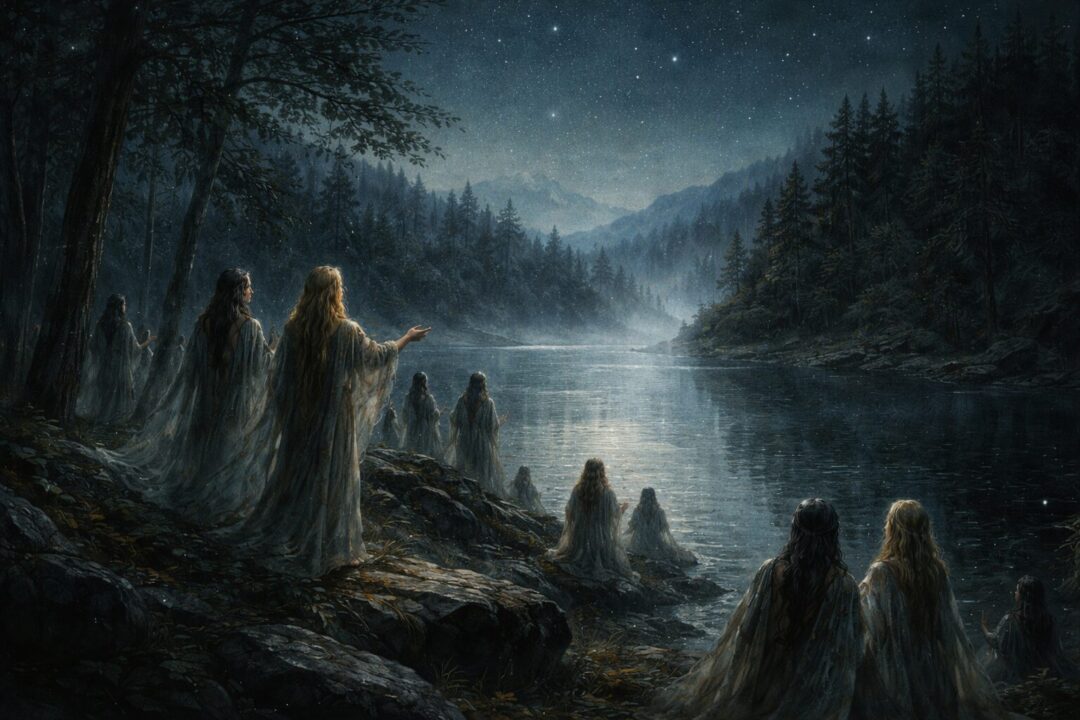
Before the Ages: the world exists before Sun and Moon
Long before the familiar stories of Hobbits, Rings, or even Númenor, Arda already exists.
The world is made. The great powers enter it. Melkor begins his rebellion within it. Vast changes happen before the first sunrise ever appears. In Tolkien’s chronology, these earliest stretches belong to the unnumbered past: first the Days before days, and later the Years of the Trees in Valinor.
This matters because it explains why “the beginning” of Tolkien’s world is not the same thing as “the First Age.”
The world is older than the First Age.
The First Age begins only when the history of the Children truly starts to be counted.
That is a very different idea.
The First Age begins earlier than many readers think
For beginners, this is usually the single most useful correction:
The First Age does not begin with the first sunrise.
It begins with the Awakening of the Elves at Cuiviénen, and that happens during the Years of the Trees. Tolkien reference works based on the appendices and later chronology consistently preserve that reckoning.
So when people picture the First Age only as the era of Beleriand under the Sun—Fëanor, the Noldor in exile, the great wars against Morgoth—they are really thinking of the later and most dramatic part of it.
That part matters enormously.
But it is not the whole Age.
The First Age stretches back into a world still lit by older lights, before the Sun and Moon rise, and before many of the best-known tragedies of the Silmarillion fully unfold.
That is one reason the First Age feels so vast.
It is.
What the First Age is really about
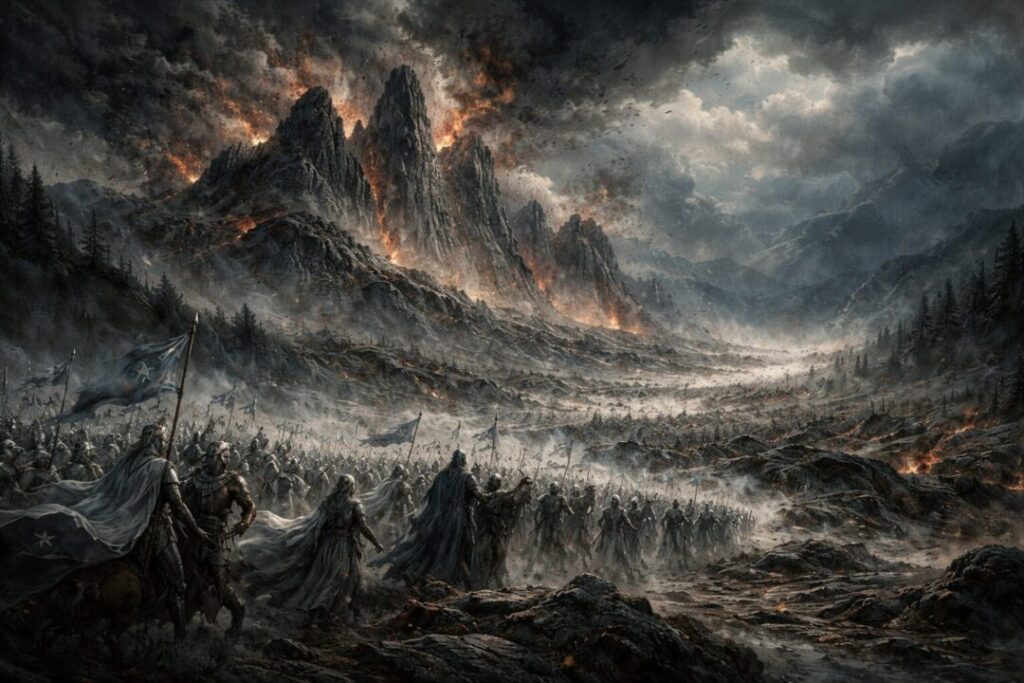
If you want the simplest mental shortcut, think of the First Age as the age of Morgoth’s open domination and the great wars against him.
This is the age of the high drama of the Elves in Beleriand. It contains the rebellion of the Noldor, the long struggle against Angband, the stories of Beren and Lúthien, Túrin Turambar, Gondolin, Doriath, and finally the War of Wrath.
But what actually ends the Age is not just exhaustion or the passing of time.
It ends with a decisive overthrow.
Appendix B states that the First Age ended with the Great Battle, in which the Host of Valinor broke Thangorodrim and overthrew Morgoth.
That detail is important because it reveals a pattern Tolkien uses again and again:
An Age ends when a ruling shadow is broken and the shape of history changes.
Not merely when a calendar page turns.
The Second Age is not just “the Númenor age,” though Númenor stands at its center
The Second Age begins after the ruin of Morgoth’s power and the reshaping of the world that follows the First Age.
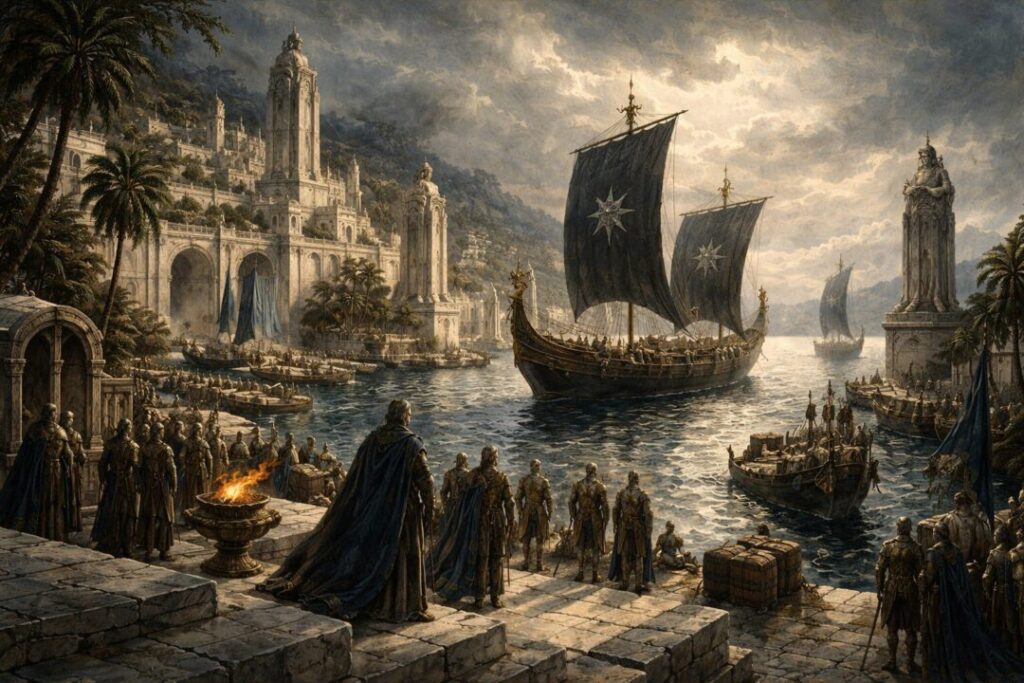
For many readers, the easiest way to remember it is this: it is the age of Númenor and the age of Sauron’s rise.
That does not mean everything in the Second Age happens on Númenor.
But Númenor is the great human kingdom that defines its central arc, just as Sauron becomes the great dark power defining its danger. The forging of the Rings of Power, the growth of Sauron in Middle-earth, the corruption and downfall of Númenor, and the founding of Arnor and Gondor all belong here.
A common beginner mistake is to assume the Second Age ends with the Downfall of Númenor.
That is understandable.
It feels like an ending.
But it is not the ending Tolkien uses for the Age itself.
The Second Age ends later, with the first overthrow of Sauron by the Last Alliance and the taking of the One Ring.
That matters because it shows Tolkien still treating Sauron—not Númenor alone—as the central shadow whose breaking marks the shift into the next era.
The Third Age is the long fading before the Ring is destroyed
The Third Age is the age most readers know best, because The Hobbit and The Lord of the Rings happen near its end.
But the Age itself is much longer than the War of the Ring.
It lasts more than three thousand years. Across that span, Arnor declines and falls, Gondor slowly weakens, the Wizards arrive, the Shadow gathers again, and many of the older powers of Middle-earth linger in diminished form. By the late Third Age, the world is still full of memory, but much of its greatness is already behind it.
That is why the Third Age has such a distinct emotional texture.
It is not the age of beginnings.
It is the age of remnants, endurance, delay, and final testing.
And like the earlier Ages, it ends when the great shadow governing it is finally broken.
In Tolkien’s reckoning, the Third Age comes to its end in the War of the Ring, through the final defeat of Sauron when the Ruling Ring is destroyed.
So if you want one sentence to remember the Third Age, it might be this:
It is the long age of Sauron’s return and final defeat.
The Fourth Age is the age of Men—but even that needs one small footnote
People often say the Fourth Age begins when Sauron falls.
That is close enough for casual conversation.
But Tolkien’s own wording is slightly more precise.
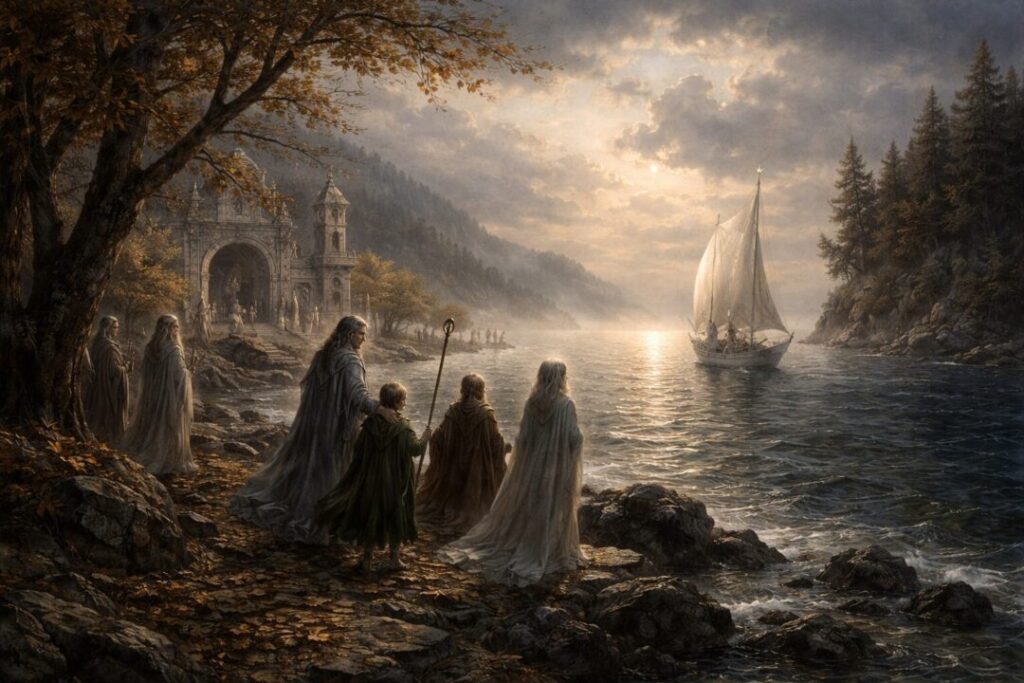
Appendix B says the Third Age came to its end in the War of the Ring, but the Fourth Age was not held to have begun until Master Elrond departed, when the dominion of Men and the decline of the other speaking peoples had truly come. Reputable chronology references preserve this distinction, while also noting that in Gondor the reckoning of Fourth Age 1 was tied to March 25 of the same year.
That detail is easy to miss.
But it reveals something beautiful about Tolkien’s idea of history.
The Fourth Age is not merely “after the battle.”
It is after the Elder world has begun to pass away for good.
The Elves are leaving.
The Three Rings have lost their power.
The old order is receding.
Men inherit the world more fully than before.
So the Fourth Age is not just an age of victory.
It is an age of transition.
Why the Ages matter more than the dates
Once readers start chasing exact year counts, the Ages can feel like a burden.
And of course, dates do matter.
They help place events.
They help separate one story from another.
They help show how immense Tolkien’s world really is.
But the deeper purpose of the Ages is not arithmetic.
It is meaning.
Each Age describes a different kind of world.
The First Age is the age of Morgoth and the heroic ruin of Beleriand.
The Second is the age of Númenor, the Rings, and Sauron’s first great rise.
The Third is the long waning age that ends with the destruction of the Ring.
The Fourth is the age in which Men come into their dominion as the Elder peoples diminish.
That is the pattern worth holding onto.
The dates support it.
But the pattern is the real key.
The simplest way to remember the Ages of Arda
If you want the shortest possible guide, here it is:
The world begins before the numbered Ages.
The First Age begins with the Elves.
The Second Age ends with Sauron’s first overthrow.
The Third Age ends with Sauron’s final defeat.
The Fourth Age belongs to the dominion of Men.
That is enough to keep most of the legendarium oriented in your head.
And in a strange way, that is very Tolkien.
Because the deeper truth of the Ages is not that time passes.
It is that worlds pass.
Lights fail.
Powers fall.
Peoples diminish.
And history moves, slowly and irreversibly, from the Elder days into something narrower, quieter, and more recognizably human. That movement from older, greater, more mythic time into the dominion of Men is one of the clearest long patterns in Tolkien’s chronology and late-history framing.
Once you see that, the Ages of Arda stop feeling like a puzzle of dates.
They start feeling like the shape of the whole story.
Sources & Notes
- J.R.R. Tolkien, The Silmarillion, “Ainulindalë” and “Of the Beginning of Days” — establishes Arda’s making and the long pre-solar history before the Sun and Moon are set in the sky.
- J.R.R. Tolkien, The Silmarillion, “Of the Coming of the Elves and the Captivity of Melkor” — places the Awakening of the Elves at Cuiviénen during the Years of the Trees, before the first sunrise.
- J.R.R. Tolkien, The Lord of the Rings, Appendix B, “The Tale of Years” — frames the First Age of the Children of Ilúvatar and says it ended with the Great Battle and the overthrow of Morgoth.
- J.R.R. Tolkien, The Silmarillion, “Akallabêth” and “Of the Rings of Power and the Third Age” — covers Númenor’s fall, Sauron’s rise, the Last Alliance, and the transition from Second to Third Age.
- J.R.R. Tolkien, The Lord of the Rings, Appendix B, “The Tale of Years” — dates the War of the Ring, the end of the Third Age, and the Fourth Age’s beginning with Elrond’s departure and the dominion of Men.