
The Blue Wizards occupy one of the strangest places in Middle-earth.
They are not central characters.
They are not explained in detail.
They are not given a clear ending.
And unlike Gandalf, Saruman, or even Radagast, they do not become part of the visible struggle in the western lands.
For many readers, that makes them feel minor.
But the texts point in a more interesting direction than that.
The Blue Wizards may matter not despite the silence around them, but because of it.
The Story Barely Lets Us See Them
In The Lord of the Rings itself, the clearest indication that there were more than the familiar three Wizards comes when Saruman speaks of “the rods of the Five Wizards.” That line matters because it confirms the order was larger than the story directly shows. But the narrative never pauses to introduce the missing two.
That restraint is important.
Middle-earth often withholds information for a reason. It does not always withhold because the answer is unimportant. Sometimes it withholds because the answer lies beyond the horizon of the story being told.
That is exactly the case with the Blue Wizards.
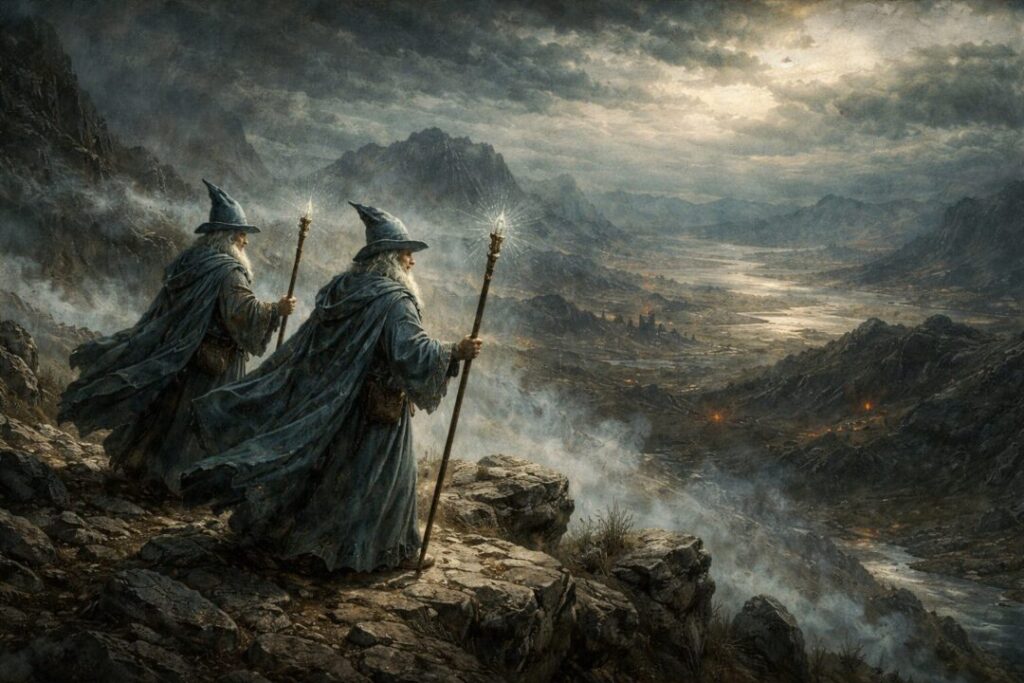
In later notes collected in Unfinished Tales, they are identified as the “Blue Wizards,” associated with sea-blue garments, and said to have gone into the East with Saruman before disappearing from the knowledge of the West. In that same tradition, they never returned, and their eventual fate is left uncertain.
That already tells us something crucial.
Their obscurity is not accidental.
It is geographical.
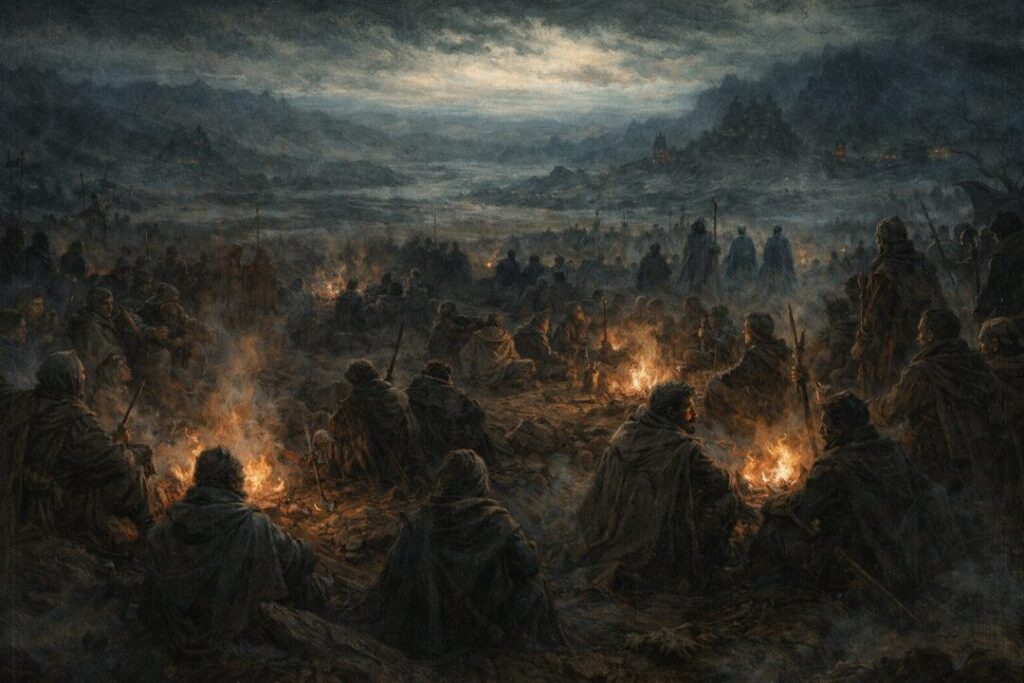
The main story of Middle-earth is overwhelmingly a northwestern story. The Shire, Rivendell, Rohan, Gondor, Isengard, Mordor: these are the lands the narrative inhabits. The Blue Wizards leave that sphere almost at once. So the silence surrounding them is partly the silence of distance.
The East Matters Even When the Story Does Not Show It
This is where the Blue Wizards become more important than they first appear.
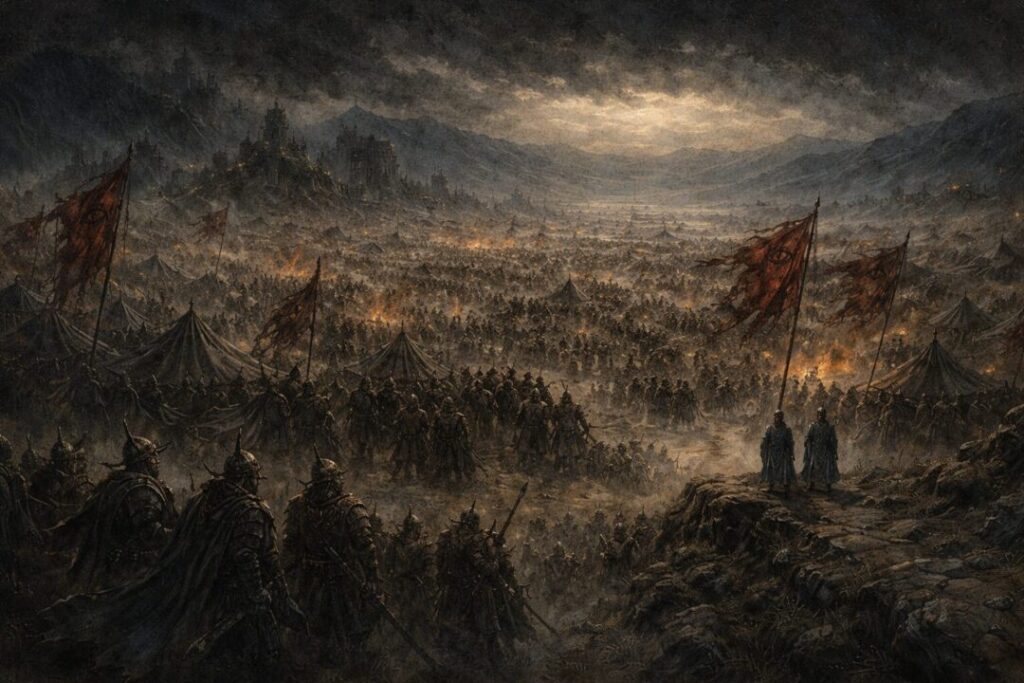
Sauron was never only a threat to Gondor or to the lands west of Mordor. His power extended east and south. Even in The Lord of the Rings, the West is repeatedly shown facing enemies from beyond the familiar map: Easterlings and Southrons fight for him, and the war is clearly larger than the journey of the Ring alone.
That means a serious question is always sitting just off the page:
Why was Sauron’s full weight not even greater?
Why, if he had vast lands behind him, did the West still survive long enough for the Ring-quest to succeed?
The later tradition about the Blue Wizards offers a striking answer.
In late writings summarized in The Peoples of Middle-earth, the two Wizards are no longer treated simply as lost emissaries who vanished into uncertainty. Instead, they are given a defined eastern mission: to help those Men who had rebelled against dark worship, to stir resistance, and to create dissension and disarray among Sauron’s strength in the East. The same material suggests that their labor helped prevent the forces of the East from overwhelming the West by sheer numbers.
If that tradition is accepted, even cautiously, the Blue Wizards become something far more consequential than a lore curiosity.
They become part of the hidden reason the West had a chance at all.
Why Their Uncertainty Is Part of Their Meaning
There is, however, an important complication.
The tradition is not perfectly fixed.
An earlier conception, reflected in Unfinished Tales and in Letter 211, suggests uncertainty about what became of them and even entertains the possibility that they failed in their mission, perhaps falling into error in a way different from Saruman.
That should not be flattened into a false certainty.
The texts do not present one perfectly stable biography of the Blue Wizards. What they give us is a shifting tradition: one version darker and more doubtful, another far more hopeful and strategically significant.
But that does not weaken the larger point.
In both traditions, the Blue Wizards matter because they were sent beyond the edges of the known story. Whether they failed there, partly succeeded there, or succeeded greatly there, their role is tied to regions the main narrative never follows closely.
That makes them symbols of something the legendarium keeps reminding us of:
The world is larger than the story’s immediate field of vision.
They Expose the Limits of the Western Point of View
This may be the deepest reason the Blue Wizards are so compelling.
Readers often unconsciously treat the northwestern map as if it were the whole of Middle-earth. But it is not. It is simply the part the main story inhabits most fully.
The Blue Wizards stand as a quiet correction to that assumption.
They remind us that whole histories are unfolding elsewhere.
Whole peoples exist beyond the lands our heroes cross.
Whole struggles against Sauron may be happening where the narrative does not linger.
That matters morally as well as geographically.
The War of the Ring is not presented as a purely local crisis. It is a world-crisis. The West experiences it in one form, but the East and South live inside the same shadow in other forms. If the Blue Wizards were sent there, then those distant peoples were not beneath notice. They too belonged to the great contest against darkness.
This is one reason the later account of their mission feels so powerful.
It suggests that resistance to Sauron was broader than the narrative spotlight reveals.
Why They Are Not Explained More Clearly
That still leaves a natural question.
If the Blue Wizards matter so much, why are they not explained in the main story?
Because explanation would alter the effect.
Part of what gives Middle-earth its depth is that not every thread is brought forward and completed. Some things remain glimpsed rather than unfolded. Some names arrive with the weight of history behind them, but without full narrative exposure. That technique makes the world feel older, wider, and less constructed around the immediate needs of the plot.
The Blue Wizards are one of the purest examples of that effect.
If we had chapters following them in the East, they would become ordinary story material. Instead, they remain what distant labor often is in history: real, necessary, and mostly unseen.
That suits their likely function.
Gandalf works where the reader can watch him.
The Blue Wizards, by contrast, seem designed to suggest the work no western chronicler could fully record.
Their Hiddenness Fits the Pattern of How Good Often Works
There is also a deeper thematic pattern here.
Middle-earth repeatedly values work that is small, indirect, or hidden. The fate of the world turns on pity shown to Gollum, on the endurance of Hobbits, on loyalty that history would normally overlook. Great evil often appears noisy and visible. Good is frequently quieter.
The Blue Wizards fit that pattern remarkably well.
If the later tradition is right, they did not defeat Sauron by confronting him in open lordship. They weakened him by reducing his hold elsewhere, by helping resistance grow in lands already under shadow, and by ensuring that his apparent vastness was less complete than it seemed.
That is a very Middle-earth kind of victory.
Not a dramatic duel.
Not a throne seized.
Not a great banner raised where all can see it.
A hidden lessening of evil’s reach.
Why So Little Knowledge Makes Them More Important, Not Less
This is the paradox at the center of the Blue Wizards.
If we knew everything about them, they would likely feel smaller.
They would become another solved corner of the map.
Another completed piece of lore.
Another biography to place in order.
But because so little is known, they keep doing something more powerful.
They force us to remember that the defeat of Sauron was not achieved only by the heroes standing in the foreground. It also depended on people, regions, and struggles the central tale only hints at. The Blue Wizards become the clearest sign that what is absent from the page may still be essential to the world.
That is why their obscurity matters.
It is not empty mystery for its own sake.
It is structural mystery.
The kind that makes the world feel larger than the story we are allowed to follow.
The Real Importance of the Blue Wizards
So what are the Blue Wizards, in the end?
Not merely a riddle.
Not merely unfinished background.
Not merely an invitation for fan theories.
They are a reminder that Middle-earth was never small enough to be contained by its most famous road.
The texts leave us with only fragments: five Wizards, not three; two who went East; uncertainty in one tradition; hidden usefulness in another; and a persistent sense that Sauron faced opposition far beyond the lands where the Ring was carried.
That is enough.
Enough to suggest that the war was wider than we saw.
Enough to suggest that unseen resistance mattered.
Enough to make their silence feel deliberate rather than accidental.
And perhaps that is precisely why the Blue Wizards remain so memorable.
Middle-earth does not fully explain them because their function is not to close the world.
It is to open it wider.
Sources & Notes
- J.R.R. Tolkien, The Lord of the Rings, Book III, Chapter 10, “The Voice of Saruman” — Saruman’s reference to “the rods of the Five Wizards” is the clearest in-story hint that the order was larger than the three seen in the West.
- J.R.R. Tolkien, Unfinished Tales, “The Istari” — identifies the two missing Wizards as the Blue Wizards, associated with blue garments and with journeys into the East beyond western knowledge.
- J.R.R. Tolkien, The Letters of J.R.R. Tolkien, Letter 211 — gives Tolkien’s more doubtful account of the two Wizards’ mission and possible failure or corruption in distant lands.
- J.R.R. Tolkien, The Peoples of Middle-earth, “Last Writings,” “The Five Wizards” — preserves the later, more hopeful tradition in which Morinehtar and Rómestámo work in the East to weaken Sauron’s support and aid resistance against him.
- J.R.R. Tolkien, The Lord of the Rings, Appendix B, “The Tale of Years” — frames the War of the Ring as a wider conflict involving battles and movements beyond the Fellowship’s immediate path.