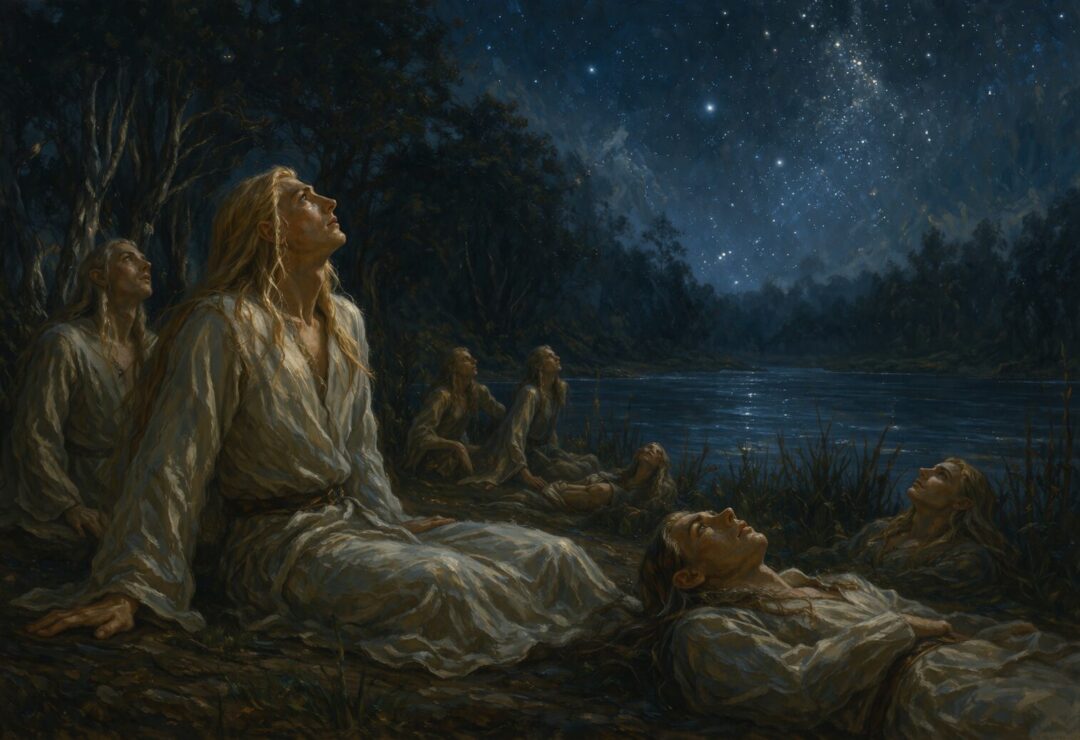
When people first hear that the Elves of Middle-earth are immortal, they usually imagine something simple.
Endless life.
No death.
No real ending at all.
But the legendarium does not present Elvish immortality that way.
In fact, one of the easiest ways to misunderstand the Elves is to assume that “immortal” means they are untouched by death, untouched by change, or untouched by sorrow. The texts support none of those ideas in such a simple form. What they describe is much stranger, and in some ways much sadder.
Elves are deathless by nature, but that does not mean they are indestructible. They are bound to the life of Arda itself, and that single fact changes everything.
Elvish immortality is tied to the world
The clearest way to begin is with this:
Elves are not “immortal” because they exist outside the world.
They are immortal because they are bound to it.
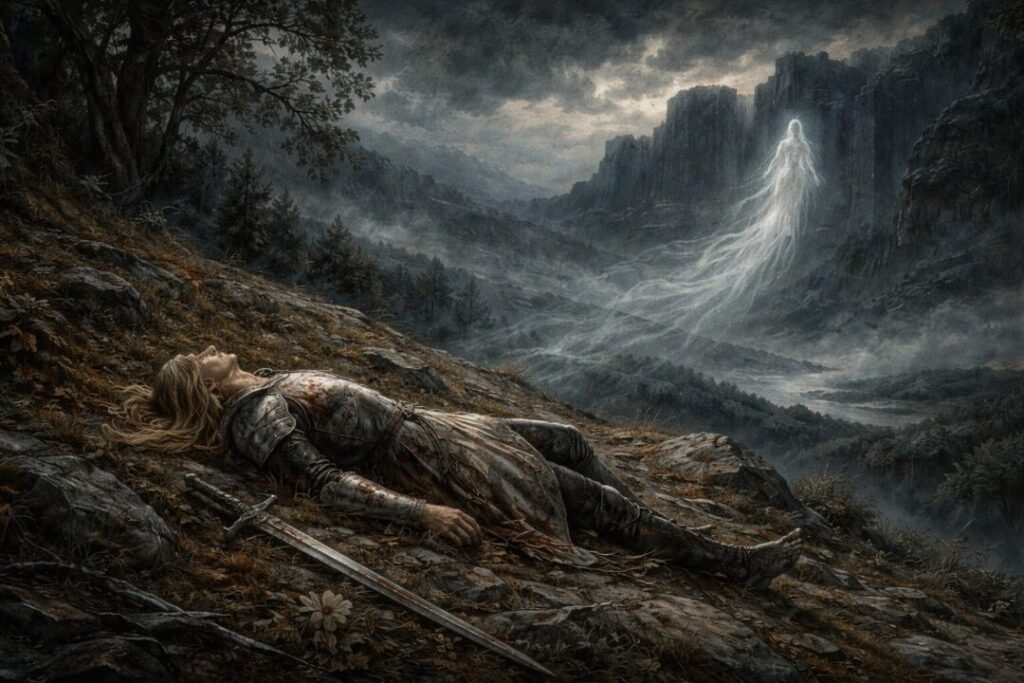
The texts repeatedly point toward the idea that the life of the Elves lasts as long as the life of Arda lasts. Their fate is not to pass beyond the world in the manner of Men. Instead, they remain within its history and within its time. That is why Elvish immortality is sometimes better understood as world-bound deathlessness rather than simple endless living.
This is the first major distinction.
Men are mortal not merely because their bodies fail, but because their ultimate fate leads beyond the circles of the world. Elves are different. Their existence is tied to Arda in a way the race of Men is not. So when readers say that Elves “live forever,” that is only partly true. A more careful phrasing would be: they endure for the life of the world.
That makes them deathless.
It does not make them beyond harm.
Elves can be killed
This is where many simplified explanations break down.
Elves do not die of old age or ordinary disease as Men do, but they can absolutely be slain. The history of the Elder Days makes that plain. Battle, violence, and overwhelming grief can bring about the separation of an Elf’s spirit and body. In other words, bodily death is real for them, even if it is not the end in the same way it is for mortals.
That distinction matters.
To say an Elf is immortal does not mean that swords cannot kill them, that fire cannot consume them, or that grief cannot break them. It means that bodily death is not the final destruction of their being. The spirit of an Elf endures after the death of the body.
So the common claim that “Elves cannot die” is not really correct.
A better claim would be this:
Elves do not die naturally of age, but they can suffer bodily death.
What happens after an Elf dies
The next part is what makes Elves truly different from Men.
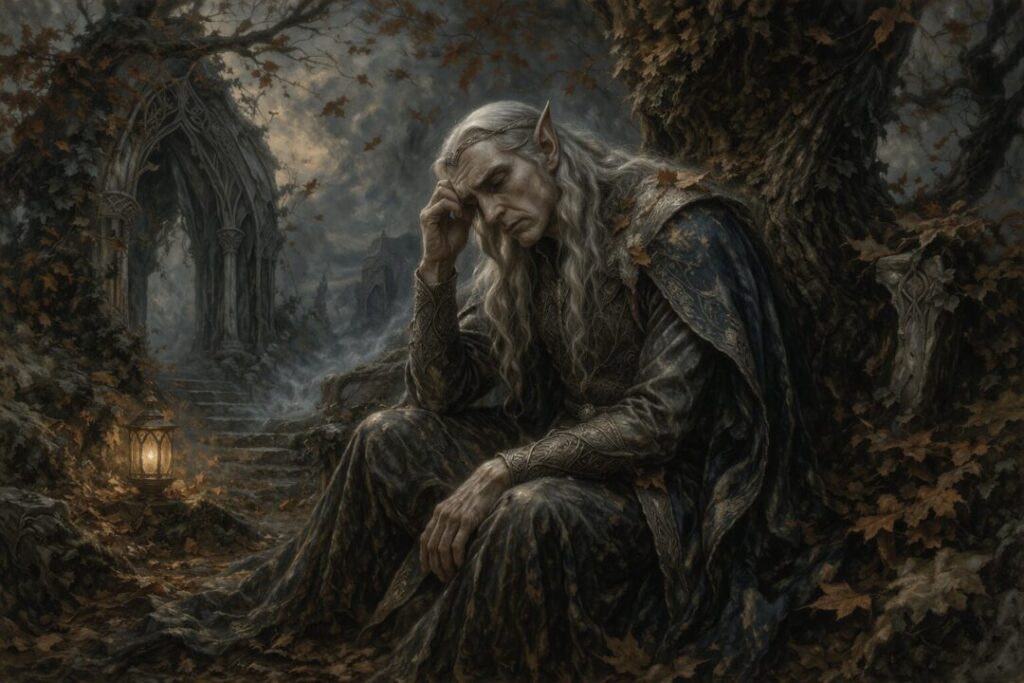
When an Elf dies, the body and spirit are separated. The fëa, or spirit, does not leave the world in the manner associated with Men. Instead, the texts point to the Halls of Mandos, where the spirits of dead Elves are gathered and await judgment, healing, and rest.
This is one of the most important lore points in the whole subject.
Elvish death is not simple annihilation. It is not the end of personhood. Nor is it presented as their natural design. In discussions preserved in later texts, the separation of spirit and body is treated as an unnatural consequence connected to the marring of the world. The Elves were meant to live as incarnate beings, with spirit and body in union.
That is why an Elf’s death carries a different weight from human death.
For Men, mortality is part of their distinct fate.
For Elves, bodily death is a wound in the order of their being.
Can Elves return after death?
In some cases, yes.
The canon supports the idea that dead Elves may be re-embodied after a time in Mandos. This is not described as a casual or automatic process in every instance, and it is certainly not something under their own control. But it is a real part of Elvish fate. The best-known example is Glorfindel, whose return is one of the clearest proofs that Elvish bodily death is not always permanent.
That said, this is the point where careful wording matters.
The texts do not justify turning Elven death into a revolving door. Re-embodiment exists, but it is exceptional in narrative terms and governed by powers beyond the individual Elf. It should not be reduced to “Elves just respawn,” because that flattens something solemn and metaphysical into something trivial.
The real point is simpler:
An Elf’s death does not have the same finality as the death of Men.
Immortality does not mean they stay unchanged
Here is the other major misunderstanding.
Even when Elves continue living, that does not mean they pass through time untouched.
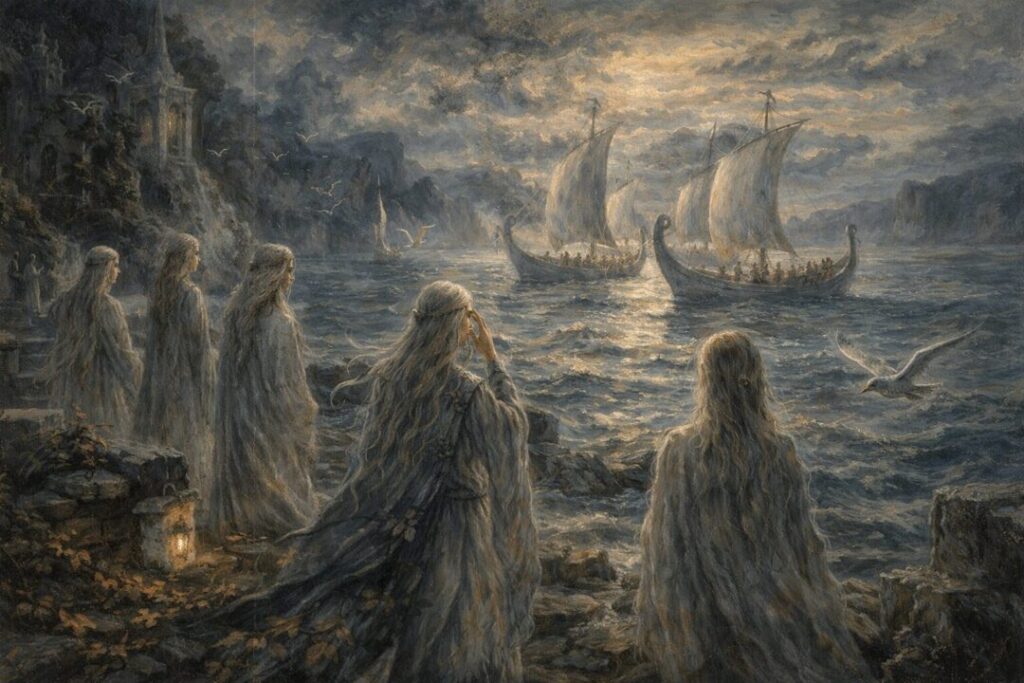
The long years leave marks on them. They accumulate memory, sorrow, and burden in ways mortals scarcely can. Tolkien Gateway’s summary of the underlying texts notes that Elves become ever more weary of the world and burdened by its sorrows, and that is essential to understanding their immortality.
This is why Elvish immortality is not simply enviable.
To live through age after age, watching realms fall, friends depart, beauty diminish, and the world change around you, is not a straightforward blessing. The legendarium repeatedly presents the Elves with a kind of deep historical weariness. They endure, but endurance itself becomes part of the burden.
So immortality in Middle-earth is not static perfection.
It is continuity.
It is memory.
It is survival inside time.
And survival can hurt.
Why the Elves fade in Middle-earth
This leads to one of the saddest ideas attached to the Elves:
fading.
The later tradition preserved in Tolkien Gateway’s summaries explains that Elves who remain in Middle-earth do not remain permanently in the same vivid embodied condition. Over immense time, their spirits come to consume the body, and they fade from ordinary mortal perception.
This does not mean they cease to exist.
It means that the relation between their spirit and bodily life changes in a long decline, especially in a world that is marred and increasingly suited to the dominion of Men. By the late ages, the Elves are not exactly defeated, but they are passing out of the ordinary history of Middle-earth.
That helps explain why the departure over Sea matters so much.
The West does not grant immortality to Elves. They already possess their own deathless nature. But Aman is not subject to decay in the same way as Middle-earth, and the Undying Lands are therefore a place more fitting to what they are.
The Sea does not make them immortal.
It delays the grief of fading in a diminished world.
Arwen proves that Elvish immortality is not just biology
One of the clearest ways to see the uniqueness of Elven fate is through Arwen.
Arwen’s story matters because it shows that “immortality” in this world is not just a biological trait like having a stronger body. In the case of the Half-elven, a genuine choice of fate can be involved. Arwen is repeatedly presented as one who gave up the Elvish fate and accepted mortality in order to remain with Aragorn.
That is a crucial point.
She does not merely agree to die sooner.
She accepts the fate of Men.
That only makes sense in a world where the destinies of Elves and Men are fundamentally different at the deepest level.
Why this idea matters so much
Once Elvish immortality is understood properly, the Elves themselves begin to look different.
They are not simply a fantasy race with better hair, sharper eyes, and endless lifespan.
They are a people caught in a profound tension.
They are bound to the world, yet the world is marred.
They endure, yet endurance brings sorrow.
They do not die as Men die, yet neither are they spared loss.
That is why the Elves often feel both beautiful and tragic at the same time.
Their immortality is real.
But it is not simple freedom from death.
It is a long fidelity to the life of Arda, with all the memory, grief, and weariness that such fidelity demands.
The clearest way to say it
So, in the simplest possible form:
Elves are immortal because they do not die of age and are bound to the life of the world.
They can still be slain, and they can die of overwhelming grief.
When they die, their spirits remain within the world’s order and go to Mandos rather than passing beyond the world as Men do.
Some may eventually be re-embodied.
And if they remain in Middle-earth long enough, immortality does not look like endless youthful life, but like memory, weariness, and fading.
That is the part many summaries miss.
The Elves do not simply live forever.
They remain.
And in Middle-earth, remaining is not always the gentlest fate.
Sources & Notes
- J.R.R. Tolkien, The Silmarillion, “Of the Beginning of Days” — establishes the different fates of Elves and Men, with Elves bound to Arda while Men pass beyond it.
- J.R.R. Tolkien, Morgoth’s Ring, “Laws and Customs among the Eldar” — the main source for Elvish death, the separation of fëa and hröa, summons to Mandos, re-embodiment, grief-death, and fading.
- J.R.R. Tolkien, Morgoth’s Ring, “Athrabeth Finrod ah Andreth” — frames mortality, Elvish deathlessness, and the marring of Arda as theological and metaphysical questions rather than simple biology.
- J.R.R. Tolkien, The Peoples of Middle-earth, “Last Writings: Glorfindel” — discusses Glorfindel’s death, sojourn in Mandos, and return as a notable case of Elvish re-embodiment.
- J.R.R. Tolkien, The Lord of the Rings, Appendix A, “The Tale of Aragorn and Arwen” — shows Arwen choosing the fate of Men, clarifying that Elvish immortality is a destiny, not merely a long lifespan.