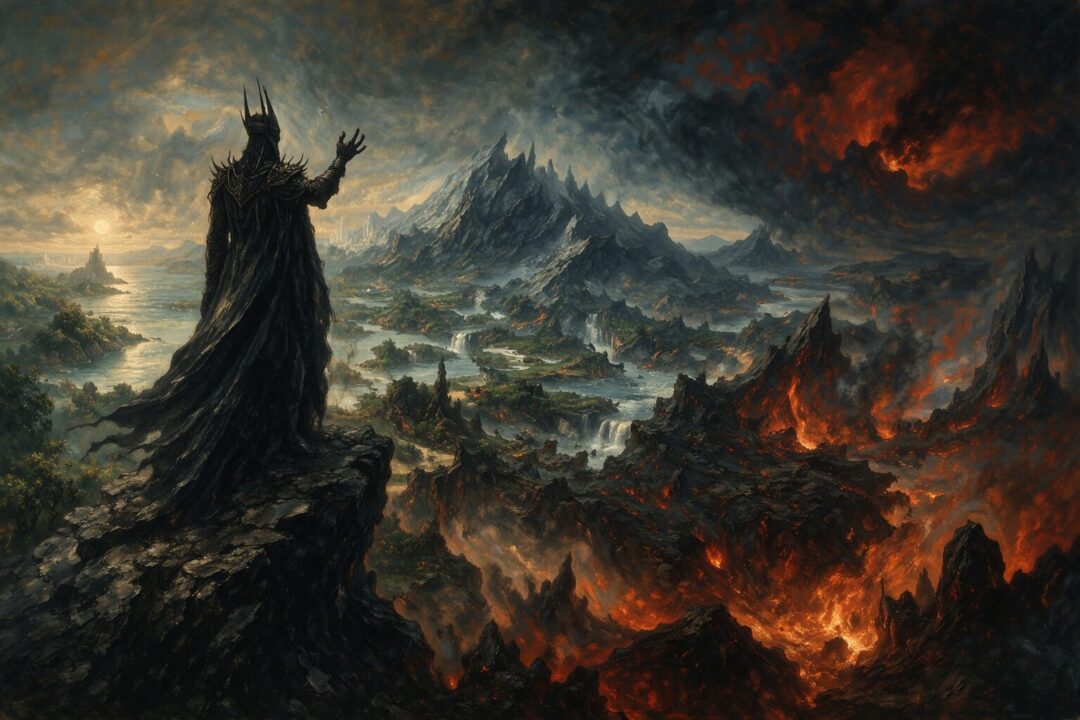
When readers ask why the Valar do not simply descend on Middle-earth and end evil by force, the question usually begins with war.
Why not another host from the West?
Why not open intervention?
Why not crush Sauron the way Morgoth was finally overthrown?
The obvious answer is destruction.
Middle-earth has already seen what happens when the great Powers go to war in their full might. The Battle of the Powers changed the shape of Middle-earth. The War of Wrath ended with Beleriand broken and drowned beneath the sea. These are not ordinary conflicts with tragic losses. They are world-altering convulsions.
But the deeper answer is not simply that war is dangerous.
The texts suggest something more precise.
The great evil in the legendarium is not violence alone. It is domination: the attempt to bend the world, and other wills, into submission to one ruling mind. That is the road Melkor takes from the beginning. It is the road Sauron refines. And it is exactly the road the Valar are not permitted to walk.
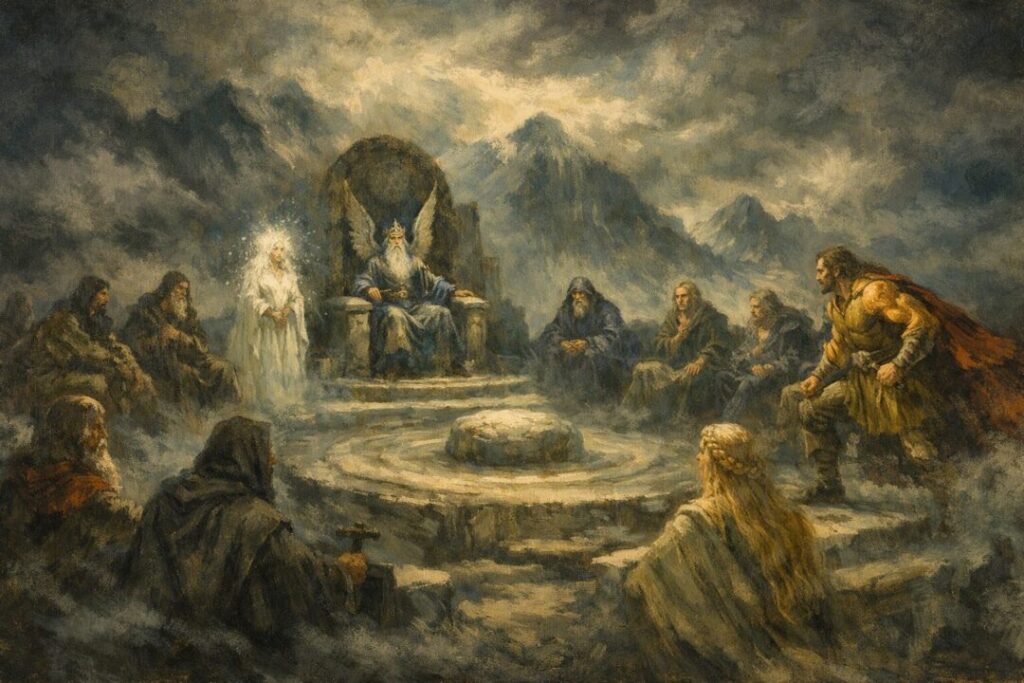
Melkor’s Sin Is Bigger Than War
Melkor is often remembered as the first Dark Lord, the great rebel, the source of vast wars and ruin.
But even that can understate what makes him truly dangerous.
His defining impulse is not merely to defeat rivals in battle. It is to possess, reorder, and dominate what is not his. Tolkien Gateway’s summary of the tradition is direct: Melkor entered Arda wishing to dominate Arda and its creatures, especially the Children of Ilúvatar. That matters because it places domination at the center before the great wars are even fully underway.
This pattern appears everywhere in the early history of Arda.
He mars what others make.
He cannot bear independent beauty.
He does not want a world with many voices in it.
He wants a world that answers to him.
War is one expression of that desire.
It is not the root of it.
That distinction changes how the Valar’s restraint should be read.
If the problem were only military aggression, the solution might simply be greater military force. But if the deeper evil is the will to dominate, then any response that begins to imitate that structure becomes morally perilous, even when used in the name of good. This is an interpretation of the pattern rather than a single stated line, but it fits the way the texts consistently oppose coercive mastery.
The Valar Are Not Meant to Be Masters of the Children
This is the point many readers miss.
The Valar are mighty, but they are not meant to be tyrants, even benevolent ones. Tolkien Gateway summarizes a key principle: their purpose was not to be lords or masters of the Children of Ilúvatar, but to serve as elders and guides. They were prohibited from depriving the Children of free will or dominating them through displays of angelic power.
That is not a minor rule.
It is one of the deepest boundaries in the world.
Elves and Men are not clay for the Valar to shape at will. Their choices matter. Their history matters. Their freedom matters. Even when that freedom leads to grief, the Valar do not have unlimited moral permission to override it.
This is why “Why didn’t the Valar just take over?” is, in one sense, the wrong question.
Because taking over would itself move toward the very logic that defines the enemy.
The Children are not meant to be ruled into goodness.
They must be guided toward it.
Why Open War Is Still Not the Deepest Fear
The Valar do wage war when they judge it necessary.
They go against Melkor for the sake of the newly awakened Elves.
They send force against him in the Battle of the Powers.
And in the First Age, the West finally intervenes in the War of Wrath.
So the claim cannot be that the Valar are absolute pacifists.
They are not.
But each of those interventions comes with an implicit warning.
The Battle of the Powers leaves the shape of Middle-earth changed. In later conception, Tolkien even emphasized the need to shield the Quendi from the violent assault on Utumno as far as possible. The War of Wrath is more devastating still, ending with the destruction of Beleriand.
That means direct conflict at the level of the great Powers is always dangerous.
Yet even that is not the whole picture.
The larger danger is that force on this scale can slide toward governance by overwhelming might. Once divine power begins to order the lives of Elves and Men from above, the line between guardianship and mastery becomes perilously thin. The texts do not phrase it exactly that way, so this should be read as an inference. But it is an inference strongly supported by the rules laid upon the Valar and by the example of the Istari.
Sauron Makes the Threat Clearer Than Morgoth
If Morgoth reveals domination in its primal form, Sauron reveals it in a colder and more concentrated one.
The One Ring is not simply a weapon.
It is an instrument of control.
It is made as the Master Ring, designed to dominate the bearers of the other Rings, and Sauron pours much of his own will and power into it. That is crucial. The Ring is not only about personal enhancement or battlefield power. It is about rule through subordination.
The same pattern appears in Númenor.
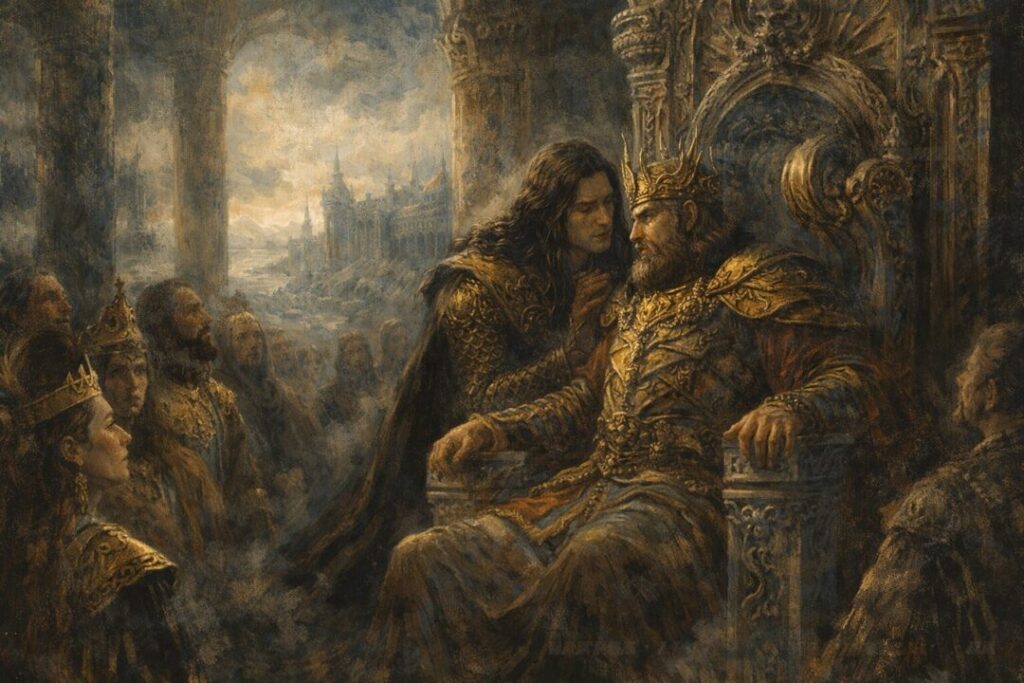
Sauron does not conquer the island first through armies. He corrupts Ar-Pharazôn and becomes the king’s adviser, and most of the Númenóreans come to obey his will. This is what makes Sauron so dangerous. He can turn fear, pride, and desire into voluntary servitude.
That is worse than open war in one very important sense.
A war may destroy a kingdom.
Domination can hollow it out from within until people no longer even recognize that they are serving another mind.
In Tolkien’s own letter to Milton Waldman, the corrupted motive of domination is defined in terms of bulldozing the real world or coercing other wills. That language reaches far beyond battlefield conquest. It names the deeper moral disease.
The Istari Prove the Rule
The mission of the Wizards may be the clearest evidence of all.
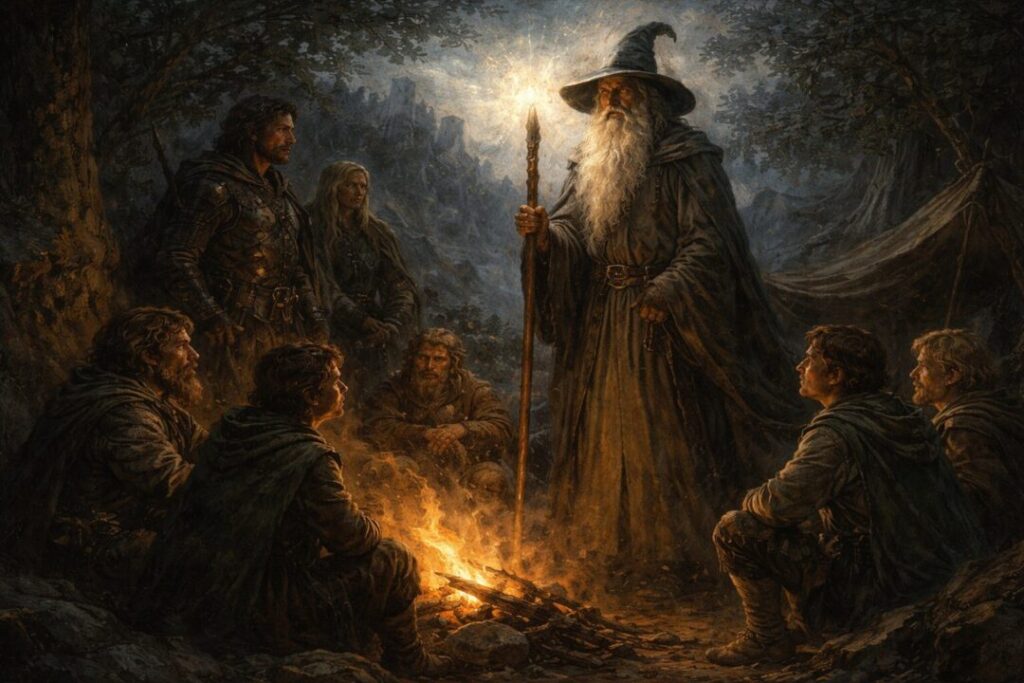
When Sauron rises again, the West does not send another overwhelming army. Instead, the Istari come as messengers meant to stir resistance, encourage courage, and unite those willing to oppose darkness. But they are forbidden to match Sauron’s power with power or to seek domination over Elves or Men by force and fear.
That one line explains an enormous amount.
It explains why Gandalf works through counsel.
It explains why the mission depends on awakening strength in others rather than replacing it.
It explains why Saruman’s fall is so revealing.
Saruman does not merely betray the cause by allying with power.
He betrays it by adopting the enemy’s method.
He turns from persuasion toward control.
From stewardship toward domination.
From resistance to imitation.
And that is why his failure is not accidental.
It is thematic.
He becomes dangerous in exactly the way he was sent to oppose.
Why the Valar’s Restraint Matters
This does not mean every act of force is wrong in Middle-earth.
It does mean that force is never the highest answer.
The highest answer is fidelity to the moral order of the world: that good does not secure itself by seizing absolute mastery over others. Even when evil seems to make that path look efficient, the legendarium repeatedly treats it as corruption. This conclusion is interpretive, but it is rooted in the repeated contrast between guidance and domination, counsel and coercion, resistance and mastery.
That is why the Valar’s restraint is not simple passivity.
It is principle.
They know what war can do to lands and seas.
But more than that, the structure of the world forbids them from becoming the kind of rulers who would simply impose goodness by irresistible power. Once that line is crossed, even victory begins to resemble the enemy’s design.
A Story About Freedom, Not Mere Victory
So why do the Valar fear one thing more than war?
Because war, terrible as it is, is still not the final corruption.
Domination is worse.
It is the impulse behind Morgoth’s rebellion.
It is the logic built into Sauron’s Ring.
It is the temptation placed before the mighty.
And it is precisely what the guardians of the world must refuse, even when refusal is costly.
Once that becomes clear, many of the largest questions in Middle-earth begin to shift.
The issue was never only whether the West had enough power to intervene.
It was whether intervention itself could remain faithful to the order of a world where the wills of Elves and Men were never meant to be owned.
And that is why the legendarium keeps returning to the same quiet truth:
The good does not win by becoming a holier version of domination.
It wins, when it wins at all, by refusing that road.
Sources & Notes
- J.R.R. Tolkien, The Silmarillion, "Ainulindalë" and "Valaquenta" — Melkor’s rebellion is framed as the will to make, possess, and order things for himself rather than serve Ilúvatar’s design.
- J.R.R. Tolkien, The Silmarillion, "Of the Coming of the Elves and the Captivity of Melkor" — the Valar’s war against Utumno shows both their willingness to act and the danger of Power-level conflict in Middle-earth.
- J.R.R. Tolkien, The Silmarillion, "Of the Voyage of Eärendil and the War of Wrath" — the overthrow of Morgoth comes at catastrophic cost, with Beleriand broken and drowned.
- J.R.R. Tolkien, The Lord of the Rings, Book II, Chapter 2, "The Council of Elrond" — the One Ring is treated as a ruling instrument that would corrupt even those who hoped to wield it for good.
- J.R.R. Tolkien, Unfinished Tales, "The Istari" — the Wizards are sent to counsel and encourage resistance, not to match Sauron with power or dominate Elves and Men by force and fear.
- J.R.R. Tolkien, The Letters of J.R.R. Tolkien, Letter 131 — Tolkien describes the corrupt motive of domination as coercing other wills and reshaping the world to one’s own designs.