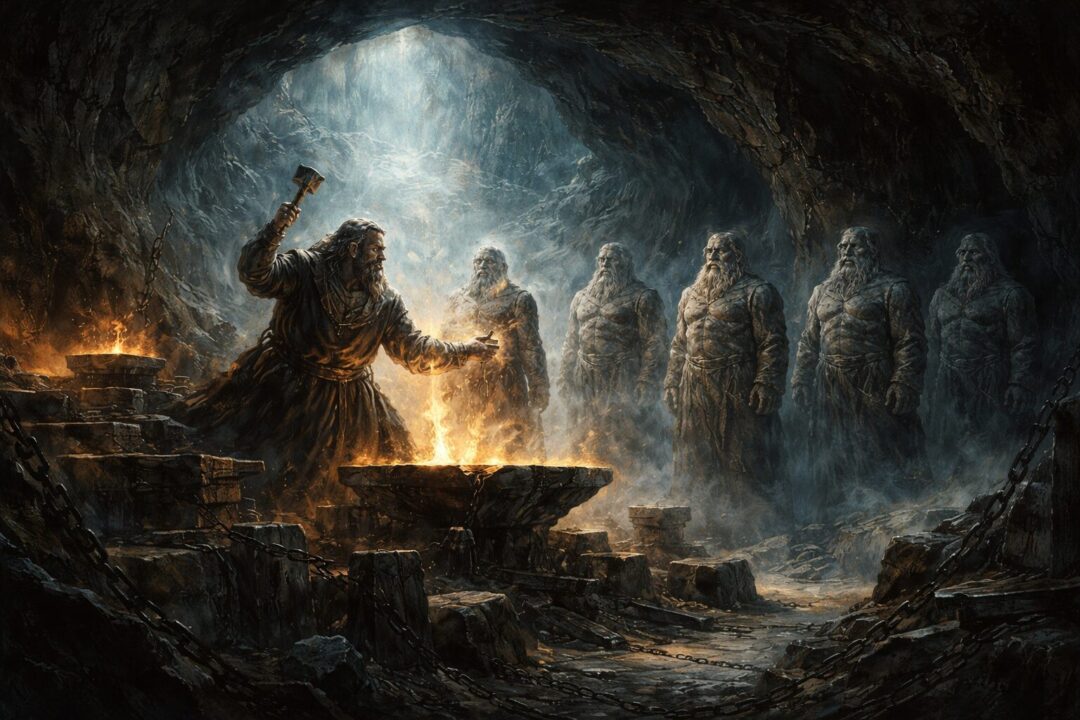
Middle-earth explains the Dwarves in a way it explains almost no one else.
Elves awaken.
Men arrive into the world with a destiny that reaches beyond it.
But the Dwarves begin with an act that was never meant to happen when it did.
That is where Aulë enters the story.
He is often remembered in the simplest possible way: the Vala who made the Dwarves. That is true, but it is not enough. It reduces one of the most revealing moments in the legendarium to a fact of origin, when it is really a statement about craft, humility, and the difference between making and mastery.
And it leaves out the name that matters most to the Dwarves themselves.
They do not primarily remember him as Aulë.
They call him Mahal.
That detail seems small at first. It is not.
Because once that Dwarvish name is taken seriously, Aulë stops being just a background power in the Elder Days and becomes the key to understanding what the Dwarves think they are, where they came from, and what kind of people they were always meant to be. Aulë is one of the Valar, one of the great Powers who shaped Arda, and his province is substance itself: stone, metal, earth, craft, and the works of skilled hands. His joy lies in making rather than possessing, and that distinction is central to his entire role in the mythology.
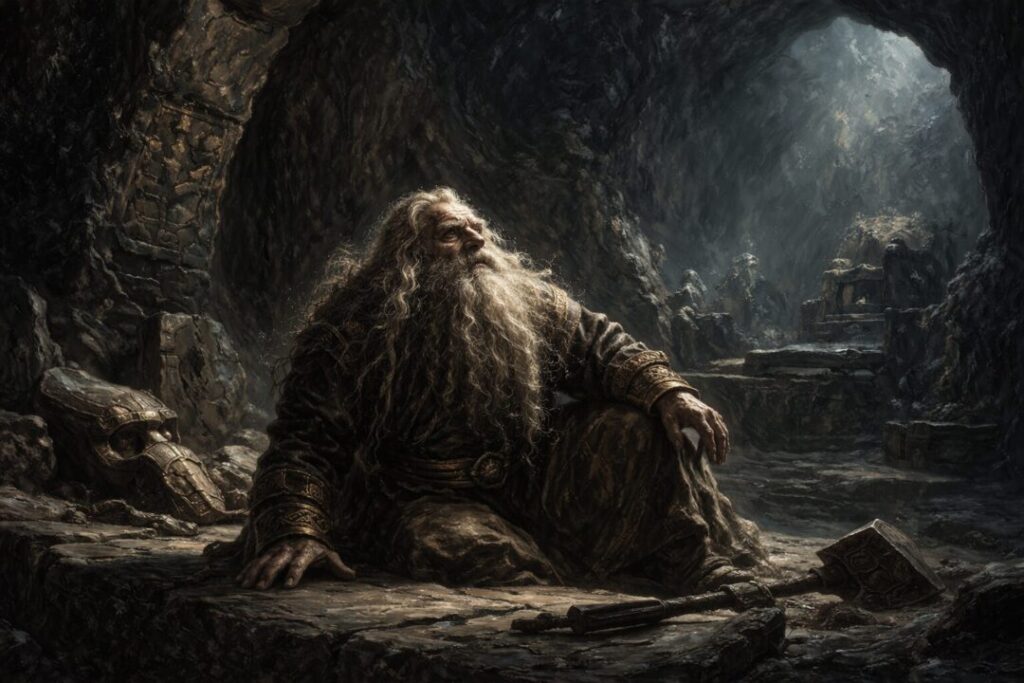
Aulë Was the Great Smith of Arda
Among the Valar, Aulë stands closest to all things that are built, forged, carved, or devised.
He is the smith.
Not merely in the narrow sense of working metal, but in the deeper sense of understanding how the material world can be shaped into form. The texts connect him with rock, ore, craftsmanship, and the very “substances” of Arda. He belongs to making in the broadest and most dignified sense.
That matters because the Dwarves are defined by exactly those things.
They are miners, stone-workers, masons, smiths, builders, and masters of hidden craft. Their greatest realms are not open kingdoms under the sky, but halls cut into mountain roots, cities raised out of endurance and skill. Khazad-dûm, Erebor, Belegost, Nogrod: these are not accidental expressions of Dwarvish culture. They fit their beginning.
But Aulë’s importance is not just that he resembles the Dwarves.
It is that the Dwarves resemble him because they begin with him.
The story does not present this as coincidence or vague affinity. Their nature as lovers of craft is directly bound to the one who first shaped their fathers. The Dwarves follow the pattern of their maker not because he ruled them as a tyrant, but because their earliest form comes from his thought and handiwork.
Why Aulë Made the Dwarves at All
The making of the Dwarves begins with impatience, but not with malice.
That distinction is essential.
Aulë did not create them in mockery of Ilúvatar, nor in rivalry like Melkor. The texts frame his error differently. He was eager for the coming of the Children of Ilúvatar and desired learners to whom he could teach craft and knowledge. He was unwilling to wait for their appointed arrival.
That impatience is real.
It is also a fault.
Aulë acts before his time and outside his authority. In doing so, he commits one of the boldest acts in the mythology. He attempts to make living beings.
But then the story turns.
He cannot truly give them independent life. What he has made moves only under his thought and will. When Ilúvatar confronts him, Aulë does not defend himself in pride. He repents. More than that, he raises his hammer to destroy what he has made, surrendering the work rather than clinging to it against the will of the One.
This is the point where Aulë is most clearly separated from Melkor.
Melkor wants ownership.
Aulë loves making.
And because he loves the making more than possession, he is able to let go.
That is one of the most important truths in the whole story. Aulë’s greatness is not simply that he can make. It is that he refuses to turn making into domination. Tolkien Gateway preserves the line that his delight is in “the deed of making” and “the thing made,” not in possession or mastery. That sentence explains both Aulë’s error and his redemption.
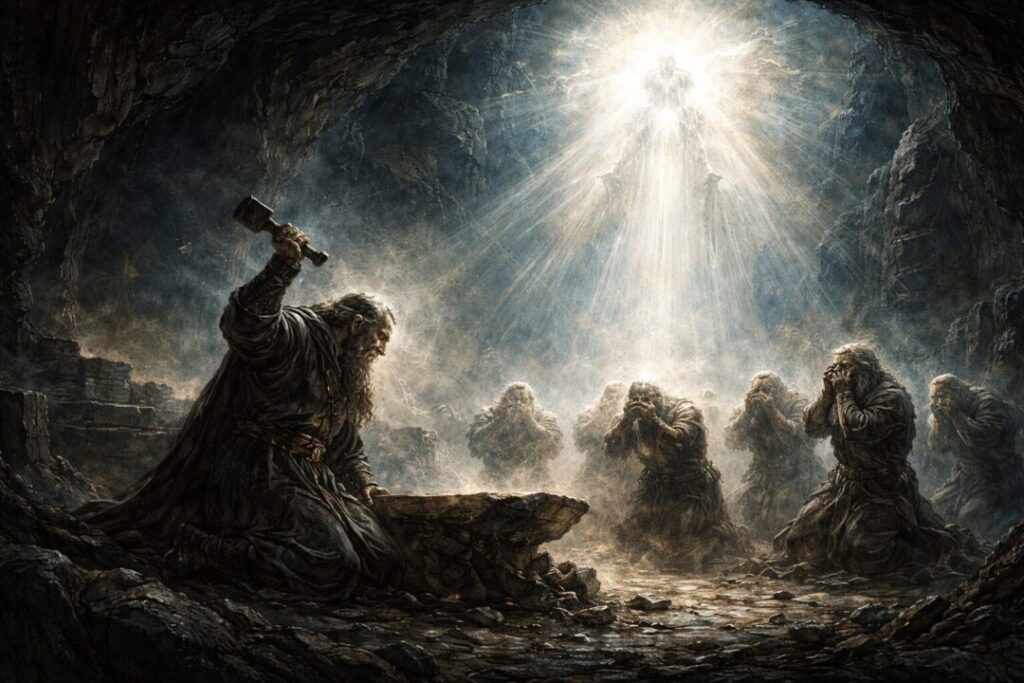
The Dwarves Were Made by Aulë, but Given Life by Ilúvatar
This is where the lore has to be stated carefully.
The Dwarves are indeed made by Aulë.
But they are not fully independent beings until Ilúvatar intervenes.
That means both parts of the story matter.
It would be wrong to say the Dwarves simply created themselves out of Aulë’s skill. It would also be wrong to say Aulë’s part was minor. The texts hold both truths together: Aulë shaped the Seven Fathers, and Ilúvatar granted them true life and a place within the design of Arda. Because Elves were to be the Firstborn, the Dwarves were then laid to sleep until after the Elves had awakened.
That gives the Dwarves an unusual status.
They are not counted among the Children of Ilúvatar in the same way as Elves and Men, yet neither are they outside the order of the world. They are often described as the Adopted Children of Ilúvatar, which captures the strangeness of their place: they begin in Aulë’s making, but are accepted into a larger providence beyond Aulë himself.
This is why their origin feels so different from every other people in Middle-earth.
Their story begins as an error.
But it is not left as an error.
It is taken up, corrected, and given a rightful place.
Why the Dwarves Call Him Mahal
Now the name begins to matter.
The Dwarves do not use the Quenya name Aulë. They call him Mahal, their own name for him in Khuzdul tradition. Tolkien Gateway glosses this as “The Maker,” while The Encyclopedia of Arda is more cautious and notes that this meaning is possible from context, though not completely certain in derivation. The safe conclusion is that Mahal is the Dwarves’ own name for Aulë and is strongly associated with his role as their maker.
That distinction matters for more than language.
To call him Mahal is not just to translate a foreign divine name into Dwarvish custom. It is to remember him according to the relationship most important to Dwarvish memory. Elves may know him chiefly as one of the Valar, lord of craft and substance. The Dwarves know him first as the one who made their fathers.
In other words, “Mahal” is not only a label.
It is a worldview.
It says: our people began with a maker.
Not in the abstract, but literally.
Not metaphorically, but in the shaping of our first fathers under the mountain roots before the coming of the Firstborn.
That is why the name carries more weight than a simple alternate title. It preserves a distinctively Dwarvish understanding of origins.
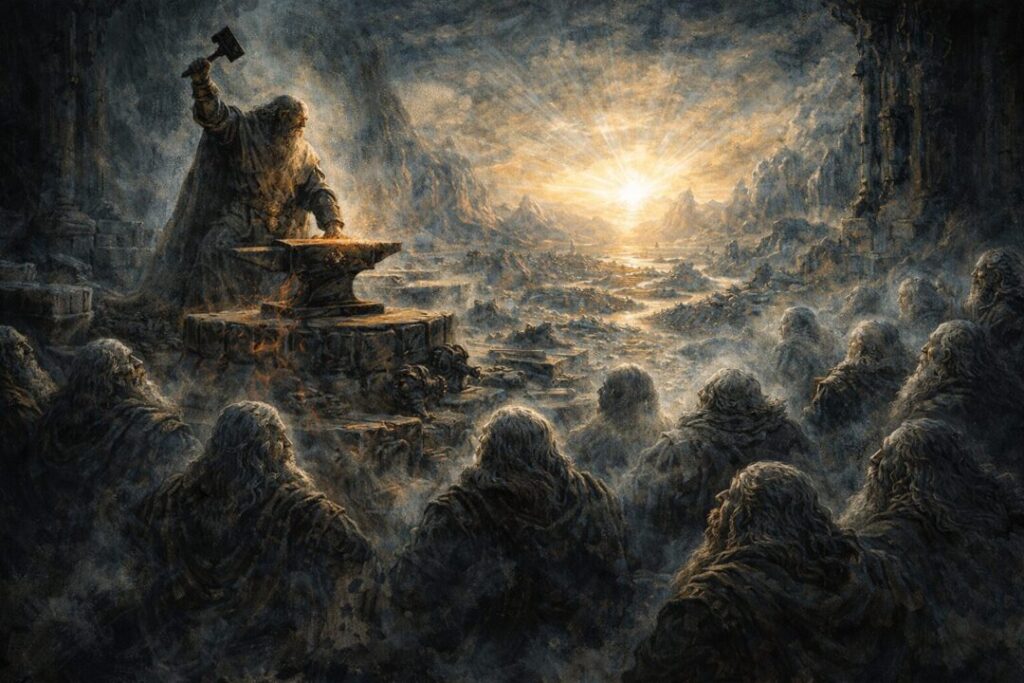
Mahal and Dwarvish Identity
Once the name is seen clearly, the whole structure of Dwarvish identity becomes easier to understand.
Their love of stone is not just cultural taste.
Their devotion to craft is not just a profession.
Their hardiness, reserve, and deep-rootedness in the material world all stand in continuity with the Vala who shaped them. Even their greatest works feel like an echo of Aulë’s province: not airy beauty, not dominion over living things, but endurance made visible in crafted form.
This does not mean the Dwarves are puppets of Aulë. The whole point of Ilúvatar’s intervention is that they become real, independent beings.
But it does mean that Dwarvish civilization bears the mark of its beginning.
The name Mahal keeps that memory alive.
And because Khuzdul is a guarded language, the use of their own name for him matters even more. It suggests intimacy of tradition, something preserved within Dwarvish inheritance rather than borrowed from Elvish lore.
The Stranger Tradition About Their Fate After Death
There is one more reason the name Mahal matters.
It does not end with origin.
In Appendix A tradition, as summarized by standard lore references, the Dwarves say that Aulë the Maker, whom they call Mahal, cares for them after death, gathering them to halls set apart in Mandos. They also say that in the End, after the Last Battle, they will aid him in the remaking of Arda. This is presented as Dwarvish belief or tradition, not as a universally confirmed doctrine, and it should be phrased that way.
But even as tradition, it is revealing.
It shows that Mahal is not only the one who began their race.
He is the one they believe still claims them.
He stands at the start of Dwarvish life and, in their own understanding, at its ending too.
And the final image is perfectly fitting.
Not ruling.
Not conquering.
Making again.
Repairing again.
Helping rebuild a broken world.
Aulë Matters Because He Reveals What the Dwarves Are
The simplest answer to the question is true.
Aulë was one of the Valar, the great Smith of Arda, and the Dwarves call him Mahal because he made their fathers.
But the deeper answer is better.
They call him Mahal because that name preserves the most intimate truth of their history. It is the Dwarves’ way of naming the one through whom their people first entered the story of the world. And because Aulë’s own character is defined not by greed or domination but by the love of making rightly ordered to humility, that origin tells us something profound about the Dwarves themselves.
They are a people of stone, labor, memory, secrecy, endurance, and craft.
They do not merely admire the maker.
They come from him.
And once that is understood, Mahal stops sounding like a stray bit of lore and starts sounding like one of the most revealing names in Middle-earth.
Sources & Notes
- J.R.R. Tolkien, The Silmarillion, “Valaquenta” — Aulë is tied to the substances of Arda, craft, smith-work, and delight in making rather than possession.
- J.R.R. Tolkien, The Silmarillion, “Of Aulë and Yavanna” — Aulë makes the Seven Fathers of the Dwarves, repents, and Ilúvatar grants them true life.
- J.R.R. Tolkien, The Silmarillion, “Of Aulë and Yavanna” — the Dwarves are set to sleep until after the awakening of the Firstborn.
- J.R.R. Tolkien, The Lord of the Rings, Appendix A, “Durin’s Folk” — Dwarvish tradition names Aulë as Mahal and connects him with their origin and final hope.
- J.R.R. Tolkien, The Lord of the Rings, Appendix F, “The Languages and Peoples of the Third Age” — background on the guarded nature of Khuzdul and Dwarvish tradition.