When readers first move through Middle-earth, its titles can seem familiar.
King. Lord. Steward. Prince.
They sound close enough to one another that it is easy to flatten them into a general language of rank and prestige. A king is above a lord. A steward is some kind of administrator. The words appear old-fashioned, but straightforward.
The problem is that Middle-earth does not use them loosely.
Again and again, the stories attach very precise meanings to titles. They are not merely decorative. They signal different kinds of legitimacy, duty, inheritance, and restraint. And nowhere is that clearer than in Gondor, where one title is deliberately refused for nearly a thousand years even while another holds the realm together.
That detail matters more than it first appears.
Because once you stop reading these words as atmosphere and start reading them as political and moral language, an important pattern emerges:
Middle-earth cares not only about who has power, but about what kind of power it is.
King Does Not Simply Mean “The One In Charge”
The easiest mistake is to assume that a king in Middle-earth is simply the strongest ruler available.
The texts point to something narrower than that.
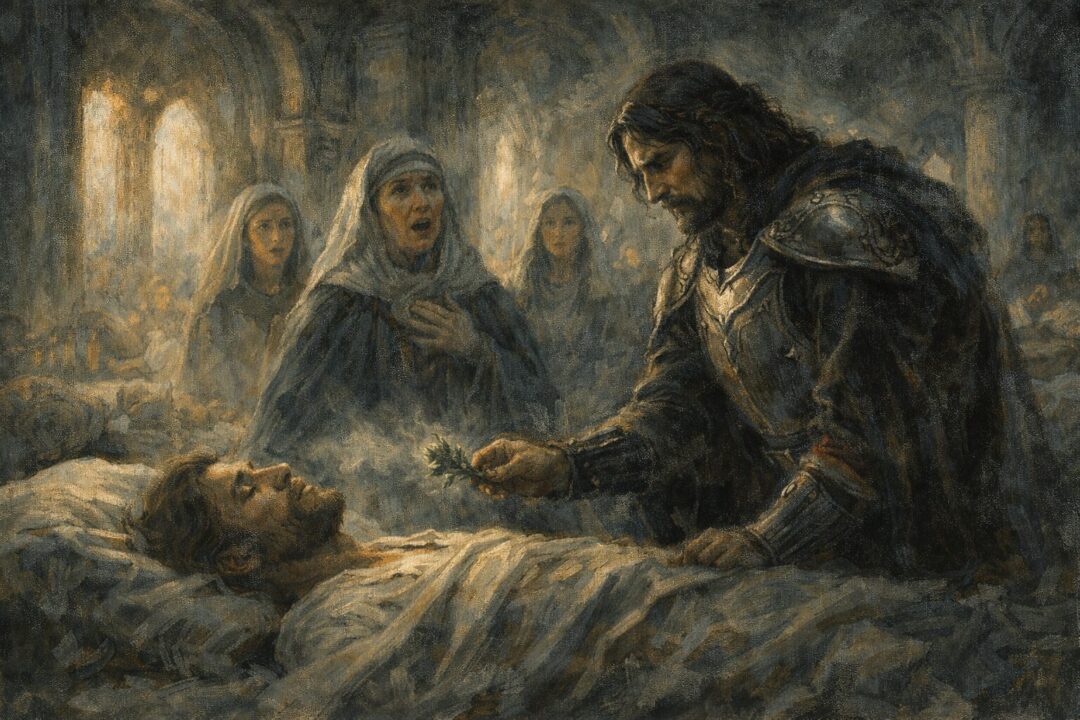
A king is usually tied to lawful inheritance, recognized lineage, and a deeper continuity between realm and ruler. In Gondor, this becomes especially important. The return of Aragorn is not treated as the arrival of a useful military commander who happened to win a war. It is treated as the restoration of a kingship that had remained vacant in a meaningful sense.
That is why the announcement of Aragorn matters so much.
Faramir does not present him merely as a victorious captain. He names his line, his descent, his tokens, and the old signs attached to rightful rule. The healing in the Houses of Healing is not random wonder-working. It confirms an older expectation: that the true king is known in part by restoration, not domination.
This is crucial to understanding kingship in Middle-earth.
A king is not just a man who governs.
He is, in the strongest cases, the proper bearer of an office that links past and present, bloodline and realm, memory and obligation.
That is why Aragorn cannot simply declare himself and be done with it. He must be recognized.
A Steward Is Powerful Precisely Because He Is Not King
No title is more misunderstood than Steward.
Modern readers often hear the word and think of a servant in a reduced sense, someone secondary, ceremonial, or politically weak. But Gondor’s Stewards are none of those things. They command armies. They hold the city. They govern the realm for generations.
And still, they are not kings.
That distinction is not accidental. It is the whole point.
The office began as that of a chief councillor to the kings of Gondor, and after King Eärnur vanished without an heir, Mardil became the first Ruling Steward, governing the realm until the king should return. The title itself preserves a limit. The Steward may rule, but he does so in custody, not in possession.
That is why the old Gondorian attitude matters so much.
When Boromir once asked how long it would take for a steward to become a king if the king never returned, Denethor’s answer was severe: in Gondor, not even ten thousand years would suffice. That line tells us something fundamental. The office of Steward was never meant to ripen into kingship by habit, convenience, or mere duration.
So the Steward’s dignity comes from restraint.
He is a ruler defined not only by what he may do, but by what he may not claim.
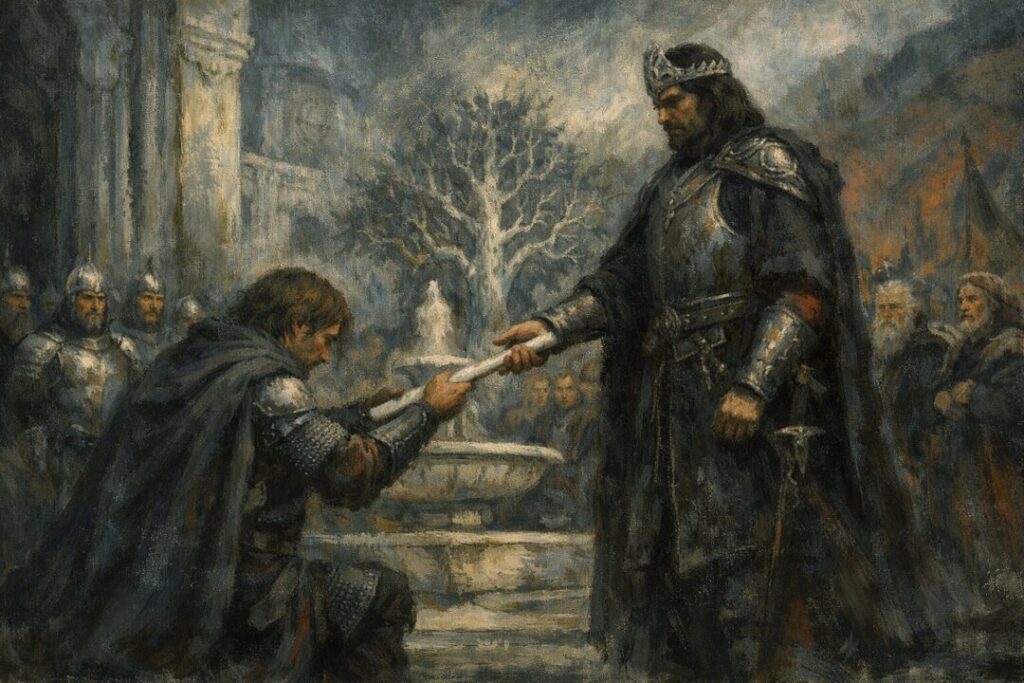
That is also why Faramir matters so much at the end of the war. He does not try to convert his authority into something larger. He performs the office exactly as Gondor’s tradition says he should: by receiving the king and yielding the rule he was only meant to hold in trust.
Lord Is the Most Flexible Title of All
If King is narrow and Steward is conditional, Lord is broader.
This is where many readers get tripped up.
In Middle-earth, “lord” can refer to a ruler, a territorial master, a noble superior, or a figure of recognized authority without implying full kingship. The title appears across different peoples and political structures, which means it does not carry one fixed constitutional meaning.
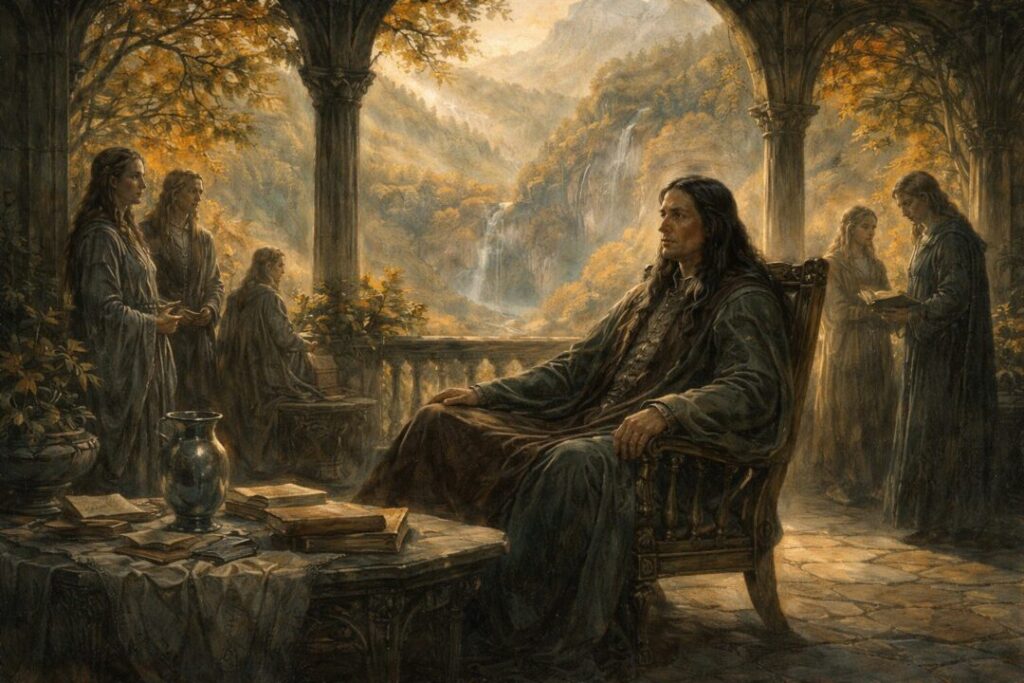
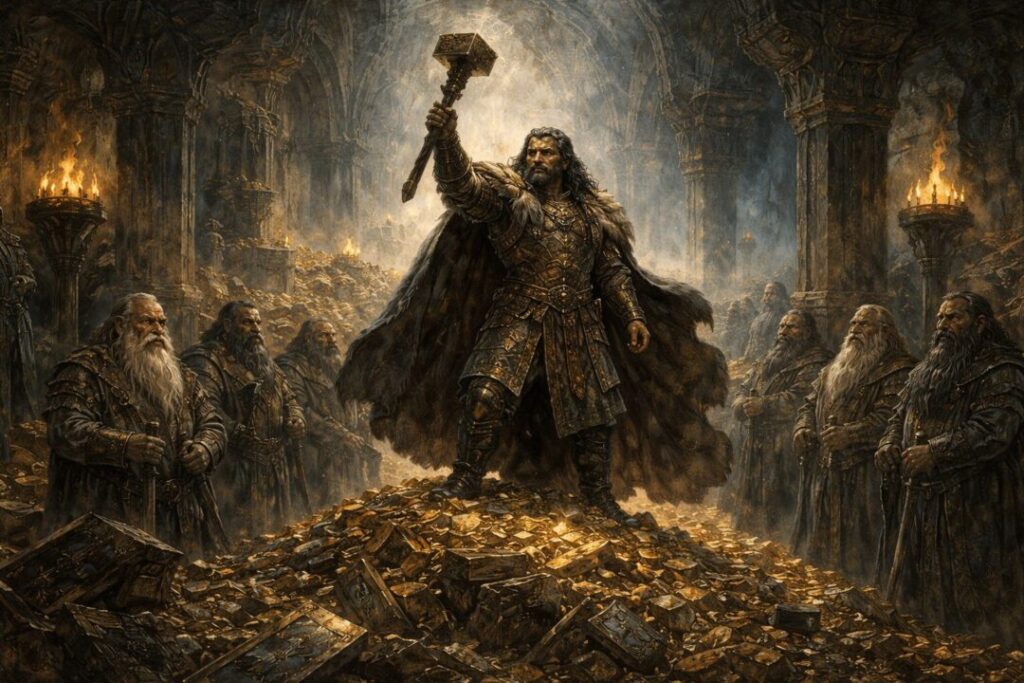
Elrond is Lord of Rivendell. That does not make him a king in exile. It marks him as the acknowledged master of that house and refuge. Gimli becomes Lord of the Glittering Caves, which signals overlordship of the colony he founds there, not a Dwarven kingship on the level of Erebor. Théoden uses the language of lord of the Mark, and the Rohirric world clearly overlaps the language of lordship and kingship in ways that are related but not identical.
That flexibility is important.
“Lord” often tells you that someone possesses authority, but not always what the final legal or dynastic source of that authority is.
In other words, it is a real title, but not the clearest one.
That is why someone may be called lord without being sovereign in the fullest sense.
Dwarves Use Kingship Differently, but Just as Seriously
The Dwarves help sharpen the contrast.
Thorin’s claim is not vague lordship. It is the title King under the Mountain. That phrase is territorial, hereditary, and dynastic. It ties rule to Erebor itself and to the royal line of Durin’s Folk that held it. When the line is broken by exile or disaster, the title does not simply vanish into whoever happens to be strongest. It remains something that can be restored to a rightful heir.
That pattern makes Middle-earth feel internally consistent across cultures.
The exact forms vary, but kingship is repeatedly linked with legitimacy that goes beyond possession.
You do not become king merely because you sit in the hall.
You must stand in the right relation to the realm.
Why Gondor Never Confused Stewardship with Kingship
This is the heart of the whole question.
If the Stewards ruled Gondor for nearly a thousand years, why did the title of king continue to matter so much?
Because Gondor did not believe authority was only practical.
A Steward could preserve the realm, defend it, administer it, and even embody much of its dignity. Denethor is described in terms that make this plain. He is formidable, lordly, and in bearing almost kingly. Yet that is exactly the point: “almost” is not “is.”
The kingdom’s memory still distinguished between rule exercised on behalf of the crown and rule possessed by right.
That distinction may sound abstract, but in Middle-earth it has moral weight.
A Steward who remains a Steward is honorable because he does not convert trust into ownership.
A king who truly is king restores what the office itself could not generate on its own.
And a people who remember the difference show that they have not reduced legitimacy to mere force or mere efficiency.
That is why Aragorn’s return is not presented as a coup, a replacement, or an upgrade.
It is a homecoming into a vacancy the realm never stopped acknowledging.
Titles in Middle-earth Are Really About Obligation
What makes these titles so compelling is that they rarely function as ornaments.
They carry burden.
A king must heal, preserve, and inherit rightly.
A steward must guard what is not finally his.
A lord must hold authority appropriate to his place, people, or dwelling.
Even when the language is grand, the moral pressure behind it is usually one of service.
That is one reason Middle-earth’s political vocabulary feels older and heavier than modern readers often expect.
These are not brands.
They are duties made visible in words.
And that is why the distinction between lord, steward, and king matters so much.
Not because the stories are obsessed with ceremony for its own sake.
But because Middle-earth repeatedly insists that power is never the whole question.
The deeper question is always whether the person holding that power has the right to hold it, the humility to limit it, and the character to use it as something received rather than seized.
Once that clicks, Gondor changes.
So does Rohan.
So does Erebor.
And the return of the king stops being a dramatic title and becomes something much more exact.
It means that after long years of rule without possession, custody without crown, and endurance without final restoration, Middle-earth still remembers the difference between governing a realm and truly being its king.
Sources & Notes
- J.R.R. Tolkien, The Lord of the Rings, Appendix A, “Gondor and the Heirs of Anárion” — explains the line of Gondor’s kings, Eärnur’s disappearance, and Mardil’s rule as Steward until the king should return.
- J.R.R. Tolkien, The Lord of the Rings, Book V, Chapter 8, “The Houses of Healing” — connects Aragorn’s rightful kingship with healing and the old saying that the hands of the king are the hands of a healer.
- J.R.R. Tolkien, The Lord of the Rings, Book IV, Chapter 5, “The Window on the West” — gives Denethor’s “ten thousand years” answer to Boromir’s question about whether a Steward could become king.
- J.R.R. Tolkien, The Lord of the Rings, Book VI, Chapter 5, “The Steward and the King” — shows Faramir acting as Steward by formally yielding rule and receiving Aragorn as king.
- J.R.R. Tolkien, The Hobbit, Chapter 1, “An Unexpected Party” — presents Thorin as heir of Thráin and grandson of Thrór, King under the Mountain, grounding Dwarvish kingship in lineage and Erebor.