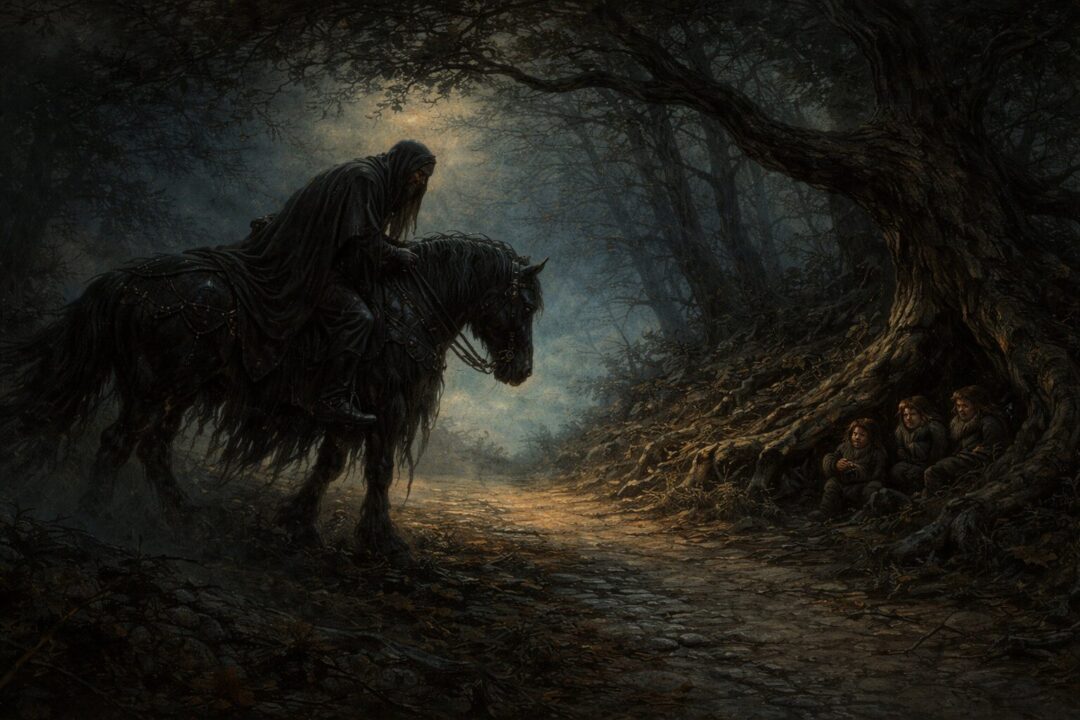
The Nazgûl are often treated as if they possess a kind of perfect supernatural awareness.
They do not.
That assumption is understandable. The Black Riders feel relentless. They appear at the edge of roads, on lonely hills, beneath trees, at the Ford, and later in the shadows of war itself. They seem less like hunters than inevitabilities.
But the text gives them something more precise than omniscience.
It gives them distorted perception.
That distinction matters, because once it is noticed, many of the most important scenes in The Lord of the Rings begin to read differently. The Nazgûl are not terrifying because they know everything. They are terrifying because they perceive the world through a different order of sense—one that makes them extraordinarily dangerous, but not infallible.
They Do Not See the Ordinary World Normally
One of the clearest explanations comes from Aragorn.
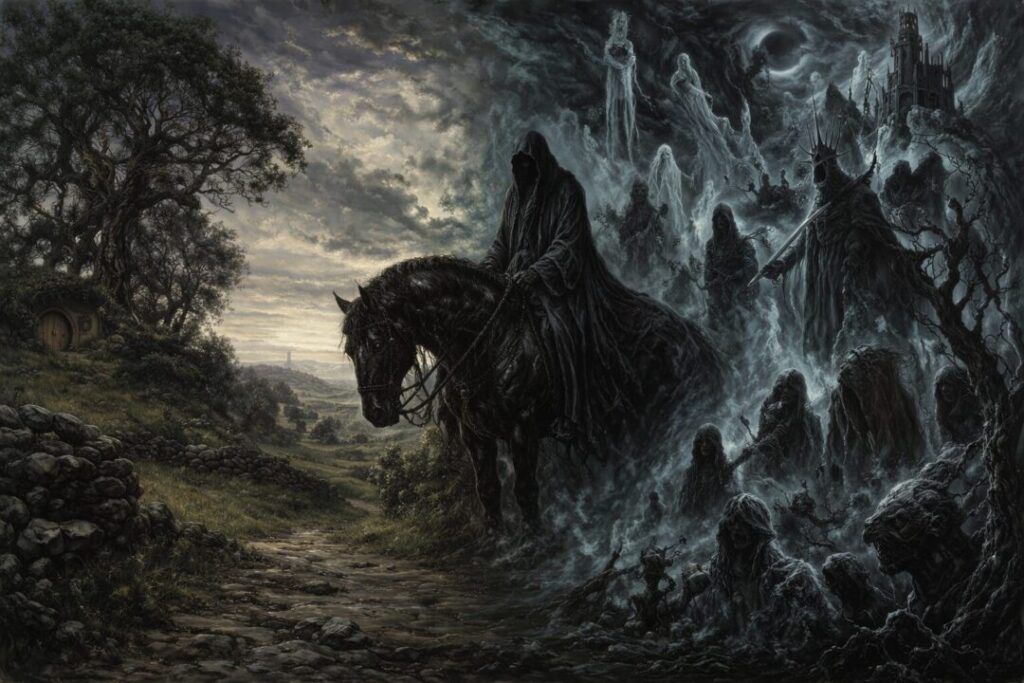
When he speaks about the Riders on the road to Weathertop, he does not describe them as blind in any simple sense. But he does say they do not see “the world of light” as ordinary living people do. Instead, living beings cast something like shadows in their minds, and darkness strengthens their perception rather than weakening it.
This is the first correction that matters.
The Nazgûl are not merely hooded men with bad eyesight. Nor are they invisible spirits who somehow detect everything around them. Their relation to the visible world is impaired, altered, and incomplete.
That is why daylight matters.
Aragorn specifically says that the noon sun diminishes this shadow-like perception. Darkness, by contrast, makes them more dangerous. So the books do not present them as equally aware under all conditions. Their power of detection is stronger in certain states of the world than in others.
That already rules out a common modern reading.
The Nazgûl are not magical scanners sweeping the landscape. Their perception is real, but conditional.
They Can Smell the Living
Aragorn then adds a detail that is easy to remember but rarely taken seriously enough.
The Nazgûl smell the blood of living things.
That line is not ornamental. It helps explain why their movements often feel animal-like as well as spectral: the lowered heads, the listening stillness, the cold searching presence, the unsettling sense that they are not merely looking but testing the air around the living world.
This also helps make sense of a scene that otherwise feels almost theatrical: the sniffing Black Rider in the Shire.
That moment is not just there for atmosphere. It reflects the way the Riders actually track. Their relation to living creatures includes more than sight. They are drawn toward embodied life, and that attraction is not gentle. Aragorn says they both desire and hate the blood of the living.
That phrase matters because it captures the contradiction at the center of them.
They were once Men.
Now they are beings unnaturally stretched past ordinary mortality, still tied to living flesh and yet alienated from it. Their sensing of blood is part of what makes them so unnerving. They do not merely detect life. They are hostile to it.
They Can Feel Presence, Not Just See It
Aragorn says something even more important after that.
There are senses other than sight or smell.
The companions can feel the presence of the Riders before seeing them, and Aragorn says the Nazgûl feel the presence of the living even more keenly. This is one of the strongest textual clues for how their hunt really works.
They are not simply searching visually.
They are perceiving presence.
This does not mean mind-reading. The books never suggest that the Nazgûl can open thoughts like a door and inspect whatever is inside. But it does mean they respond to a kind of nearness of life, fear, and vulnerable being. Their presence presses on the hearts of others, and the reverse is also true.
That is why they can feel close before they become visible.
That is also why so many encounters with them begin with dread before form.
The Ring Draws Them—but Not Like a Beacon
Aragorn adds one more line in the same passage: “the Ring draws them.”
That is true.
But readers often turn that truth into something larger than the text supports.
The story never shows the Nazgûl using the Ring like a perfect locating signal. If that were the case, Frodo’s concealment would fail almost immediately, and many of the long evasions in the Shire, on the road, and later in the wilderness would become hard to explain.
Instead, what the narrative shows is attraction without precision.
They are drawn toward it. They become more dangerous when it is used. They are hunting for it specifically. But they still need information, roads, timing, witnesses, terror, and pursuit. Sauron himself sends them out asking questions. They do not ride directly to the Ring at once as if summoned by an exact inward map.
That restraint is important.
The Ring exerts a pull within a larger field of uncertainty. It is not a lantern tied to Frodo’s hand.
Why Wearing the Ring Changes Everything
At Weathertop, Frodo puts on the Ring.
The scene alters immediately.
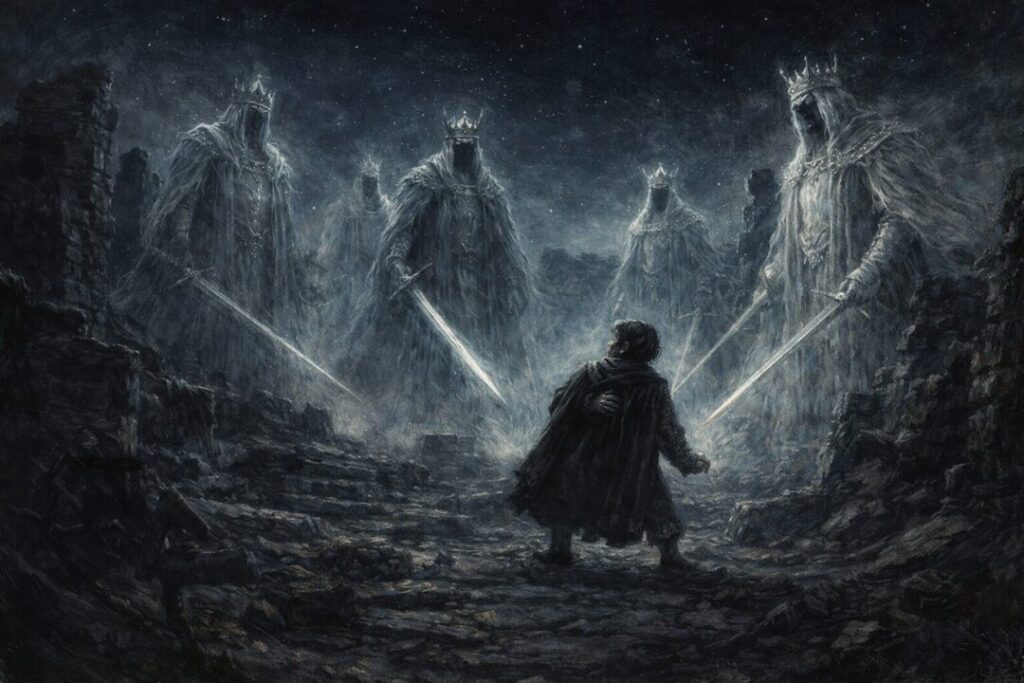
He no longer sees the Riders as vague black shapes wrapped in cloaks. He sees them more clearly, as pale kings with helms and swords, terrible and distinct. This is one of the clearest demonstrations of what happens when a bearer is shifted toward the Unseen.
The Nazgûl belong partly to that realm. Frodo, by wearing the Ring, enters their field of visibility more fully.
This does not mean that the Ring always broadcasts its wearer in the same way under all circumstances. The text is more cautious than that. But it does show that using the Ring changes the terms of perception between bearer and wraith.
The attack on Weathertop is therefore not just a physical assault.
It is a moment in which Frodo steps closer to the plane on which the Nazgûl most truly exist.
That is why the danger sharpens so suddenly.
The Morgul Wound Pushes Frodo Further Toward Their World
The next crucial detail is the wound.
After Weathertop, Frodo does not simply suffer pain. He begins to slip. By the time he reaches the Ford, his perception is altered even without wearing the Ring. He can see the Riders with abnormal clarity, and later Gandalf explains why.
Had the splinter remained, Frodo would in time have become a wraith under the Dark Lord.
This is one of the strongest answers to the question of Nazgûl perception, because it shows that the boundary between worlds is not fixed. A living person can be drawn across it. Frodo’s changing vision is not random; it is a symptom of spiritual displacement.
So when Frodo sees more than ordinary eyes should see, the text is not making the Nazgûl inconsistent.
It is showing Frodo becoming vulnerable to the mode of being in which they dwell.
Glorfindel Reveals the Other Half of the Picture
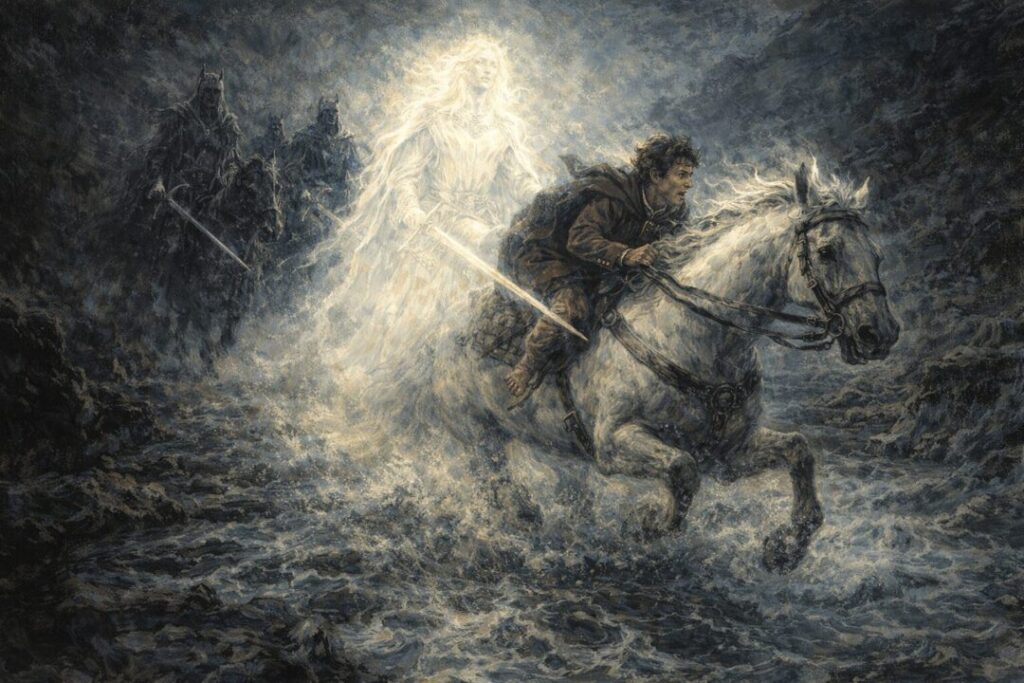
At the Ford, Frodo also sees Glorfindel as a white figure that does not dim like the others.
That detail is easy to overlook, but it is one of the most revealing in the entire discussion.
Later, Gandalf confirms that Frodo saw Glorfindel “as he is upon the other side.”
That means the Unseen is not merely a realm of corruption, horror, or dark sorcery. It also includes the intensified spiritual presence of the mighty among the Eldar. Glorfindel is especially dangerous to the Nazgûl not only because he is brave or skilled, but because he exists with force in the very dimension where their own perception is strongest.
This tells us something crucial.
The Nazgûl can perceive more than ordinary bodies. They are alert to beings whose spiritual presence is potent in the Unseen. That is part of why Glorfindel is such a threat to them, and why they shrink from him.
Their senses are therefore not broad in every direction.
They are deep along one axis.
What They Cannot Do
Once all of this is put together, the limits become clearer.
The Nazgûl cannot simply see everything everywhere.
They cannot track the Ring with flawless precision across all distances and conditions.
They cannot rely on ordinary daylight sight the way living riders can.
They are not shown reading minds.
And they are not independent masters of perception equal to Sauron in awareness. The clearest moment of sudden, exact recognition comes not from the Nazgûl but from the Dark Lord when Frodo claims the Ring at Sammath Naur. That late revelation matters precisely because such certainty is not treated as constant beforehand.
So the Black Riders are not blind.
But neither are they all-seeing.
They are beings who sense life, fear, blood, and spiritual presence with unnatural intensity, especially in darkness and especially when the boundary of the Unseen is crossed.
Why This Makes Them More Frightening, Not Less
The Nazgûl would actually be simpler if they were omniscient.
Then they would be only a problem of power.
But the books make them stranger than that. They are hunters who feel around the edges of the living world, catching scent, shadow, and weakness. They are close enough to be felt before seen. They are drawn by the Ring, but not served by certainty. They live in a warped mode of perception that is both heightened and crippled.
That is why their pursuit feels so oppressive.
They do not descend like gods.
They press inward like dread.
And that may be the real answer.
The Nazgûl are terrifying not because nothing can escape their notice, but because they can sense just enough of the living and the Unseen to make hiding from them feel uncertain at every step.
Sources & Notes
- J.R.R. Tolkien, The Lord of the Rings, Book I, Ch. 11, “A Knife in the Dark” — Aragorn explains that the Riders do not see the world of light as living people do, but perceive shadows, smell blood, and sense living presence.
- J.R.R. Tolkien, The Lord of the Rings, Book I, Ch. 11, “A Knife in the Dark” — Frodo’s use of the Ring at Weathertop makes the Ringwraiths appear in their terrible unveiled forms, showing the shift toward the Unseen.
- J.R.R. Tolkien, The Lord of the Rings, Book I, Ch. 12, “Flight to the Ford” — Frodo’s wound changes his perception as he nears wraithdom, and he sees both the Riders and Glorfindel with altered sight.
- J.R.R. Tolkien, The Lord of the Rings, Book II, Ch. 1, “Many Meetings” — Gandalf explains the Morgul-knife’s purpose and says Frodo saw Glorfindel as he is “upon the other side.”
- J.R.R. Tolkien, Unfinished Tales, “The Hunt for the Ring” — the Nine rely on questioning, roads, fear, and pursuit, supporting the article’s point that their search is powerful but not an exact Ring-beacon.