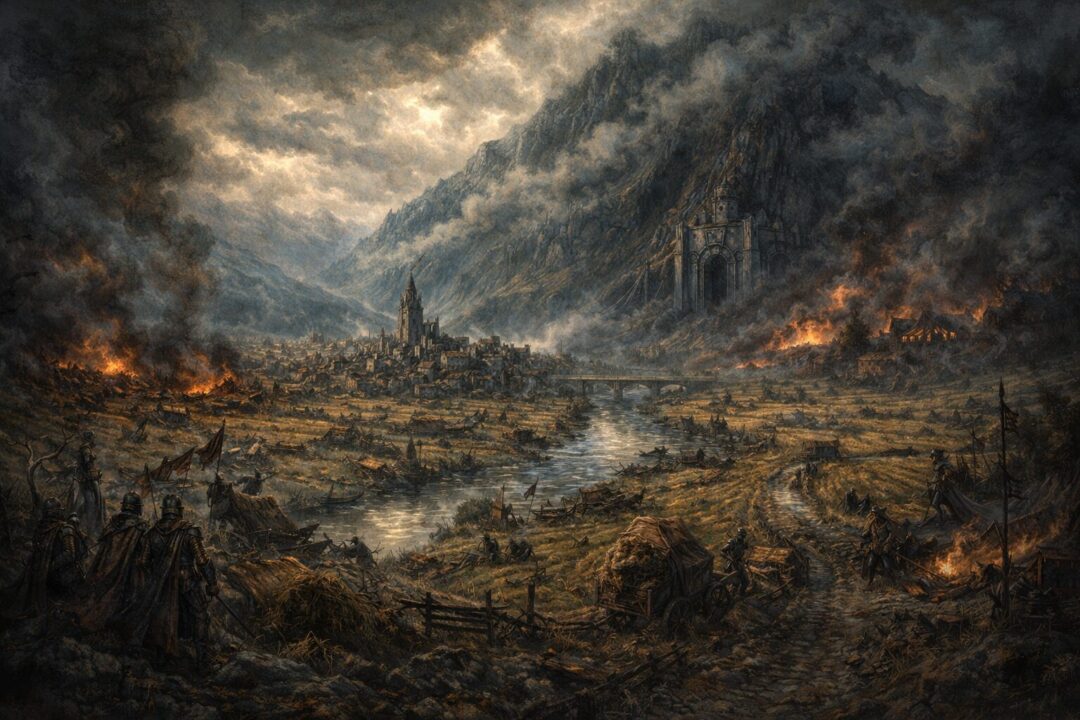
When people imagine famine in Middle-earth, they usually look first toward the bleakest land on the map.
They think of Mordor.
They think of ash, slag, barrenness, and the mechanical violence of Sauron’s war-making. It seems like the obvious answer. If a great war spread across Middle-earth, surely the first land to starve would be the darkest one.
But the texts point in a more complicated direction.
Because famine in war does not begin only where the soil is worst.
It begins where food can no longer move.
It begins where fields are abandoned, orchards burned, roads cut, ports closed, river trade broken, and large populations suddenly depend on stores that were never meant to last. In that sense, the first hunger in Middle-earth would likely strike not in the most visibly cursed land, but in the places where agriculture and war stand closest together. That is an inference from the texts rather than a line stated outright, but it fits the geography and military pressure the narrative actually gives us.
Mordor Is Not the Simple Answer
At first glance, Mordor seems unavoidable.
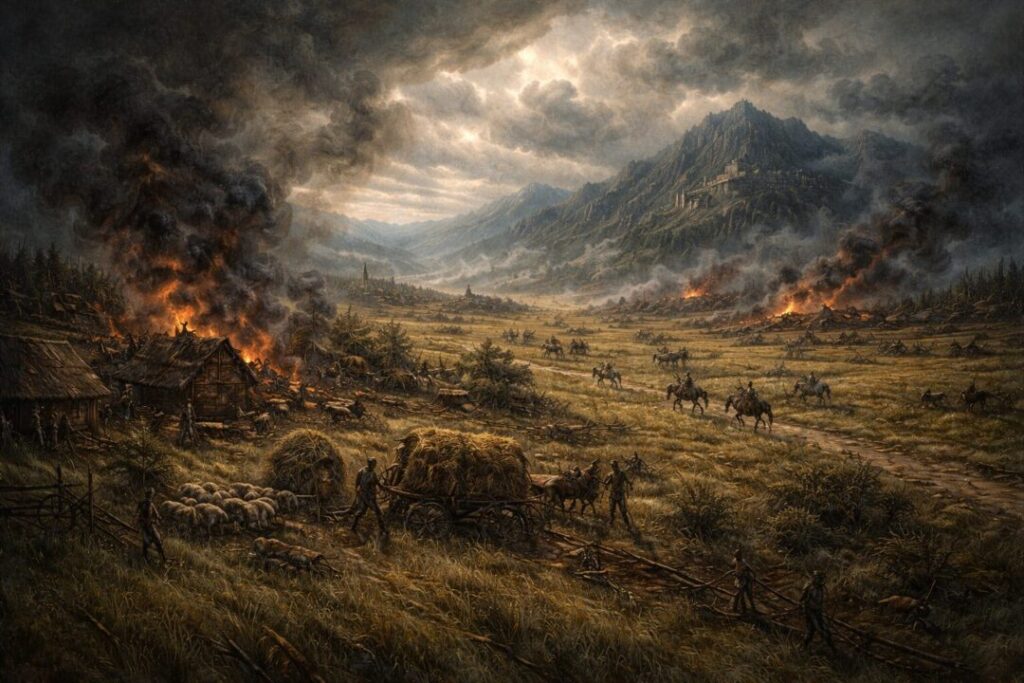
Much of it is harsh and inhospitable, especially Gorgoroth. But the crucial detail is that Sauron’s realm does not rely on Gorgoroth itself for ordinary sustenance. The texts point instead to Núrn in southern Mordor, where slaves work the fields around Lake Núrnen to feed Sauron’s armies. That means Mordor’s war-machine already depends on a separate agricultural base inside the realm.
That matters because it shifts the question.
Mordor is not self-sustaining everywhere. It is a militarized state drawing food from a specific productive region. So if we are asking where hunger would appear first, the answer is not “where the land looks dead,” but “where the logistical chain is most strained.” Mordor can still suffer hunger, especially if its armies overextend or if Núrn is disrupted, but the texts do not present it as a realm already starving by default.
In other words, Mordor is dangerous because it organizes food brutally, not because it has no food at all.
Why Minas Tirith Is One of the Strongest Answers
If we move from appearance to logistics, Minas Tirith becomes far more important.
The city is powerful, but it is still a city. Cities do not feed themselves. The Pelennor is not decorative land around the White City. It is productive farmland, with tilled fields, orchards, barns, livestock, granaries, and kilns. Nearby regions such as Lossarnach and Anórien are likewise fertile, and Lossarnach in particular supplies much of the fruit required in Minas Tirith.
That means Gondor’s capital sits beside one of the clearest food systems described in the narrative.
And the war strikes it directly.
Before the siege, the people and livestock are withdrawn, the Rammas Echor is overrun, homes and trees are burned, and trenches of fire are cut across the Pelennor. This is not just military pressure. It is the destruction or suspension of the food-bearing land that supports the city. Once that happens, Minas Tirith becomes exactly the kind of place where famine can arrive very fast: a fortified concentration of people cut off from the fields nearest to it.
This is why Minas Tirith may be the clearest answer if we mean the first major population center to face acute hunger in a full war.
Not because Gondor lacks fertile land.
But because Gondor’s fertility lies directly in the path of invasion.
Gondor’s Real Vulnerability Is Concentration
There is another reason Gondor stands out.
Its strength is also its weakness.
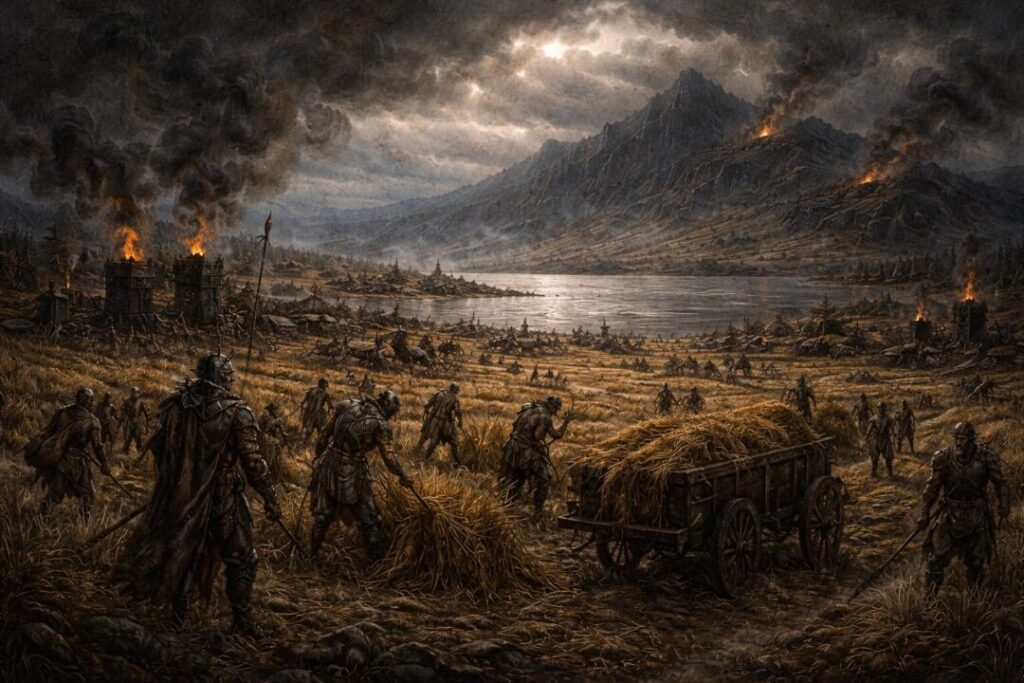
Gondor has multiple productive regions, not just the Pelennor: Lossarnach, Anórien, Lebennin, and the southern lands linked to Pelargir. That makes it richer and more resilient than a single valley kingdom. But it also means Gondor fights as a structured realm of roads, fiefs, river movement, ports, and defended centers. Once enemies strike from several directions at once—Mordor in the east, corsairs on the coast, pressure on the river routes—the danger is not merely battlefield defeat. The danger is disconnection.
A scattered village can hide or flee.
A great city cannot.
So if war deepens and the supporting countryside is devastated, Gondor’s people do not simply “go elsewhere.” They compress inward. They rely on stored grain, organized transport, and relief from other fiefs. If those lines fail, famine follows quickly. Again, the text does not say, “Minas Tirith starved,” because relief came in time. But the siege shows how close such a city sits to that edge.
Dale and Erebor May Be Even More Fragile Than They Look
If Minas Tirith is the strongest southern answer, Dale and Erebor may be the strongest northern one.
Dale prospers because the valley is cultivated and because trade flows along the River Running to Long Lake and beyond. The rebuilt realm is explicitly tied to tillage and commerce: the valley becomes tilled again, and wealth returns through exchange between Dale, Lake-town, and Erebor. That is prosperity, but it is also dependency.
A narrow valley kingdom can be rich without being secure.
If war blocks the river, severs the roads, or forces the population behind defenses, the food question becomes immediate. Erebor itself is a mountain stronghold. Mountains do not produce broad agricultural surplus. That is one reason the old relationship mattered so much: Men of Dale provided food and trade, while Dwarves supplied craft and wealth. The arrangement is strong in peace and vulnerable in siege.
This is why the north deserves more attention than it often gets.
A war that presses on Dale and Erebor does not merely threaten two allied realms. It threatens a tightly linked local economy built on valley agriculture, river movement, and exchange between mountain and town. That kind of network can break suddenly.
So if we are not speaking of a capital under immediate siege, but of a kingdom that could tip into shortage very quickly, Dale may be one of the best answers in all Middle-earth.
Rohan Would Suffer Differently
Rohan is a more complicated case.
It is a land of herdsmen and farmers, and much of its population dwells in villages or farms scattered across broad grasslands. That gives it a kind of resilience. It is not as dependent on one walled city as Minas Tirith is, and it is not concentrated in one narrow trade corridor like Dale.
But Rohan has another problem.
Its openness makes it easy to ravage.
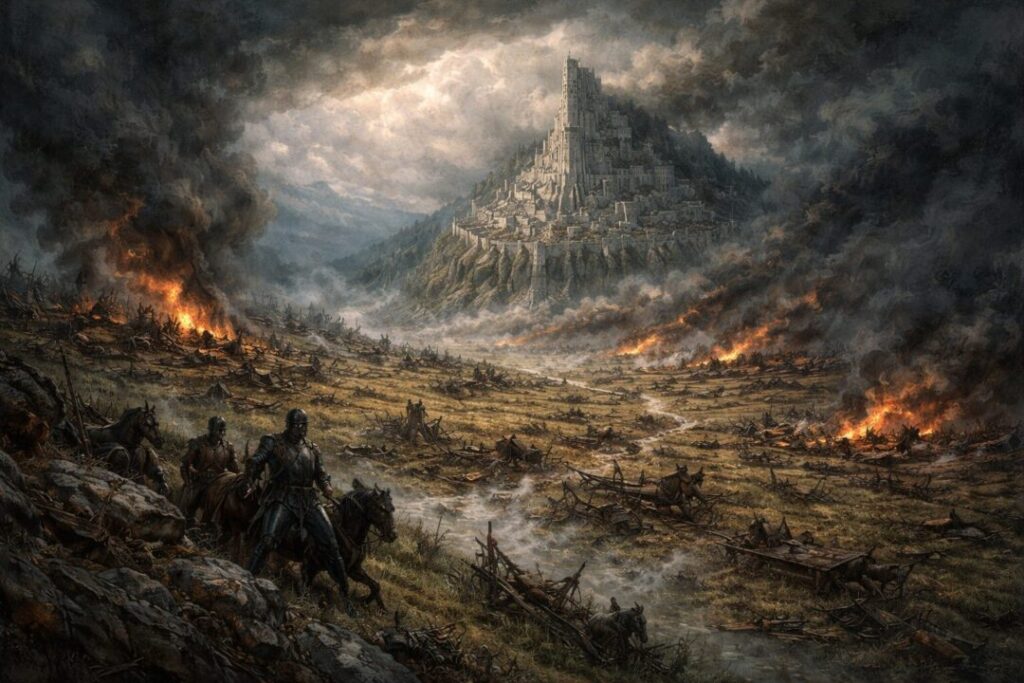
Its settlements are spread out. Its economy is tied to pasture, horses, and rural life across exposed country. In war, that means burning, raiding, and forced flight can do terrible damage before “famine” appears in a formal sense. Rohan can lose livestock, seed, labor, and harvest capacity over wide areas all at once. The result may not be the dramatic starvation of a trapped city, but the slow collapse of the food base of an entire people.
So Rohan may not be first in the narrowest sense.
But it is one of the lands most exposed to agricultural ruin.
Why the Shire Would Probably Not Starve Early
The Shire is almost the opposite case.
It is fertile, well-tilled, and full of cultivated land, mills, and ordinary rural productivity. More importantly, it lies far from the main war-fronts of the War of the Ring. That isolation is not absolute protection, as the Scouring of the Shire later proves in another form, but it does make early famine less likely than in Gondor, Rohan, or Dale.
In fact, the Shire’s great vulnerability is not military encirclement from hostile kingdoms.
It is internal seizure and misrule.
When Sharkey’s system takes hold, stores are gathered, distribution is distorted, and the ordinary life of the land is damaged. That is still dangerous, but it is different from the kind of war-driven frontier famine that threatens Minas Tirith or Dale. The Shire suffers when its peace is violated from within, not because it sits on the edge of the main theatres of battle.
So Where Would Famine Strike First?
The most careful answer is that it depends on what scale we mean.
If we mean the first major city to face immediate food crisis in war, the strongest answer is Minas Tirith and the eastern heartland of Gondor. The reason is simple: the city depends on nearby productive land, that land is directly ravaged in siege, and a large concentrated population cannot live long on disruption alone.
If we mean the first kingdom or regional system likely to collapse into shortage once routes are broken, then Dale and Erebor are extremely strong candidates. Their prosperity is real, but it rests on a narrower agricultural and commercial corridor. A valley, a river, a trade chain, and a mountain stronghold can become precarious very fast once war closes in.
If we mean the broadest agricultural suffering across open country, then Rohan deserves serious attention, because so much of its life can be devastated by raiding and forced movement before formal siege ever begins.
And if we mean which land is least likely to be first, the Shire is near the top of that list. It is remote, fertile, and structured around ordinary production rather than frontier war.
The Deeper Point the Map Reveals
What makes this question so interesting is that Middle-earth is not arranged like a simple morality chart.
The darkest land is not automatically the first to hunger.
The fairest land is not automatically safe.
The strongest city may be more vulnerable than a quiet farming country.
And a prosperous kingdom can become fragile if its roads, river, and fields all depend on one another too closely.
So where would famine strike first in a Middle-earth war?
Probably not where most readers first look.
Not in the deadest-looking place.
But in the place where war can sever food from people fastest.
And once you see that, the map of Middle-earth begins to feel less romantic, and much more real.
Sources & Notes
- J.R.R. Tolkien, The Lord of the Rings, Book V, Chapter 1, “Minas Tirith” — describes the Pelennor as tilled lands with townlands, byres, granaries, orchards, and farms supporting the White City.
- J.R.R. Tolkien, The Lord of the Rings, Book V, Chapter 4, “The Siege of Gondor” — shows Sauron’s forces overrunning the Rammas Echor and burning homes and fields before the siege, making Gondor’s food base part of the battlefield.
- J.R.R. Tolkien, The Lord of the Rings, Book VI, Chapter 2, “The Land of Shadow” — identifies the slave-worked fields around Lake Núrnen as a food source for Mordor, complicating the idea that Mordor is simply barren everywhere.
- J.R.R. Tolkien, The Hobbit, Chapter 10, “A Warm Welcome” — presents Lake-town’s river trade and its old commercial links with Dale and the Mountain, supporting the article’s point about northern prosperity depending on routes and exchange.
- J.R.R. Tolkien, The Lord of the Rings, Appendix A, “Durin’s Folk” — summarizes the rebuilding and renewed prosperity of Dale and Erebor after Smaug, giving the background for their linked human-Dwarven economy.
- J.R.R. Tolkien, The Lord of the Rings, Book VI, Chapter 8, “The Scouring of the Shire” — supports the contrast with the Shire, where scarcity comes through seizure, misrule, and disrupted local stores rather than a front-line siege.