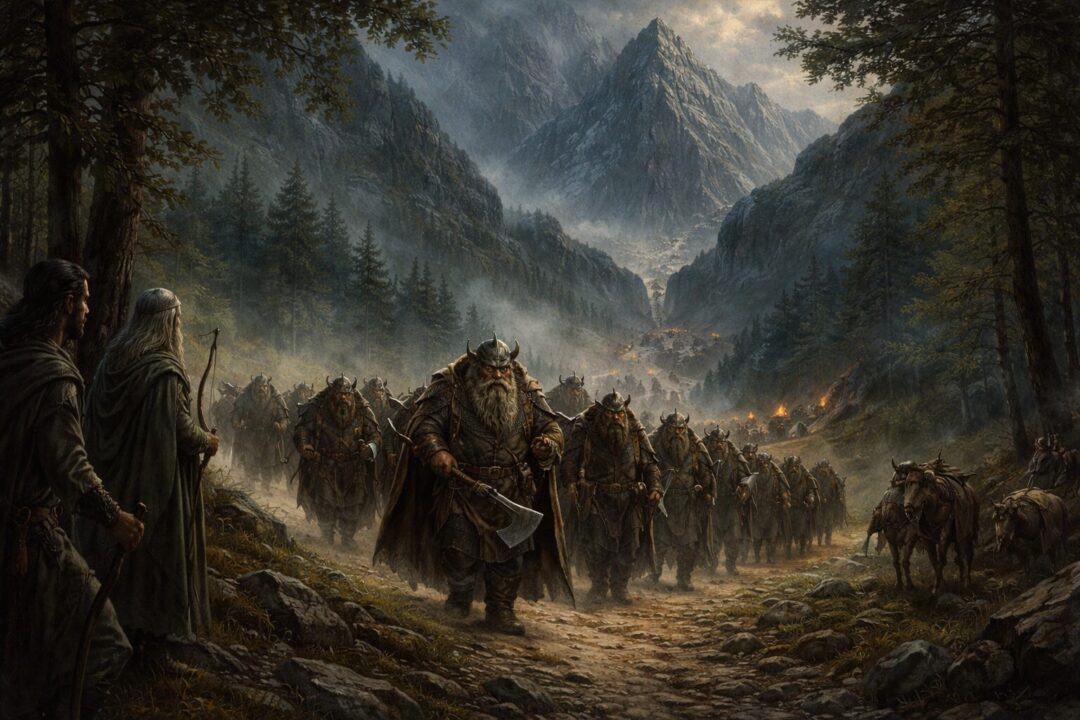
At first glance, the Dwarves of Belegost and Nogrod can seem strangely delayed.
Beleriand fills with rulers, migrations, prophecies, and wars long before these two great Dwarven cities feel central to the story. By the time many readers begin to notice them, Thingol is already established, Melian has already shaped the mood of Doriath, and the great Elvish histories are well underway. So the obvious question follows: if Belegost and Nogrod were important realms in the Blue Mountains, why do they seem to enter the story so late?
The most careful answer is this: they do not necessarily enter the world late. They enter the main narrative focus late.
That distinction matters. The published First Age material is not written as a neutral census of every people in Middle-earth from the same starting line. It is shaped around what becomes historically important for Beleriand, especially through Elvish memory and Elvish-centered events. Belegost and Nogrod become prominent when they begin to affect that western story directly: through contact with the Sindar, through craft and exchange, through the making of Menegroth, through war, and eventually through disaster.
They were not “late-created” peoples
The first mistake is to assume that a late narrative entrance means a late origin.
It does not. In the Dwarves’ origin story, Aulë makes the Seven Fathers, but they are not permitted to awaken before the Firstborn. They are laid to sleep until after the Elves awaken. Later tradition associates two of those Fathers with the Blue Mountains, from whom came the Broadbeams and Firebeards, the peoples linked to Nogrod and Belegost. So the foundation behind those western Dwarven houses belongs to the deep past, not to some later patch in the story.
There is, however, one important note of caution. Tolkien’s later writings do not lock every chronological detail into one perfectly simple timeline. One later tradition says it is not known exactly when the Fathers first awoke, though some thought it was around the time of the Eldar’s westward departure. That does not change the main point: the Dwarves are not presented as newly invented when Beleriand first notices them. It only means that exact dating should be handled carefully.
The story is centered on Beleriand, not on every people equally
A second mistake is to read silence as absence.
Much of the early Silmarillion narrative is arranged around the awakening of the Elves, their divisions, the Great Journey, Thingol’s separation from the Teleri, the Sindarin realm in Beleriand, and then the return of the Noldor. In a structure like that, a people can exist beyond the center of the lens without being denied importance. Belegost and Nogrod sit in the Blue Mountains on the eastern edge of Beleriand’s world, and the narrative truly sharpens on them when dealings with the Sindar begin.
That is why their first major entrance in the published story feels abrupt but is actually very deliberate. In the chapter on the Sindar, the Dwarves come forth from Nogrod and Belegost into Beleriand, and the Elves are astonished to find other speaking craftsmen in Middle-earth. The moment is not saying, “Here is a people who did not exist before.” It is saying, “Here is the moment when the Beleriand story must now account for them.”
Their importance begins when exchange begins
Once the Dwarves of the Blue Mountains enter Beleriand’s active history, they matter immediately.
The texts emphasize mutual profit. Thingol welcomes them. Trade and craftsmanship begin to bind Elves and Dwarves together despite cultural distance. The Dwarves establish roads across East Beleriand, and that practical fact matters more than it first appears. Roads mean movement of goods, contact between realms, and the emergence of Beleriand as a connected political space rather than a scattering of isolated woods and halls.
This is one of the strongest reasons they appear where they do in the story. Their entrance coincides with the point at which Beleriand needs them not merely as neighbors, but as agents of change. Their role is structural. They are builders, road-makers, smiths, miners, traders, and masters of stone. Once the western lands begin consolidating into named realms and fortified centers, Belegost and Nogrod stop being background geography and become historically necessary.
Menegroth is one of the clearest answers
If you want one concrete reason the Dwarves of Belegost and Nogrod become visible when they do, Menegroth is near the top of the list.
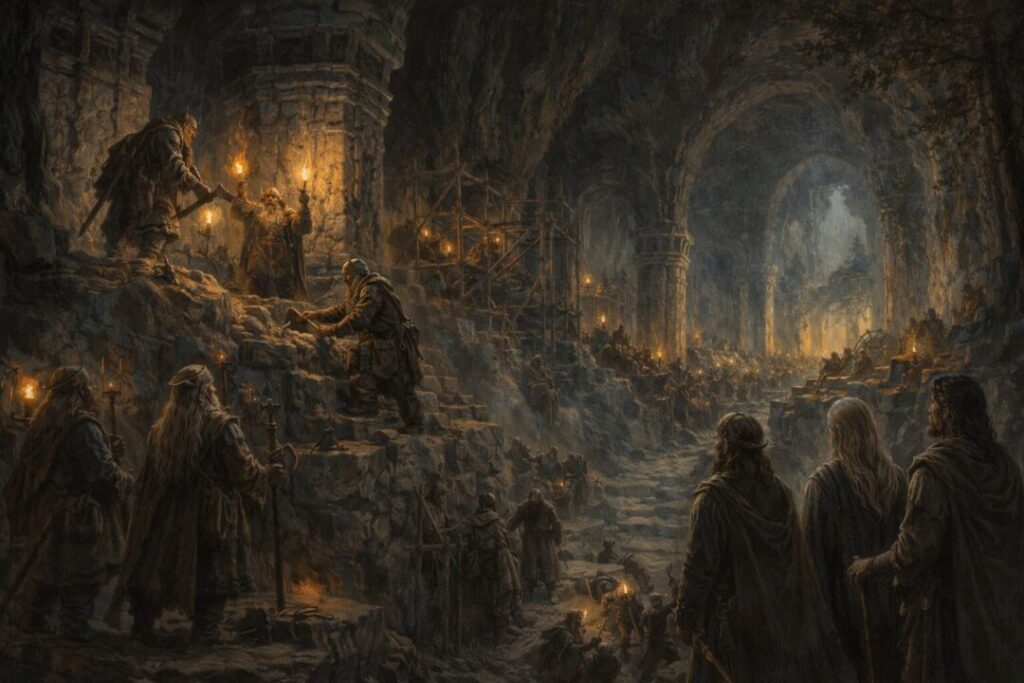
Thingol does not simply hide in a natural cave and let the story move on. With Dwarven aid, a vast underground stronghold is delved and adorned, becoming Menegroth, the Thousand Caves. This is not a decorative side note. Menegroth becomes one of the defining centers of First Age Beleriand. Its architecture, security, symbolism, and wealth all depend in part on Dwarven craftsmanship. The moment Beleriand begins to require that kind of realm, the Dwarves necessarily move closer to the center of the tale.
That also explains why their entrance feels “late” in literary terms. They arrive not at the world’s beginning, but at the moment when the story needs a durable hidden kingdom of hewn stone under royal authority. In other words, they become prominent precisely when their unique strengths can no longer remain offstage.
Belegost and Nogrod are not the same in the story
Another reason their entrance can be misleading is that the two cities are often mentally grouped together and then forgotten together.
But the First Age material does not treat them identically.
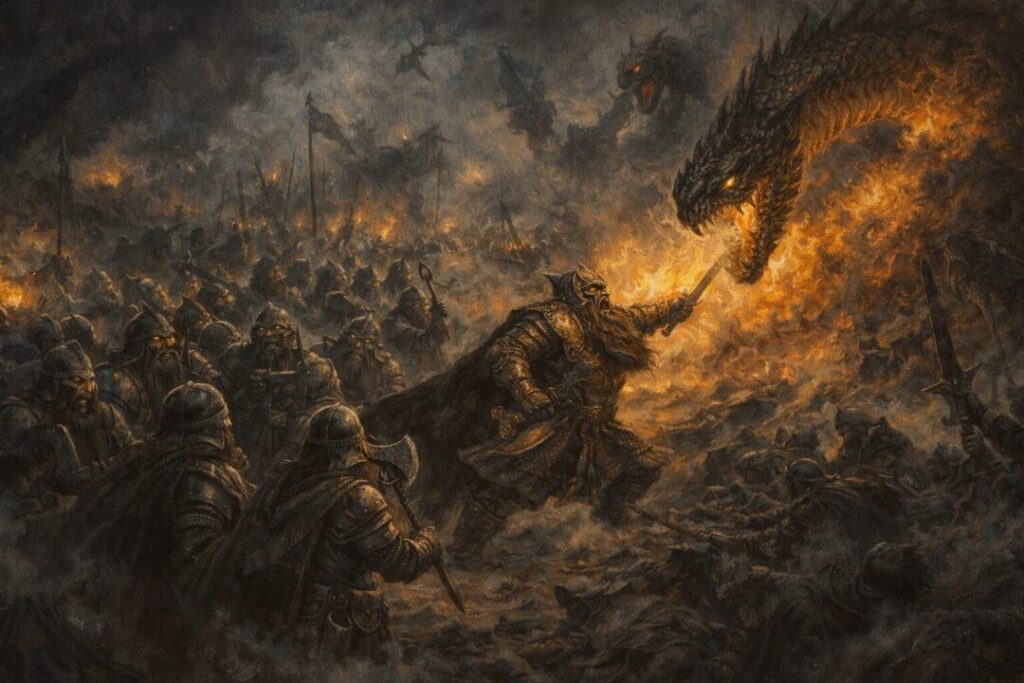
Belegost develops a comparatively better reputation in the western wars. Its people are connected with alliance and battlefield honor. At the Nirnaeth Arnoediad, the Dwarves of Belegost stand firm against dragon-fire more successfully than Elves or Men, aided by their endurance and their war-masks, and Azaghâl wounds Glaurung before he falls. That is not a marginal contribution. It is one of the most memorable Dwarven moments in the entire Elder Days.
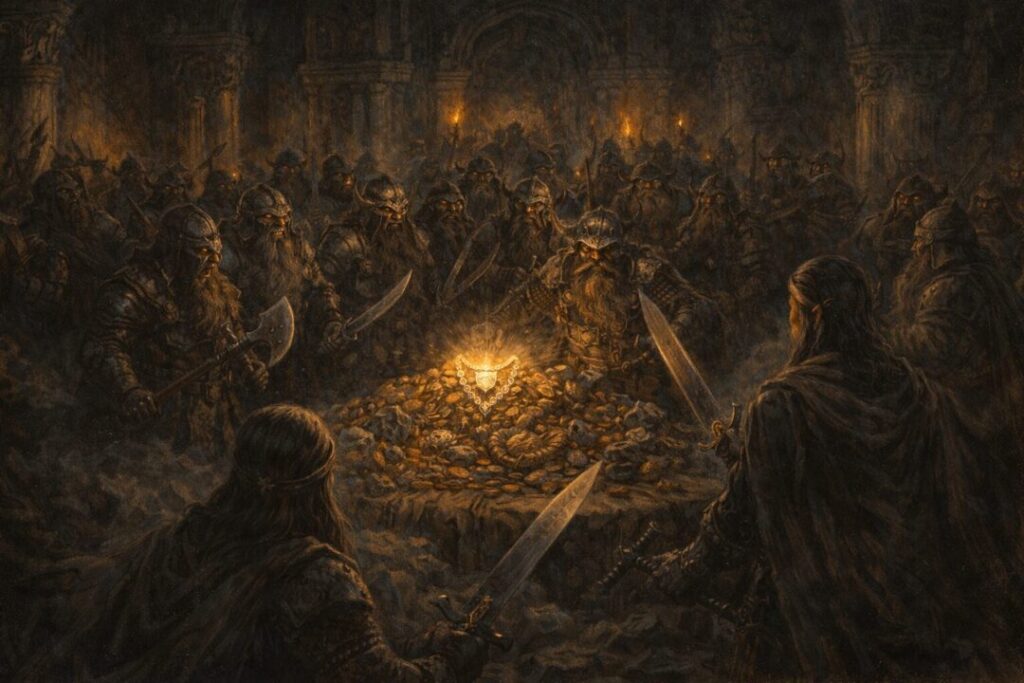
Nogrod, by contrast, becomes inseparable from the crisis around the Nauglamír and the Silmaril. In the published Silmarillion, the fatal quarrel in Menegroth and the later sack of Doriath bind Nogrod to one of the darkest Elvish-Dwarvish conflicts in the First Age. Even where the Dwarves’ own account differs in later retellings and echoes, the core tradition remains: Nogrod’s name is drawn into the ruin that follows treasure, grievance, and pride.
So they do not merely “arrive late.” They arrive and then split into distinct moral and political trajectories.
Their page-time is short, but their impact is large
This is the paradox at the heart of the question.
Belegost and Nogrod do not dominate chapter after chapter in the way Gondolin, Doriath, or Nargothrond do. Yet their influence runs through some of the most important mechanisms of the First Age: wealth, hidden architecture, long-distance exchange, military alliance, and the destructive magnetism of treasure.
That is why the “late entrance” can fool readers. We tend to measure importance by continuous visibility. But the Dwarves of the Blue Mountains work differently. They emerge where the story intersects with stone, craft, payment, roads, and memory. Their effect is less like constant narration and more like pressure at crucial hinges. When they appear, the shape of events changes.
A small but important nuance: “not first noticed” is not “first present”
There is one further nuance worth mentioning.
Later material connected with the Great Journey preserves the idea that Petty-dwarves had settled in Beleriand before the Eldar came there. That does not erase the importance of Belegost and Nogrod, which remain the great Dwarven cities relevant to the main First Age political story. But it does reinforce the broader point: the history is not as simple as “there were no Dwarves here, and then suddenly there were.” Rather, the published narrative highlights the moment when the major Blue Mountain Dwarves enter relations that matter to the rising history of Beleriand.
So even the idea of a “late entrance” should be handled with care. What is late is the spotlight.
The real reason they seem late
In the end, the best answer is literary and historical at once.
Belegost and Nogrod seem to enter the story late because the story is not trying to introduce every people at the earliest possible moment. It is tracking the growth of Beleriand’s great histories. The Dwarves of the Blue Mountains become central when they become entangled with those histories in visible ways: first through astonishment and contact, then through exchange and construction, later through alliance in war, and finally through one of the most bitter treasure-conflicts in the Elder Days.
That is why their entrance feels delayed but never accidental.
They do not arrive too late for the world. They arrive exactly when the history of Beleriand can no longer be told without them.
Sources & Notes
- J.R.R. Tolkien, The Silmarillion, “Of Aulë and Yavanna” — Aulë makes the Seven Fathers, but they are laid to sleep until after the coming of the Firstborn, so a late narrative entrance is not a late origin.
- J.R.R. Tolkien, The Peoples of Middle-earth (History of Middle-earth XII), “Of Dwarves and Men” — later dwarf-traditions connect the Firebeards and Broadbeams with the Blue Mountains and preserve caution about the exact awakening chronology.
- J.R.R. Tolkien, The Silmarillion, “Of the Sindar” — the Dwarves of Nogrod and Belegost come into Beleriand, open trade with Thingol’s people, make roads, and help delving Menegroth.
- J.R.R. Tolkien, The Silmarillion, “Of the Fifth Battle: Nirnaeth Arnoediad” — the Dwarves of Belegost withstand Glaurung’s fire, and Azaghâl wounds the dragon before he dies.
- J.R.R. Tolkien, The Silmarillion, “Of the Ruin of Doriath” — the Nauglamír conflict draws Nogrod into the sack of Doriath, showing how brief Dwarven page-time can still alter First Age history.