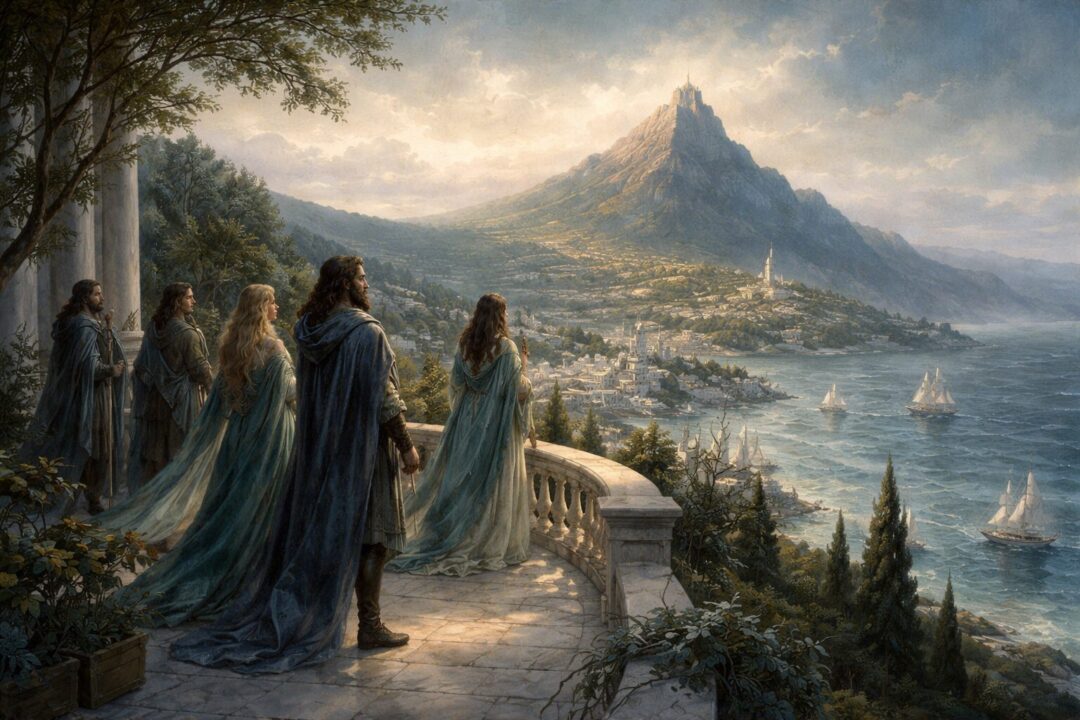
Most readers meet the word “Dúnedain” in a late and diminished world.
They meet it through Aragorn.
Through the Rangers.
Through the long shadow of Númenor after its glory has already fallen into memory.
That is why the word is so often treated as if it simply means “the people of Gondor,” or perhaps “the noble bloodline that survives into the War of the Ring.”
But that is not where the name begins.
Before Gondor exists, before Arnor exists, before Elendil’s ships make landfall in Middle-earth after the Downfall, the word already carries a complete identity of its own. In Sindarin, Dúnedain means “Men of the West,” built on dûn, “west.” In Tolkien’s lore, it is a name for the Númenóreans: the Men of Westernesse, descended from the Edain of the First Age and established on the island kingdom of Númenor at the beginning of the Second Age.
That matters more than it first appears.
Because it means the word does not originally describe a Gondorian people at all.
It describes a western people.
The Name Points to Númenor Before It Points to Gondor
The simplest mistake is also the most common one.
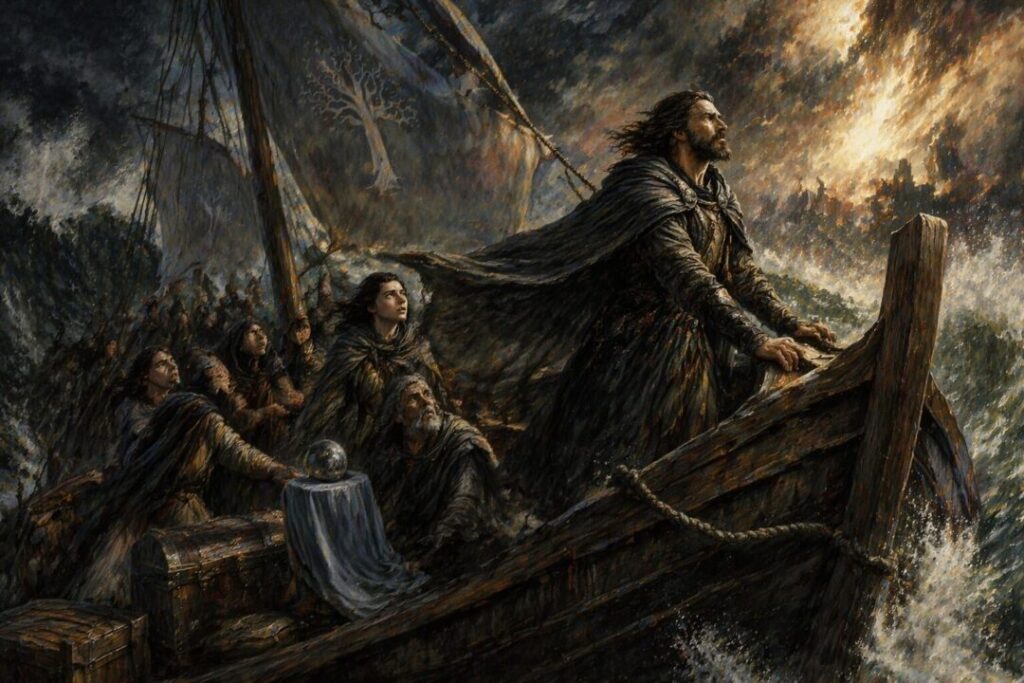
When readers hear “Dúnedain,” they often imagine a political label tied to the later kingdoms in Middle-earth. But the name predates those kingdoms completely. Númenóreans are explicitly identified as Dúnedain, and the term “Men of the West” points first to their homeland and origin, not to any later mainland realm.
That changes the emotional weight of the word.
“Gondorian” is a national term.
“Dúnedain” is older than nationality in that sense.
It carries memory of a people who were already distinct before the founding of Gondor. They were the heirs of the Edain who had aided the Eldar in the First Age and were granted Númenor as a dwelling place after the overthrow of Morgoth. Their identity was shaped by westernness in the deepest possible way: geographically, linguistically, politically, and spiritually. Númenor itself was Westernesse. Its people were the Men of Westernesse. The Sindarin form of that idea is Dúnedain.
So before Gondor exists, “Dúnedain” does not mean “the people who will someday rule Minas Tirith.”
It means the Númenóreans themselves.
Why “West” Matters So Much
The key element in the name is not kingship.
It is not warfare.
It is not Gondor.
It is not even exile.
It is west.
That may sound almost too obvious, but it is the center of the whole idea. In Tolkien’s languages, west is not a neutral compass point. It is charged with history. The west is where Númenor lies, raised in the Great Sea for the Edain. It is also the direction that keeps memory of the Blessed Realm and of the old alliance between Men and the Eldar.
This is why the word carries more than geography.
To be one of the Dúnedain is to belong to the western branch of Men that was elevated in wisdom, stature, and lifespan compared with other mortal peoples. It is to stand inside a tradition of sea-lore, high kingship, ancient speech, and inherited memory reaching back beyond the familiar map of Gondor and Rohan. Tolkien Gateway summarizes this tradition directly: the Númenóreans, or Dúnedain, were descendants of the Edain who were granted Elenna as their dwelling place and became the greatest of Men in the Second Age.
So the word does not begin as a provincial label.
It begins as a civilizational one.
The Dúnedain Exist Before the Realms in Exile
This is the point that quietly rearranges the timeline.
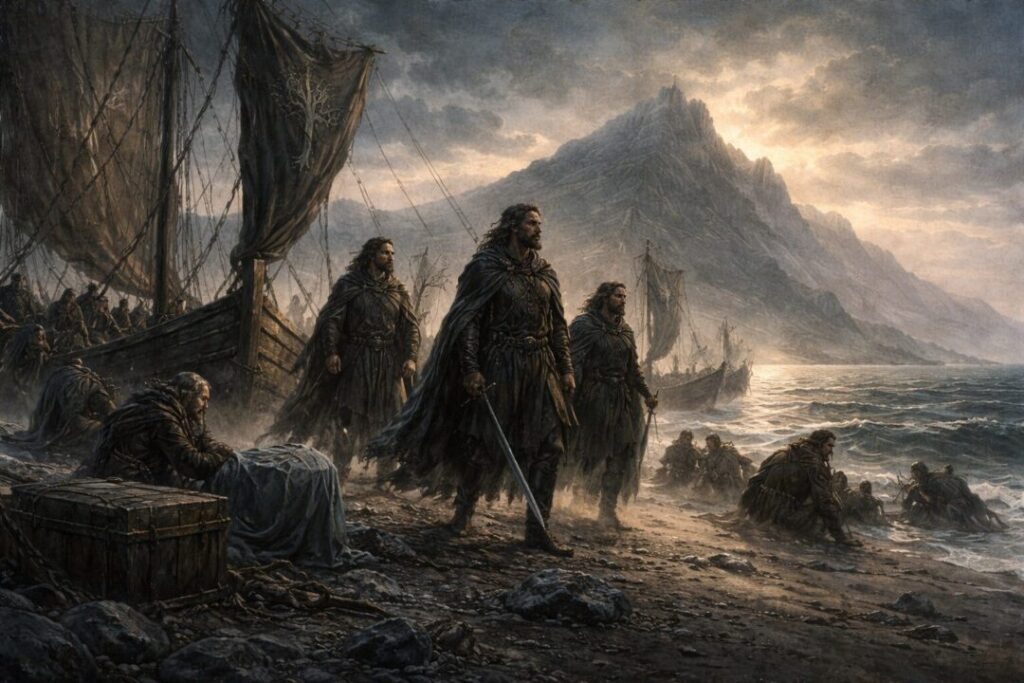
Elendil and his sons did not found Gondor and thereby become Dúnedain.
They were already Dúnedain when they escaped the drowning of Númenor.
Arnor and Gondor are described as the Realms in Exile, often called the Kingdoms of the Dúnedain. That language is revealing. These kingdoms are not the birthplace of the identity. They are what the identity becomes after catastrophe.
That means Gondor is not the origin of the name.
It is one of its surviving vessels.
The distinction matters because it keeps the older loss in view. When we meet the Dúnedain in the Third Age, we are seeing a remnant culture. Its grandeur belongs partly to the present, but even more to a past that has already gone under the sea. The title preserves that submerged history. It is a memory-word as much as a people-word.
And that is why it feels so large.
The Word Is Broader Than Gondor, but Later Usage Narrows
There is one point that needs careful phrasing.
In its broadest sense, Dúnedain refers to the Númenóreans and their descendants. That is the core meaning. But after the Downfall, the surviving Númenórean populations in Middle-earth do not all occupy the same moral or political position. Some are the Faithful under Elendil. Others descend from the King’s Men, including the Black Númenóreans established in places such as Umbar.
Because of that, later storytelling often makes the word feel more closely attached to the Faithful line and to the heirs of Elendil, especially in the context of The Lord of the Rings. That is a fair reading of later usage, but it should not erase the wider original sense. Strictly speaking, the name begins with Númenórean identity itself, before the post-Downfall divisions become the dominant frame.
So when readers automatically translate Dúnedain as “the good Númenórean survivors in Gondor and Arnor,” they are reading the later, narrowed picture back into the older term.
The older term is wider.
Why the Distinction Changes How We Read Aragorn
This is not only a dictionary issue.
It changes the feel of Aragorn’s inheritance.
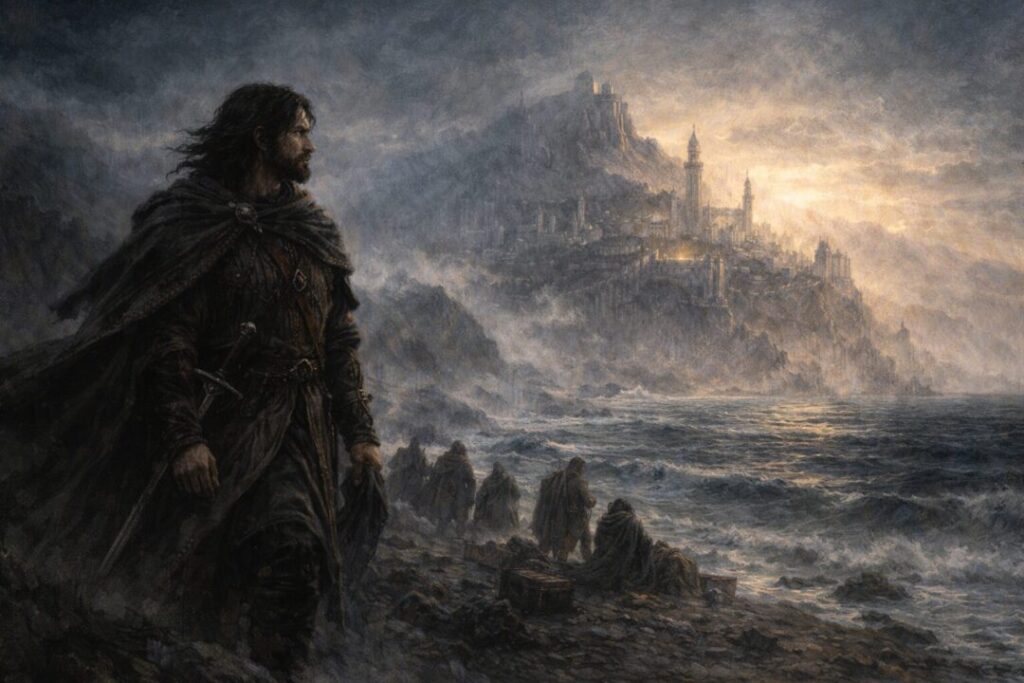
When Aragorn is called one of the Dúnedain, the title is not merely saying he descends from a royal line in the North or has a claim to Gondor. It places him inside the far older continuity of Westernesse. He is not simply a man reclaiming a throne. He is the surviving branch of a people whose identity began on an island kingdom that no longer exists. Galadriel’s message to Aragorn asks, “Where now are the Dúnedain?” and the force of that question depends on this deep history.
Without that older meaning, the word shrinks.
With it, Aragorn is not just the return of a king.
He is the return of a nearly lost inheritance.
That is why the title carries both dignity and sorrow.
Before Gondor, the Name Already Carries Loss
This is the part readers often miss.
Even before Gondor enters the story, the word “Dúnedain” already leans toward tragedy, because its center is a western homeland that will not last. Númenor rises in glory, grows in might, and finally falls in the last years of the Second Age. The survivors who establish Arnor and Gondor do not create the identity from nothing. They preserve what they can of a broken one.
So the name contains an absence.
It points to a place the characters of the Third Age cannot go back to.
It points to greatness that survives only in fragments.
It points to a people whose later kingdoms are already, in one sense, aftermath.
That is why “Dúnedain” sounds heavier than “Gondorians.”
It is not only the name of a kingdom.
It is the name of a remembered west.
What the Word Really Means
Before Gondor exists, “Dúnedain” does not mean “the people of Gondor.”
It means the Númenóreans: the Men of the West, the people of Westernesse, descended from the Edain and shaped by Númenor long before the Realms in Exile are founded. Gondor later becomes one of the greatest realms of the Dúnedain, but it is not the source of the word.
That is the crucial order.
First comes the people.
Then the island.
Then the fall.
Then the kingdoms in exile.
And once you see that sequence clearly, a great many later scenes change shape.
Aragorn is no longer just the heir of Gondor.
He is heir to something older.
The Rangers are no longer only the remnants of Arnor.
They are the last weathered edge of Westernesse.
And the word “Dúnedain” stops being a local political label and becomes what it always was underneath:
a surviving name for a lost world.
Sources & Notes
- J.R.R. Tolkien, The Lord of the Rings, Appendix A, “The Númenórean Kings” — identifies the Númenóreans as the Dúnedain, the Men of Westernesse, and gives the line from Elros through Elendil to the later realms.
- J.R.R. Tolkien, The Silmarillion, “Akallabêth” — tells how the Edain were given Númenor in the West and became the Men of Westernesse before the Downfall and the founding of Gondor.
- J.R.R. Tolkien, The Silmarillion, “Of the Rings of Power and the Third Age” — shows Elendil’s survivors founding Arnor and Gondor as kingdoms of Númenórean exiles, not as the origin of the Dúnedain identity.
- J.R.R. Tolkien, Unfinished Tales, “A Description of the Island of Númenor” — gives the western island setting and Númenórean culture behind the older meaning of Dúnedain as a people of Westernesse.
- J.R.R. Tolkien, The Lord of the Rings, Book V, Chapter 2, “The Passing of the Grey Company” — uses Galadriel’s “Where now are the Dúnedain?” message to frame Aragorn as heir to the older northern and Númenórean tradition.