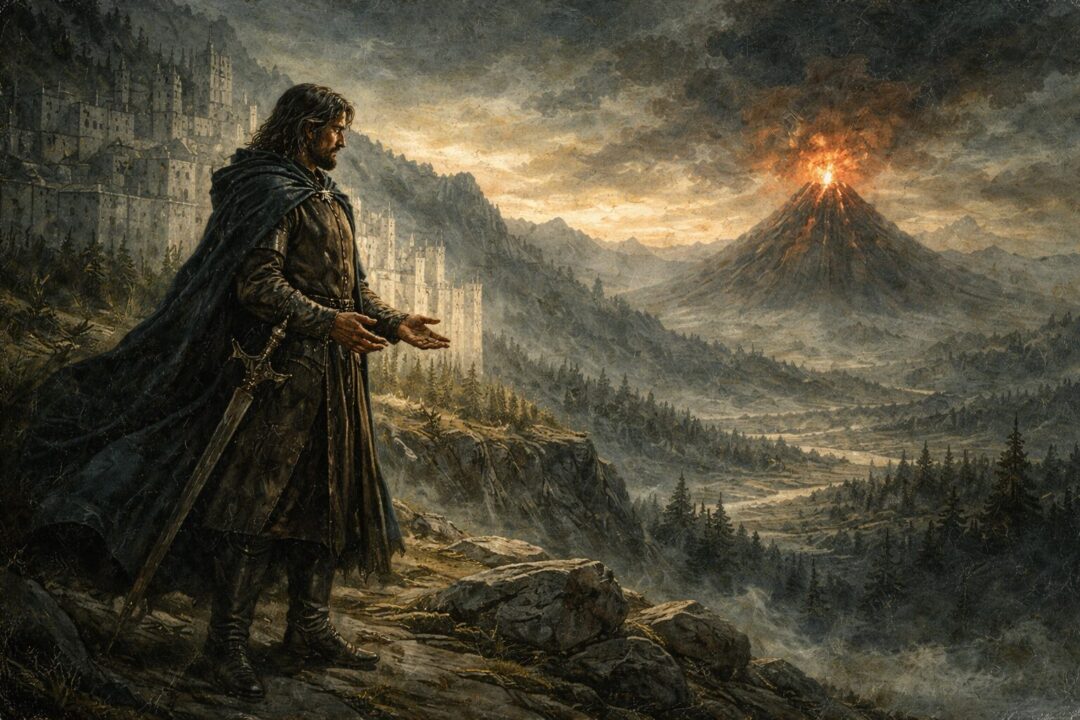
By the end of The Lord of the Rings, Aragorn seems to stand on the edge of the most familiar ending in heroic literature.
He is the hidden heir.
He bears the sword that was broken and made again.
He passes through darkness, gathers the Dead, comes up the River in black ships, and reveals the standard of Elendil at the moment when hope is nearly gone.
Everything appears to be moving toward one final personal confrontation.
A lesser story would almost certainly deliver it.
Aragorn would meet the Witch-king before the walls.
Or he would challenge Sauron before the Black Gate.
Or the return of the king would be sealed by a single victorious blow, sword against sword, in front of all the world.
But that is not the shape this story chooses.
Aragorn is one of the greatest war leaders in Middle-earth by the end of the Third Age, yet he is never given the duel many readers instinctively expect.
That absence matters.
It is not an oversight.
It is not a withheld spectacle.
And it is not because Aragorn lacks the stature for it.
The story denies him a duel because his role is larger, stranger, and more revealing than the role of a conventional conquering hero.
The Story Refuses the Obvious Opponent
If Aragorn were going to receive a climactic duel, there are only a few likely candidates.
The Witch-king is the most obvious.
He is the captain of Sauron’s war, the visible face of terror before Minas Tirith, and one of the greatest remaining servants of the Shadow. Aragorn is Isildur’s heir, bearer of Andúril, and the foremost war-leader of the West. On the surface, the structure seems to set them on a collision course.
But the text does not permit it.
The Witch-king falls instead to Éowyn and Merry on the Pelennor. That is not a random reassignment of glory. It is one of the most deliberate moments in the book. The old prophecy concerning the Witch-king’s fall is not fulfilled by the returning king, but by figures the enemy does not understand and does not properly fear.
That alone should make us pause.
The story actively turns away from the expected heroic matchup.
And it does the same again with Sauron.
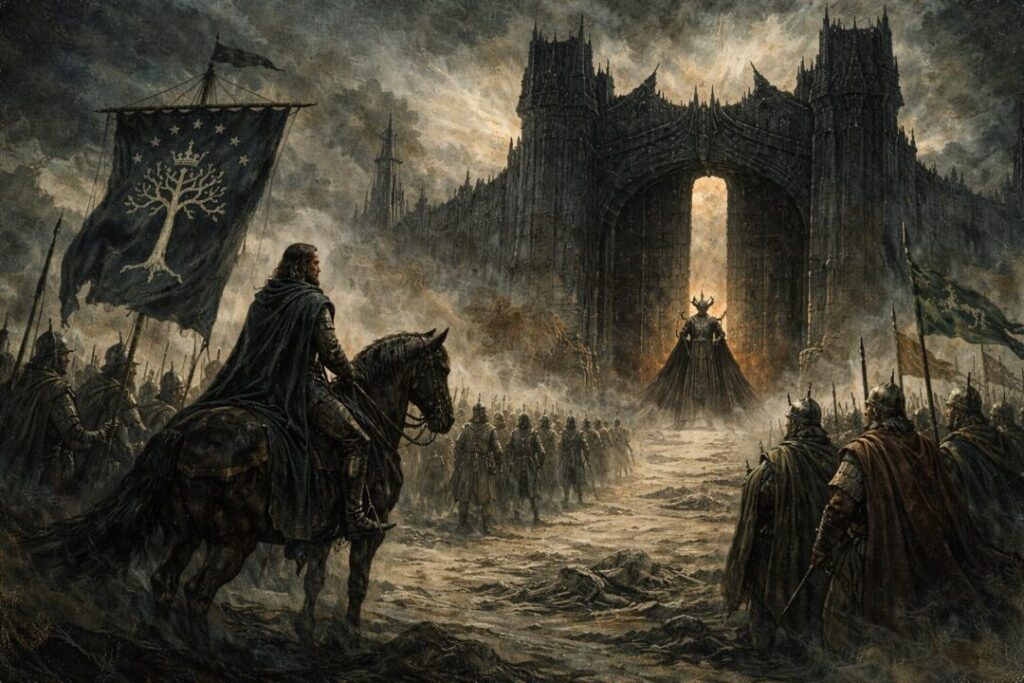
At the Morannon, Aragorn does not receive a final duel with the Dark Lord. Sauron does not come forth at all. The Black Gate opens, but what emerges first is the Mouth of Sauron, a herald and lieutenant. Aragorn’s part in that scene is not to win a physical contest. It is to stand, to endure insult, and to hold kingly authority in the presence of calculated humiliation.
The expected duel is withheld twice.
That is too consistent to be accidental.
Aragorn’s Real Contest Begins Before the Battlefield
By the final movement of the war, Aragorn has already entered into a different kind of confrontation.
Before the march on the Black Gate, he uses the Orthanc-stone and reveals himself to Sauron as the heir of Elendil. He shows himself openly and forces the Dark Lord to reckon with a claimant he had not properly measured.
This matters because it shifts the nature of Aragorn’s struggle.
His greatest direct challenge to Sauron is not a clash of blades.
It is a clash of will.
The palantír episode is one of Aragorn’s boldest acts in the entire war. He does not overpower Sauron by force of arms. He withstands him, declares himself, and deliberately presses the Enemy into haste. The march to the Black Gate then continues that same strategy. Aragorn and the Captains of the West are not going there because they think they can win a military victory. They go to draw the Eye away from Frodo.
In other words, Aragorn’s final confrontation is already underway long before any duel could occur.
And it is not about personal triumph.
It is about bearing the weight of command in full knowledge that the move may end in death.
The Pelennor Gives Aragorn Victory Without Personal Combat
When Aragorn arrives at the Pelennor, the text gives him one of the great entrances in all the legendarium.
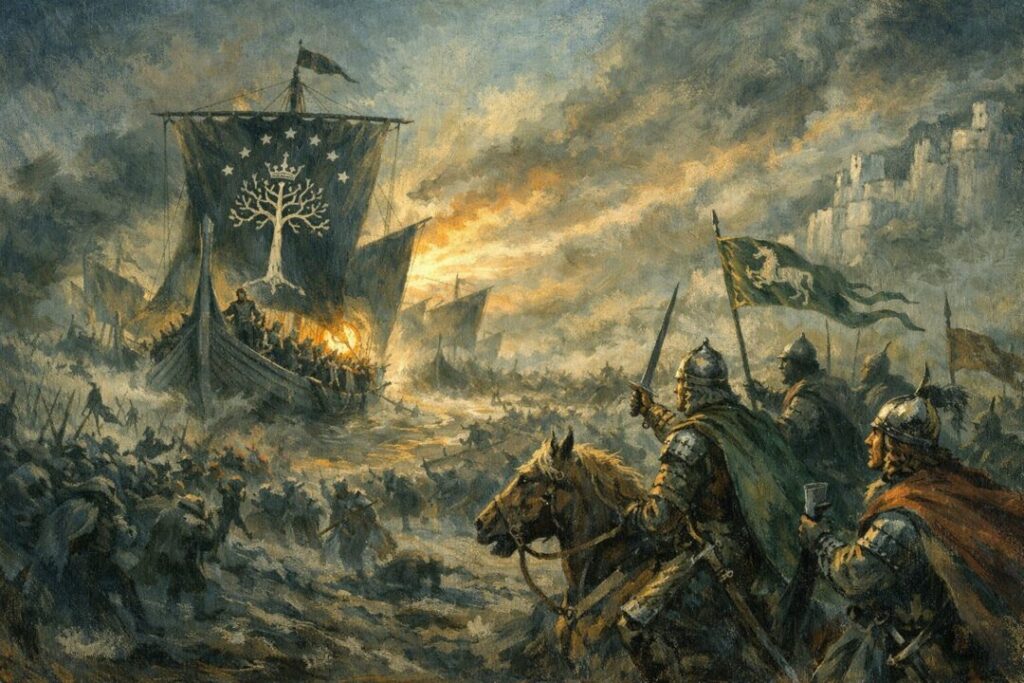
He comes by the captured ships of Umbar.
The standard of Elendil is revealed.
The battle turns.
This is a moment of triumph, but even here the story is careful.
Aragorn does not win the day by singling out the enemy captain and slaying him in front of both armies. He wins by arriving at the right hour, bringing unexpected strength, and restoring order where despair was beginning to close over the field.
That difference is crucial.
He is not functioning merely as the strongest warrior present.
He is functioning as the returning king.
His presence changes the battle because of what he represents: legitimacy, renewal, memory, and the reappearance of a line that the Shadow had long treated as broken.
The enemy is not overthrown through a king’s personal duel.
The enemy’s design begins to unravel because the king has returned.
That is a much broader and more political kind of victory.
And the text underlines it almost immediately, because Aragorn does not rush from that triumph to claim the city in theatrical style. He refuses to enter Minas Tirith in a self-exalting manner. The war is not yet ended, and the forms of kingship still matter to him.
That restraint is part of the point.
The Hands of the King Are the Hands of a Healer
If the story truly wanted Aragorn’s kingship to be proven by single combat, it had every opportunity.
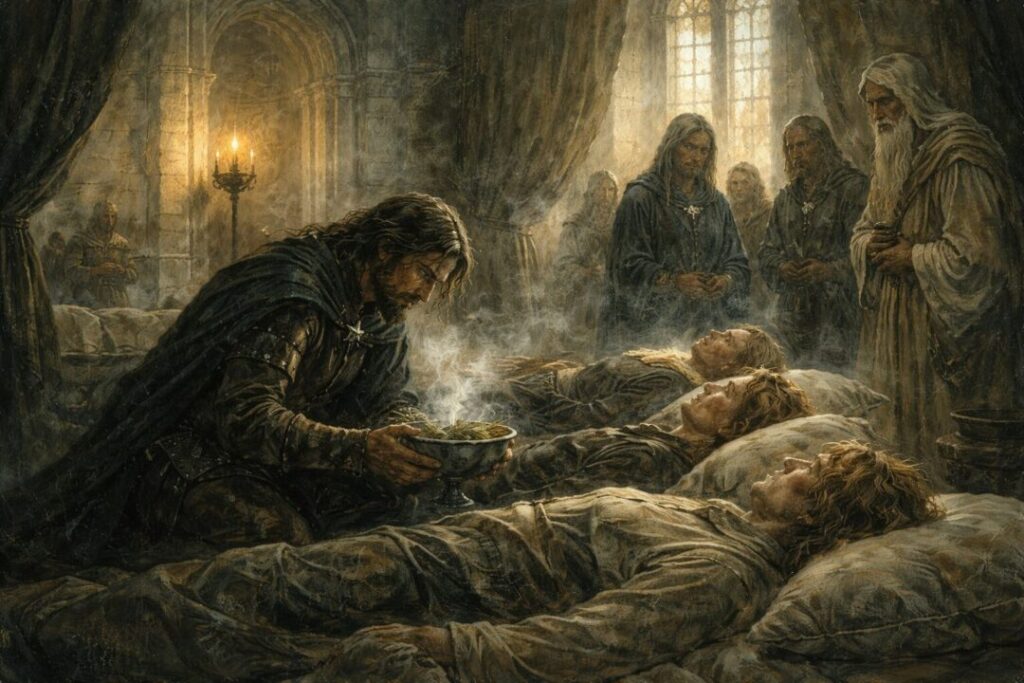
Instead, after battle, it moves him into the Houses of Healing.
This is one of the most revealing choices in the entire ending.
The old Gondorian saying returns: the hands of the king are the hands of a healer. Aragorn is recognized not because he kills the chief enemy in personal combat, but because he restores life where darkness has left its mark. Faramir, Éowyn, and Merry all lie under shadows that ordinary skill cannot remove. Aragorn comes to them not first as war-captain, but as rightful king.
This is not a soft alternative to heroism.
It is the story’s correction of what true kingship means.
Aragorn can lead men in war. The text never questions that.
He can endure hardship, command loyalty, and inspire courage.
But the sign that he is the rightful ruler is not that he is the deadliest swordsman on the field.
It is that strength and healing meet in him together.
A duel would have narrowed that revelation.
The Houses of Healing enlarge it.
They show that Aragorn’s role is not simply to defeat evil in combat, but to begin the repair of a world that has been wounded by long war.
Sauron Is Not That Kind of Enemy
There is another reason Aragorn does not receive a final duel with Sauron.
Sauron is not presented in The Lord of the Rings as the sort of enemy who should be defeated that way.
In the older history of Middle-earth, dark lords and great captains do sometimes meet in direct combat. But by the end of the Third Age, Sauron’s power works differently. He dominates through fear, command, deception, military force, and the Ring itself. His war is systemic. It spreads outward through armies, servants, towers, roads, and terror.
To reduce that to one noble duel would misstate the problem.
This is why the Morannon is so bleak and so important.
The Captains of the West stand before an enemy they cannot overthrow by strength. Even if Sauron came forth, the real issue would remain the Ring. As long as it exists, he cannot truly be defeated. And when the Ring is destroyed, he falls without Aragorn ever striking him.
That is not a narrative cheat.
It is the theological and moral center of the story.
The Shadow is not finally overthrown by the most kingly man winning the greatest duel.
It is overthrown at the Cracks of Doom, where Frodo fails to surrender the Ring, Gollum seizes it, and the Ring is destroyed in a turn bound up with pity, mercy, and providence.
That ending does not diminish Aragorn.
It places him correctly.
He is essential, but he is not the one by whom everything is personally finished.
Why the Absence Matters
Once this becomes clear, the question changes.
The issue is no longer, “Why wasn’t Aragorn given a duel?”
The real question is, “What would have been lost if he had?”
Quite a lot, in fact.
A duel with the Witch-king would have taken from Éowyn and Merry one of the story’s most meaningful reversals.
A duel with Sauron would have shifted the center of the ending away from the Ring-bearer and toward a more ordinary kind of heroic resolution.
And a king whose claim is proved mainly by killing would be a smaller figure than the one the text actually gives us.
Aragorn is not smaller because he lacks a duel.
He is larger because he does not need one.
His authority is shown in command.
His courage is shown in choosing hopeless roads.
His legitimacy is shown in healing.
His greatness is shown in restraint.
And his final test is to walk toward the Black Gate knowing that victory, if it comes at all, must come from somewhere else.
That is why the ending feels so different from a familiar heroic climax.
The expected kingly duel never arrives because Aragorn’s story is not about seizing victory through personal might.
It is about becoming the kind of king for whom victory does not need to look like that at all.
Sources & Notes
- J.R.R. Tolkien, The Lord of the Rings, Book V, Chapter 6, “The Battle of the Pelennor Fields” — the Witch-king’s fall belongs to Éowyn and Merry, not to Aragorn.
- J.R.R. Tolkien, The Lord of the Rings, Book V, Chapter 6, “The Battle of the Pelennor Fields” — Aragorn’s arrival in the ships of Umbar turns the battle through kingship, timing, and command rather than a duel.
- J.R.R. Tolkien, The Lord of the Rings, Book V, Chapter 8, “The Houses of Healing” — Aragorn is recognized by the saying that “the hands of the king are the hands of a healer.”
- J.R.R. Tolkien, The Lord of the Rings, Book V, Chapter 9, “The Last Debate” — Aragorn’s use of the Orthanc-stone and the Captains’ march are framed as a deliberate challenge and diversion, not a hope of military victory.
- J.R.R. Tolkien, The Lord of the Rings, Book V, Chapter 10, “The Black Gate Opens,” and Book VI, Chapter 3, “Mount Doom” — Sauron is not defeated in personal combat; his fall follows the destruction of the Ring.