
At first glance, this feels like one of the easiest questions in Middle-earth.
Saruman knew Gandalf bore Narya, the Red Ring.
He resented that fact.
And when Gandalf came to Orthanc, Saruman had him trapped.
So why did he not simply take it?
The pieces seem to line up too neatly for the answer to be complicated. If Saruman envied Gandalf’s possession of one of the Three Elven Rings, and if he had both the opportunity and the motive, then the absence of any seizure can look like a gap in the story.
But the closer we look, the less this resembles a plot hole.
Because the text does not present Orthanc as a moment when Saruman is trying to strip Gandalf down to whatever objects he carries. It presents something more revealing, and in some ways more dangerous: Saruman still wants Gandalf himself.
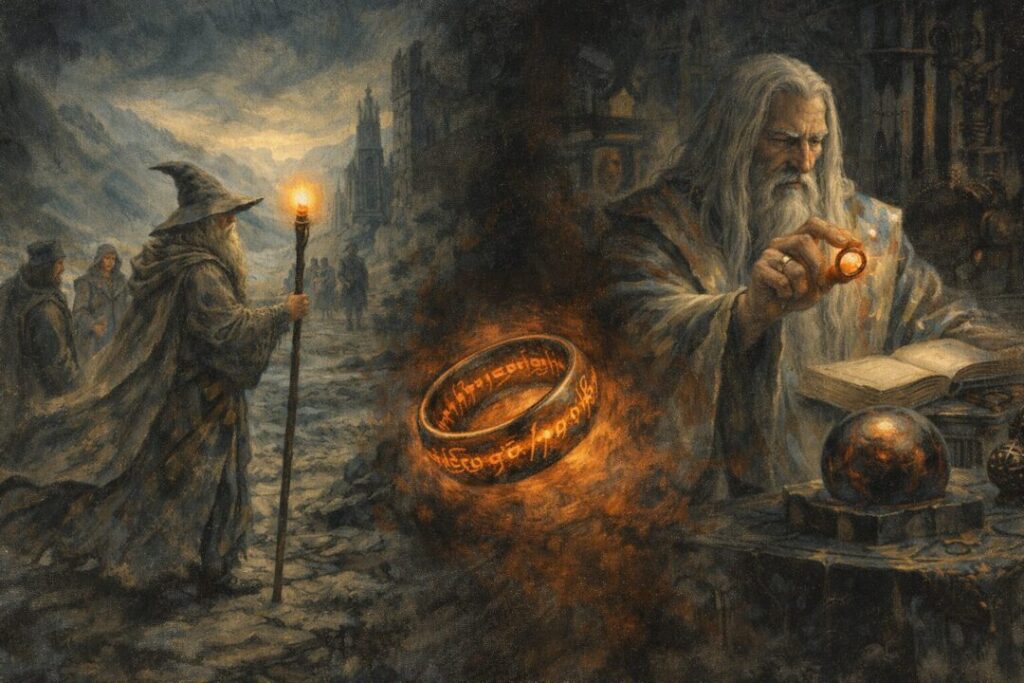
Saruman Did Resent Gandalf’s Possession of Narya
That part is not in doubt.
In the tradition about the Istari, Círdan gives Narya to Gandalf when the Wizards arrive in Middle-earth. The reason is not office or rank. Saruman is the acknowledged head of the order, and yet Círdan perceives in Gandalf “the greatest spirit and the wisest.” Narya is then entrusted to Gandalf to support him in his labors and to help him “rekindle hearts in a world that grows chill.”
This matters for two reasons.
First, it means Gandalf’s keeping of Narya is not accidental or merely administrative. It reflects a judgment about fitness for the task of the Third Age.
Second, Saruman later becomes aware of this gift and begrudges it. The resentment is explicitly part of the growing ill-will he bears toward Gandalf.
So yes, Saruman had reason to envy Narya.
But envy alone does not tell us what he would do when opportunity came.
That is where Orthanc becomes important.
What Saruman Actually Tries to Do at Orthanc
When Gandalf recounts the meeting at the Council of Elrond, the scene is striking.
Saruman does not begin by attacking him.
He does not begin by searching him.
He does not even begin by demanding Narya.
He begins by offering a choice.
His language is the language of persuasion, superiority, and recruitment. He speaks as though Gandalf ought to understand that resistance is futile and that wisdom now lies in joining him. Saruman imagines a partnership in which they bide their time, study events, and ultimately profit from Sauron’s rise by taking power for themselves. When Gandalf refuses, Saruman imprisons him on the pinnacle of Orthanc.
This is a crucial detail.
Saruman is not acting like someone whose immediate priority is to confiscate a rival’s treasured object.
He is acting like someone who still believes that Gandalf’s cooperation is obtainable—and valuable.
That makes sense.
Gandalf is one of the Istari.
He is deeply trusted across Middle-earth.
He has influence with Elves, Men, Dwarves, and Hobbits.
And by the time of Orthanc, Saruman suspects that Gandalf stands closer than anyone else to the truth about the One Ring.
In other words, Gandalf is worth more to Saruman as a converted ally—or a broken captive with useful knowledge—than as a body searched for jewelry.
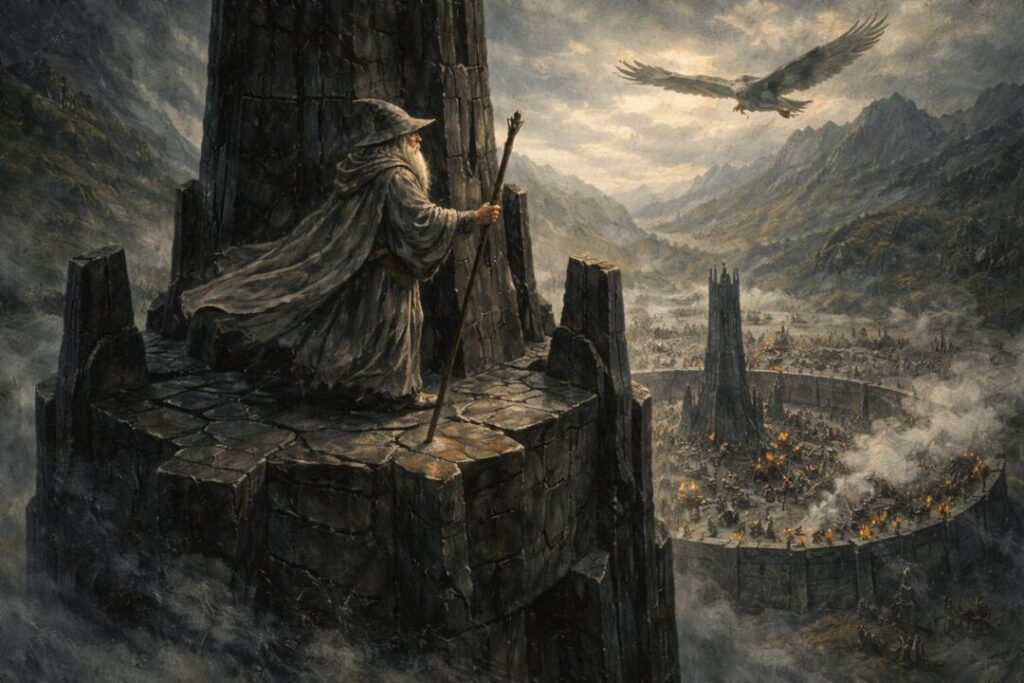
Narya Was Not the Prize Saruman Most Wanted
This is where the scale of Saruman’s ambition matters.
By the late Third Age, Saruman is not aiming merely to accumulate interesting artifacts. He is turning toward the same central desire that ruins so many in Middle-earth: domination. He studies ring-lore, imitates Sauron, and even styles himself “Ring-maker.” The text also notes the ring on his own finger when Gandalf meets him at Orthanc, a sign that Saruman’s mind has already moved in that direction.
But Narya is not the One Ring.
That distinction is everything.
Narya is one of the Three, and the Three are repeatedly treated differently from the Ruling Ring. They were not made as weapons of conquest. Elrond explicitly says they were not made for war or domination, but for understanding, making, healing, and preserving what is unstained. Narya in particular is associated with endurance against weariness and with rekindling courage in a failing world.
So even if Saruman desired Narya out of pride, insult, or possessiveness, it was not the instrument that could solve his main problem.
His real obsession was power on the scale of Sauron.
That means the One Ring.
Orthanc makes more sense once that hierarchy is clear. Narya is symbolically important. The One is strategically decisive. Saruman is trying to position himself for the larger game.
Why Simply Taking Narya Would Not Have Solved Anything
There is also a deeper irony here.
Narya fits Gandalf because Gandalf’s whole mission operates through encouragement, resistance to despair, and the strengthening of others rather than domination. That is exactly how he works throughout the Third Age. He does not build an empire. He travels, advises, awakens, and unites. The ring’s stated purpose aligns with his role unusually well.
Saruman, by contrast, has already drifted away from that mode of action.
He wants control.
He wants instruments.
He wants leverage.
And that means that even his resentment of Narya may be slightly misdirected. The insult is real, but the ring itself is not a shortcut to the kind of mastery he craves. To take Narya would not make him what Círdan had recognized in Gandalf. It would only confirm the pettiness of the wound.
That point is interpretive, but it fits the evidence better than the idea that Saruman simply overlooked the ring. The texts do not say he forgot it. They suggest something more characteristic: he was aiming at a grander victory and misjudged what mattered most.
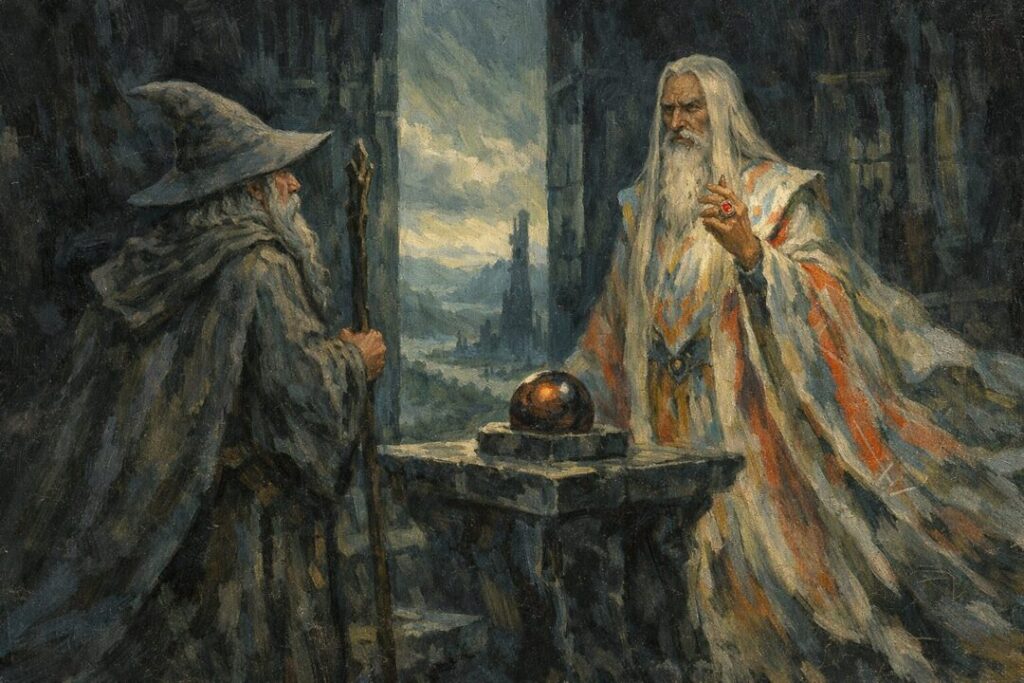
The Text Never Says He Could Not Take It
This is an important limit.
The story does not give a technical explanation.
It does not tell us that Gandalf hid Narya by some special method.
It does not say Saruman was magically prevented from touching it.
And it does not describe any explicit attempt to strip Gandalf of it.
So the safest reading is not “Saruman was unable to take Narya.”
The safer reading is that the narrative is showing a different priority.
Saruman wants Gandalf’s agreement.
Failing that, he wants Gandalf contained.
And beyond both of those, he wants the One Ring located and eventually possessed.
On that scale, Narya is not irrelevant—but it is secondary.
This is one of those places where the absence of an action tells us more than the action would have. If Saruman had lunged immediately for Narya, the scene would be simpler. It would become a matter of greed and confiscation.
Instead, the scene reveals ambition mixed with vanity. Saruman still imagines himself as the mind superior to Gandalf’s, the one who sees the true course of history. He wants Gandalf to acknowledge that superiority. Taking the ring at once would have been cruder, smaller, and in a sense beneath the role Saruman is performing for himself.
Why the Omission Fits Saruman’s Character
Saruman is dangerous partly because he does not think like a mere plunderer.
He is proud.
He is theatrical.
He prefers the corruption of wills to open blows whenever possible.
That is true later as well. His voice, his manipulations, his self-justifying political language—all of it points to someone who would rather bring others under himself than simply destroy them. Orthanc follows that pattern. Gandalf is offered incorporation before he is reduced to imprisonment.
That makes the question of Narya more revealing than it first appears.
Why did Saruman not take it?
Because the text points to a darker answer than simple theft.
He did not merely want what Gandalf had.
He wanted Gandalf to admit that Saruman’s way was the winning one.
And beyond both, he wanted the greater ring that would make all lesser calculations seem small.
In that light, not taking Narya is not an oversight.
It is a clue.
The Real Defeat Was Misreading Gandalf
There is one more irony in all this.
Círdan’s gift had always carried an implicit judgment. Gandalf was chosen not because he held higher rank, but because he was better suited to the burden: wiser, humbler, more enduring, more capable of kindling resistance without seeking mastery. Saruman’s resentment of that choice is understandable on the level of pride, but pride also blinds him to what the gift means.
At Orthanc, he still thinks in terms of leverage.
He thinks Gandalf can be persuaded, cornered, or waited out.
He thinks the real contest is about alignment with power.
But Gandalf’s strength is not built that way.
And that may be the deepest answer to the question.
Saruman did not take Narya from Gandalf because, in the scene where he finally appears to have the advantage, he is still chasing something he values more: submission, legitimacy, strategic control, and ultimately the One Ring itself.
He sees the ring on Gandalf’s hand through the lens of envy.
He does not fully see the kind of authority Gandalf actually embodies.
And that failure matters far more than whether Narya could have been seized.
Because the scene at Orthanc is not really about a lost opportunity to take a ring.
It is about a mind so bent toward domination that it no longer understands the sort of strength it most needs to fear.
Sources & Notes
- J.R.R. Tolkien, Unfinished Tales, “The Istari” — tells how Círdan gave Narya to Gandalf on the Wizards’ arrival, judging him the “greatest spirit and the wisest,” and later notes Saruman’s jealousy of that gift.
- J.R.R. Tolkien, The Lord of the Rings, Book II, Chapter 2, “The Council of Elrond” — Gandalf’s account of Orthanc shows Saruman trying persuasion, alliance, and imprisonment rather than immediately seizing Narya.
- J.R.R. Tolkien, The Lord of the Rings, Book II, Chapter 2, “The Council of Elrond” — Elrond distinguishes the Three from weapons of domination, saying they were made for understanding, making, healing, and preservation.
- J.R.R. Tolkien, The Silmarillion, “Of the Rings of Power and the Third Age” — explains the making of the Three, Sauron’s failure to touch them, and their purpose in resisting decay rather than ruling by force.
- J.R.R. Tolkien, The Lord of the Rings, Book III, Chapter 10, “The Voice of Saruman” — displays Saruman’s characteristic weapon: persuasive domination of wills, which supports reading Orthanc as a bid to command Gandalf rather than merely rob him.