
One of the most persistent misconceptions about J.R.R. Tolkien’s legendarium is that it is rigid—closed, immutable, and hostile to reinterpretation. Many readers assume that because Tolkien cared so deeply about internal consistency, any story not explicitly written by him must automatically violate his world. In reality, the opposite is true.
Tolkien’s world is not governed by narrative convenience or modern franchise logic. It is governed by metaphysical law. When characters fall, return, or endure beyond expectation, it is never accidental, sensational, or arbitrary. It is permitted—and permission matters more in Middle-earth than possibility.
Understanding this distinction fundamentally changes how we read unfinished tales, unresolved fates, and narrative silences scattered throughout Tolkien’s writings.
Death in Middle-earth Is Not Uniform
From the earliest stages of his mythology, Tolkien established that death does not function the same way for all beings. Mortality is not a single condition but a defining metaphysical boundary between peoples.
Men, the Secondborn, are granted what Tolkien called the “Gift of Ilúvatar.” Upon death, their spirits leave the world entirely, passing beyond the Circles of the World to a fate unknown even to the Valar. This uncertainty is not a flaw in the system—it is the point. Mortality is freedom, terrifying and beautiful.
Elves, by contrast, are bound to Arda itself. When slain or when their bodies fail, their fëar are summoned to the Halls of Mandos, where they must wait. Some are rehoused after long ages of reflection and healing; others remain until the end of the world. Their immortality is endurance, not invulnerability.
This alone opens narrative space. Death, in Tolkien’s world, is not an on/off switch. It is a process shaped by nature, purpose, and judgment.
Gandalf and the Misunderstood Return
When Gandalf falls in Moria, many readers casually describe his return as a resurrection. Tolkien would have rejected that framing outright.
Gandalf is not a Man, nor even truly an Elf. He is a Maia, a spirit sent into Middle-earth under strict limitations. When he confronts the Balrog, he does not “die” in the mortal sense—his physical form is destroyed, and his spirit passes beyond the world’s immediate bounds.
In The Two Towers, Gandalf himself explains that he was sent back “until my task is done,” and that his authority has increased even as his freedom has diminished. This is not a reward. It is a burden.
His return is unique, rare, and purposeful. It required direct intervention from Ilúvatar himself, something Tolkien makes clear was not a mechanism to be repeated casually.
Yet Gandalf’s return is not without precedent.
Precedent: Beren, Lúthien, and Mandos’ Mercy
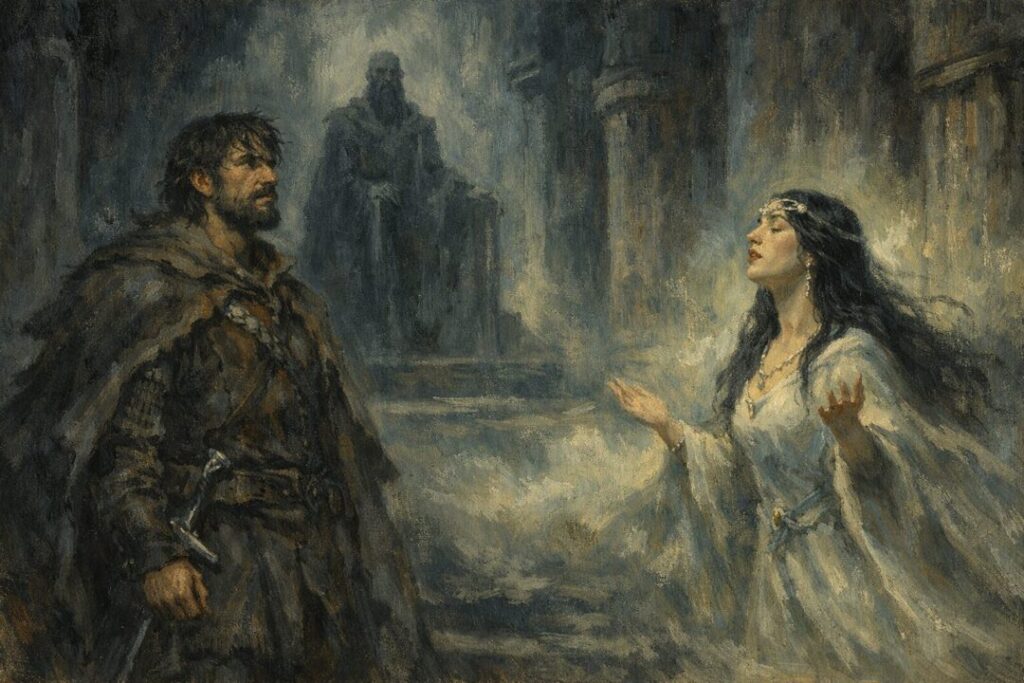
Perhaps the most extraordinary return from death in Tolkien’s legendarium is that of Beren, whose fate is altered through the song of Lúthien before Mandos himself.
This moment is unparalleled. Tolkien emphasizes that Mandos, the Doomsman of the Valar, is moved only once in all his long existence. The laws he pronounces are usually unyielding. For him to relent is cosmically significant.
This tells us something crucial: returns from death are not narrative loopholes. They are exceptions carved into the structure of reality itself. They carry cost. Lúthien must surrender her immortality. Beren is restored not as he was, but as one who has already passed through death.
This is not a model for repetition. It is a reminder that Tolkien’s world allows mercy—but never cheaply.
Glorfindel and the Long Memory of Arda
Then there is Glorfindel, a case that often confuses readers who assume Tolkien contradicted himself.
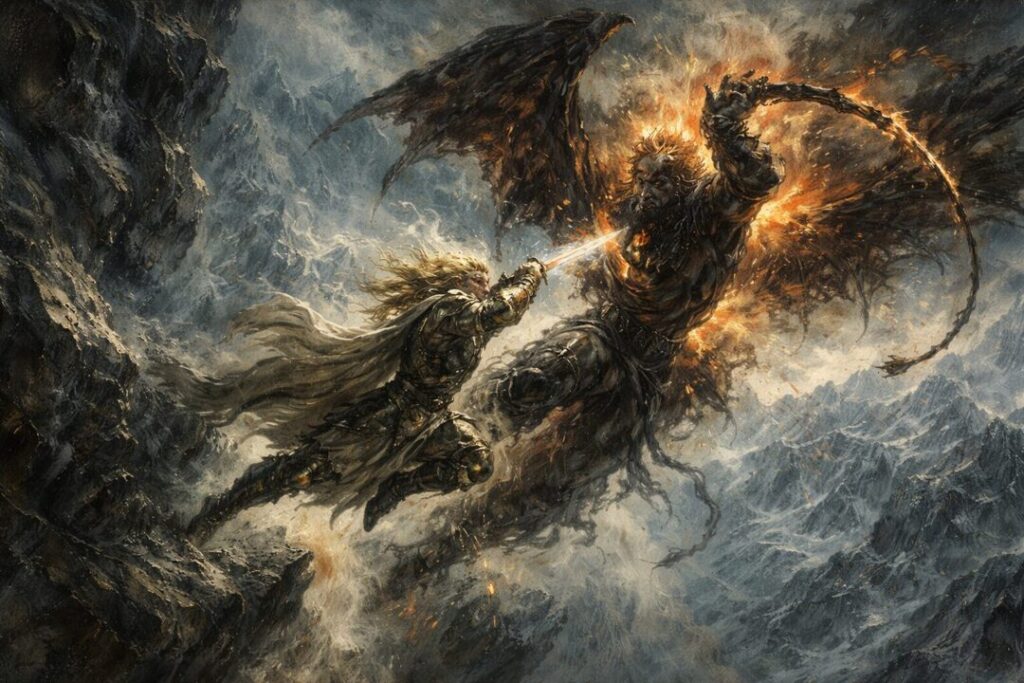
Glorfindel dies heroically during the Fall of Gondolin, battling a Balrog and perishing in the abyss. Thousands of years later, he appears in Rivendell as one of Elrond’s chief allies—radiant, powerful, and unmistakably the same individual.
Tolkien addressed this directly in his letters. Glorfindel was rehoused and sent back by the Valar, likely as an emissary rather than a simple returnee. His power in the unseen world is so great that the Nazgûl flee from him at the Ford of Bruinen.
This is not a retcon. It is theology.
Glorfindel’s return shows that Tolkien was willing to revisit characters when it aligned with the deeper structure of Arda. His presence serves a purpose tied to the struggle against Sauron, not nostalgia or convenience.
The Silence Around Other Fates
Yet Tolkien leaves many stories unfinished.
What became of the Blue Wizards after they journeyed into the East? Did they fail, as Tolkien later suspected, or did they succeed quietly, weakening Sauron’s influence beyond the West? What paths did the Dwarves of the East walk, far from the chronicles of Gondor and Rivendell? What of characters whose ends are hinted at but never shown?
These silences are often mistaken for impossibility.
In reality, Tolkien frequently left doors closed—not locked.
Christopher Tolkien acknowledged repeatedly that many narrative threads were abandoned not because they contradicted lore, but because his father did not live long enough to resolve them. In some cases, Tolkien himself changed his mind, leaving multiple versions of events without final synthesis.
Absence of detail is not prohibition.
Why This Matters
When modern audiences debate whether a story could exist in Middle-earth, the correct question is not, “Would Tolkien have written this?”
That question is unknowable and ultimately irrelevant.
The correct question is:
Would the metaphysics of Arda allow it?
Does it respect the Gift of Men?
Does it honor the binding of Elves to the world?
Does it avoid cheap reversals of fate and consequence?
Does it align with the Music of the Ainur rather than contradict it?
If the answer is yes, then the story is not heresy. It is hypothetical.
That distinction preserves Tolkien’s integrity while allowing thoughtful exploration of his world.
The Difference Between Invention and Imagination
Tolkien despised arbitrary invention. He loathed allegory imposed from outside and spectacle detached from meaning. But he celebrated sub-creation—the careful act of imagining within rules, not against them.
Any story that violates the Music of the Ainur fails immediately. Any story that respects it may stand, at least in theory, even if Tolkien never wrote it.
Middle-earth is not small. It is vast, layered, and deliberately unfinished. Tolkien did not close every door because he understood that mystery is part of myth.
And sometimes, what was never written tells us just as much as what was.
Not every silence is a denial.
Some are an invitation—to think more carefully, not more freely.
Sources & Notes
- J.R.R. Tolkien, The Silmarillion, “Ainulindalë” — the Music of the Ainur gives the article its governing idea: Arda has deep order, not franchise-style arbitrariness.
- J.R.R. Tolkien, The Silmarillion, “Of the Beginning of Days” — Elves are bound to Arda while Men receive the Gift of Ilúvatar, supporting the distinction between Elvish and mortal death.
- J.R.R. Tolkien, The Lord of the Rings, Book III, Chapter 5, “The White Rider” — Gandalf says he was sent back until his task is done, grounding the article’s treatment of his return as unique and purposeful.
- J.R.R. Tolkien, The Silmarillion, “Of Beren and Lúthien” — Lúthien’s song before Mandos and Beren’s return show mercy as an extraordinary exception with a cost, not a repeatable loophole.
- J.R.R. Tolkien, The Peoples of Middle-earth, “Last Writings: Glorfindel” — Tolkien’s late note on Glorfindel explains his rehousing and return, fitting the article’s point about rare returns within Arda’s laws.
- J.R.R. Tolkien, Tree and Leaf, “On Fairy-stories” — Tolkien’s idea of sub-creation and inner consistency supports the article’s distinction between respectful imagination and arbitrary invention.