
The One Ring is often treated as a blunt instrument of evil — a magical object that simply overpowers whoever holds it long enough. In casual discussion, it’s described almost like radiation: exposure equals corruption, and the only variable is time.
But Tolkien never wrote the Ring that way.
In fact, one of the most unsettling aspects of the Ring is how unevenly it works.
Sméagol kills almost immediately.
Frodo endures for months — even years.
Sam holds the Ring and gives it back.
This is not inconsistency.
It is not a narrative shortcut.
It is design.
The Ring does not operate on a timer. It operates on desire.
The Ring Does Not Create Desire — It Exploits It
The most important thing to understand about the Ring is this: it does not invent new ambitions. It does not rewrite a person’s nature from scratch. Instead, it magnifies what already exists, bending it toward domination and possession.
This is why the Ring feels almost intelligent. It does not tempt everyone the same way because it cannot.
Sméagol murders Déagol not because the Ring forces him to, but because the Ring immediately recognizes something usable. The moment Sméagol sees the Ring, he wants it — not because of prophecy, not because of fate, but because wanting what others have is already part of who he is.
Tolkien is careful here. Sméagol is not portrayed as innocent before the Ring. Gandalf explicitly describes him as curious, secretive, and inclined toward possessiveness even before his corruption. The Ring simply finds fertile ground.
And that is why the transformation feels instant.
Sméagol does not slowly decline. He snaps. The Ring meets no resistance because it does not need to overcome any internal boundary. It offers ownership, secrecy, and power — and Sméagol already wants all three.
This is why his corruption feels shocking but also disturbingly clean. The Ring does not have to work on him. It simply amplifies him.

Frodo Baggins: A Ring-Bearer Who Never Wanted Power
Frodo stands in direct contrast to Sméagol in almost every meaningful way.
He does not seek the Ring.
He does not desire it.
He does not even fully understand it at first.
He inherits it — and, crucially, he accepts it out of responsibility rather than ambition.
This matters more than almost anything else in the story.
Throughout The Lord of the Rings, Frodo almost never imagines ruling, commanding, or reshaping the world. Unlike Boromir or even Gandalf, he does not picture himself using the Ring for good. His temptation is quieter and more human: rest, relief, the end of pain.
The Ring cannot seize Frodo quickly because it does not have a clear shape to exploit. There is no grand hunger for power to inflate. Instead, it must wear him down slowly, pressing on fatigue, fear, and isolation.
Tolkien reinforces this not through spectacle, but through time.
Frodo’s decline is slow, cumulative, and deeply tragic precisely because it is resisted. Every step toward Mordor increases the pressure, not because Frodo is weak, but because the burden itself is additive. The Ring grows heavier not because it becomes stronger, but because Frodo becomes more exhausted.
And then Tolkien does something vital.
At the end, Frodo fails.
But he fails only at the absolute limit of endurance — at the Crack of Doom, after bearing the Ring further than anyone else in Middle-earth ever could. This failure is not moral collapse. It is not weakness of character. It is the inevitable breaking point of a finite being carrying an infinite weight.
Tolkien makes it clear elsewhere: no one could have done better.
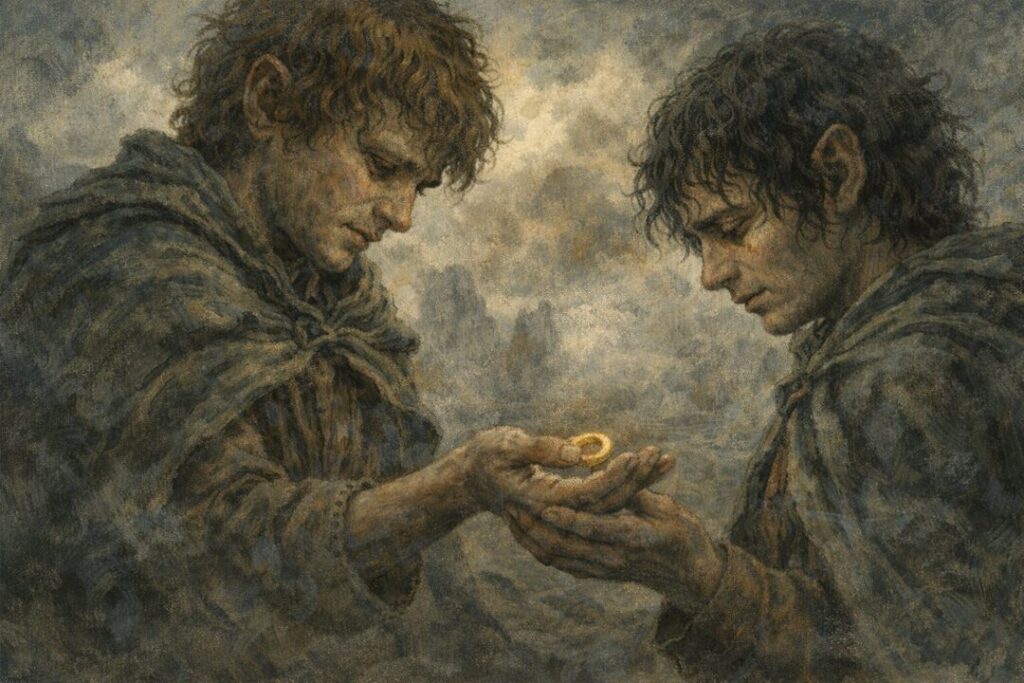
Samwise Gamgee: Why the Ring Struggles With Him
Samwise Gamgee is often described as “immune” to the Ring, but this is an oversimplification. Tolkien never presents Sam as untouched by temptation. In fact, he shows us exactly how the Ring tries to work on him — and why it fails.
When Sam carries the Ring in Mordor, it does not offer him domination in the usual sense. Instead, it adapts.
The Ring offers Sam a vision: Samwise the Strong, hero of the age, turning the desolation of Mordor into a vast garden. It is a revealing temptation, because it proves the Ring is capable of subtlety.
This is critical.
The Ring does find a lever.
But the lever is too small.
Sam’s love is local, personal, and grounded. Even when imagining greatness, he cannot escape his essential nature. His dream of power collapses almost immediately into something gentle, domestic, and fundamentally unthreatening.
Just as importantly, Sam’s loyalty runs outward. His sense of self is defined not by ownership, but by service. He does not see himself as the center of the story — and the Ring cannot function without that assumption.
Most importantly of all: Sam never confuses possession with purpose.
He never believes the Ring is the point. It is only ever a tool, and even then, one he distrusts. The Ring cannot entangle him because it cannot convince him that it matters more than Frodo.
That is why he gives it back.
Sméagol: Why He Was Lost — and Sam Wasn’t
Sméagol had no such anchor.
Before the Ring, Sméagol already defined himself by ownership, secrecy, and resentment. After the Ring, those traits simply metastasize. The Ring does not erase him. It reveals him.
This is one of Tolkien’s most uncomfortable truths: evil does not always destroy identity. Sometimes it clarifies it.
Sam, by contrast, knows exactly who he is. His sense of self does not depend on possession, recognition, or control. It is rooted in love, memory, and duty — things the Ring cannot easily twist.
This is why Sméagol falls immediately, Frodo falls slowly, and Sam barely falls at all. Not because of strength. Not because of luck. But because of alignment.

Tolkien’s Real Warning
Tolkien was not writing about magical artifacts.
He was writing about temptation.
The Ring corrupts fastest where desire already aligns with its purpose. It struggles where humility, love, and self-forgetfulness stand in the way. It preys on ambition, fear, and the need to possess — but it falters when confronted with contentment and loyalty.
That is why strength is irrelevant.
That is why intention matters more than willpower.
And that is why Sam’s brief temptation is not a flaw, but proof of victory.
The Ring fails with Sam not because it does not try —
…but because it offers him a world he simply does not want.
Sources & Notes
- J.R.R. Tolkien, The Lord of the Rings, Book I, Chapter 2, “The Shadow of the Past” — Gandalf’s account of Sméagol and Déagol shows how quickly possession, secrecy, and murder follow the Ring’s discovery.
- J.R.R. Tolkien, The Lord of the Rings, Book II, Chapter 2, “The Council of Elrond” — Frodo accepts the Ring as a burden rather than a prize or weapon of rule.
- J.R.R. Tolkien, The Lord of the Rings, Book VI, Chapter 1, “The Tower of Cirith Ungol” — Sam’s vision as “Samwise the Strong” reveals the Ring adapting its temptation to his homely desires.
- J.R.R. Tolkien, The Lord of the Rings, Book VI, Chapter 3, “Mount Doom” — Frodo’s final claim of the Ring comes only at the end of the long, crushing journey into Mordor.
- J.R.R. Tolkien, The Letters of J.R.R. Tolkien, Letter 246 — Tolkien explains Frodo’s failure at the Sammath Naur as occurring under a pressure beyond ordinary endurance, not as simple moral weakness.