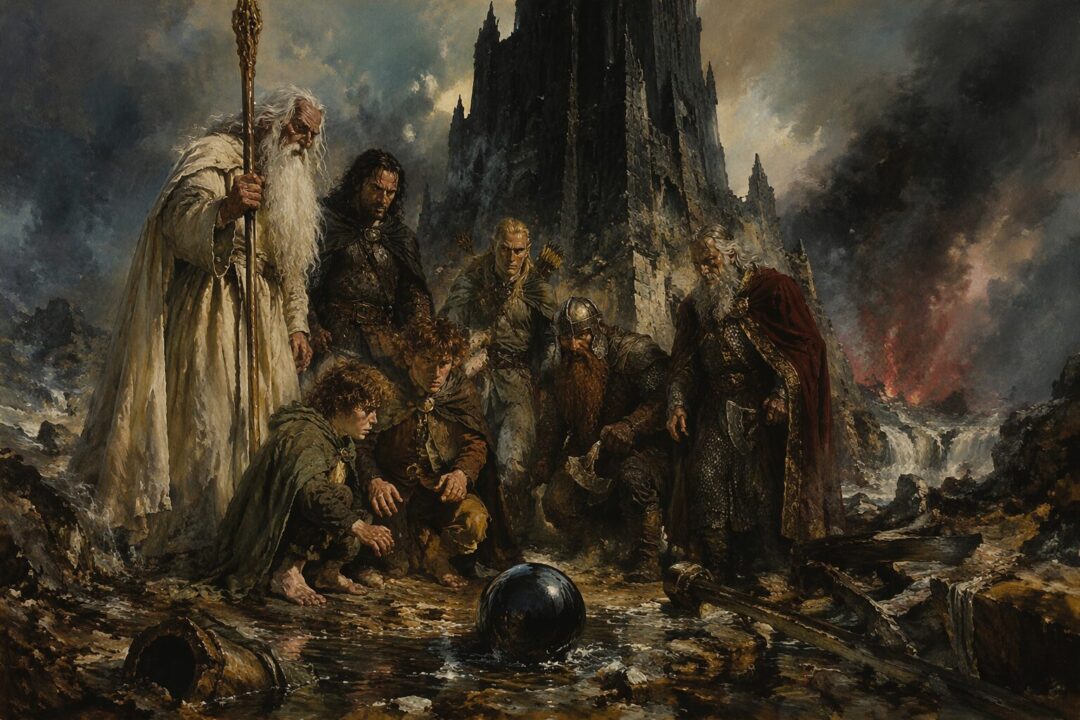
When Pippin looks into the dark stone taken from Orthanc, the scene turns at once from triumph to danger.
Until that moment, Saruman has been broken, Isengard has fallen, and the company seems, for a brief instant, to have gained an unexpected prize. Then the stone answers.
And the question that follows has bothered readers ever since:
Why didn’t Gandalf know what it was immediately?
At first glance, the moment can look almost strange. Gandalf is no ordinary wanderer. He is one of the Wise. He knows forgotten histories, old tongues, vanished kingdoms, and the deep lore of Middle-earth. A mysterious stone emerging from Orthanc seems exactly the kind of thing he should recognize at once.
But the texts point to a more precise answer.
Gandalf did not fail because the palantíri were beneath his knowledge.
He failed because the surviving palantíri no longer belonged to the world as living knowledge.

The palantíri were never common objects
One of the most important facts about the seeing-stones is also one of the easiest to miss.
They were not ordinary heirlooms, and they were never widespread public knowledge. In the tradition preserved in Unfinished Tales, the palantíri are described as things that were not matters of common use or common knowledge even in Númenor. In Middle-earth they were kept in guarded places, and access to them belonged to kings, rulers, and appointed wardens rather than to the public.
That matters.
Readers sometimes imagine the palantíri as famous magical objects whose identities would be obvious to any learned figure. But the texts suggest something narrower and more political. These were instruments of rule, not museum pieces and not popular legends in everyday circulation.
So Gandalf’s broad learning does not automatically mean instant recognition in the dark, in the field, under pressure, from a single glance at a stone that has only just been hurled from a tower.
He knows the old world.
But the old world has become fragmented.
By the late Third Age, much of their history had faded
The decline of the palantíri is part of the wider decline of the Númenórean kingdoms.
One stone was lost in the Anduin. Others vanished with the fall of Arnor. The Ithil-stone was presumed lost when Minas Ithil fell. The Elostirion-stone was isolated from the rest. Even the Anor-stone in Minas Tirith was withdrawn from common use because of the danger that Sauron might hold its counterpart. Over time, the network ceased to function as it once had, and knowledge of the stones receded with it.
This is the real setting of Gandalf’s uncertainty.
He is not living in the high age of Gondor, when the stones formed part of the kingdom’s practical inheritance. He is living at the far end of decline, after centuries of loss, interrupted transmission, and ruined institutions.
In that context, a palantír is no longer an expected tool of power.
It is a relic from a broken order.
That helps explain why Gandalf can know of palantíri in lore without instantly treating any dark polished sphere as one in practice.
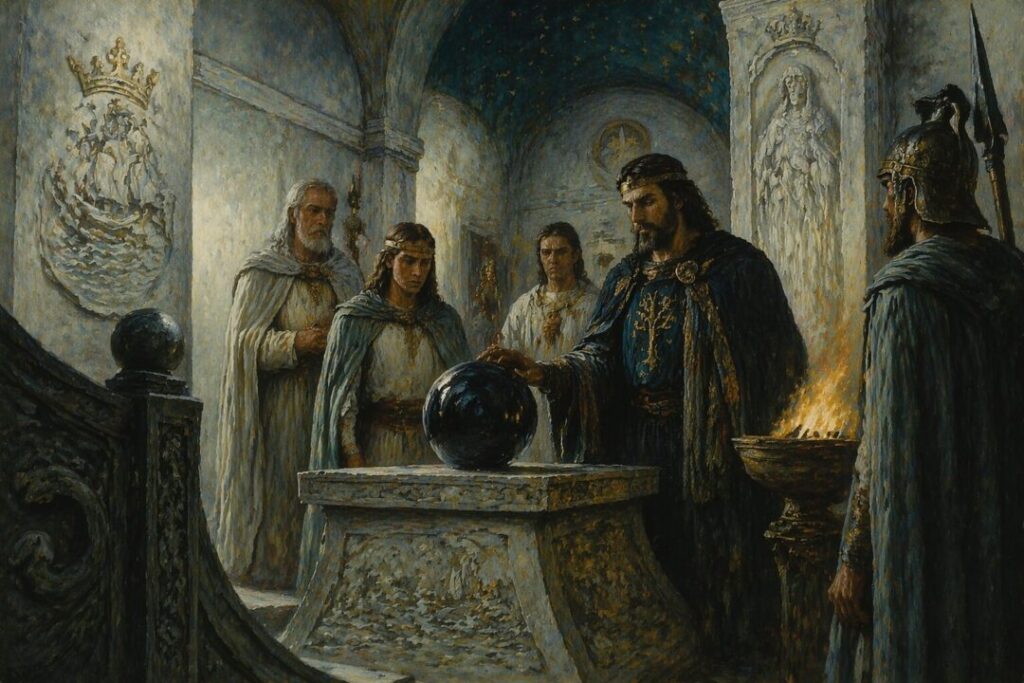
Orthanc’s stone was hidden inside a larger silence
There is another piece that makes the scene darker.
Saruman appears not merely to have possessed the Orthanc-stone, but to have kept that fact from the White Council. Gandalf says, after the revelation, that Saruman never spoke a word of it to the Council, and that they themselves had not given much thought to the fate of the palantíri of Gondor in its ruinous wars. By Men they were almost forgotten.
That line changes the shape of the whole question.
Why did Gandalf not know?
Because Saruman had reason to keep the matter secret.
If Orthanc still held a seeing-stone, that fact would have been of enormous importance. It would help explain Saruman’s unusual access to information, his growing confidence, and eventually his exposure to Sauron through the stone. Gandalf’s uncertainty is not simply a gap in scholarship. It is the effect of deliberate concealment by someone who stood at the center of the same circle of the Wise.
So the scene is not really Gandalf overlooking something obvious.
It is Gandalf discovering that Saruman has been hiding something foundational.
Gandalf knew the concept, not the present reality
This is where the wording needs to stay careful.
It would be too strong to say Gandalf had no idea what a palantír was in principle. The broader lore of the stones was not wholly unknown to the Wise, and Gandalf is later able to explain their nature, their great antiquity, and the probable identity of the stone Sauron holds. The issue is not that he lacked all knowledge of the palantíri as a class.
The issue is that he did not know this stone, here and now, was one of them.
That distinction matters.
“Why didn’t Gandalf know what the palantír was?” sounds like a question about ignorance.
The more accurate version is subtler:
Why didn’t Gandalf know that Orthanc still possessed an active seeing-stone, hidden in secret, and already entangled with Sauron?
That is a very different question, and the texts answer it much more easily.
Because almost no one still thought in those terms.
And the one person who certainly did had every reason not to tell them.
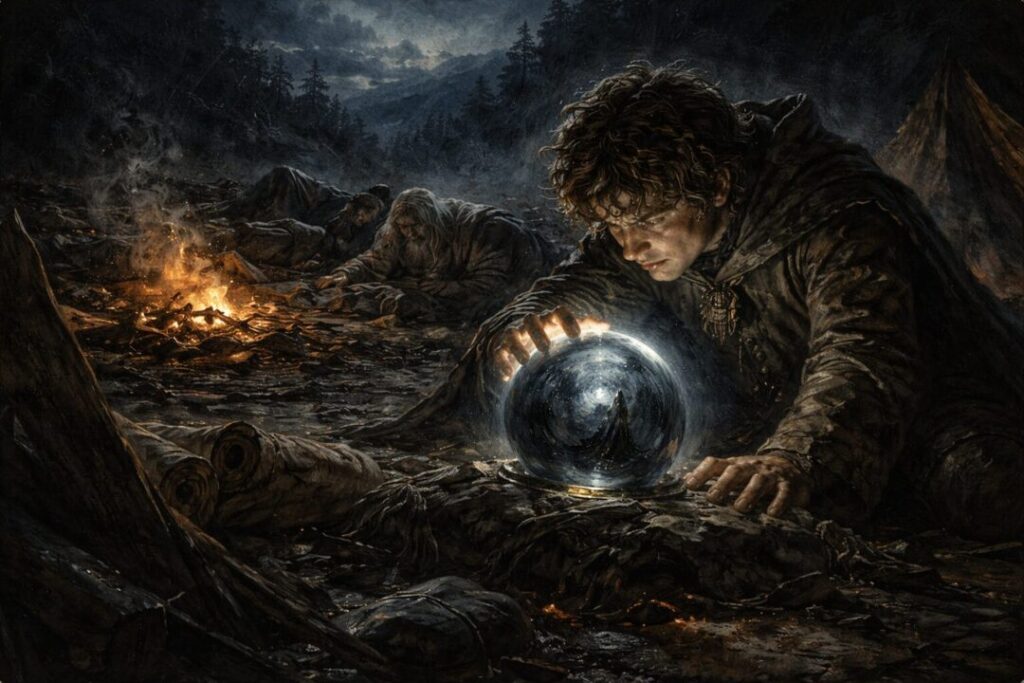
The moment of recognition comes through danger
The identification of the stone is not made in calm study.
It is forced by crisis.
Pippin handles the stone. Sauron answers through it. Gandalf questions Pippin and then realizes what has happened: the object cast from Orthanc is one of the seven palantíri, and Saruman has used it to communicate with the Dark Lord. That realization immediately changes the strategic situation. Gandalf understands that Sauron now has fresh reason to act, that messengers may soon come to Orthanc, and that delay is dangerous.
This is important because it shows how recognition works in the scene.
Gandalf does not identify the stone by leisurely visual inspection alone.
He identifies it when its function reveals itself.
That is far more plausible in the world of the story. A smooth black stone might be many things until it answers the Enemy. After that, the old fragments of lore lock suddenly into place.
What looks like belated recognition is really recognition under proof.
Middle-earth has become a world that half-remembers itself
The deeper answer, then, is larger than Gandalf.
This scene is about civilizational fading.
Again and again, The Lord of the Rings shows a world living among the remains of greater ages. Towers still stand whose makers are gone. Names survive whose full meanings have dimmed. Ancient powers persist in fragmentary, dangerous, or misunderstood forms. The palantír belongs exactly to that pattern. It is not merely an object. It is a remnant of a political and intellectual world that no longer exists intact.
So Gandalf’s hesitation is not a failure of character.
It is a sign of the age.
Even the wise do not move through Middle-earth with complete possession of its past. They move through ruins, partial traditions, and secrets buried by centuries of loss.
That is one reason the scene feels so eerie.
The stone is not only dangerous because Sauron can use it.
It is dangerous because it comes from an order of things that has slipped almost out of living memory.
Saruman’s secrecy is the real key
If one element must be placed at the center, it is this.
Saruman knew.
He had the Orthanc-stone. He used it. He concealed it. And Gandalf’s own words suggest that this concealment helped keep the matter outside the active concerns of the Council.
That makes Gandalf’s uncertainty tragic in a very particular way.
He is not outmatched by deeper wisdom.
He is being damaged by the secrecy of an ally who has already begun to turn.
Once that is clear, the scene sharpens. Gandalf is not a scholar forgetting a famous artifact. He is a guardian in a diminished age, confronting a relic another guardian has hidden and abused.
And that is far more in keeping with the moral pattern of the story.
The great dangers in Middle-earth are often not unknown powers appearing from nowhere.
They are known powers kept in the dark until the moment of crisis.
The real answer
So why didn’t Gandalf know what the palantír was?
Because the palantíri were never common objects to begin with. Because by the end of the Third Age their history had been broken by war, loss, and the fading of old kingdoms. Because the surviving stones had largely passed out of living use and, among Men, almost out of memory. And above all because Saruman kept the Orthanc-stone secret from the very people who might have recognized what its survival meant.
Which means the scene is not really about Gandalf failing to know enough.
It is about Middle-earth no longer fully knowing itself.
And once that becomes clear, the dark stone from Orthanc stops looking like a simple surprise.
It becomes what it really is:
A fragment of an older world returning at exactly the moment when almost no one is prepared for it.
Sources & Notes
- J.R.R. Tolkien, The Lord of the Rings, Book III, Chapter 11, “The Palantír” — Gandalf learns what the Orthanc-stone is after Pippin looks into it, and says Saruman never told the Council of it.
- J.R.R. Tolkien, Unfinished Tales, “The Palantíri” — gives the history, guarded use, and fading knowledge of the seven seeing-stones in Númenórean and Gondorian tradition.
- J.R.R. Tolkien, The Lord of the Rings, Appendix A, “Annals of the Kings and Rulers” — outlines the decline of Arnor and Gondor that forms the background for the loss and neglect of the stones.
- J.R.R. Tolkien, The Silmarillion, “Akallabêth” — places the palantíri among the heirlooms brought from Númenor by Elendil, supporting their ancient and exceptional status.