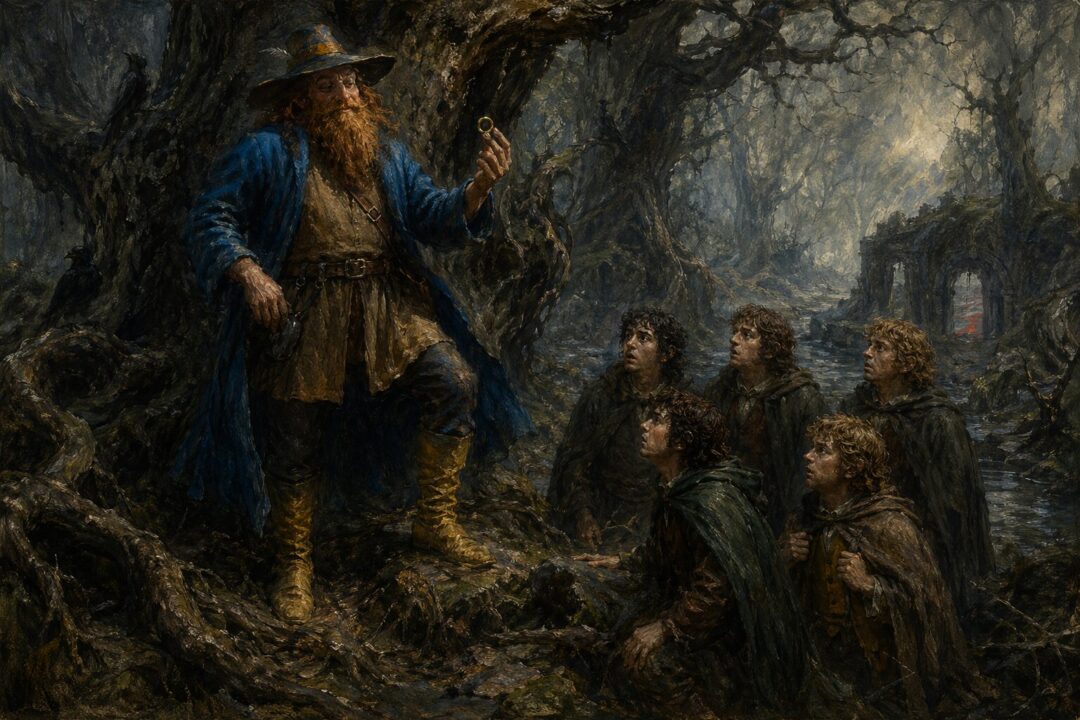
Tom Bombadil feels, at first, like a contradiction.
He is ancient beyond explanation.
He lives in a land where even Old Man Willow and the Barrow-wight cannot defy him for long.
The Ring itself seems strangely powerless in his hands.
And yet when the fate of Middle-earth hangs in the balance, Tom is never presented as its savior.
That is the real puzzle.
Not simply: what is Tom Bombadil?
But: why is someone so old, so untouched, and so singular also so unconcerned with the great war that will decide the age?
The answer begins once we stop assuming that power and concern must always go together.
Tom Is Not Written as a Hidden Champion
Readers often approach Bombadil as though he must secretly belong to some familiar category.
A veiled Vala.
A Maia in disguise.
A guardian-spirit assigned to the Old Forest.
Some surviving power from before the ordered histories of Elves and Men.
But the text never confirms any of that.
Instead, it carefully refuses to place him.
Tom calls himself “Eldest,” and says he remembers the first raindrop and the first acorn. Elrond later recalls that he is known as “oldest and fatherless.” Those descriptions make him feel older than the ordinary histories of Middle-earth, but they do not explain his nature. They only deepen the mystery.
That matters, because the story does not treat his mystery as a clue that will eventually resolve into a familiar answer.
It treats it as something that remains outside the normal map.
And once that is clear, his unconcern begins to make more sense.
The Ring Reveals What Tom Is Not
The most famous thing about Bombadil is that the Ring seems to have no hold on him.
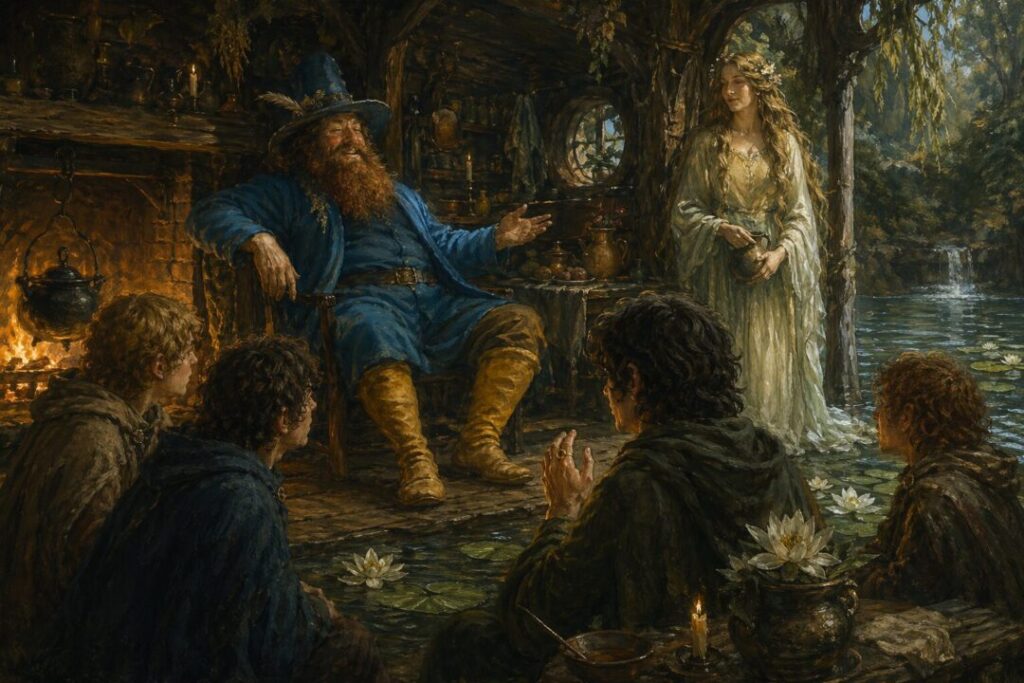
When he handles it in his house, nothing happens that Frodo expects. Tom does not vanish when he puts it on. Then, even more strangely, when Frodo wears it, Tom still sees him. In other words, the Ring does not establish the usual terms of power, concealment, or fear between them.
But this is exactly where many interpretations go too far.
The text does not say that Tom is therefore stronger than Sauron in some simple contest of raw might.
It says something subtler.
The Ring has little or no purchase on him because Tom does not relate to the world in the way the Ring was made to exploit. The One Ring is an instrument of domination. It is tied to command, possession, and the bending of other wills toward one center. Bombadil appears almost completely detached from those impulses.
That is why his immunity is not the same thing as suitability.
Being untouched by the Ring does not make him the right bearer of the Ring.
In fact, it makes him a terrible one.
The Council of Elrond Gives the Clearest Answer
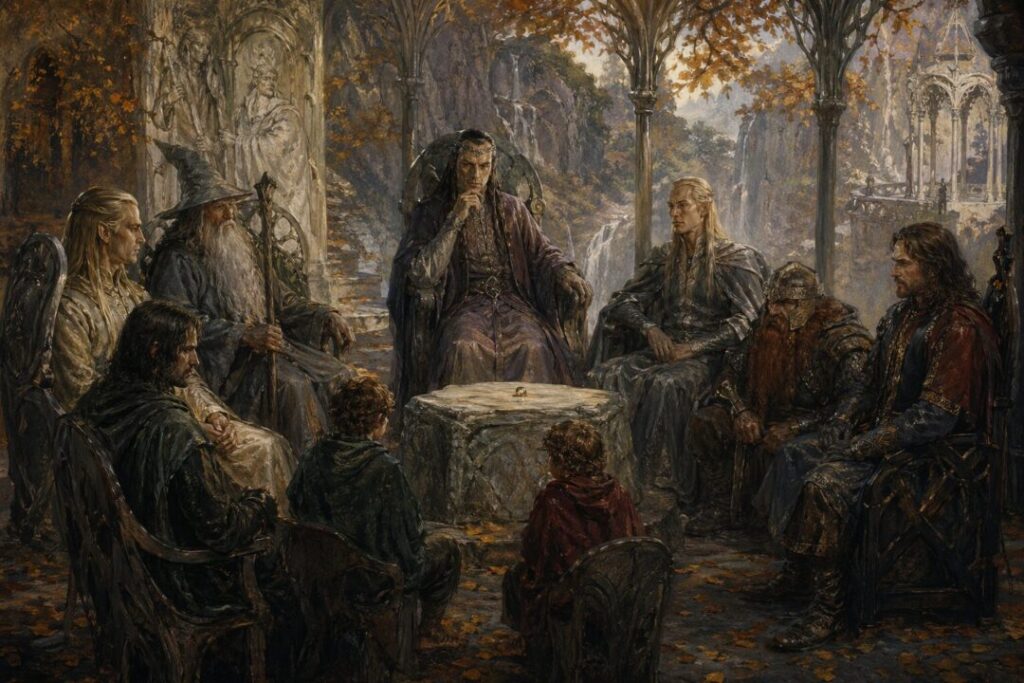
The most direct explanation comes when the Wise consider whether Bombadil should keep the Ring.
The proposal fails almost immediately.
Gandalf says Tom would not willingly take such a burden, and even if persuaded, he would not truly grasp the need in the way the others do. Worse, if entrusted with it, he might simply forget it or throw it away. The problem is not corruption. The problem is indifference to the entire structure of strategic responsibility the war demands.
That is an astonishing judgment.
Middle-earth is full of characters who are deemed unsafe because they desire the Ring too much.
Tom is unsafe for the opposite reason.
He does not desire it at all.
And because he does not desire it, he cannot be trusted to guard it in a world where vigilance, sacrifice, memory, and deliberate resistance are necessary.
The Wise go even further.
Glorfindel argues that hiding the Ring with Bombadil would only delay disaster. Sauron would eventually learn where it was and bend his power toward that place. And if everything else were conquered, Bombadil too would fall, “last as he was first.” The line is striking because it does not deny Tom’s greatness. It denies that his kind of being is the answer to this kind of war.
Tom’s Horizon Is Small on Purpose
One of the quiet truths about Bombadil is that his concern is local.
This is not a criticism. It is simply how he is presented.
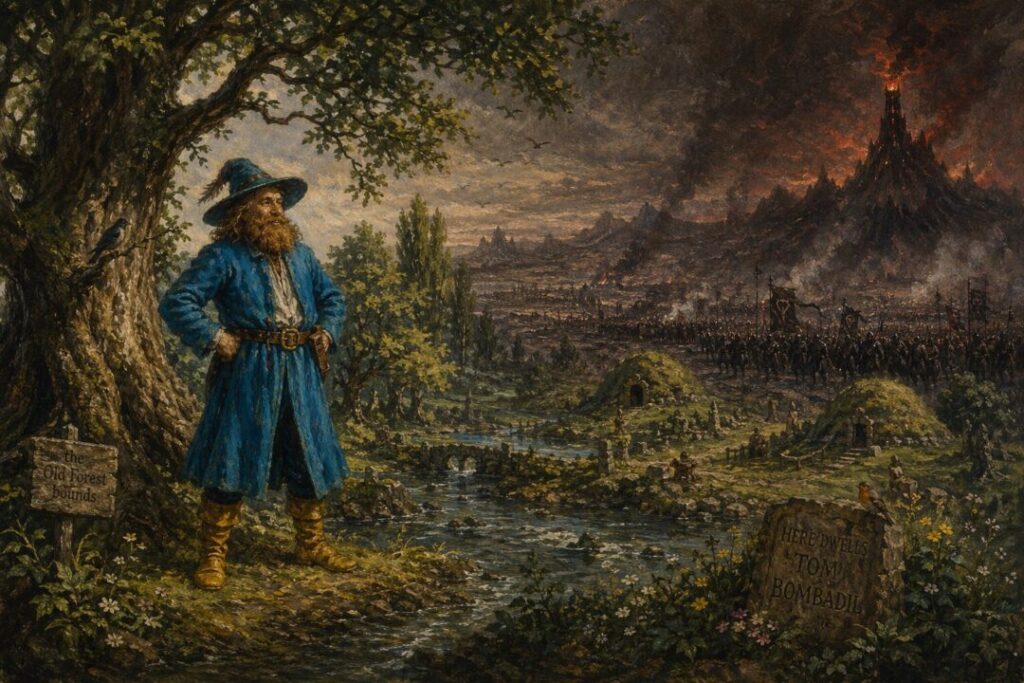
He is master in his own country. He rescues the hobbits from dangers within that country. He knows its songs, paths, trees, downs, and waters. He protects what lies within his bounds, and the text repeatedly suggests that he would not leave that land to take part in a wider campaign.
That localness is essential.
Tom is not unconcerned because he is asleep.
He is unconcerned because his mode of being is not historical in the same way as Aragorn’s, Gandalf’s, Elrond’s, or even Frodo’s.
Those characters live inside a long struggle shaped by inheritance, memory, defeat, duty, and foresight. They must think about what comes next if Sauron wins. They must act on behalf of peoples, kingdoms, lineages, and future generations.
Tom does not appear to inhabit the world on those terms.
He belongs to place more than to history.
And that is why the fate of all Middle-earth does not grip him in the same way it grips everyone else.
His Detachment Is Not Moral Failure
It is tempting to treat Bombadil’s unconcern as negligence.
Why does he not help more?
Why does he not stand with the Free Peoples?
Why does he remain merry while the world darkens?
But the text does not frame him as selfish or cowardly.
It frames him as other.
He helps freely when the hobbits enter his sphere. He saves them more than once. He offers shelter, counsel, food, song, and rescue. He is generous, not cruel. Yet that generosity does not expand into a universal mission to oppose evil everywhere.
That distinction is important.
Bombadil is not a failed warrior.
He is not a retired power.
He is not a good king neglecting his office.
He simply does not belong to the same order of response.
A later explanatory letter describes him as standing outside the normal circle of domination and hostility that entangles the rest of the world. That should be used carefully, because it explains rather than replaces the novel’s evidence. But it fits what the story already shows: Tom is detached not because darkness is unreal, but because the contest for mastery is not his native mode at all.
Why He Matters to the Story
If Tom is not there to solve the war, why is he there?
Because he reveals something the rest of the story might otherwise hide.
In The Lord of the Rings, even the good are forced into relation with power.
They must resist it, refuse it, hide from it, carry it, destroy it, or endure its pressure. Their virtue is real, but it unfolds within a world already distorted by the need to answer domination with perilous action.
Tom shows another possibility.
He is a glimpse of a being for whom possession has no attraction and mastery no fascination. In him, the Ring appears almost ridiculous. That does not save the world. It does something stranger: it exposes how deeply the world has been shaped by power everywhere else.
That is why Bombadil can feel both comforting and unsettling.
Comforting, because he seems free in a way almost no one else is.
Unsettling, because that freedom cannot be scaled up into a political or military answer.
He is not a model for winning the War of the Ring.
He is a reminder that there are realities older and less possessive than war, even while war remains unavoidable.
Why Tom Was So Unconcerned
So why was Tom Bombadil so unconcerned about the fate of Middle-earth?
Not because he did not know darkness existed.
He explicitly speaks of the time before the Dark Lord came from outside. The Council also assumes that, in the end, Sauron’s victory would reach even him. Tom is not ignorant of evil in any absolute sense.
And not because he was secretly the strongest being in the story.
If that were true, the Council’s debate would make no sense.
He was unconcerned because he stands outside the kind of possessive, strategic, world-ordering struggle that defines the War of the Ring. He is attached to being, place, song, weather, river, tree, and immediate delight more than to conquest, policy, or the management of history. The Ring cannot seize his mind for exactly that reason. But the same detachment also means he cannot become the guardian the age requires.
That is the deeper answer.
Tom Bombadil is not the character who proves the war does not matter.
He is the character who proves that not every form of goodness belongs to war.
And in a book filled with kings returning, realms falling, and powers contending for the shape of the age, that may be why his unconcern feels so unforgettable.
It is not a gap in the story.
It is one of the clearest signs that Middle-earth contains more than the struggle we can easily explain.
Sources & Notes
- J.R.R. Tolkien, The Fellowship of the Ring, Book I, Chapter 7, “In the House of Tom Bombadil” — Tom calls himself Eldest and proves strangely untouched by the Ring.
- J.R.R. Tolkien, The Fellowship of the Ring, Book I, Chapter 8, “Fog on the Barrow-downs” — Tom’s rescue of the hobbits shows his power within his own country, not a wider war-leadership role.
- J.R.R. Tolkien, The Fellowship of the Ring, Book II, Chapter 2, “The Council of Elrond” — the Wise reject giving Tom the Ring because he would not bear that responsibility and might forget or discard it.
- J.R.R. Tolkien, The Fellowship of the Ring, Book II, Chapter 2, “The Council of Elrond” — Glorfindel’s “last as he was first” warning frames Bombadil as great but not an answer to Sauron’s conquest.
- J.R.R. Tolkien, The Letters of J.R.R. Tolkien, Letter 144 — Tolkien describes Bombadil as having renounced control and as interested in things for themselves, not as material for power or domination.