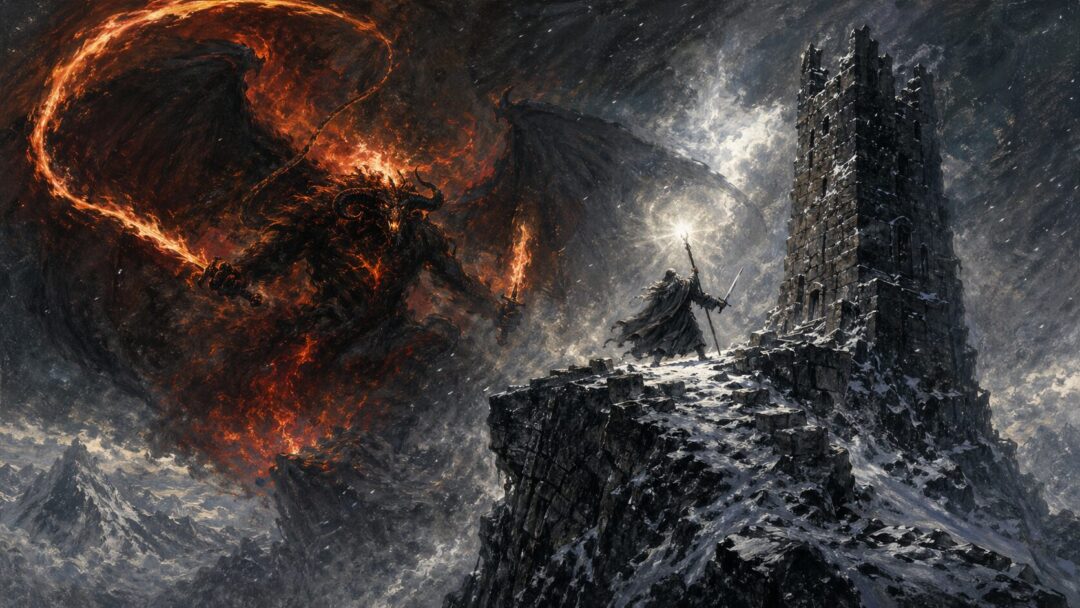
Most readers experience the moment in Moria the same way the Fellowship does.
It feels sudden.
Violent.
Unplanned.
The Company is already battered, half-blind in the dark, and fleeing for its life through the ruined halls of Khazad-dûm. Then something worse than Orcs appears behind them. The air changes. The terror deepens. Legolas cries out the name at last.
A Balrog.
And in a few lines one of the most famous confrontations in Middle-earth begins.
Because of how quickly it happens, the scene is often understood in the simplest possible way: Gandalf and the Balrog met by chance, and Gandalf chose to hold the bridge because no one else could.
That is true as far as it goes.
But it may not go far enough.
The deeper question is not whether Gandalf planned to meet Durin’s Bane. The texts do not say that he did. The deeper question is whether, once that evil rose before him, the confrontation became part of the very work he had been sent into Middle-earth to do.
That is where the real answer begins.
Gandalf Was Not in Middle-earth by Accident
To understand Moria, we have to begin much earlier.
Gandalf was not simply a wandering wise man who happened to be present when the War of the Ring began. He belonged to the Istari, the emissaries sent from the West to help the peoples of Middle-earth resist Sauron.
Their task was highly specific.
They were not sent to dominate.
They were not sent to reveal themselves in overwhelming power.
They were not sent to rule.
They were sent to advise, to encourage, to unite resistance, and to oppose the spread of Shadow without becoming another version of it.
That matters.
Because Gandalf’s mission was never limited to guiding one Ring-bearer from one safe house to another. His purpose was broader than the road to Mordor, even though that road became central to everything. He was in Middle-earth to resist the great evil that still remained from the ancient wars.
And the Balrog was not some unrelated monster.
It was one of those ancient evils.
The Balrog in Moria Was More Than a Local Threat
Durin’s Bane had hidden beneath Khazad-dûm since the end of the First Age.
That alone makes the encounter feel larger than it first appears.
This was not merely a creature of the wild or a nameless horror living in forgotten tunnels. It was a Balrog of Morgoth: a surviving being from the elder darkness, a remnant of a far older order of war than Sauron’s present campaign.
In other words, Gandalf did not meet just another obstacle.
He met a surviving fragment of the world’s oldest Shadow.
That is one reason the scene has such weight. Moria is not just dangerous because the Fellowship is trapped. It is dangerous because the deep past of Middle-earth suddenly rises into the present. The Company does not merely stumble into bad luck. It collides with something buried for ages beneath history itself.
And only Gandalf among them is remotely fitted to stand against it.
Aragorn is great, but this is beyond Aragorn.
Boromir is brave, but this is beyond Boromir.
Legolas can recognize the terror, but not master it.
The others can only flee.
Gandalf turns because there is no one else who can do what must be done.
Did Gandalf Know He Would Meet It?
Here the texts become careful, and we should be careful too.
They do not say that Gandalf entered Moria because he knew a Balrog waited there and believed he was personally destined to confront it. In fact, when describing the earlier struggle at the Chamber of Mazarbul, Gandalf sounds uncertain at first about what he has encountered. Recognition grows during the flight, and the full truth becomes clear only as the danger draws near.
So the answer is no, not in that narrow sense.
There is no explicit statement that Gandalf walked into Moria saying to himself that this was the hour appointed for his battle with Durin’s Bane.
But that does not settle the larger matter.
Middle-earth is full of moments that are not planned by the people inside them and are still not merely accidental. The story repeatedly suggests that events can be shaped by a providence deeper than the designs of evil. Gandalf himself says as much elsewhere when speaking of Bilbo and the Ring.
That pattern matters here.
The absence of foreknowledge is not the same thing as the absence of meaning.
The Bridge Changes the Question
Once the Balrog appears, the issue stops being prediction and becomes purpose.
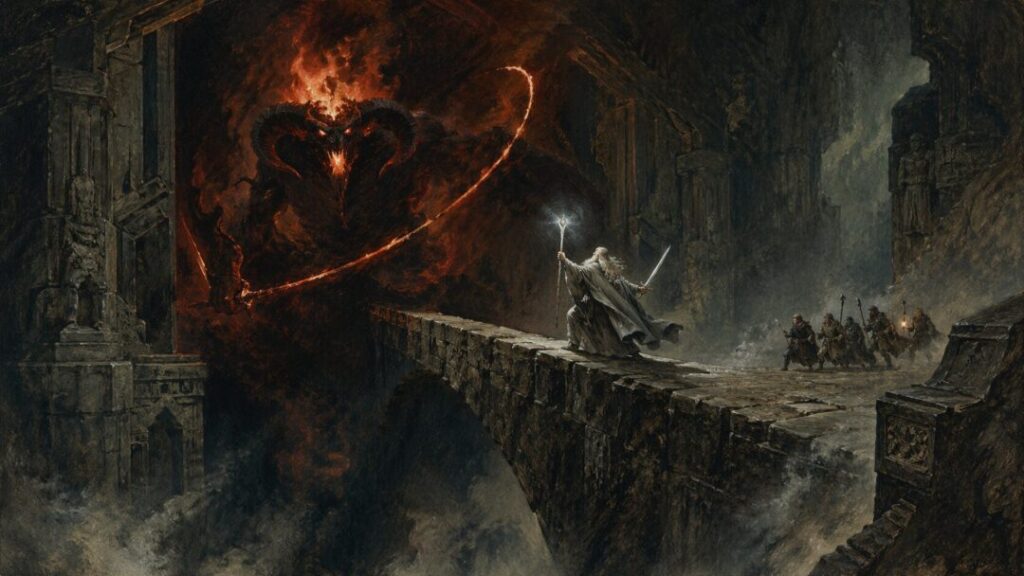
Gandalf does not merely delay an enemy for a few seconds.
He confronts it directly.
He names it.
He forbids its passage.
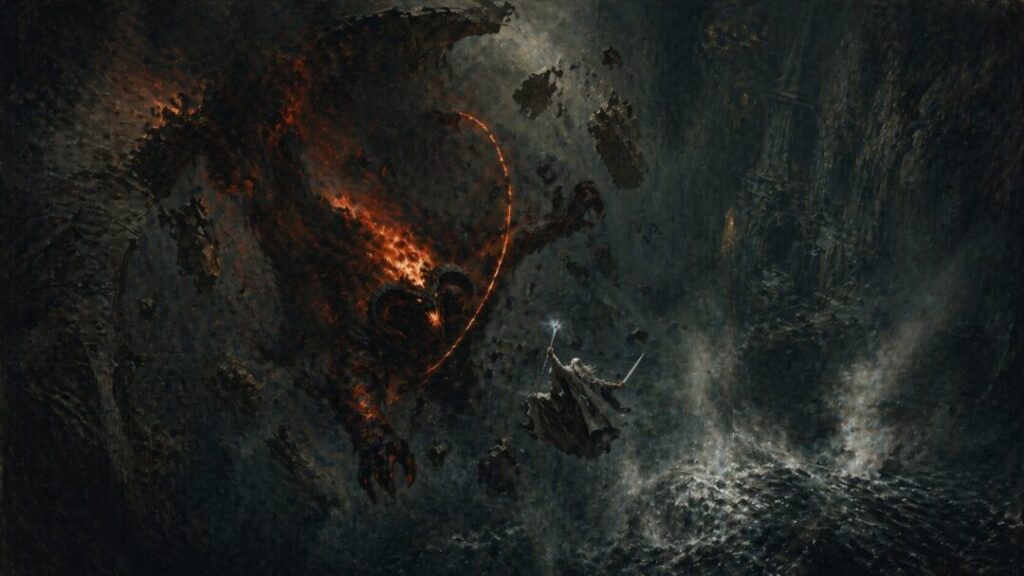
And when he falls, he continues the fight far below the world, through fire, water, darkness, nameless tunnels, and finally to Zirakzigil itself.
This is not presented as a brief unlucky skirmish.
It becomes one of the greatest single combats in the whole of The Lord of the Rings.
That is important because the struggle does two things at once.
It saves the Fellowship in the immediate sense. Without Gandalf’s stand, the others likely die in Moria.
But it also removes Durin’s Bane from the story entirely.
A Balrog is not left roaming free in the depths while the West goes to war.
It is cast down.
That has often been overshadowed by Gandalf’s apparent death, yet it is enormous. One of the last surviving terrors of Morgoth is destroyed in the middle of the War of the Ring, and it is Gandalf who does it.
If he was sent to oppose the Shadow, it is hard to argue that this fell outside his mission.
“Needless Were None of the Deeds of Gandalf in Life”
The most revealing passage comes after Moria, not during it.
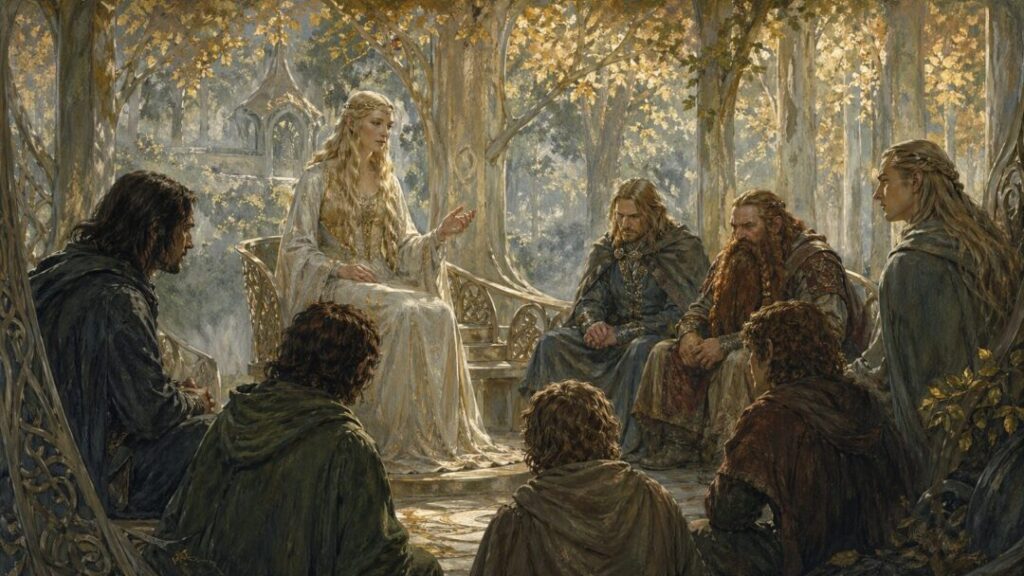
In Lothlórien, when the Company recounts what happened, Celeborn speaks as though Gandalf may have gone needlessly into the net of Moria. It is a reasonable thought. From the outside, the whole passage through Khazad-dûm looks disastrous.
But Galadriel immediately resists that judgment.
She says that it would be rash to say such a thing. Needless were none of the deeds of Gandalf in life. Those who followed him did not know his full purpose.
That does not mean she is giving us a neat, literal answer that Gandalf was specifically commanded in advance to fight the Balrog.
But it does mean the text refuses the easy reading that Moria was simply a blunder.
Her words widen the scene.
They suggest that Gandalf’s choices had a purpose larger than his companions could fully see at the time. Even after his fall, the narrative leaves room for meaning, intention, and necessity beyond immediate appearances.
That is a remarkable thing to say about a journey that seems, on the surface, like catastrophe.
Gandalf’s Death Was Not the End of the Mission
Then comes the final piece.
Gandalf dies.
Later material makes clear that this is real death, not merely exhaustion or symbolic language. Yet he is sent back until his task is done.
That return changes how Moria must be read.
If the battle with the Balrog were only an unfortunate interruption, it would still matter. But Gandalf’s death and return place the confrontation at the center of a transformation. The Grey Pilgrim goes into the abyss. Gandalf the White returns.
The texts do not say he was sent back because he defeated the Balrog. We should not overstate that.
But they do connect his sacrificial endurance, his faithfulness, and his unfinished task.
And that makes the confrontation feel less like an accident that derailed his mission and more like an ordeal through which his mission passed.
So Was He Meant to Confront the Balrog?
The safest answer is also the most interesting one.
Not in the simple sense that the texts explicitly announce a prior assignment: Gandalf, go to Moria and fight Durin’s Bane.
They never say that.
But neither do they leave the event looking random.
Gandalf was sent into Middle-earth to oppose the Shadow.
The Balrog was one of the greatest surviving powers of that Shadow.
When it emerged, Gandalf alone could stand against it.
His stand saved the Fellowship.
His victory removed an ancient evil.
Galadriel later insists that his deeds were not needless.
And his death in that struggle becomes part of the path by which he is sent back to finish his task.
So was he “meant” to confront the Balrog?
If by meant we mean explicitly told beforehand, the texts do not confirm it.
If by meant we mean that this encounter became part of the deeper purpose for which he had been sent, the story strongly points that way.
That is why the scene feels so much larger than a brave last stand on a narrow bridge.
It is not only a moment of courage.
It is one of those rare places in Middle-earth where hidden purpose and visible disaster meet at exactly the same point.
The Fellowship sees only loss.
But under the mountain, something more is happening.
An ancient servant of darkness rises out of the buried past.
A weary pilgrim sent to resist the Shadow turns to face it.
And the war that will decide the age is changed in ways almost no one around him can yet understand.
Sources & Notes
- J.R.R. Tolkien, The Lord of the Rings, Book II, Chapter 5, “The Bridge of Khazad-dûm” — shows Gandalf recognizing and withstanding Durin’s Bane when the Fellowship can only flee.
- J.R.R. Tolkien, The Lord of the Rings, Book III, Chapter 5, “The White Rider” — Gandalf recounts the battle from the abyss to Zirakzigil, his death, and his return to complete his task.
- J.R.R. Tolkien, The Lord of the Rings, Book II, Chapter 7, “The Mirror of Galadriel” — Galadriel warns that none of Gandalf’s deeds in life should be called needless.
- J.R.R. Tolkien, Unfinished Tales, “The Istari” — explains that Gandalf and the other Wizards were sent to aid resistance to Sauron by counsel and encouragement, not by domination.
- J.R.R. Tolkien, The Silmarillion, “Valaquenta: Of the Enemies” — identifies Balrogs as ancient spirits corrupted into Morgoth’s demons of terror, supporting Durin’s Bane as an elder Shadow rather than a local monster.