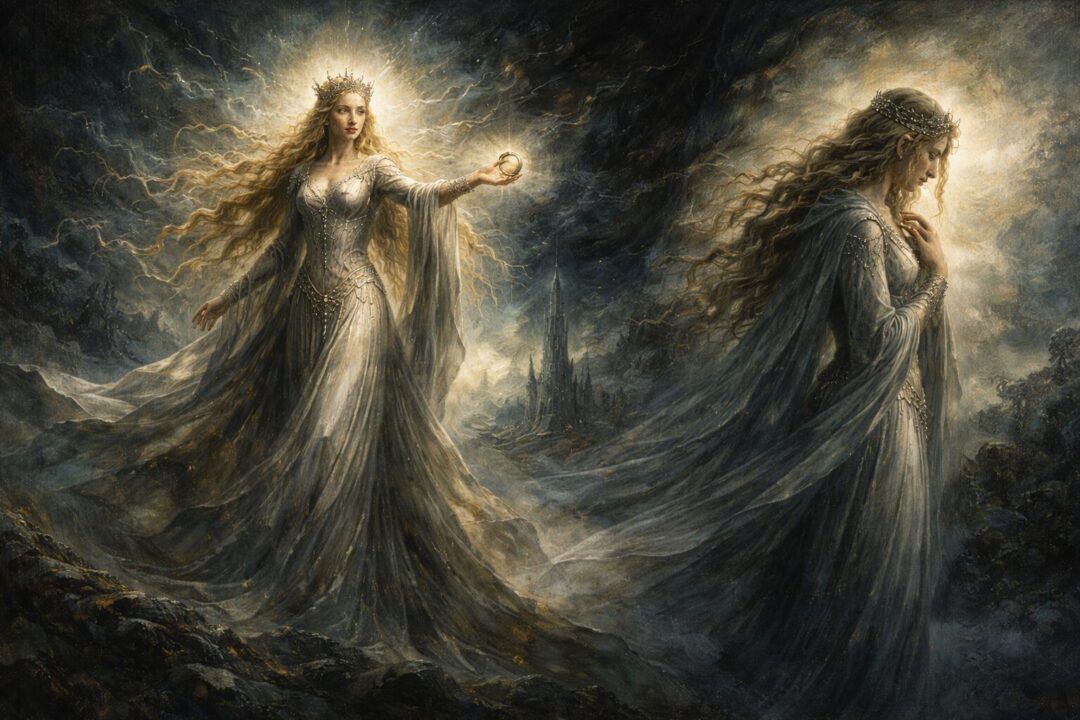
Frodo Baggins does not fear Galadriel in the way he fears the Ringwraiths, the darkness of Mordor, or even the Ring itself when it stirs too strongly in his mind. There is no sense of immediate danger when he stands before her. No threat. No raised voice. No drawn blade.
And yet, the encounter in Lothlórien leaves Frodo deeply unsettled.
His fear is quieter than terror, and far more enduring. It is the fear that comes from understanding something too clearly, too soon — and realizing that the burden he carries will not be taken from him, no matter how powerful the one standing before him may be.
By the time the Fellowship reaches Lothlórien, Frodo is already worn thin. Gandalf has fallen. The Company has been hunted, scattered, and tested. The Ring presses constantly on his thoughts, sometimes whispering, sometimes weighing on him like an invisible hand. Every step forward feels dangerous. Every pause feels like a mistake.
More than anything, Frodo wants certainty.
He wants someone wiser and stronger to tell him what must be done.
Instead, he is given a mirror.
Frodo’s Burden Before He Ever Reaches the Mirror
It is important to understand Frodo’s state of mind before his meeting with Galadriel. He is not a hero seeking glory or battle. He is a hobbit who never wanted power, leadership, or the fate of the world placed upon his shoulders. His strength lies in endurance, not ambition.
Yet the Ring does not care about intent. It does not ease its pressure because its bearer is humble. If anything, Frodo’s awareness of his own limits makes the burden heavier.
By the time he arrives in Lothlórien, Frodo has already learned that no one else can fully share what he carries — not Aragorn, not Legolas, not even Gandalf, who once guided him and now lies beyond reach. The Ring has isolated him, not physically, but inwardly.
Lothlórien, with its golden light and untouched beauty, should feel like refuge.
Instead, it becomes a place of reckoning.
The Mirror of Galadriel: Vision Without Comfort
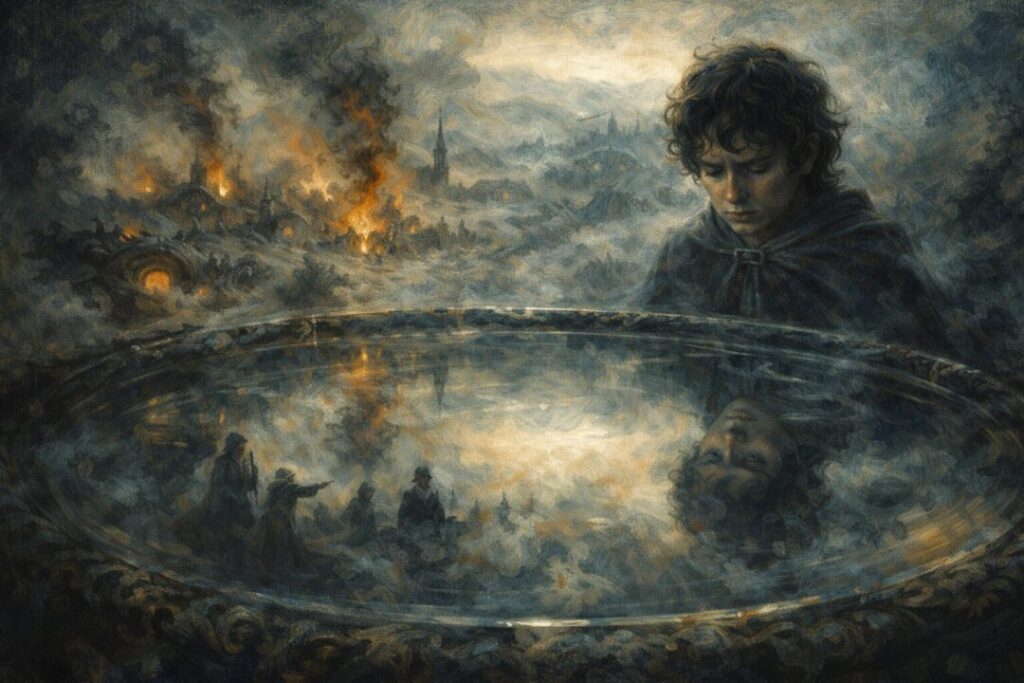
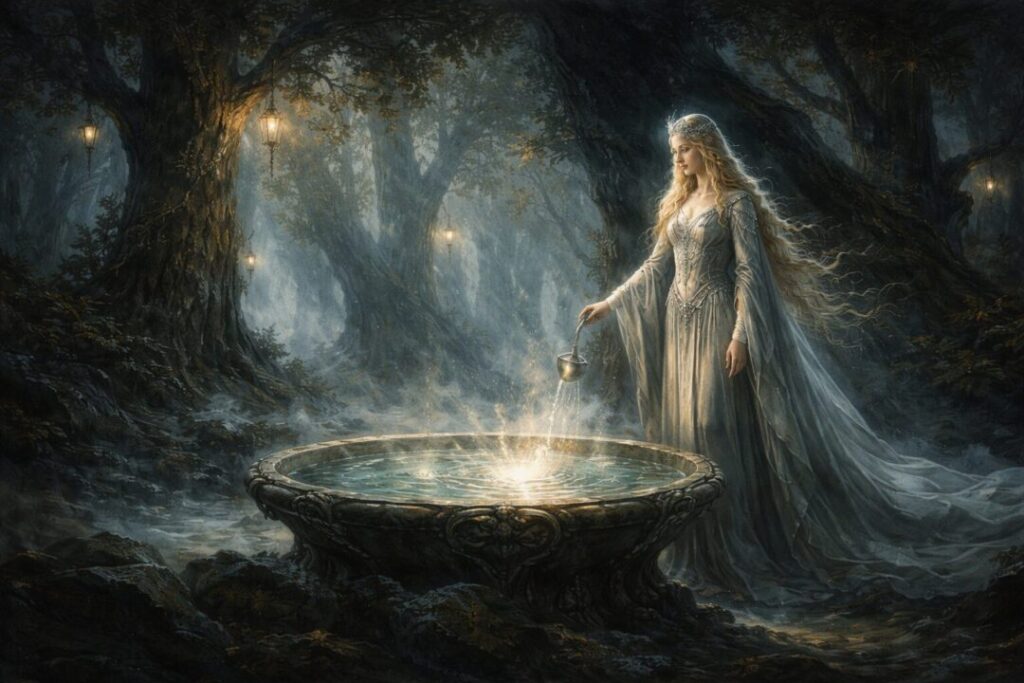
Galadriel does not summon Frodo in a public display. She does not test him before the eyes of the Fellowship. There is no ceremony, no challenge of strength or wit. Quietly, almost gently, she invites him to look into the Mirror of Galadriel.
The Mirror is not a tool of prophecy in the usual sense. It does not show what will be. It shows what may be — things that could come to pass, depending on choices not yet made.
That distinction matters.
What Frodo sees is deeply unsettling. The Shire in ruin. Trees cut down. Smoke rising where peace once lived. Friends in danger. Paths diverging into futures that feel both distant and frighteningly close.
There is no reassurance attached to these visions. No promise that they will be avoided. No instruction on how to prevent them.
The Mirror offers knowledge without guidance.
And that is the first reason Frodo feels fear:
because the burden remains entirely his.
Nothing in the vision relieves him of responsibility. In fact, it sharpens it. Frodo realizes that even small choices may carry terrible consequences — and that no one, not even Galadriel, will make those choices for him.
The Offer Born of Exhaustion
After the vision fades, Frodo does something extraordinary.
He offers Galadriel the Ring.
This moment is sometimes misunderstood as naïveté or desperation, but it is neither simple nor foolish. Frodo is not trying to rid himself of the Ring out of cowardice. He is acknowledging a truth he can barely bear: that the power required to oppose Sauron may lie beyond him.
The offer is born from exhaustion. From fear. From hope that someone older, wiser, and far more powerful could take the burden and succeed where he might fail.
It is, in its own way, an act of trust.
What follows is one of the most revealing moments in all of Middle-earth.
Galadriel’s Vision — and Her Refusal
Galadriel does not dismiss the Ring lightly. She does not scoff at the temptation or wave it away as beneath her. Instead, she confronts it fully.
For a moment, Frodo sees what she could become if she accepted it:
a Queen beautiful and terrible, radiant and overwhelming, ruling by fear and awe, her power stretching across Middle-earth like light that burns as much as it illuminates.
This is not an illusion meant to deceive. It is a true possibility.
And then Galadriel refuses.
“I pass the test,” she says. “I will diminish, and go into the West, and remain Galadriel.”
This choice is the turning point — and the true source of Frodo’s quiet fear.
The Fear Frodo Cannot Put Into Words
Galadriel stands before Frodo as someone who could wield the Ring. Someone who might even overthrow Sauron by force of will and power. And yet she chooses not to.
This realization unsettles Frodo more than any threat ever could.
The Ring, he understands now, does not tempt all beings in the same way. Some fall quickly. Some resist briefly. And some — like Galadriel — resist not because they are weak, but because they understand exactly what the cost would be.
Her mastery lies in restraint.
She stands beside immense power without grasping it. She does not deny its allure. She simply refuses to let it define her.
That level of control is something Frodo does not yet possess.
And that is what frightens him.
Power Without Domination
Throughout his journey, Frodo has encountered many forms of power: brute strength, authority, violence, command. Kings rule through law. Warriors through force. Dark Lords through terror.
Galadriel represents something else entirely.
She does not command Frodo’s path. She does not instruct him where to go or what to do. When he seeks answers, she offers honesty instead of certainty: even the wise cannot see all ends.
This absence of control is more frightening than tyranny.
Because it means Frodo must continue on without guarantees. Without assurance that he will succeed. Without knowing whether his sacrifices will matter.
The burden remains his — not because Galadriel cannot take it, but because she will not.
Why This Moment Changes Frodo Forever
Frodo leaves Lothlórien outwardly unchanged. He does not speak of fear. He does not voice doubt. He takes his place in the Fellowship and continues onward.
But inwardly, something has shifted.
He has seen what true power looks like in Middle-earth — and it is not loud, not violent, not impatient. True power waits. It endures. It restrains itself even when action would be easier.
And Frodo knows, with a clarity that frightens him, that he has not yet learned how to do the same.
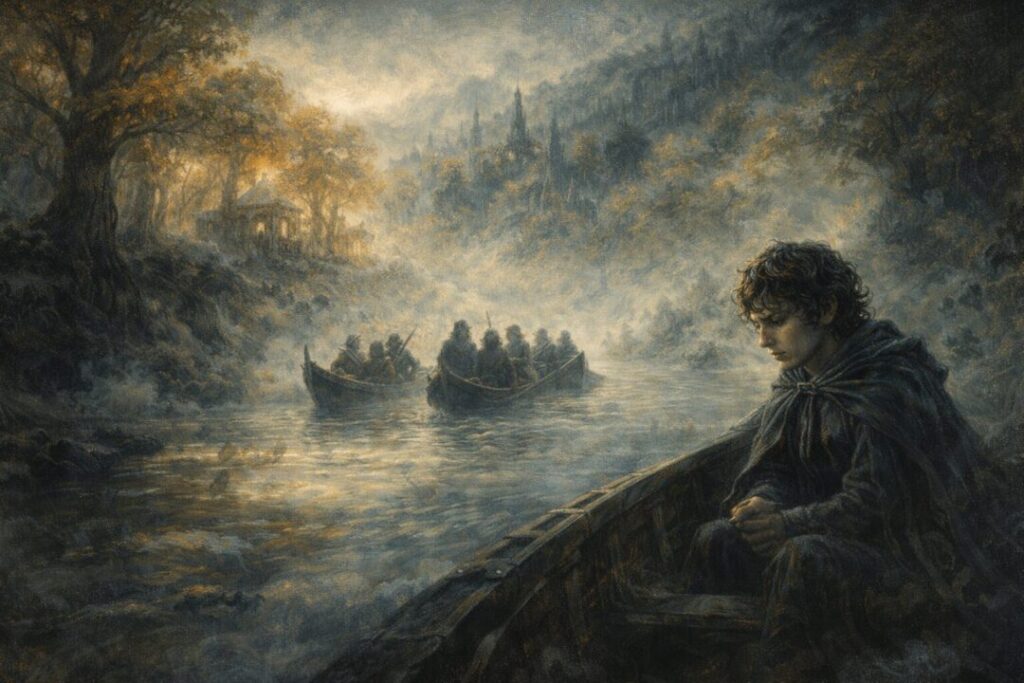
That knowledge stays with him long after the golden leaves of Lórien fade behind the Fellowship, long after the boats drift down the Anduin, and long after Galadriel herself has passed from his sight.
It is not fear of Galadriel that lingers.
It is fear of what her example reveals — and of the long road still ahead, where he must learn restraint, endurance, and sacrifice without ever being certain that they will be enough.
Sources & Notes
- J.R.R. Tolkien, The Lord of the Rings, Book II, Chapter 7, “The Mirror of Galadriel” — Galadriel tells Frodo the Mirror may show things that were, are, or may be, and Frodo sees the Shire threatened without receiving clear guidance.
- J.R.R. Tolkien, The Lord of the Rings, Book II, Chapter 7, “The Mirror of Galadriel” — Frodo offers Galadriel the One Ring, and her “beautiful and terrible” vision followed by refusal directly supports the article’s reading of power restrained.
- J.R.R. Tolkien, The Lord of the Rings, Book II, Chapter 8, “Farewell to Lórien” — Galadriel’s gifts and parting with the Company show that Lórien offers aid and insight, not an escape from the road Frodo must still take.
- J.R.R. Tolkien, The Lord of the Rings, Book I, Chapter 2, “The Shadow of the Past” — Gandalf’s warning that he would wield the Ring through pity but become too great and terrible gives context for why even the wise must refuse it.