
Saruman did not fall in a single moment.
His betrayal was not a sudden turning of the heart, nor a dramatic oath sworn in darkness. It was a long, careful descent—measured in years of study, quiet envy, and the slow hardening of pride. He did not abandon his purpose all at once; he reinterpreted it, convinced that he alone truly understood the task set before the Istari.
Nowhere is this clearer than in the way he spoke to Gandalf.
When Gandalf came to Orthanc, he believed he was meeting an ally. Saruman was the White Wizard, chief among the Istari, the one entrusted with leadership and counsel. If there was any mind in Middle-earth capable of discerning the shape of the rising Shadow, it was his.
Saruman knew this.
And he used it.
Knowledge as a Weapon
Unlike the Dark Lord, Saruman did not rule through terror alone. His most dangerous weapon was not force, but intellect. His voice was calm, persuasive, and steeped in lore. He spoke as one who had read deeper and longer than any other, who had traced the roots of power back to their beginnings.
He studied ancient histories, the making of Rings, and the long defeats and fleeting victories of the West. Over time, knowledge ceased to be a tool and became a measure of worth. Saruman came to believe that wisdom conferred authority—and that authority justified control.
When Gandalf arrived at Orthanc, Saruman did not immediately reveal his treachery. He did not demand allegiance or issue threats. Instead, he spoke of understanding the Enemy. Of patience. Of the necessity of meeting power with power. His words were reasonable, even compelling.
To a lesser mind, they might have sounded like prudence.
But beneath these arguments lay something far more personal.

The Weight of Origins
Saruman reminded Gandalf of who they truly were.
Not old men, robed in grey and white. Not wanderers and counselors among Elves and Men. But spirits from before the shaping of the world, sent into Middle-earth with a charge. They were not bound to its fate as its peoples were. They were emissaries.
The Istari had been given clear instruction: to guide, to advise, to inspire resistance against the Shadow—but never to dominate.
Saruman’s brilliance lay in how he invoked this shared origin. He did not recite it as doctrine. He used it as comparison. As implication.
The unspoken message was clear: I remember our purpose more clearly than you do.
In this framing, Gandalf’s humility became a failure of vision. His friendships with Hobbits and Men were not virtues, but distractions. His refusal to seek mastery was not restraint, but weakness.
Saruman positioned himself not as a rebel, but as a realist.
Testing Loyalty Through Memory
Saruman never directly accused Gandalf of disobedience. That would have invited resistance. Instead, he tested him—quietly, relentlessly—through memory.
He spoke dismissively of Gandalf’s wanderings, of his habit of arriving late and departing early. He questioned the value of hope placed in the small and the powerless. He implied that Gandalf had misunderstood the nature of the war they were sent to fight.
Each remark was carefully placed.
Each one waited for a reaction.
Would Gandalf deny his origin?
Would he defend his choices?
Would he accept Saruman’s authority?
Gandalf did none of these.
He listened.
And then, when the moment came, he refused.
That refusal was decisive.
In that instant, Saruman understood that Gandalf could not be bent—not by reason, not by shared history, and not by appeals to forgotten greatness. Gandalf remembered his origin, but he did not worship it.

The Meaning of the White Hand
Saruman’s symbol was once a sign of unity and leadership. The color white represented completeness, the blending of all hues. But Saruman did not wish to contain the colors—he wished to replace them.
Even before his open alliance with the Enemy, the White Hand symbolized something deeply revealing: the belief that Saruman had been chosen to improve upon the mission of the Istari.
Where Gandalf remained content to serve, Saruman wished to command.
Where Gandalf trusted in the freedom of others, Saruman believed freedom required direction—his direction. In his mind, domination was not corruption, but efficiency.
And this is why Gandalf’s acknowledgment mattered so much to him.
If Gandalf accepted Saruman’s framing—accepted that they were beings meant to rule rather than guide—then Saruman’s path would be validated. His descent would become evolution.
But Gandalf would not give him that absolution.
Captivity and Clarity
When Saruman finally revealed his intentions, the mask fell away. The offer was no longer subtle: join me, or be removed. Serve the new order, or be cast aside.
Gandalf’s response was simple.
He would not trade one darkness for another.
He would not oppose Sauron only to see Middle-earth ruled by a different tyrant, even one who cloaked his ambition in wisdom and white robes.
By rejecting Saruman’s appeal to shared origin and lost glory, Gandalf reaffirmed his true purpose—not as Olórin of old, but as Gandalf the Grey, servant of the free peoples of Middle-earth.
Saruman imprisoned his body.
Gandalf preserved his identity.
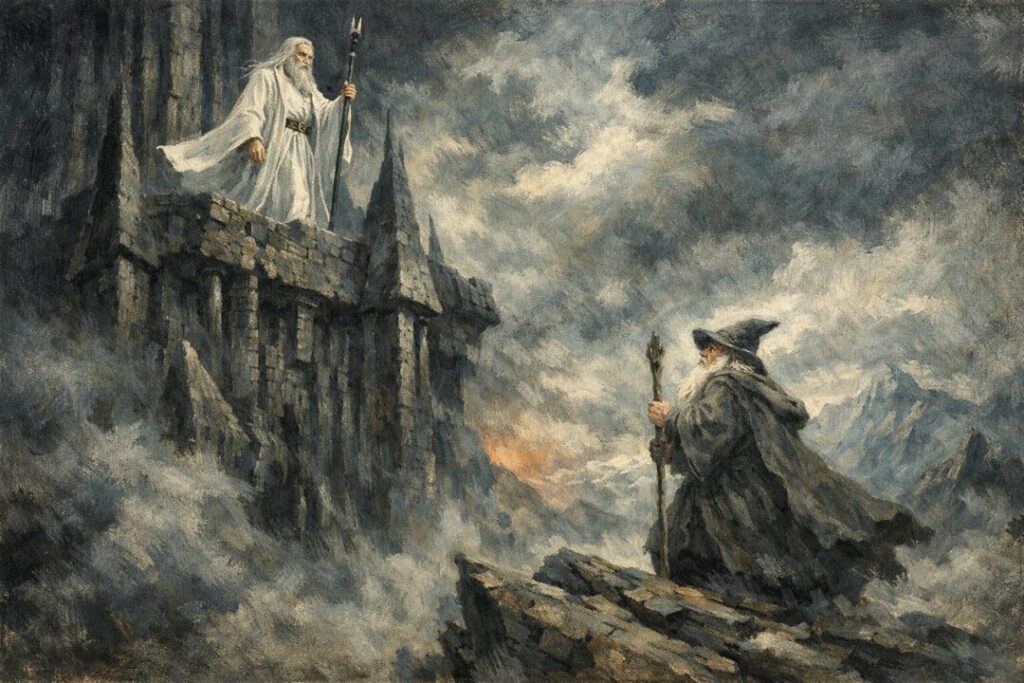
Two Paths, One Origin
Both wizards began the same way. Both were sent with the same charge. Both possessed great power restrained by design.
What separated them was not knowledge, but humility.
Saruman remembered who he had been—and demanded the world acknowledge it.
Gandalf remembered who he was sent to serve.
Saruman sought to dominate through remembrance, to turn memory into authority. Gandalf endured through humility, allowing memory to inform compassion rather than command.
And in that quiet exchange, atop a tower of stone rather than a battlefield of fire, the fate of Middle-earth shifted.
No armies clashed.
No swords were drawn.
But one wizard fell—and another proved worthy to rise.
Sources & Notes
- J.R.R. Tolkien, The Lord of the Rings, Book II, Chapter 2, “The Council of Elrond” — Gandalf’s account of Orthanc gives the central scene: Saruman’s private arguments, his claim to superior wisdom, and Gandalf’s refusal to join him.
- J.R.R. Tolkien, Unfinished Tales, “The Istari” — explains the Wizards as emissaries sent from the West to counsel and encourage resistance, not to rule Middle-earth by force.
- J.R.R. Tolkien, The Silmarillion, “Of the Rings of Power and the Third Age” — sets Saruman among the Wise, records his study of Ring-lore, and frames the larger struggle against Sauron’s dominion.
- J.R.R. Tolkien, The Lord of the Rings, Book III, Chapter 10, “The Voice of Saruman” — shows Saruman’s chief weapon as persuasive speech, using reason, flattery, and pressure even after his open fall.
- J.R.R. Tolkien, The Letters of J.R.R. Tolkien, Letter 131 — Tolkien’s summary of the Istari’s mission and Sauron’s will to domination helps distinguish Gandalf’s service from Saruman’s desire to order others.