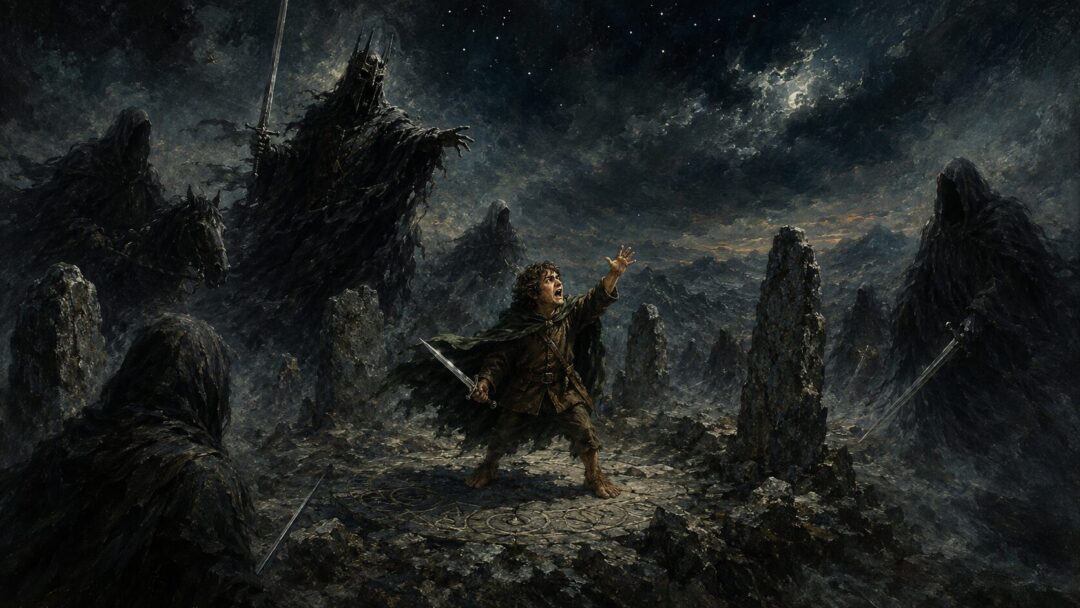
At Weathertop, Frodo Baggins is almost overcome.
The fire has sunk low. The other Hobbits are afraid. The black shapes of the Ringwraiths close in, and the world seems to narrow around the Ring. Frodo sees them more clearly after putting it on: pale faces, grey robes, and a kingly figure taller than the rest.
Then the Witch-king comes toward him.
In that moment, Frodo does something strange.
He throws himself forward, strikes at the enemy’s feet, and cries out:
“O Elbereth! Gilthoniel!”
At first, it may sound like a desperate shout. A fragment of Elvish remembered in terror. A frightened Hobbit crying words he does not fully understand.
But the text does not treat the words as meaningless.
Aragorn later says that the name of Elbereth was more deadly to the Witch-king than Frodo’s blade. That is the key to the whole moment.
Frodo’s cry is not a spell in the ordinary sense. It is not a warrior’s command. It is not a hidden technique for defeating Ringwraiths.
It is something quieter and deeper.
It is a cry toward the light.
Frodo Heard the Name Before Weathertop
The name does not come from nowhere.
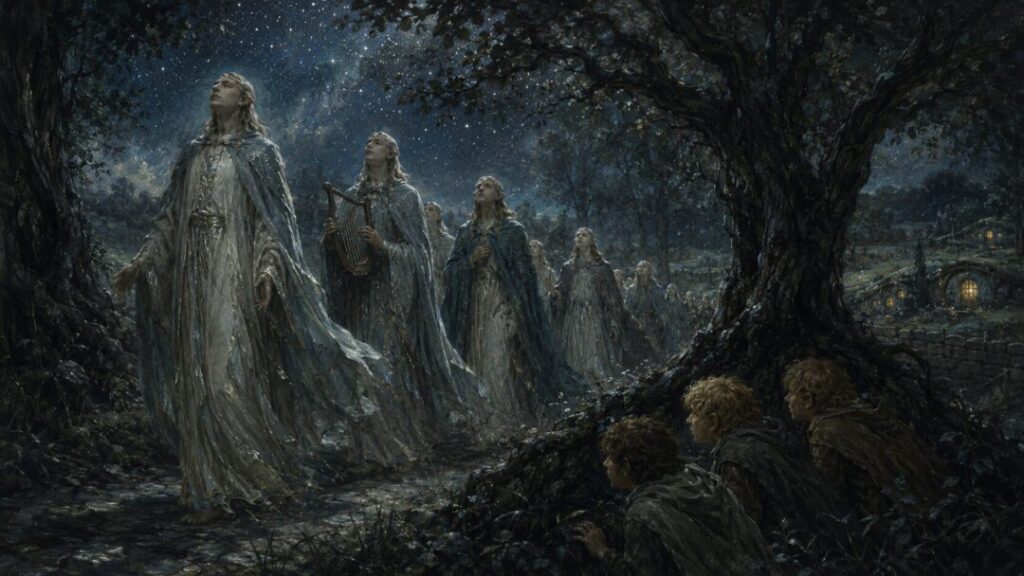
Earlier in The Fellowship of the Ring, before Frodo reaches Bree, he and the other Hobbits encounter a company of Elves led by Gildor Inglorion. A Black Rider is near, and the arrival of the Elves changes the atmosphere of the scene.
The Elves sing a hymn beginning with the name of Elbereth.
This matters.
Frodo does not arrive at Weathertop carrying a full understanding of the Valar, the Elder Days, or the sacred traditions of the Elves. He is still very much a Hobbit of the Shire. But he has heard the Elves call upon that name in song.
The name has entered his memory.
And when the Ringwraiths press upon him, it rises again.
The wording of the scene is important. Frodo does not seem to calmly choose the phrase. The narration says he heard himself crying aloud. That suggests something almost instinctive: not mindless, but not fully planned either.
In a moment when fear should silence him, the Elvish name comes out.
That alone tells us something about Frodo.
He is not merely reacting to terror. Something he has encountered on the road — something beautiful, ancient, and holy — has taken root in him.
Who Is Elbereth Gilthoniel?
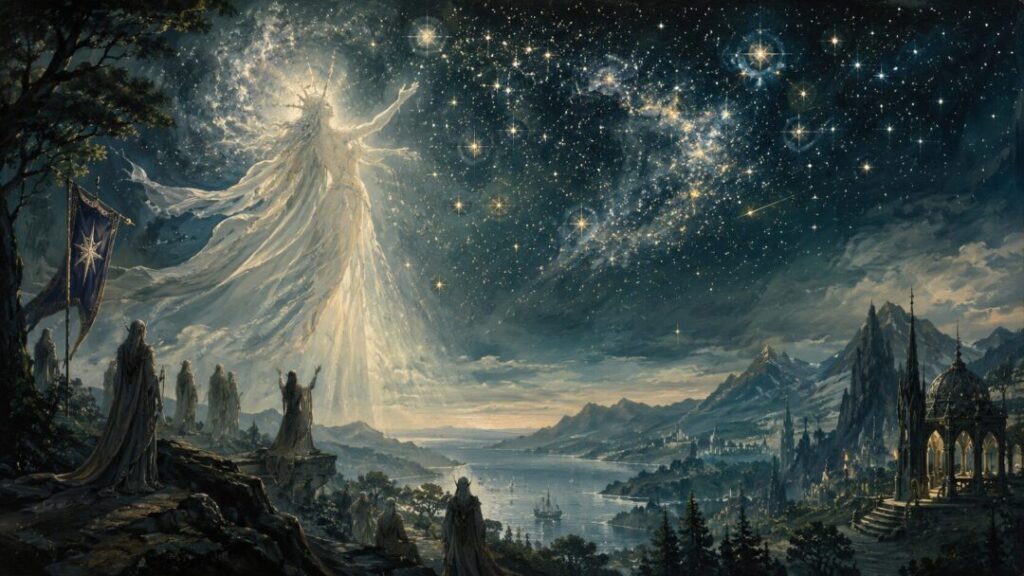
Elbereth is the Sindarin name of Varda.
She is one of the Valar, the great Powers of the West. In the older legends, she is associated above all with the stars. The Elves especially revere her, and her name is loved among them.
“Gilthoniel” means “Star-kindler.”
So when Frodo cries “O Elbereth! Gilthoniel!” he is calling upon Varda under her Elvish names: the Star-queen, the Kindler of the stars.
This is not a casual reference.
In the mythology of Middle-earth, the stars have enormous importance for the Elves. They awoke beneath the stars before the first rising of the Sun and Moon. Starlight belongs to their earliest memory of the world.
That connection makes Elbereth’s name especially powerful in Elvish song and devotion.
But Frodo is not an Elf.
That makes the moment even more striking.
A Hobbit, far from the Shire, surrounded by servants of Sauron, cries out the name most beloved by the Elves. He stands in darkness and reaches — however imperfectly — toward the light of the stars.
Why Would the Nazgûl Fear That Name?
The Nazgûl are not simply frightening men in black cloaks.
They are Ringwraiths: once mortal kings or lords of Men, now enslaved through the Nine Rings and bound to Sauron’s will. Their chief weapon is terror. They do not merely attack the body; they press upon the mind and spirit.
At Weathertop, that terror is almost enough.
Frodo feels compelled to put on the Ring. Once he does, he becomes more visible to them and more vulnerable. The Witch-king wounds him with a Morgul-knife, and that wound nearly turns Frodo into a wraith under their power.
So why should a name matter?
Because the name belongs to a power utterly opposed to the darkness the Nazgûl serve.
The texts do not present “Elbereth” as a magic formula that automatically drives evil away. That would be too simple. Frodo is still wounded. The Witch-king is not destroyed. The Nazgûl are not permanently defeated.
But Aragorn’s explanation makes clear that the name had real force in that encounter.
Frodo’s physical blow matters less than the holy name he cries.
That is the deeper point.
The Witch-king can understand weapons. He can understand fear. He can understand domination. But the name of Elbereth belongs to a different order of reality — one rooted in reverence, memory, and light.
Frodo’s Courage Is Not the Courage of a Warrior
This moment is often misunderstood because readers expect courage to look like strength.
Frodo does not look strong at Weathertop.
He is terrified. He has put on the Ring. He cannot defeat the Ringwraiths in combat. Even his strike with the blade is not enough to save him from being stabbed.
But Middle-earth repeatedly shows that courage is not always the same as power.
Frodo’s courage is the courage to resist when resistance seems useless.
He does not conquer the Witch-king. He does not stand over him in triumph. He does not understand everything that is happening.
But he refuses to surrender completely.
That refusal matters.
He strikes. He cries out. He remembers the name of the Star-kindler in the deepest dark.
This is why the scene is so important. Frodo’s heroism is not based on skill, rank, or hidden might. It is based on the fact that even under terror, he turns toward something higher than himself.
That is not a small thing.
In the moral world of Middle-earth, it may be one of the strongest things a person can do.
The Cry Is Not a Spell
It is tempting to treat “O Elbereth! Gilthoniel!” like an incantation.
Say the words, repel the Nazgûl.
But the text is more subtle than that.
Frodo’s cry is not explained as a technique. No one teaches him to use it as a weapon. Gildor does not hand him a secret phrase for emergencies. Aragorn does not say that any person can simply repeat the name and expect the same result in every situation.
Instead, the scene depends on meaning.
Frodo has heard the name in Elvish song. He carries it with him. In the moment of terror, it emerges from him as an appeal, a memory, and a defiance.
That is very different from a spell.
The power is not in Frodo controlling the name.
The power is in what the name points to.
Elbereth represents a light beyond Sauron’s reach. The Nazgûl are creatures of shadow, fear, and enslavement. Frodo’s cry places another reality into the scene — one they cannot master.
This is why the moment feels so piercing.
A small voice on a ruined hill calls out to the stars.
And the darkness flinches.
Why Aragorn’s Comment Matters
After the attack, Aragorn explains that Frodo’s blade did little physical harm. The thrust missed its mark or did not land as Frodo hoped. Yet Aragorn says the name of Elbereth was more deadly to the Witch-king.
That line prevents us from reducing the scene to action alone.
The important thing was not Frodo’s combat ability. It was not a lucky sword stroke. It was the collision between the Nazgûl’s terror and the holy name Frodo cried.
This also helps explain why the Ringwraiths withdraw after wounding him.
The text does not say that Elbereth’s name alone drove them away in a simple mechanical sense. Other factors matter: Aragorn is present, fire is brought against them, and the Witch-king has succeeded in stabbing Frodo with the Morgul-knife. The Nazgûl may expect the wound to do its work.
But Aragorn’s words make clear that Frodo’s cry was not incidental.
It was part of the resistance.
And perhaps that is the most important thing about Weathertop: Frodo is wounded, but he is not spiritually conquered.
The Pattern Continues Later
The name of Elbereth does not disappear after Weathertop.
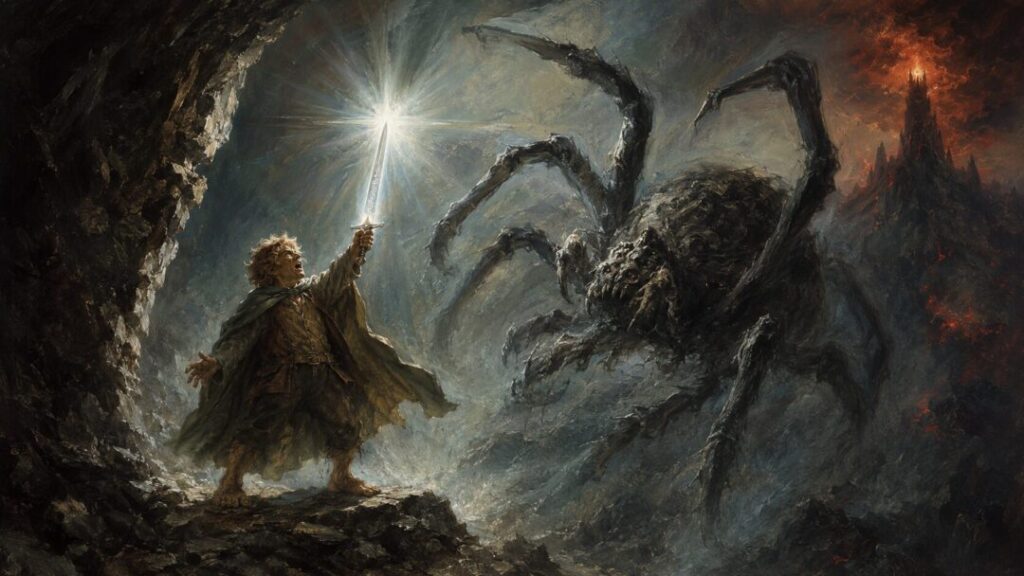
It returns in moments of darkness. Sam, too, calls upon Elbereth when facing Shelob near Cirith Ungol. Once again, the cry appears where ordinary courage is almost at its limit.
This repetition shows that the Weathertop moment is not random.
The name of Elbereth belongs to a pattern in the story: small people, trapped in darkness, remembering a light they cannot see.
That is one of the great contrasts in The Lord of the Rings.
Sauron seeks to make himself unavoidable. His Eye, his Ring, his servants, and his will all press toward domination. He wants every road to lead back to fear.
But Elbereth’s name points beyond him.
It reminds the characters — and the reader — that Sauron is not the highest power in the world. His darkness is terrible, but it is not ultimate.
That matters enormously.
Frodo’s cry at Weathertop is one of the first times that truth breaks into the story so sharply.
Why Frodo Says It Without Fully Understanding It
Frodo does not need to understand everything about Elbereth for the cry to matter.
This is important.
He is not a loremaster. He does not know the full depth of the ancient West. He has only begun to step out of the Shire and into the wider history of the world.
But he has listened.
He has heard the Elves sing. He has received beauty before he fully understands its meaning. And in the crisis, that beauty becomes part of his resistance.
This is deeply consistent with Frodo’s character.
He is changed by what he encounters. He listens to songs. He pays attention to names. He is moved by things older and greater than himself.
At Weathertop, that openness becomes unexpectedly important.
He cannot outfight the Nazgûl.
But he can remember.
And in Middle-earth, memory is not weak. Remembering the light can itself be an act of defiance.
The Real Meaning of the Cry
So why does Frodo cry “O Elbereth! Gilthoniel!” at Weathertop?
Because in his fear, he reaches for the holiest name he has recently heard.
Because the Elves’ song has stayed with him.
Because Elbereth’s name represents starlight, holiness, and a power the servants of Sauron hate and fear.
Because Frodo’s deepest resistance is not strength, but faithfulness to the light he has encountered.
The moment is not about Frodo suddenly becoming powerful.
It is about the darkness discovering that even a Hobbit can carry a name it cannot bear.
That is why the scene matters.
At Weathertop, Frodo is wounded. He nearly falls. The Morgul blade enters him, and its shadow will follow him long after the night is over.
But before the wound, before the collapse, before the long road to Rivendell, Frodo cries out.
Not to power.
Not to victory.
To Elbereth, the Star-kindler.
And for one brief moment on that ruined hill, the terror of the Nine is answered by the memory of the stars.
Sources & Notes
- J.R.R. Tolkien, The Lord of the Rings, Book I, Ch. 3 “Three Is Company” — Gildor’s Elves sing the hymn to Elbereth before Frodo reaches Bree.
- J.R.R. Tolkien, The Lord of the Rings, Book I, Ch. 11 “A Knife in the Dark” — Frodo cries “O Elbereth! Gilthoniel!” at Weathertop, and Aragorn later says the name was deadlier to the Witch-king than Frodo’s blade.
- J.R.R. Tolkien, The Silmarillion, “Valaquenta” — Varda/Elbereth is named as the Lady of the Stars, especially revered by the Elves.
- J.R.R. Tolkien, The Silmarillion, Ch. 3 “Of the Coming of the Elves” — the Elves awaken under the stars, grounding the article’s link between Elbereth, starlight, and Elvish memory.
- J.R.R. Tolkien, The Lord of the Rings, Book IV, Ch. 10 “The Choices of Master Samwise” — Sam’s later invocation of Elbereth against Shelob echoes the pattern of small figures resisting darkness by remembering the light.