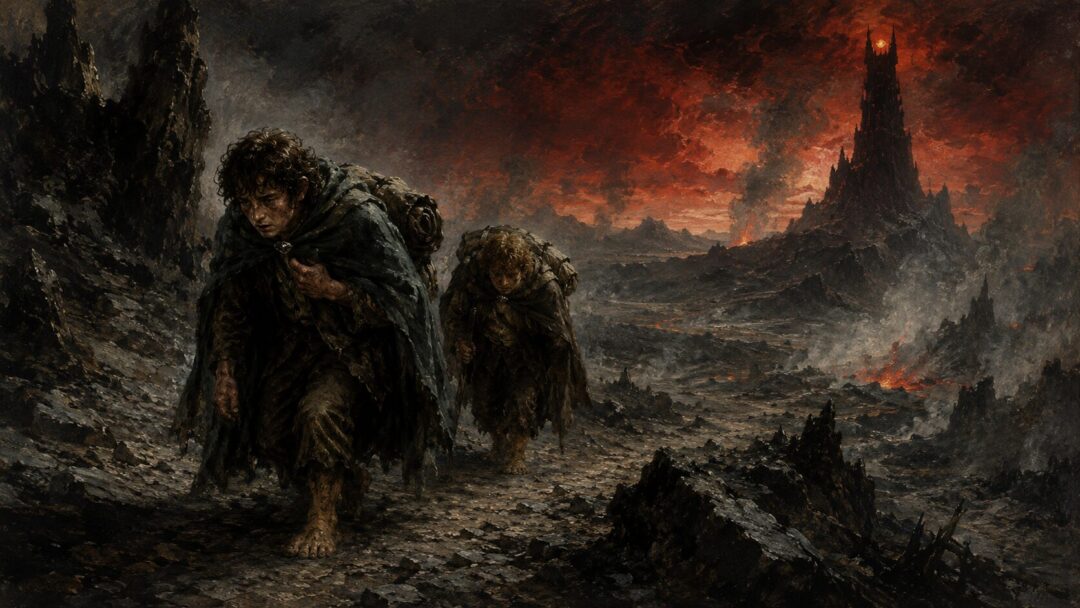
Sauron’s power is easy to misunderstand.
On the surface, he looks like a ruler of overwhelming force. He has Mordor. He has Barad-dûr. He commands Orcs, trolls, siege engines, spies, armies from the East and South, and the Nine Ringwraiths. By the end of the Third Age, the Free Peoples know that if the war becomes a contest of strength alone, they cannot win.
But that is only the outer shape of his dominion.
The deeper horror of Sauron is not simply that he can destroy cities.
It is that he turns fear into order.
His enemies do not merely fear death. They fear being watched. They fear being found. They fear that resistance is already pointless. His servants do not merely obey because they love him or believe in him. In many cases, the texts suggest something colder: they obey because the terror behind them feels worse than the danger before them.
That is how Sauron rules.
Not only by crushing bodies, but by narrowing the imagination.
He makes people believe there is no safe place outside his will.
The Dark Lord Who Wanted Control
Sauron’s evil is not presented as chaos for its own sake.
That matters.
He is not simply a destroyer like a mindless fire. In the older histories, he is associated with order, craft, planning, and command. His fall is bound up with domination: the desire to arrange the world according to his own will and to make other wills serve it.
That distinction runs through the whole story.
Morgoth wounds the world by pouring his malice into it. Sauron inherits that darkness, but his own method is often more administrative, more calculated, and in some ways more intimate.
He does not only want enemies defeated.
He wants wills bent.
This is why the One Ring is so central to his story. It is not merely a weapon, and it is not merely a source of personal strength. It is made to rule the other Rings and, through them, to dominate those who use them. The Ring is Sauron’s philosophy given form: control hidden inside gift, mastery hidden inside power.
Fear is part of that same pattern.
It is domination before the final command is even spoken.
The Eye Is Not Just a Symbol
The Eye of Sauron is one of the most famous images in Middle-earth, but it is also one of the easiest to flatten.
In the books, the Eye is not simply a giant searchlight sweeping across Mordor. It is more often experienced as a will: watchful, hostile, seeking, pressing against the mind. Frodo feels it as a presence that wants to pierce concealment and find him. Galadriel speaks of Sauron striving to see her thought, though the door remains closed. Near Mordor, Frodo becomes increasingly aware of the direction and pressure of that will.
This is not ordinary surveillance.
It is spiritual pressure.
The terror of the Eye lies in the feeling that privacy itself is becoming thin. Cloud, earth, flesh, distance, and secrecy all seem less reliable. Sauron does not need to see everything at every moment for the fear to work. The fear works because those who oppose him begin to live under the possibility of being seen.
That is a very different kind of power.
A guard must be present to frighten you.
An army must arrive to besiege you.
But the Eye can shape behavior even when it is absent.
It teaches caution. It teaches silence. It teaches despair.
It makes the world feel already occupied.
The Nazgûl Are Fear Given Shape
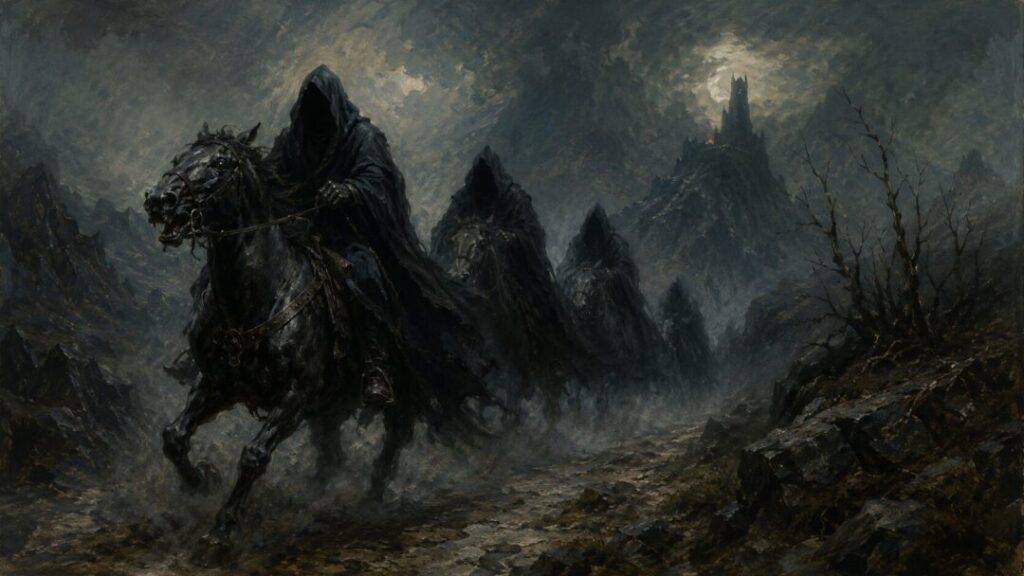
The Nazgûl are Sauron’s clearest living instruments of terror.
They are dangerous, of course. They are servants of the Nine Rings, bound to Sauron, and their presence carries dread. But their greatest power is not simply their ability to kill. Again and again, their terror attacks the will before the body.
Their cries cause fear. Their unseen presence unsettles the heart. Their approach can make ordinary courage falter. In the siege of Gondor, the terror of the Lord of the Nazgûl and his riders becomes part of the battle itself, not an ornament added to it.
This is important because Sauron’s war is never only physical.
The Nazgûl do not merely clear roads. They weaken resistance before armies arrive. They make people feel small, exposed, and doomed. They turn the imagination against itself.
And yet the texts also show that their fear is not absolute.
At Weathertop, Aragorn resists them. At the Ford of Bruinen, they are overthrown. Before Minas Tirith, the Witch-king’s terror is met by defiance. In the end, he falls not to a greater terror, but to courage, pity, loyalty, and the strange workings of prophecy.
That is one of the quiet checks on Sauron’s method.
Fear is powerful.
But it is not the same as truth.
Mordor Runs on Fear
Sauron’s own land shows the same pattern from the inside.
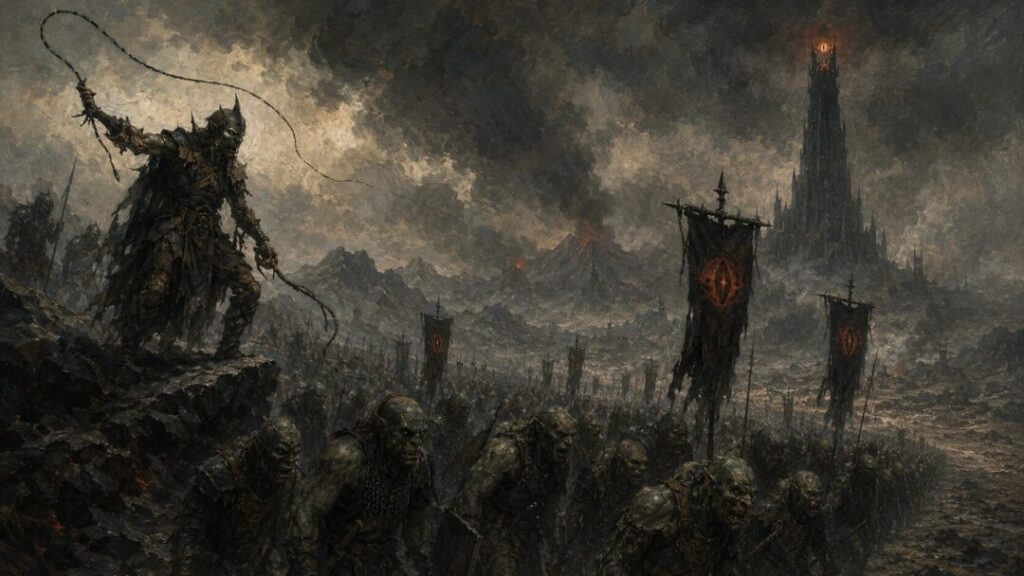
Mordor is not portrayed as a realm held together by love of its ruler. The Orcs we overhear do not sound like devoted citizens of a noble cause. They complain. They quarrel. They fear punishment. They dream, in their own brutal way, of getting away from bosses, whips, and orders.
That does not make them innocent. The texts do not ask us to forget their cruelty. But it does show something important about Sauron’s rule.
His servants are trapped inside fear too.
The armies of Mordor are driven forward by command, threat, and dread. The pressure of Sauron’s will hangs over them. Even his captains operate in a world where failure is dangerous. This is why fear becomes a form of administration. It organizes movement. It enforces obedience. It replaces loyalty with terror.
A realm ruled this way can be immense.
It can build roads, towers, mustering grounds, and engines of war.
But it is also brittle.
Because when the ruling will is removed, the structure cannot hold itself together. At the destruction of the Ring, Sauron’s power collapses, and with it the confidence and coherence of his forces. Many flee. The spell of inevitability breaks. Mordor does not become gentle, but its central terror is gone.
That is the weakness hidden inside fear-based rule.
It can compel obedience.
It cannot create true allegiance.
Númenor Shows the Older Pattern
Sauron’s use of fear did not begin in Mordor.
In the Akallabêth, his corruption of Númenor works through a different but related dread: the fear of death.
The Númenóreans are mighty, wealthy, and long-lived, but they remain mortal. Their resentment grows around the Ban of the Valar and the fate of Men. Sauron exploits that wound. He does not conquer Númenor by marching into it with a stronger army. He enters as a prisoner and becomes a counsellor. He turns fear into doctrine.
The fear is not crude at first.
It is dressed as wisdom.
It is dressed as liberation.
It is dressed as a promise that the old limits can be broken.
But underneath it is the same method: take a real anxiety, feed it, name the wrong enemy, and offer obedience as the path out.
That is how fear becomes rule without looking like chains.
By the time Númenor moves toward catastrophe, its terror of death has been turned into rebellion, worship, cruelty, and finally ruin. Sauron does not need to create mortality. He only needs to twist the fear of it until a great people can no longer see clearly.
This is one of the most revealing episodes in his history.
Sauron’s greatest victories are not always won by force.
Sometimes they begin when people accept his explanation of what they should fear.
The Mouth of Sauron and the Theater of Despair
At the Black Gate, Sauron’s method becomes almost theatrical.
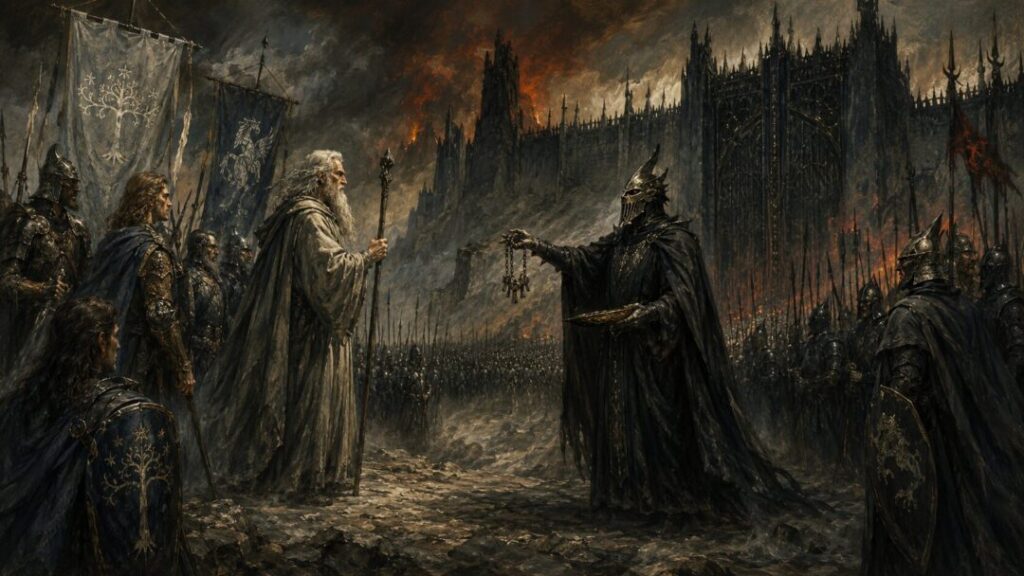
The Mouth of Sauron does not come out merely to negotiate. He comes out to break the hearts of the West. He displays Frodo’s belongings and lets the Captains believe the Ring-bearer may have been captured and tormented.
This is psychological warfare.
The goal is not simply to exchange terms. The goal is to make hope collapse.
That moment matters because Sauron’s enemies are already militarily outmatched. The army at the Black Gate is a feint, a desperate act meant to draw Sauron’s gaze away from Frodo and Sam. If despair takes them, the plan dies inwardly before it dies outwardly.
But Gandalf refuses the trap.
He does not accept Sauron’s framing. He does not let the tokens become the whole truth. He rejects the terms and with them the fear Sauron is trying to impose.
That refusal is crucial.
Sauron’s terror often works by making his version of reality feel final. The Mouth offers a story: your friend is taken, your cause is foolish, your resistance is over, and only submission remains.
Gandalf answers by refusing to live inside that story.
Denethor and the Danger of Seeing Too Much
Denethor’s fall is one of the most tragic examples of fear becoming rule from a distance.
He is not a servant of Sauron. That should be said clearly. Denethor is proud, strong-willed, and committed to Gondor. The text does not present him as a simple puppet.
But through the palantír, he has looked toward Sauron’s strength. What he sees is not necessarily false, but it is not whole. He sees enough of Mordor’s vastness to lose hope. He sees power without providence, numbers without hidden mercy, danger without the small hands moving through the dark.
That is how despair enters.
Sauron does not need Denethor to love him. He only needs Denethor to believe resistance is meaningless.
And by the end, Denethor’s fear has become a prison. He cannot imagine victory. He cannot imagine healing. He cannot even imagine a future for Faramir except death before dishonor. Sauron’s rule has reached him not as command, but as despair.
This is one of the most frightening things about Sauron.
His dominion can touch people who never kneel.
Why Sauron Fails to Understand Courage
For all his intelligence, Sauron repeatedly misreads his enemies.
He cannot imagine that anyone would try to destroy the Ring rather than use it. He assumes that the Ring will be claimed by someone seeking power. When Aragorn reveals himself through the palantír, Sauron interprets the move through his own logic of domination. He believes the Ring may be used against him by a rival lord.
That mistake is not stupidity.
It is moral blindness.
Sauron understands ambition.
He understands fear.
He understands threat, possession, and command.
He does not understand pity well enough. He does not understand humility well enough. He does not understand why the small, the wounded, and the apparently powerless might matter more than armies.
This is why the Quest of the Ring succeeds in the narrow space Sauron cannot properly imagine.
He has built a world of fear, but the Ring is carried through that world by things his system cannot fully measure: friendship, mercy, endurance, and the refusal to become another master.
The Real Horror of Sauron’s Rule
Sauron’s rule is terrifying because it does not stop at conquest.
He wants the inner world.
He wants enemies to despair before they fight.
He wants servants to obey without love.
He wants the watched to feel already caught.
He wants the strong to imagine only power.
He wants the weak to believe they have no part to play.
That is fear turned into government.
And this is why the fall of Sauron feels like more than the defeat of a military ruler. When the Ring is destroyed, the Shadow lifts. The armies of Mordor lose their center. The Captains of the West are saved not because they have become stronger than Mordor, but because the will holding Mordor together has been broken.
Sauron’s terror depended on inevitability.
The Ring’s destruction proves that inevitability was a lie.
The Answer Hidden in the Smallest Resistance
The deepest answer to Sauron’s fear is not fear in return.
It is not a greater Dark Lord on the other side. The Wise reject that path. Gandalf and Galadriel both understand that to use the Ring for domination would be to become another version of the same disaster.
Instead, the answer comes through refusal.
Frodo refuses, for most of the road, to surrender to hatred.
Sam refuses to abandon Frodo.
Aragorn refuses to hide from his identity.
Gandalf refuses despair at the Black Gate.
Éowyn refuses the terror of the Witch-king.
Faramir refuses the temptation to seize the Ring.
None of these acts erase fear.
That is important.
Courage in Middle-earth is rarely the absence of fear. It is the decision that fear will not be the final ruler of the will.
That is why Sauron’s defeat is so complete.
He turned fear into a system. He made it march, watch, threaten, and command. He built a realm where terror seemed practical and hope seemed naïve.
But the story finally turns on those who would not accept his account of reality.
Sauron ruled by making others feel small.
He fell because the small were never as powerless as he believed.
Sources & Notes
- J.R.R. Tolkien, Letter 131 — describes Sauron’s particular temptation as ordering and coordinating things for his own purposes, a useful storycraft frame for fear as domination rather than mere destruction.
- J.R.R. Tolkien, The Silmarillion, “Of the Rings of Power and the Third Age” — gives the One Ring’s purpose: to rule the other Rings and bring their bearers under Sauron’s control.
- J.R.R. Tolkien, The Lord of the Rings, Book II, Chapter 7, “The Mirror of Galadriel” — presents the searching Eye and Galadriel’s guarded mind as Sauron’s will pressing toward surveillance and discovery.
- J.R.R. Tolkien, The Lord of the Rings, Book V, Chapter 4, “The Siege of Gondor” — shows the Nazgûl’s cries and the Lord of the Nazgûl turning terror itself into a weapon against Gondor.
- J.R.R. Tolkien, The Silmarillion, “Akallabêth” — shows Sauron exploiting Númenor’s fear of death until anxiety becomes rebellion, worship, cruelty, and ruin.
- J.R.R. Tolkien, The Lord of the Rings, Book V, Chapter 10, “The Black Gate Opens” — uses the Mouth of Sauron and Frodo’s tokens as deliberate theater meant to break hope before the battle is joined.