
One of the most quietly strange details in Tolkien’s legendarium isn’t a battle, a prophecy, or a lost king.
It’s an absence.
Bilbo Baggins wears the One Ring many times during The Hobbit. He uses it openly—at least by his standards—to escape goblins, sneak past enemies, and even stand unseen in the presence of powerful beings.
And yet, nothing happens.
No Nazgûl ride north.
No dark servants begin searching the wild.
No shadow falls over the Shire.
By the time Frodo Baggins inherits the Ring in The Lord of the Rings, however, everything changes. Wearing it becomes dangerous. Visibility increases. The Eye begins to search. Even Gandalf fears what prolonged use might do.
So what’s the difference?
To understand why Sauron never noticed Bilbo, we first have to let go of a very modern assumption—that the Ring works like a magical alarm system.
It doesn’t.
The Ring Does Not Reveal — It Amplifies
The One Ring does not automatically expose its bearer to Sauron.
Instead, it amplifies presence in the unseen world.
When someone wears the Ring, they do not simply turn invisible. They step partially into the wraith-world—the same shadow-realm inhabited by the Nazgûl. But how brightly they appear there depends on who they are and what they are doing.
Power matters.
Intent matters more.
This is why Frodo, at Weathertop, suddenly becomes visible to the Ringwraiths the moment he puts the Ring on. He does not simply vanish from the physical world—he enters a realm where beings like them exist fully.
It is also why Frodo sees Glorfindel shining with a terrible and beautiful light when he wears the Ring. The Ring does not create that radiance. It reveals what already exists beneath the surface.
Bilbo, by contrast, reveals almost nothing.
Not because he is unimportant—but because he is unassertive.
Bilbo Is Spiritually Small — And That Matters
Bilbo is not powerful in the way Tolkien’s world defines power.
He has no great lineage.
No spiritual authority.
No desire to shape events beyond his own survival.
This does not make him weak. It makes him hard to perceive.
In Tolkien’s cosmology, presence in the unseen world corresponds to inner will. To the desire to impose oneself on reality. To the urge to command, dominate, or reshape.
Bilbo lacks that urge almost entirely.
Even when he acts bravely, his courage is reactive, not declarative. He responds to danger; he does not project himself into it.
That distinction is crucial.
Bilbo Never Uses the Ring to Dominate
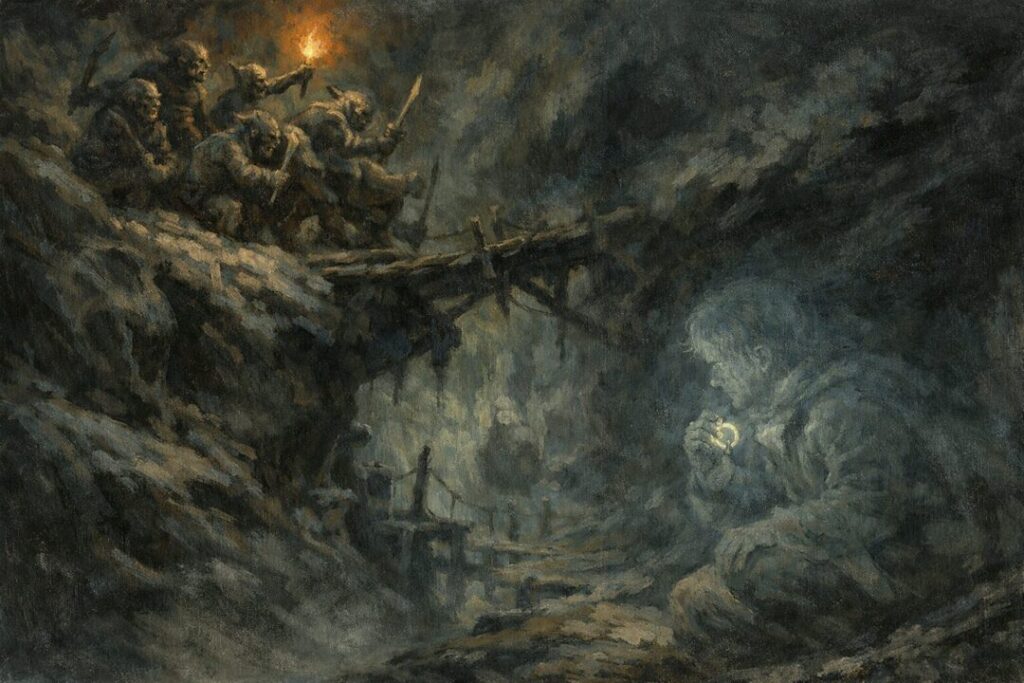
Throughout The Hobbit, Bilbo uses the Ring for one purpose only: avoidance.
He hides.
He escapes.
He survives.
He never commands. Never threatens. Never reaches outward with the Ring’s power. He does not attempt to bend others to his will—or even influence events beyond staying alive.
This is not accidental.
Tolkien repeatedly emphasizes that the Ring’s true danger lies in its temptation to dominate. It whispers not merely I can hide, but I can rule. I can decide outcomes. I can make the world bend.
Bilbo never listens to that voice.
Even when facing Gollum, Bilbo spares him. Not because it is strategically wise, but because it feels wrong to kill someone who is already broken.
When confronting the spiders of Mirkwood, Bilbo fights—but he does not claim mastery. He acts out of desperation, not authority.
When dealing with the Elvenking, he remains cautious, quiet, and deferential.
At every stage, Bilbo refuses to step into dominance.
That refusal keeps him dim in the unseen world.
The Ring Responds to Will, Not Usage
A common misconception is that the Ring grows louder simply by being worn.
But Tolkien’s writing suggests something subtler.
The Ring responds to willful assertion.
When Frodo uses the Ring at moments of fear or pain, its effects are limited. But when he uses it with intention—especially when he begins to claim it—the consequences escalate.
By the time Frodo reaches Mordor, the Ring is no longer passive. It presses itself into his thoughts. It encourages ownership. It blurs the line between bearer and master.
Bilbo never crosses that line.
He gives the Ring up—reluctantly, painfully, but willingly. That alone marks him as almost unique in Middle-earth.
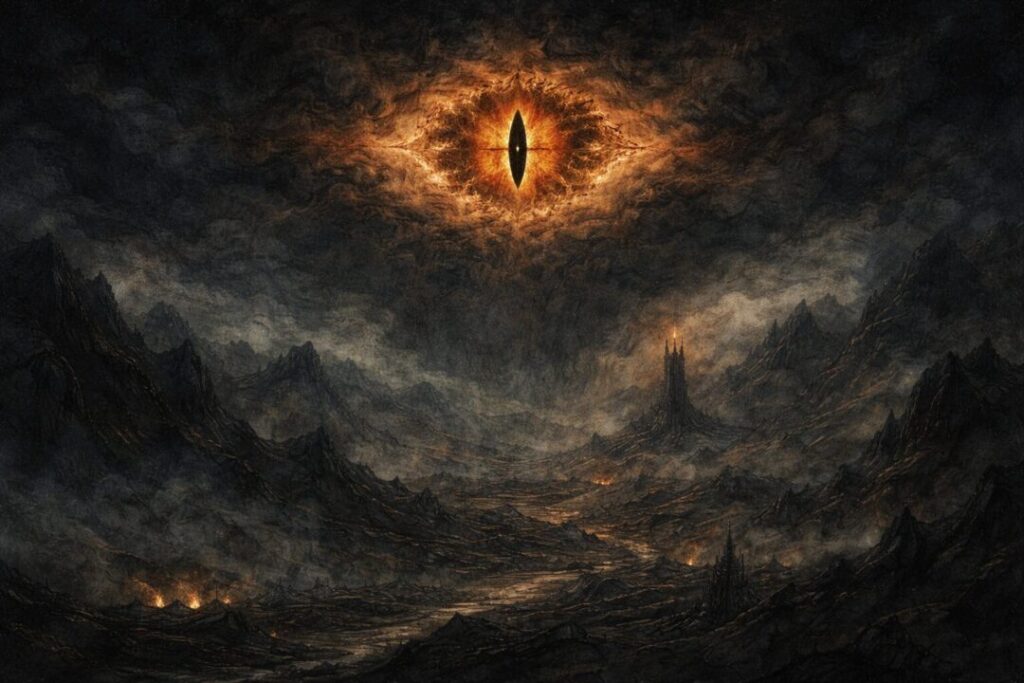
Sauron Was Not Actively Searching for the Ring — Yet
Timing also matters.
During the events of The Hobbit, Sauron is active again, but he is not yet certain that the Ring still exists in the world. He believes it lost—perhaps destroyed, perhaps irretrievable.
Without a signal—without someone asserting the Ring’s presence—there is nothing specific for him to perceive.
The Ring itself is patient.
It does not scream its location. It waits for a bearer who will use it properly—that is, who will try to wield it.
Later, during The Lord of the Rings, that changes.
The Ring is used more often.
Its power is felt more strongly.
Its movements disturb the fabric of the world.
By the time Frodo leaves the Shire, the Ring has begun to stir. Not because it is being worn—but because it is being carried toward purpose.

Hobbits Are Hard to See — By Design
Tolkien repeatedly emphasizes that Hobbits are overlooked not because they are weak, but because they are unassuming.
They do not seek power.
They do not crave dominance.
They do not reshape the world by their presence.
This makes them uniquely resistant—not immune, but resistant—to the Ring’s influence.
Bilbo’s long, quiet possession of the Ring is not a plot hole.
It is proof of concept.
The Ring is most dangerous in the hands of those who want to use it.
Bilbo never does.
Why This Matters for Frodo
Understanding why Sauron didn’t see Bilbo reframes Frodo’s entire journey.
Frodo doesn’t endure because he is stronger than others.
He endures because, like Bilbo, he is inward-focused, reluctant, and morally cautious.
But Frodo goes farther.
He carries the Ring into Mordor.
He bears it under pressure Bilbo never faced.
He becomes visible not because he fails early—but because no one could remain invisible forever under that weight.
Eventually, Frodo does claim the Ring.
And in that moment, Sauron sees him immediately.
Not because the Ring suddenly “turns on”—but because Frodo finally steps into the kind of presence the Ring was made to amplify.
The Ring Is Frightening Because It Waits
Bilbo’s invisibility was never guaranteed.
It was conditional.
And once you understand that, the One Ring becomes far more unsettling—not because it is always watching, but because it waits patiently for you to make yourself visible.
It does not betray the humble.
It waits for ambition.
Sources & Notes
- J.R.R. Tolkien, The Hobbit, Chapter 5, “Riddles in the Dark” — Bilbo first gains the Ring and uses it as a device of invisibility, before its full history or Sauron’s search is in view.
- J.R.R. Tolkien, The Hobbit, Chapter 8, “Flies and Spiders” — Bilbo repeatedly uses the Ring to hide and rescue the Dwarves, illustrating his practical, non-dominating use of it.
- J.R.R. Tolkien, The Lord of the Rings, Book I, Chapter 2, “The Shadow of the Past” — Gandalf explains that Sauron learned “Shire” and “Baggins” only after Gollum, and that Bilbo’s pity and surrender of the Ring mattered.
- J.R.R. Tolkien, The Lord of the Rings, Book I, Chapter 12, “Flight to the Ford” — while wearing the Ring Frodo sees the wraith-world more clearly, including Glorfindel as a shining figure.
- J.R.R. Tolkien, The Lord of the Rings, Book II, Chapter 1, “Many Meetings” — Gandalf says Frodo was partly in the wraith-world while wearing the Ring, helping explain why Ringwraiths could perceive him differently from ordinary foes.
- J.R.R. Tolkien, The Lord of the Rings, Book VI, Chapter 3, “Mount Doom” — Sauron perceives Frodo at once when Frodo claims the Ring, contrasting mere concealed use with open assertion of ownership.