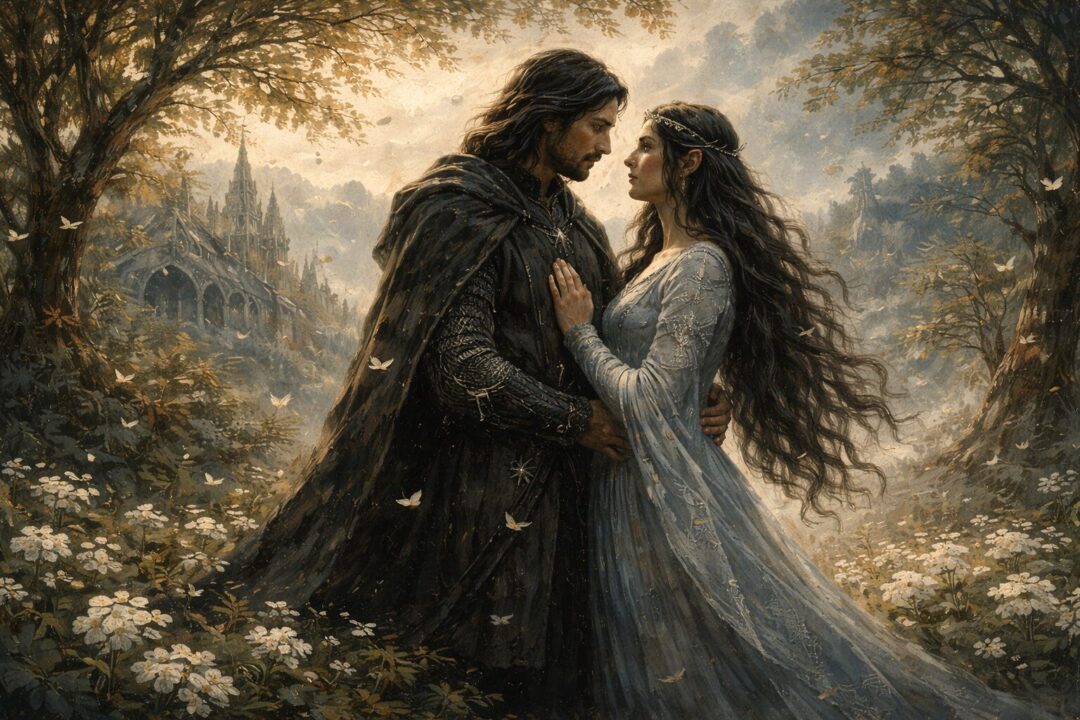
Arwen Undómiel barely speaks in The Lord of the Rings. She does not lead armies, confront Dark Lords, or shape events through force. She has no extended point-of-view chapters, no heroic last stand, and no climactic moment where the fate of Middle-earth visibly turns on her actions.
And yet Tolkien anchors one of the story’s most final, irreversible decisions in her hands.
To understand why Arwen matters, we must look not at what she does, but at what she gives up—and how Tolkien deliberately frames that loss. Her importance lies not in spectacle, but in permanence.
Arwen Is Not a Symbol. She Is a Decision.
Arwen is introduced as the daughter of Elrond, descended from Lúthien Tinúviel, and bound by what Tolkien calls the Doom of the Half-elven. Like her father—and unlike almost anyone else in Middle-earth—she is given a choice that defines the shape of her entire existence.
She may remain with the Elves: immortal, unchanging, bound to the long memory of the world and ultimately destined to sail West to the Undying Lands.
Or she may choose the fate of Men: mortality, aging, death, and separation from everything she has known since the beginning of the world.
This is not metaphorical.
It is not symbolic.
It is not softened by ambiguity.
Tolkien is explicit: once this choice is made, it cannot be undone—not by repentance, heroism, or later wisdom. It is not a test that can be retaken. It is not a road with a return.
This alone makes Arwen’s story radically different from many others in The Lord of the Rings. Frodo’s suffering, for all its depth, is ultimately eased by passage to the West. Sam returns home. Even the Elves, in their fading, have the promise of Valinor.
Arwen has none of this.
Her choice closes doors forever.
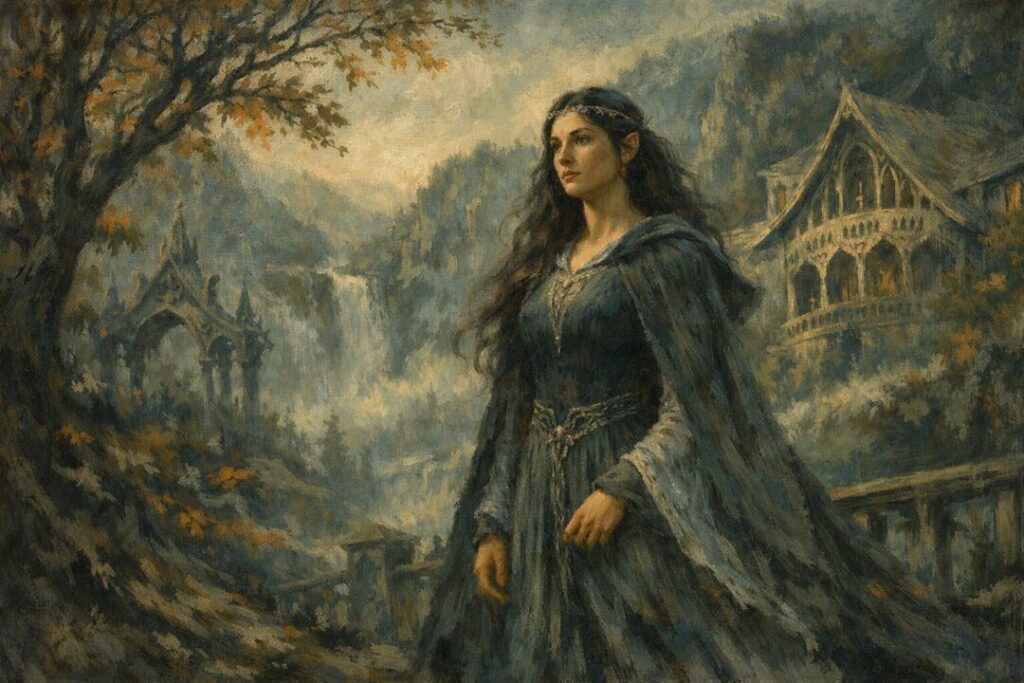
Love Is Not the Cost. Immortality Is.
Modern retellings—especially visual adaptations—often frame Arwen’s story as a romantic tragedy: a beautiful immortal who gives up eternity for love. While not incorrect, this framing can obscure something essential.
In Tolkien’s text, love is not the cost.
Immortality is.
Arwen does not merely risk loss. She chooses it with full knowledge of its consequences. She understands precisely what loving Aragorn entails:
- Watching him age while she remains unchanged
- Accepting death where once there was timelessness
- Severing herself permanently from Valinor
- Sharing a life defined by grief, endings, and eventual separation
This is not a youthful mistake or a moment of passion. Tolkien goes out of his way to ensure that Arwen’s decision is informed and deliberate.
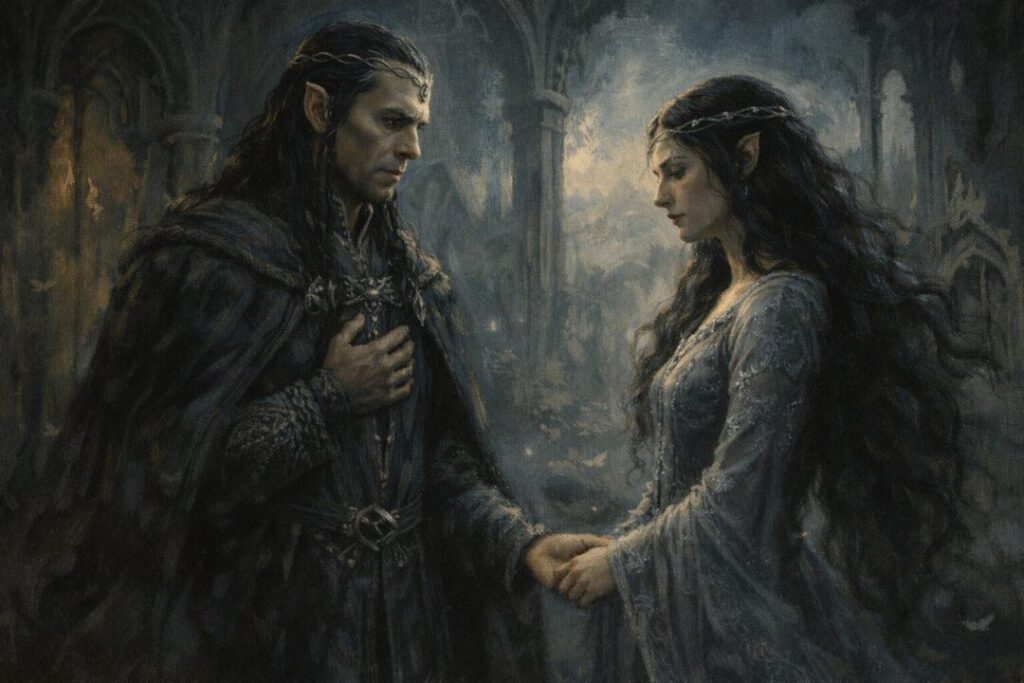
Elrond does not forbid her choice. He explains it.
He tells her plainly that if she chooses Aragorn, she will share the Doom of Men fully. There will be no sailing West. No reprieve at the end of long years. No healing beyond the circles of the world.
And Arwen accepts this.
Tolkien makes sure the reader understands: Arwen is not ignorant. She is resolute.
Why Tolkien Refuses to Romanticize the Choice
One of the most striking things about Arwen’s story is how little Tolkien dramatizes it.
There is no long internal monologue.
No moment where time stops and the weight of the world presses down.
No emotional climax centered on her decision.
This is not an oversight. It is intentional.
Tolkien consistently avoids turning moral gravity into spectacle. The most important acts in his world often happen quietly, without witnesses, applause, or immediate consequence.
Just as Hobbits save the world without glory, Arwen alters the fate of the Eldar without fanfare.
Her choice mirrors the broader movement of Tolkien’s mythology: the passing of the Elves. Not a defeat. Not a catastrophe. A relinquishing.
Arwen is not an exception to the fading of the Elves. She is its most personal expression.
Arwen and the Long Shadow of Lúthien
Arwen’s lineage matters deeply to Tolkien’s framing of her choice. She is not the first to walk this path.
Her ancestor Lúthien Tinúviel made the same decision in the First Age, choosing mortality for the sake of love. Tolkien explicitly links Arwen and Aragorn to Lúthien and Beren, presenting them as a renewal of that ancient story.
But Tolkien also ensures that we understand something crucial: repetition does not make the choice easier.
If anything, it makes it heavier.
Lúthien’s story is told in the mythic register of the First Age, filled with cosmic struggle, divine intervention, and the presence of the Valar. Arwen’s story unfolds in a quieter world, where the great powers have withdrawn and miracles are rarer.
Arwen does not confront Morgoth.
She does not sing before Mandos.
She receives no special dispensation.
Her choice is made in a diminished age—and it remains absolute.
The Grave on Cerin Amroth
Tolkien’s final word on Arwen is devastating precisely because of its restraint.
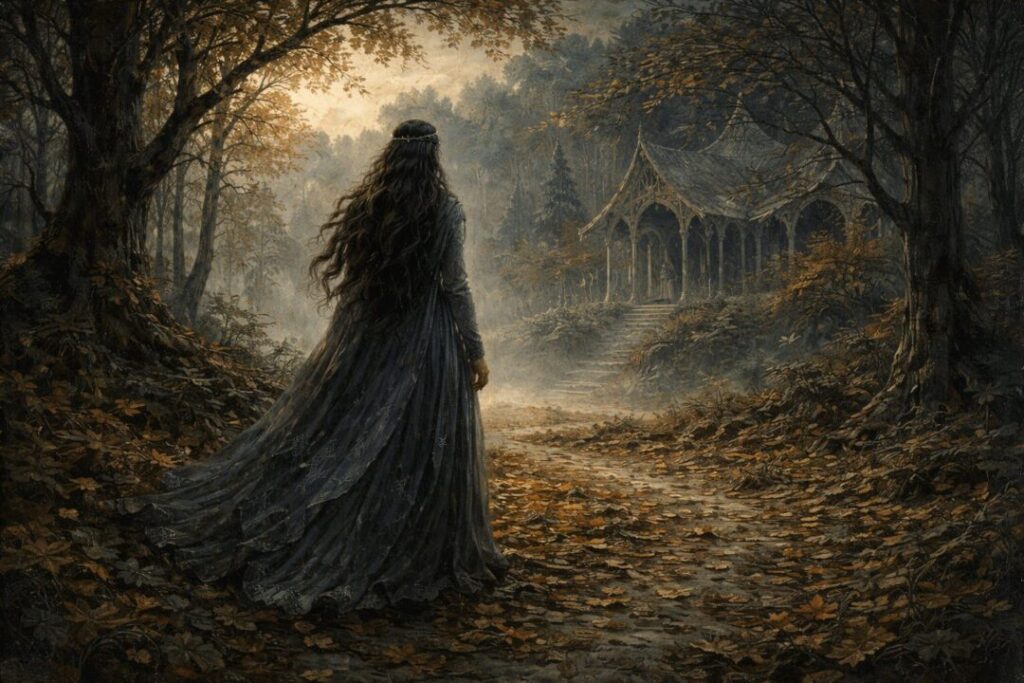
After Aragorn’s death, Arwen does not seek consolation among the Elves. She does not sail West. She does not linger in Rivendell or Minas Tirith, surrounded by memory and honor.
She travels alone to Lórien—now empty, silent, and fading—and lies down to die on Cerin Amroth, where she and Aragorn once pledged themselves.
There is no reunion scene.
No divine reward.
No vision of the afterlife.
Tolkien offers no softening.
This is not punishment.
It is consequence.
And Tolkien refuses to undo it.
In a legendarium where mercy often intervenes at the last moment, Arwen’s ending stands apart. It is final. Unaltered. Unrescued.
Permanence as Moral Weight
In modern fantasy, permanence is rare. Death is reversible. Choices are recontextualized. Power escalates until meaning dissolves into spectacle.
Tolkien does the opposite.
He makes permanence frightening again.
Arwen’s story reminds us that some choices matter precisely because they cannot be undone. Their weight lies not in drama, but in duration.
Her sacrifice is not validated by cosmic affirmation. It is validated by endurance.
She lives out the consequences of her choice fully, without exemption.
Why Arwen Is a Moral Center, Not a Side Character
Once this is understood, Arwen can no longer be dismissed as peripheral.
She does not move the plot forward through action, but she embodies one of Tolkien’s deepest moral convictions: that true freedom includes the freedom to choose loss.
Her story is not about romance.
It is about consent.
About mortality.
About accepting finitude in a world that is slowly passing away.
In choosing a mortal life, Arwen affirms the value of the world as it is—not as an eternal, preserved ideal, but as something fragile, temporary, and meaningful because it ends.
And once you see that, Arwen Undómiel is no longer a background figure.
She becomes one of the clearest moral anchors in all of Middle-earth—quiet, resolute, and irrevocable.
Sources & Notes
- J.R.R. Tolkien, The Lord of the Rings, Appendix A, “The Tale of Aragorn and Arwen” — the central account of Arwen’s choice, Elrond’s warning, and her mortal death after Aragorn.
- J.R.R. Tolkien, The Lord of the Rings, Book VI, Chapter 6, “Many Partings” — Arwen gives Frodo her place on the ship West, showing she has chosen to remain in Middle-earth as mortal.
- J.R.R. Tolkien, The Silmarillion, “Of the Voyage of Eärendil and the War of Wrath” — establishes the Doom of the Half-elven and the family choice inherited through Elros and Elrond.
- J.R.R. Tolkien, The Silmarillion, “Of Beren and Lúthien” — Arwen’s story deliberately echoes Lúthien’s earlier surrender of immortality for a mortal destiny.
- J.R.R. Tolkien, The Letters of J.R.R. Tolkien, Letter 131 — Tolkien’s own summary of Elvish immortality, the Gift of Men, and why choosing mortality is spiritually weighty rather than merely romantic.