
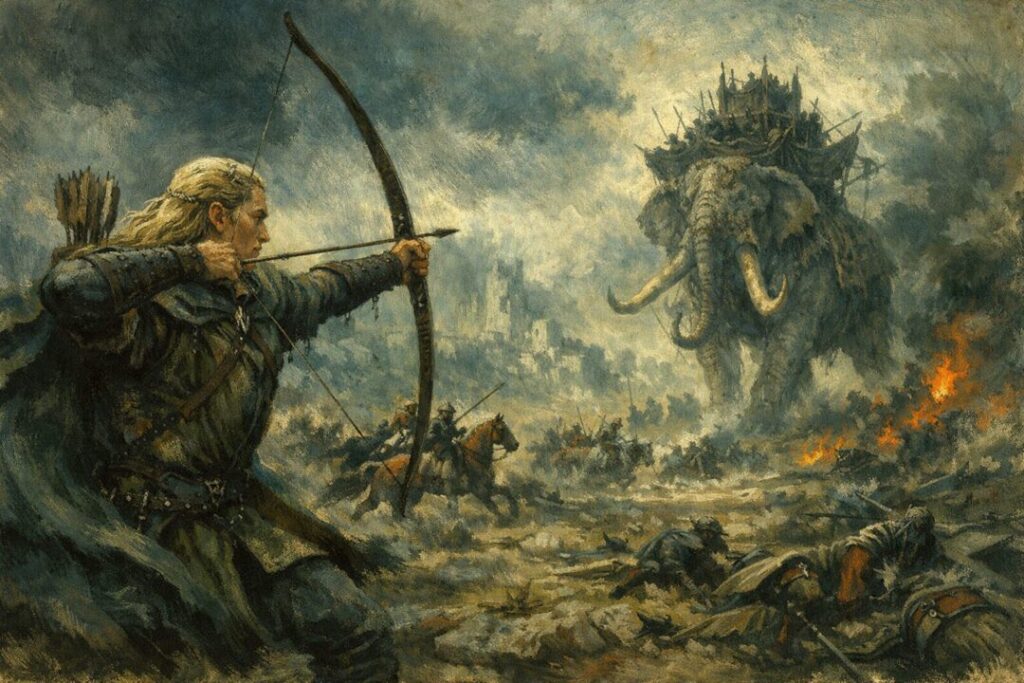
Few moments in The Lord of the Rings are as instantly recognizable as Legolas bringing down a Mûmakil on the Pelennor Fields. It’s swift, elegant, and decisive — a perfect visual expression of Elven agility, balance, and precision. One warrior, one beast, one spectacular victory.
But Tolkien’s Middle-earth is not a world where spectacle defines truth.
When we step away from cinematic language and return to the text itself, a very different picture emerges — one that treats Mûmakil, warfare, and even Elven prowess with far more restraint, gravity, and consequence.
To answer whether Legolas could realistically kill a Mûmakil alone, we need to understand three things as Tolkien presents them: what Mûmakil actually are, how large-scale battles truly function, and what limits even the greatest warriors in Middle-earth face.
What Mûmakil Are in Tolkien’s World
Our clearest introduction to the creatures comes not through warriors or generals, but through the eyes of a Hobbit. In The Two Towers, Sam Gamgee describes the Oliphaunts with wonder and disbelief. They are vast beyond expectation — “like moving hills,” with legs like trees and tusks like white towers.
This perspective matters.
Mûmakil are not framed as monsters to be conquered, nor as enemies meant for individual heroics. They are ancient animals, rare even in the South, and so large that their very presence alters the battlefield. Tolkien emphasizes their scalebefore anything else. They are living embodiments of weight, momentum, and terror.
By the time of the War of the Ring, these beasts are used deliberately by the Haradrim as mobile war platforms. Towers are fastened to their backs, filled with archers and soldiers. Their sides are armored. They are trained to charge, trample, and break formations.
Crucially, Tolkien never presents them as something a lone hero simply “takes down.”
They are not narrative obstacles designed for personal triumph. They are forces of war.
How Tolkien Depicts Killing a Mûmakil
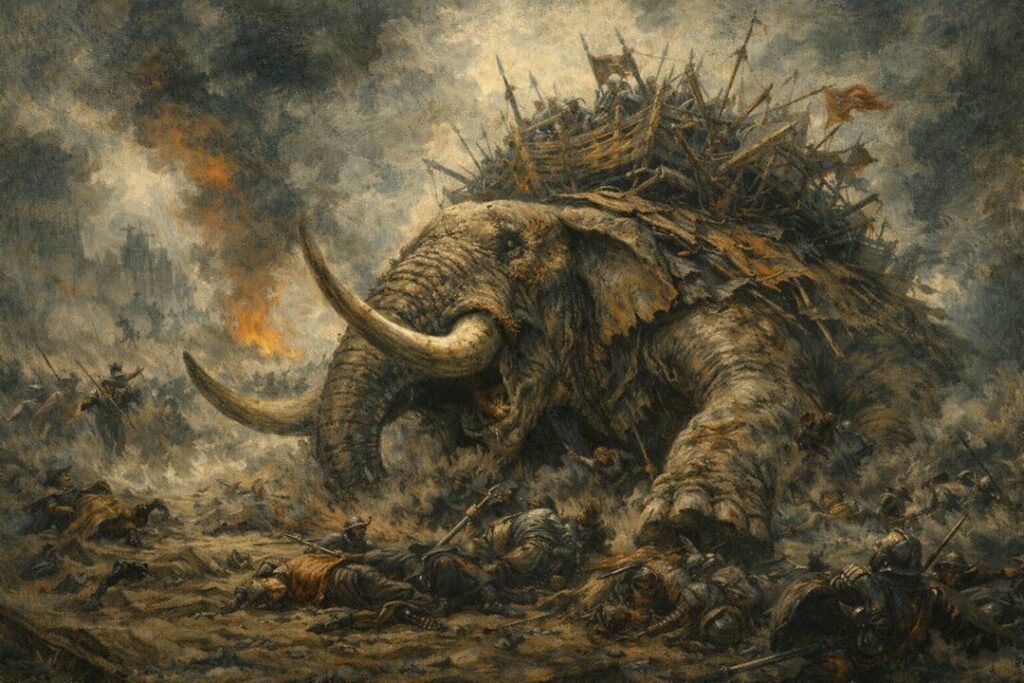
The most important detail about Mûmakil deaths in Tolkien’s writing is this: they are never clean.
During the Battle of the Pelennor Fields, when one finally falls, it does not collapse neatly or heroically. Instead, it crashes down in terror and confusion, crushing friend and foe alike beneath its bulk. Its death is chaotic, dangerous, and horrifying.
Tolkien lingers not on the warrior who caused the fall, but on the destruction that follows.
This emphasis tells us something vital about Tolkien’s worldview. Killing a Mûmakil is not framed as a moment of glory — it is framed as a catastrophe barely survived by those nearby. Even victory carries risk and cost.
The Rohirrim, charging in disciplined formations with spears and horses, struggle to deal with them. The beasts disrupt lines, scatter riders, and turn courage into panic through sheer size alone.
Nowhere does Tolkien suggest that a single combatant — no matter how skilled — could safely or reliably bring one down alone.
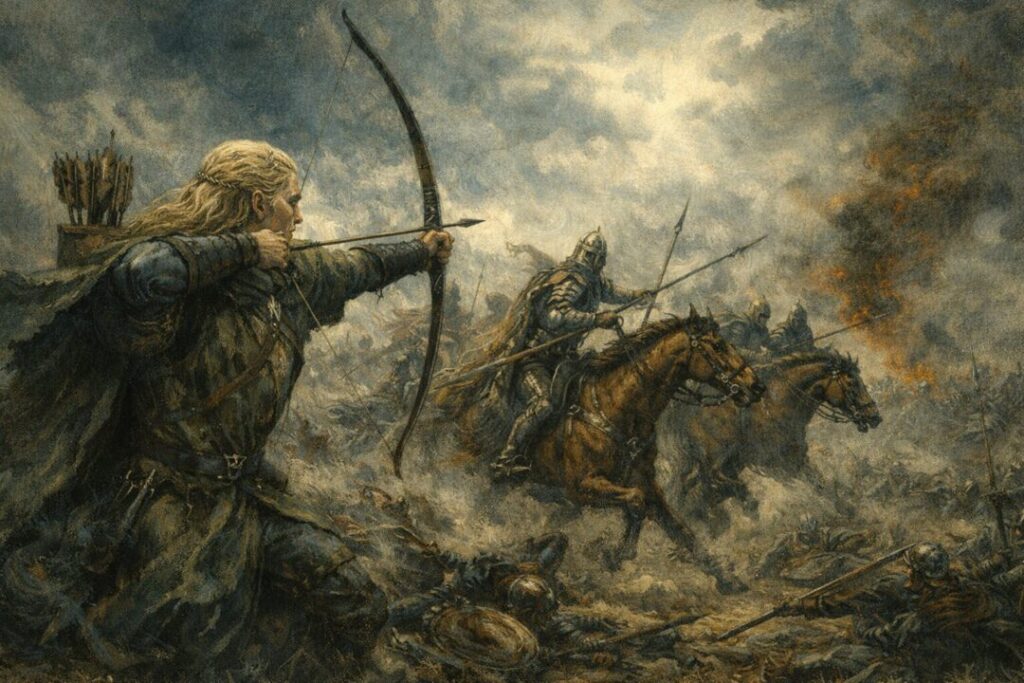
Legolas: Deadly, but Not Invincible
Legolas is extraordinary, but Tolkien grounds him firmly in the physical world.
He is swift, perceptive, and lethal with a bow — but he is not immune to exhaustion, injury, or limitation. He marches for days, feels the weight of despair, and depends on food, rest, and companionship just like the rest of the Fellowship.
Tolkien never portrays Elves as superheroes.
Legolas’s greatest strengths lie in precision and awareness. He excels at striking exposed enemies, killing from range, navigating difficult terrain, and reacting faster than most can follow. These skills make him devastating against Orcs, scouts, riders, and soldiers.
A Mûmakil offers almost none of these advantages.
Its vital points are elevated, protected, and surrounded by enemies. Its hide is thick. Its armor is designed specifically to resist missiles. And even if its drivers were killed, the beast itself would not simply collapse — more likely, it would panic, thrash, or continue moving blindly.
At best, Legolas could create confusion.
Confusion is not the same as a clean kill.
The Physics Tolkien Never Ignores
One of the most overlooked aspects of Tolkien’s writing is how seriously he treats mass and momentum.
A Mûmakil does not need to strike Legolas directly to kill him. Simply falling, stumbling, or rolling could crush anyone nearby. Getting close enough to target it alone would be extraordinarily dangerous — especially amid battle, noise, arrows, and charging troops.
Tolkien consistently respects the idea that size matters.
No amount of agility negates gravity.
Why the Film Version Feels So Different
The films translate Tolkien’s mythic atmosphere into visual shorthand. A single hero accomplishing what would realistically take many allows the audience to feel the scale of the battle instantly.
It is not about lore accuracy. It is about cinematic clarity.
A crowd of soldiers slowly wearing down a massive beast is difficult to communicate quickly on screen. One Elf performing an impossible feat communicates heroism in seconds.
But Tolkien’s writing resists this kind of compression.
He avoids “boss fights.” He avoids power scaling. He avoids the idea that enough skill automatically conquers overwhelming force. Even legendary warriors rely on circumstance, allies, and sacrifice.
What Legolas Could Actually Do
Within Tolkien’s world, Legolas could absolutely influence the fate of a Mûmakil — just not alone and not instantly.
He could:
- Kill or scatter the Haradrim riders
- Disrupt the beast’s guidance and control
- Sow panic among its handlers
- Contribute decisively as part of a wider engagement
What he could not do is cleanly slay a Mûmakil single-handedly and walk away untouched.
That kind of victory belongs to modern fantasy logic — not Middle-earth.
Why Tolkien Writes It This Way
Tolkien does not glorify domination.
Even when evil is defeated, it comes at a cost. Triumph is mixed with grief, exhaustion, and loss. Victory is often partial, delayed, or paid for dearly.
A lone Elf effortlessly killing a living war-engine would undermine the weight Tolkien gives to battle — and to life itself.
Legolas remains heroic not because he breaks reality, but because he fights within it. He is part of something larger than himself, contributing skill where it matters most rather than claiming solitary glory.
And that restraint — that refusal to turn power into spectacle — is exactly what makes Middle-earth feel real.
Not because its heroes are unstoppable.
But because they are not.
Sources & Notes
- J.R.R. Tolkien, The Lord of the Rings, Book IV, Chapter 4, “Of Herbs and Stewed Rabbit” — Sam’s first sight of a Mûmak/Oliphaunt stresses its immense scale, tusks, and terrifying battlefield presence.
- J.R.R. Tolkien, The Lord of the Rings, Book V, Chapter 6, “The Battle of the Pelennor Fields” — the Mûmakil of Harad are described as war-beasts carrying towers and throwing the field into disorder.
- J.R.R. Tolkien, The Lord of the Rings, Book V, Chapter 6, “The Battle of the Pelennor Fields” — when a Mûmak falls, Tolkien presents it as a dangerous catastrophe rather than a clean heroic kill.
- J.R.R. Tolkien, The Lord of the Rings, Book III, Chapter 7, “Helm’s Deep” — Legolas is shown as a deadly archer in battle, but his feats remain within a larger fight alongside allies, not solitary monster-slaying.