
Aragorn’s long life is easy to notice, but rarely examined.
Born in the year 2931 of the Third Age, Aragorn lives until the year 1541 of the Fourth—210 years in total. By any standard of the later ages, this is extraordinary. Yet within The Lord of the Rings, it is treated as something almost natural. The narrative does not pause to explain it. No character expresses disbelief. No justification is offered.
It is simply accepted as part of who Aragorn is.
That quiet acceptance raises an important question.
If the blood of Númenor has been fading for centuries, why does Aragorn endure when others do not?
The Númenórean Inheritance — And Its Limits
Aragorn descends from the Númenor, the great island kingdom of Men that once stood between Middle-earth and the Undying Lands. The Númenóreans were granted long life, wisdom, and strength beyond other Men—not as immortality, but as an extension of their mortal span.
In the early Third Age, this inheritance was still strong.
The first kings of Gondor regularly lived well over 150 years. Even in their old age, they retained clarity of mind and command of body far beyond what later generations would consider normal.
But that longevity did not last.
As the centuries passed, the blood of Númenor slowly diminished. Intermarriage with other Men, political decline, and the steady erosion of memory all took their toll. By the time of the War of the Ring, most Gondorians lived little longer than ordinary Men elsewhere in Middle-earth.
Even the Stewards—men of high lineage and great responsibility—did not escape this decline. Denethor, for all his will and intelligence, dies at 89. His sons fare no better. Boromir dies at 41, in the full strength of his manhood.
Against this backdrop, Aragorn’s lifespan stands out sharply.
He is not merely long-lived.
He is an anomaly.
Preserved, Not Expanded
The first part of the answer lies in how Aragorn’s line was preserved.
Unlike the rulers of Gondor, Aragorn is descended from the Chieftains of the North—the leaders of the Dúnedain who guarded the ruins of Arnor in secrecy and obscurity. These Men lived hard lives. They were few in number, often hunted, rarely celebrated.
But they guarded something with great care: their lineage.
Through generations of watchfulness and restraint, the blood of Númenor remained less mingled in the North than it did in the South. Aragorn inherits this preserved strain not because his ancestors sought power, but because they accepted obscurity.
This alone explains part of his longevity.
But not all of it.
Other Dúnedain lived long lives. None lived as long as Aragorn.
So ancestry, while essential, is not the full answer.

Longevity as a Moral Condition
In Middle-earth, long life is not merely biological.
It is moral.
The Númenóreans were not granted extended years as a reward for greatness. They were entrusted with them as a responsibility. Their long life was meant to allow wisdom to deepen, memory to endure, and leadership to mature slowly and carefully.
Their downfall began when that gift was misunderstood.
When later Númenóreans began to resent death—when they clung to life not as a trust but as a possession—their long years became a source of fear instead of peace. The desire to escape mortality corrupted them long before any physical decline set in.
Aragorn never makes that mistake.
Throughout his life, he consistently refuses the kind of power that shortens the soul even while it prolongs the body.
He does not seize the throne of Gondor by force, even when he has the right.
He does not use fear to command loyalty.
He does not touch the Ring, even though it could secure his kingship instantly.
Again and again, Aragorn chooses patience over domination.
His long life is not sustained by resistance to death, but by acceptance of it.
Power Without Possession
Aragorn’s path stands in contrast to many rulers before him.
He wanders for decades without a crown.
He serves under other leaders.
He fights battles that earn him no glory and no recognition.
This is not wasted time.
It is preparation.
By refusing to grasp prematurely, Aragorn allows his authority to grow without corruption. His long life becomes a space in which humility, endurance, and restraint can take root.
In Middle-earth, this alignment matters.
Those who attempt to force their destiny burn out quickly—whether through despair, madness, or spiritual diminishment. Those who accept their role endure.
Aragorn’s longevity reflects this deeper harmony. He lives long not because he resists the nature of Men, but because he fulfills it.
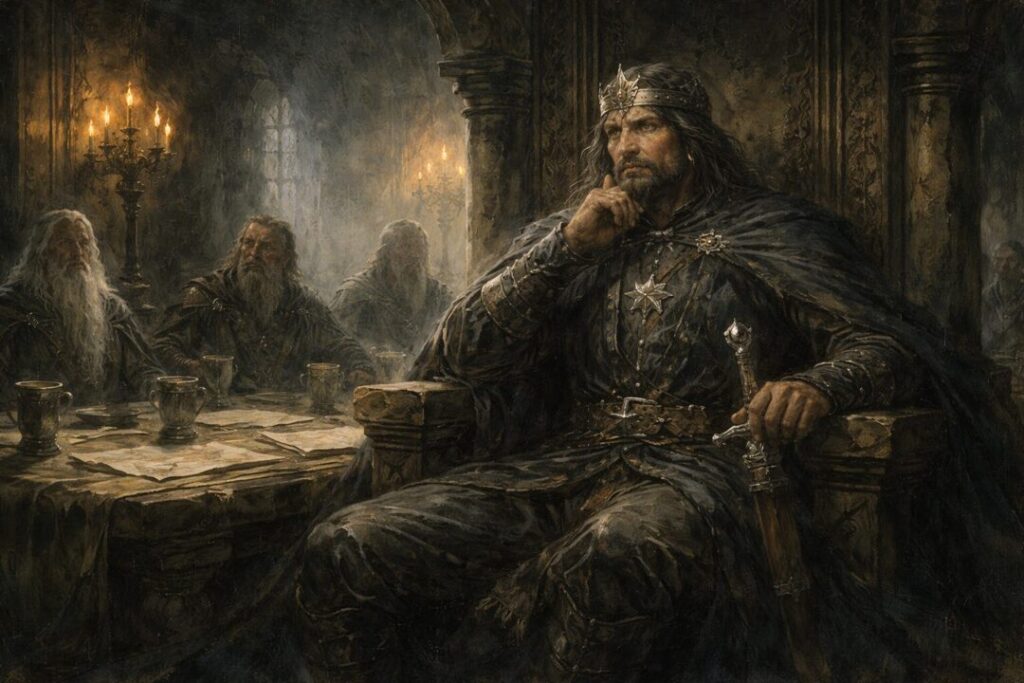
The Choice That Defines Aragorn
Aragorn’s greatest moment does not come on the Pelennor Fields, nor at the Black Gate.
It comes quietly, at the end of his life.
When his strength begins to fail, Aragorn does something almost unheard of among later Men: he chooses the moment of his death.
He does not cling to life until decay overtakes him.
He does not fear the end.
He does not seek preservation through legacy or monuments.
Instead, he lies down willingly and lets go.
This is not despair.
It is mastery.
In this act, Aragorn restores the ancient Númenórean understanding of death—not as a punishment, but as a gift that lies beyond the world. Death is not the Enemy. Fear of death is.
By choosing freely, Aragorn proves that his long life was never about escape.
It was about completion.
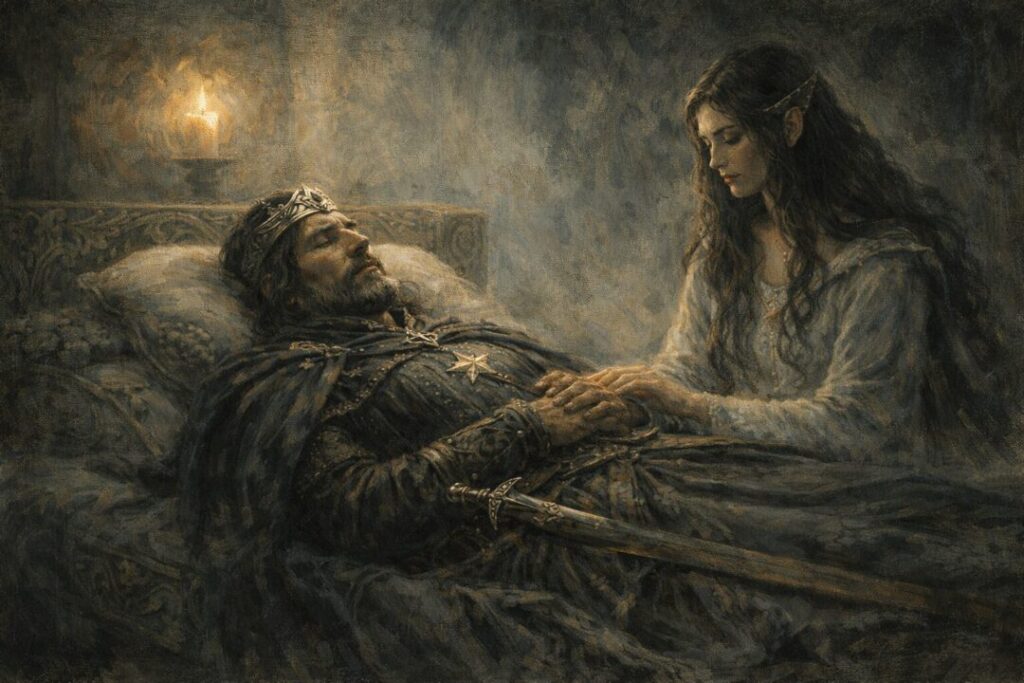
Arwen and the Cost of Choice
This moment is made even more powerful by the presence of Arwen.
Arwen does not share Aragorn’s fate. In choosing him, she accepts mortality herself. Where Aragorn’s death is peaceful, hers is marked by grief and solitude.
This contrast matters.
Aragorn can accept death because it belongs to his nature.
Arwen must learn to endure it because it does not.
Their shared story reinforces the central truth of Men in Middle-earth: mortality is not diminished by love, nor softened by power. It must be faced honestly.
Aragorn’s willingness to die does not erase Arwen’s sorrow—but it gives it meaning.
Why This Matters
Aragorn’s long life is not about endurance.
It is about right relationship with power.
Those who fear death cling to life and diminish themselves.
Those who seek immortality lose the wisdom they hoped to preserve.
Those who accept their limits gain authority without corruption.
Aragorn lives long because he does not grasp.
He dies freely because he understands when his time is complete.
In a world filled with beings who seek to dominate time, fate, and death itself, Aragorn stands apart—not as the strongest, but as the most balanced.
And in that final act of surrender, he proves himself not merely a great king…
…but fully human, as Men were always meant to be.
Sources & Notes
- J.R.R. Tolkien, The Lord of the Rings, Appendix A, “The Tale of Aragorn and Arwen” — gives Aragorn’s birth and death dates, his 210-year span, and his willing surrender of life as King Elessar.
- J.R.R. Tolkien, The Lord of the Rings, Appendix A, “The Númenórean Kings” — traces the Dúnedain line through Elendil, Arnor, Gondor, and the Northern Chieftains, the lineage behind Aragorn’s preserved longevity.
- J.R.R. Tolkien, The Lord of the Rings, Appendix A, “Gondor and the Heirs of Anárion” — shows the waning of Númenórean blood and stature in Gondor, setting Aragorn apart from later Stewards and captains.
- J.R.R. Tolkien, The Silmarillion, “Akallabêth” — explains the Númenórean gift of long life, the Ban of the Valar, and the spiritual disaster that followed when Men began to fear and resent death.
- J.R.R. Tolkien, The Letters of J.R.R. Tolkien, Letter 131 — Tolkien describes mortality as the special fate, or gift, of Men, supporting the article’s reading of Aragorn’s death as acceptance rather than defeat.