
Few moments in The Lord of the Rings carry as much quiet weight as Galadriel’s refusal of the One Ring.
There is no battle.
No clash of armies.
No visible victory.
And yet, this moment may be one of the most decisive turning points in the entire history of Middle-earth.
When Frodo offers the Ring to Galadriel, the world seems to pause. Time stretches. The reader is allowed to glimpse a future that could unfold—and then never will.
Galadriel does not hesitate because she doubts her strength.
She hesitates because she understands it too well.
To ask whether Galadriel could have defeated Sauron by taking the Ring is to misunderstand what the Ring truly offers—and what “victory” actually means in Tolkien’s world.
Galadriel’s Power Is Real—and Enormous
Galadriel is not a minor Elf-lady trembling before temptation.
She is one of the greatest of the Noldor: born in Valinor before the Exile, a witness to the light of the Two Trees, and one of the last living figures in Middle-earth who remembers the Elder Days firsthand. She learned wisdom from Melian the Maia, resisted the call of Morgoth, and survived the ruin of Beleriand itself.
By the Third Age, Galadriel is not merely old—she is seasoned. Her will has been tested across ages of loss, exile, and slow fading.
She is also the bearer of Nenya, one of the Three Rings of the Elves, through which she preserves the beauty and timelessness of Lothlórien. That realm remains unconquered not by chance, but because her power actively resists Sauron’s shadow.
Even the Dark Lord himself avoids open confrontation with her while the One Ring is lost.
So yes—if Galadriel took the One Ring, she would gain the ability to challenge Sauron directly.
Tolkien himself implies that among the Free Peoples, she is one of the very few beings capable of such a confrontation.
But that is not the same as saying she would save Middle-earth.

What the Ring Actually Does
The One Ring does not simply amplify strength.
It amplifies intent.
Specifically, it magnifies the desire to impose order—to bend the world into a shape that reflects the will of its bearer.
Sauron does not rule through chaos. He rules through domination, surveillance, and the systematic elimination of resistance. The Ring was created precisely for that purpose: to gather all wills under one supreme authority.
Anyone who takes the Ring does not escape this function. They inherit it.
This is why the Ring tempts not with cruelty, but with solutions.
When Galadriel imagines herself as a Queen, she does not picture darkness, fire, or terror. She imagines a world healed of its wounds. A realm made orderly, fair, and unmarred by decay.
And that is precisely the danger.
Her rule would not begin with tyranny. It would begin with protection, wisdom, and benevolent governance. People would follow her willingly. They would believe in her goodness.
But over time, dissent would become intolerable—not because it is evil, but because it disrupts the vision of what ought to be.
Tolkien makes this clear again and again: evil does not need to look monstrous to be evil. Sometimes it looks beautiful. Sometimes it looks necessary.
Why Galadriel’s Victory Would Have Been a Defeat
If Galadriel defeated Sauron while wielding the Ring, Middle-earth would not be freed from domination.
It would be rebranded.
Sauron seeks order through fear. Galadriel would seek order through wisdom and light. But the result would still be absolute control—the end of moral choice, the quiet suffocation of freedom beneath a perfect, unchallengeable will.
And unlike Sauron, Galadriel would be loved.
That makes her far more dangerous.
This is why Tolkien’s moral framework rejects the idea of “using evil to destroy evil.” The Ring cannot be wielded for good in the long term—not by Men, not by Wizards, not even by the greatest of the Eldar.
The corruption may be slower. It may feel justified. But it is inevitable.
The price is always the same.
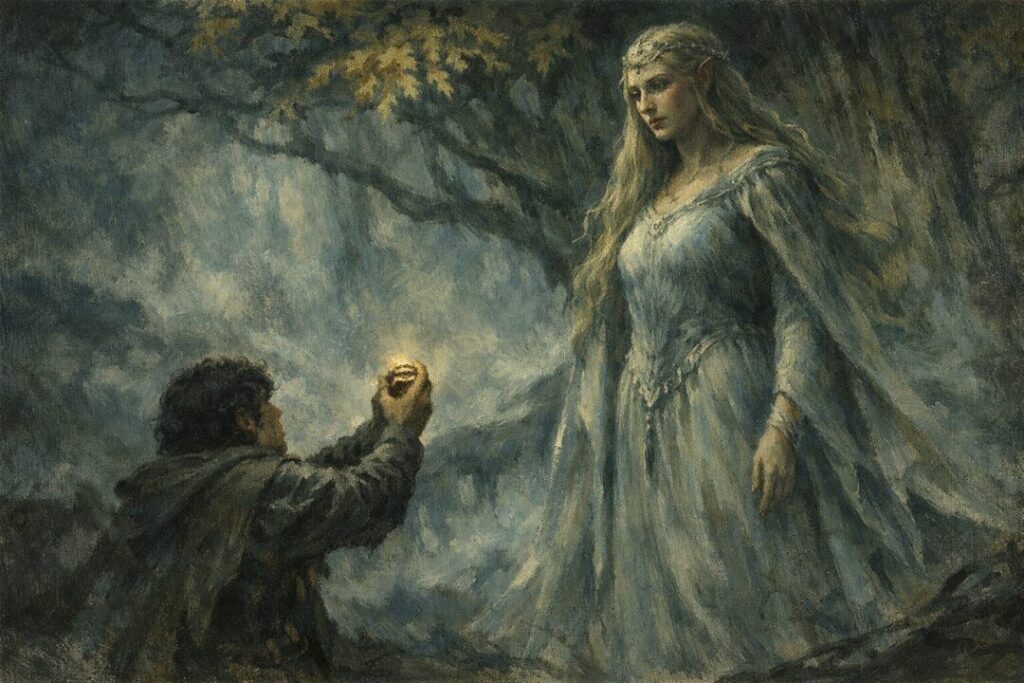
“I Pass the Test”
When Galadriel refuses the Ring, she does something extraordinary.
She chooses diminishment.
“I pass the test,” she says. “I will diminish, and go into the West, and remain Galadriel.”
This is not a rejection of power. It is a rejection of dominion.
She chooses to remain herself rather than become something greater and worse. She accepts the fading of the Elves. She accepts that the world will pass into the hands of others—imperfect, fragile, and free.
In this moment, Galadriel understands something Sauron never does:
That victory gained through absolute power is not victory at all.
By refusing the Ring, she ensures that Middle-earth does not simply survive the War of the Ring—but survives without exchanging one tyrant for another.

Why This Moment Matters More Than Any Battle
The War of the Ring is not won at Pelennor Fields.
It is not won at the Black Gate.
It is won in moments like this—quiet refusals, unseen moral choices, and the courage to step away from power when taking it would be easy.
Galadriel’s decision mirrors others across the story:
Gandalf refusing the Ring.
Elrond never claiming kingship over all Elves.
Frodo continuing long after hope has faded.
These are not acts of weakness. They are acts of restraint.
Galadriel could have defeated Sauron.
But she would have lost everything that made such a victory worth having.
And that is why she is not merely powerful—but wise.
That is why she stands, even in refusal, as one of the true guardians of Middle-earth.
And that is why this quiet moment beneath the trees of Lothlórien may matter more than any battle ever fought.
Sources & Notes
- J.R.R. Tolkien, The Lord of the Rings, Book II, Chapter 7, “The Mirror of Galadriel” — gives Frodo’s offer of the Ring and Galadriel’s “I pass the test” refusal, the article’s central scene.
- J.R.R. Tolkien, The Lord of the Rings, Book I, Chapter 2, “The Shadow of the Past” — Gandalf explains why he dares not take the Ring, framing the danger of using its power even for pity or good intentions.
- J.R.R. Tolkien, The Lord of the Rings, Book II, Chapter 2, “The Council of Elrond” — rejects wielding the Ruling Ring against Sauron because it was made by him and is altogether evil.
- J.R.R. Tolkien, The Silmarillion, “Of the Rings of Power and the Third Age” — describes Sauron making the One Ring to rule the other Rings and dominate their bearers.
- J.R.R. Tolkien, The Letters of J.R.R. Tolkien, Letter 131 — Tolkien’s own summary of Sauron’s motive as domination and ordering all things according to his will.