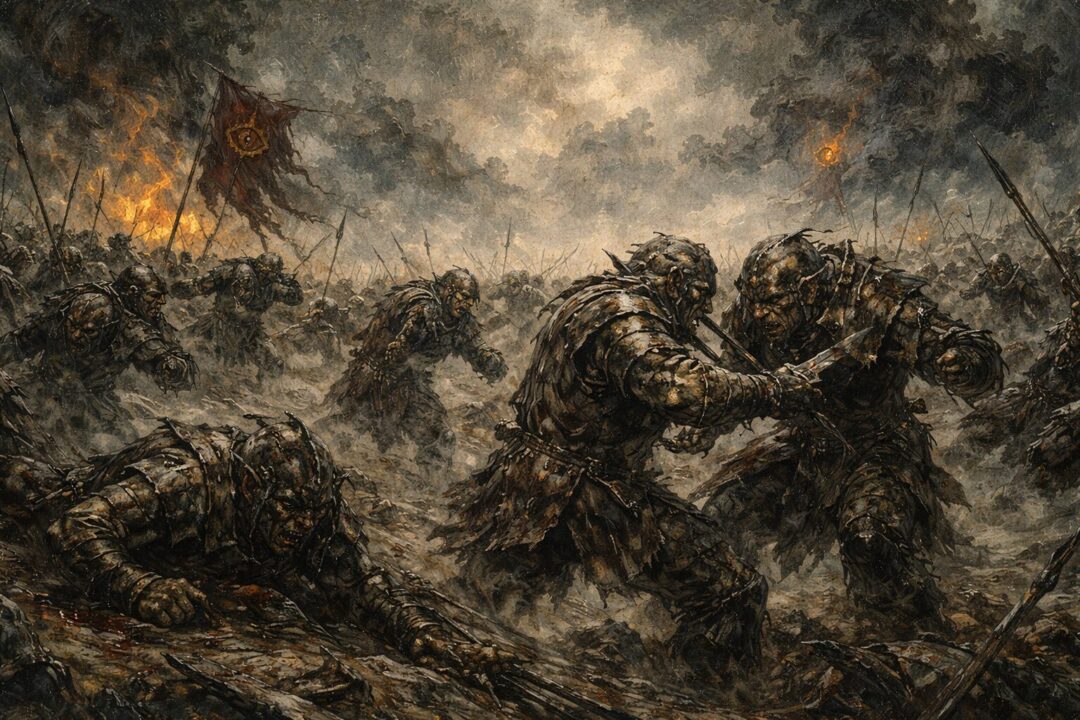
Few creatures in Middle-earth feel as contradictory as Orcs.
At times, they appear capable of planning, negotiation, and even a kind of dark humor. They speak in organized bands, understand chains of command, recognize when orders matter, and when they might be bent. They argue about strategy, complain about their superiors, and show a sharp awareness of danger and self-interest.
And then, in other moments, they seem almost subhuman.
They howl instead of speak.
They rush forward in screaming masses.
They are driven into battle like animals, barely reacting except to pain, fear, or the lash.
This contrast raises a question that has puzzled readers for decades:
Are Orcs meant to be intelligent beings — or mindless monsters?
At first glance, the answer appears inconsistent. But the deeper truth is more unsettling.
Orcs are not written inconsistently because of narrative carelessness. They are written inconsistently because they are broken.
And that brokenness is the point.
Orcs Were Never Meant to Be What They Are
Orcs do not originate as a natural people with a stable culture, shared traditions, or a coherent moral framework. Whatever their earliest beginnings may have been, by the time of the Third Age they exist as the result of prolonged corruption, domination, and systematic destruction of will.
They are not merely violent — they are damaged.
This matters because Tolkien does not portray evil as a creative force. Evil does not build healthy societies. It does not nurture loyalty freely given. It does not produce harmony, even among its own servants.
Instead, evil imitates order while hollowing it out from the inside.
Orc society reflects this perfectly.
What structure exists among them is imposed, not grown. Authority is enforced through fear rather than respect. Discipline is maintained by threat rather than shared purpose. Any sense of unity collapses the moment that pressure eases.
As a result, Orcs do not develop evenly.
Some retain fragments of independent thought.
Some show initiative, sarcasm, or tactical reasoning.
Others are so reduced by terror and conditioning that they function almost as extensions of command rather than individuals.
This is why Orc intelligence varies wildly — not only between different groups, but between individuals in the same band.
They are not inconsistent by accident.
They are inconsistent because their inner lives have been fractured.
Fear Is the Only Thing Holding Them Together
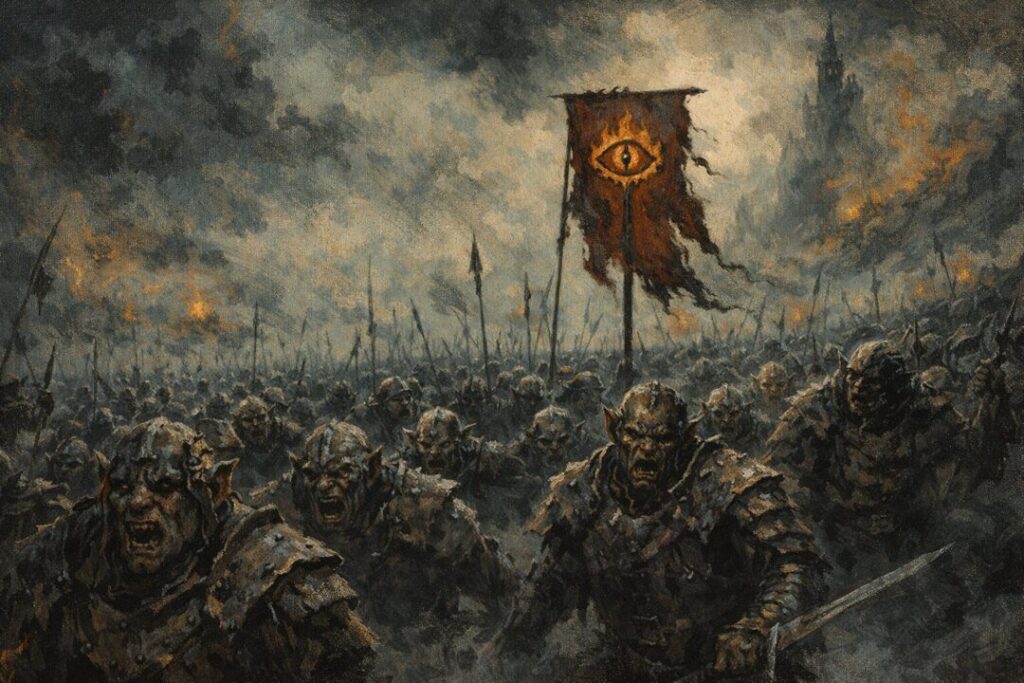
Orc society does not operate on loyalty.
It operates on fear.
They fear their captains.
They fear punishment.
They fear their masters above all else.
This fear creates obedience, but it never creates commitment.
Because obedience enforced through terror is never internalized, Orcs constantly test boundaries. They complain when authority is absent. They argue over loot. They betray one another whenever the risk seems manageable. Infighting is not an exception — it is the norm.
This is why Orcs bicker endlessly in the text. Why they squabble over prisoners. Why they turn on one another at moments of stress. Their unity is artificial, sustained only so long as punishment is imminent.
Contrast this with the free peoples of Middle-earth.
Elves, Men, Dwarves, and Hobbits cooperate not because they are forced to, but because they share stories, values, and trust built over time. Their societies endure pressure precisely because loyalty is voluntary.
Orcs lack all of this.
They are not united because they believe in anything.
They are united because they are trapped.
And captivity does not create stability — it creates resentment.
Intelligence Without Moral Direction
One of the most revealing aspects of Orc behavior is how they use intelligence.
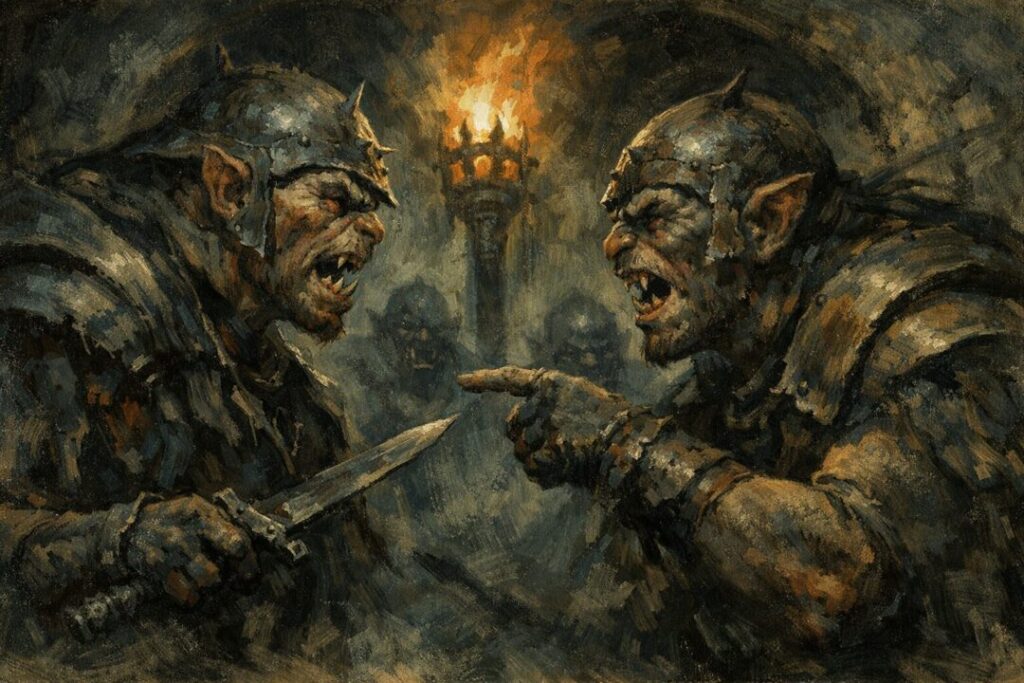
Orcs are capable of speech, planning, and coordination, but their thinking is almost entirely reactive. Their conversations revolve around immediate survival: avoiding punishment, gaining advantage, escaping danger, or exploiting weakness.
They rarely speak of ideals.
They never speak of hope.
They do not imagine a future beyond the next command.
This is why Orc dialogue often feels bitter, cynical, and exhausted. They understand enough to recognize their suffering, but not enough to imagine a world beyond it.
That awareness does not lead to meaningful rebellion because Orcs lack the foundations that make rebellion possible. They do not trust one another. They do not organize toward a shared vision. Fear has narrowed their world to the present moment.
In this sense, Orc intelligence is not absent — it is misdirected.
They think, but only in ways that serve domination or escape from it. Their minds have been trained to function inside a cage.
Why Orc Armies Collapse So Easily
One of the most telling patterns in the War of the Ring does not appear during great battles, but after them.
When central authority breaks, Orc forces disintegrate.
They do not regroup.
They do not rally.
They do not reorganize.
They scatter, flee, fight one another, or simply dissolve into chaos.
This is not because they are physically weak. It is because evil cannot sustain order without constant coercion. Once the pressure of command is removed, nothing remains to bind them together.
Unlike free peoples, Orcs have no shared cause that survives the loss of leadership. Their obedience was never voluntary, so it does not endure.
This is why the downfall of their masters leads so quickly to their own ruin.
Remove the Eye, and the armies collapse.
Different Masters, Different Orcs
Not all Orcs behave the same way, and this too is deliberate.
Those under different rulers show different levels of discipline, cruelty, and initiative. Some are more regimented. Others are more chaotic. Some rely heavily on threats. Others encourage rivalry among subordinates.
This reflects the nature of domination itself.
When authority is imposed rather than earned, its effects depend entirely on who wields it. Orcs become mirrors of their masters — not unified citizens of a cause, but distorted reflections of power imposed from above.
This further explains why Orc behavior shifts from place to place and moment to moment. Their identity is not stable because it was never allowed to form freely.
Inconsistency as a Theme, Not a Flaw
Tolkien does not depict Orcs inconsistently by mistake.
Their fractured behavior reflects the nature of domination itself. Evil may produce short-term efficiency, but it always creates long-term instability. It can force obedience, but it cannot cultivate loyalty. It can command armies, but it cannot build communities.
Orcs are the living evidence of that failure.
They are not monsters because they lack intelligence.
They are monsters because their intelligence has been twisted into something joyless, fearful, and destructive.
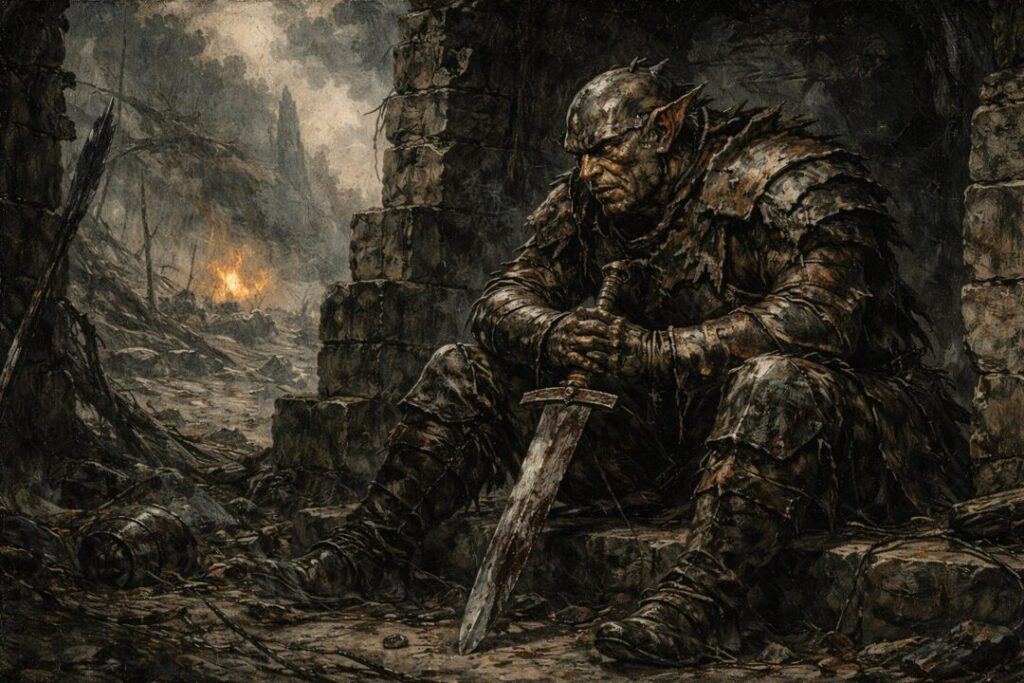
They exist in a constant state of tension — aware enough to suffer, but too broken to change their fate.
And that makes them one of the most unsettling creations in Middle-earth.
Not because they are mindless.
But because they are not.
Sources & Notes
- J.R.R. Tolkien, The Silmarillion, ‘Of the Coming of the Elves and the Captivity of Melkor’ — gives the classic account of Orcs as a people ruined and made in mockery, not naturally created by evil.
- J.R.R. Tolkien, The Lord of the Rings, Book III, Chapter 3, ‘The Uruk-hai’ — Uglúk, Grishnákh, and their companies show Orcs arguing, calculating, obeying orders, and splintering under rival commands.
- J.R.R. Tolkien, The Lord of the Rings, Book VI, Chapter 1, ‘The Tower of Cirith Ungol’ — Shagrat and Gorbag’s talk and the tower’s massacre reveal intelligence mixed with mistrust, fear, greed, and violent disunity.
- J.R.R. Tolkien, The Lord of the Rings, Book VI, Chapter 2, ‘The Land of Shadow’ — the Mordor Orcs’ marching discipline, bullying, complaints, and fear of command support the article’s reading of coercive order.
- J.R.R. Tolkien, The Letters of J.R.R. Tolkien, Letter 131 — Tolkien’s explanation that evil is derivative and corruptive supports the theme that domination can imitate order but not create healthy loyalty or community.