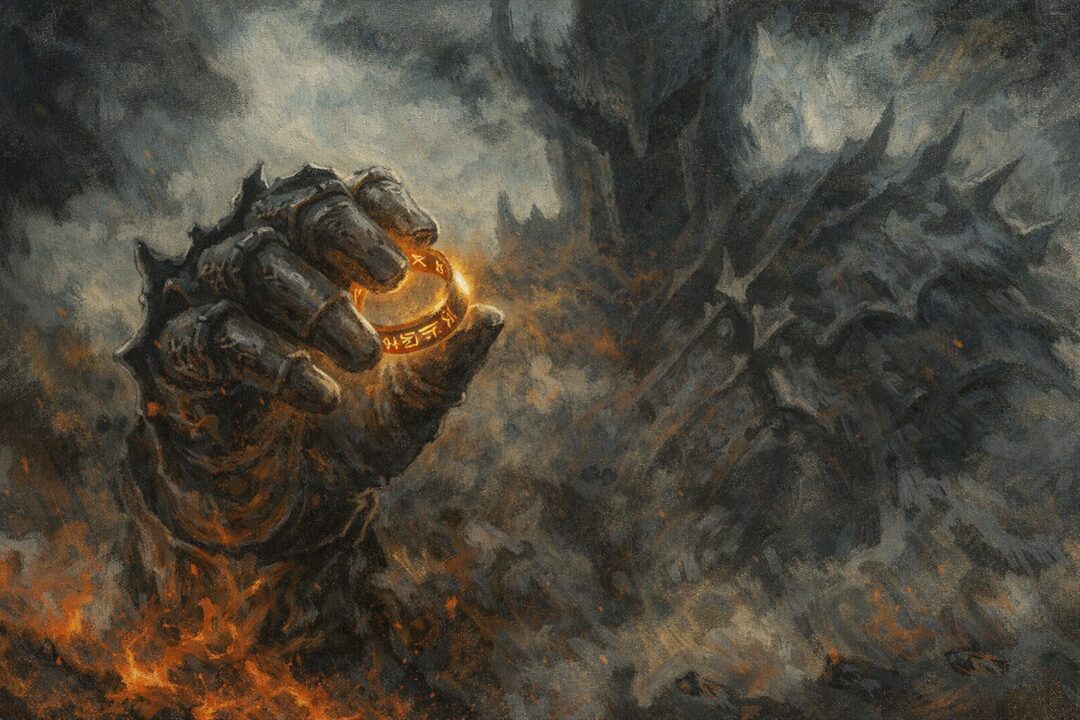
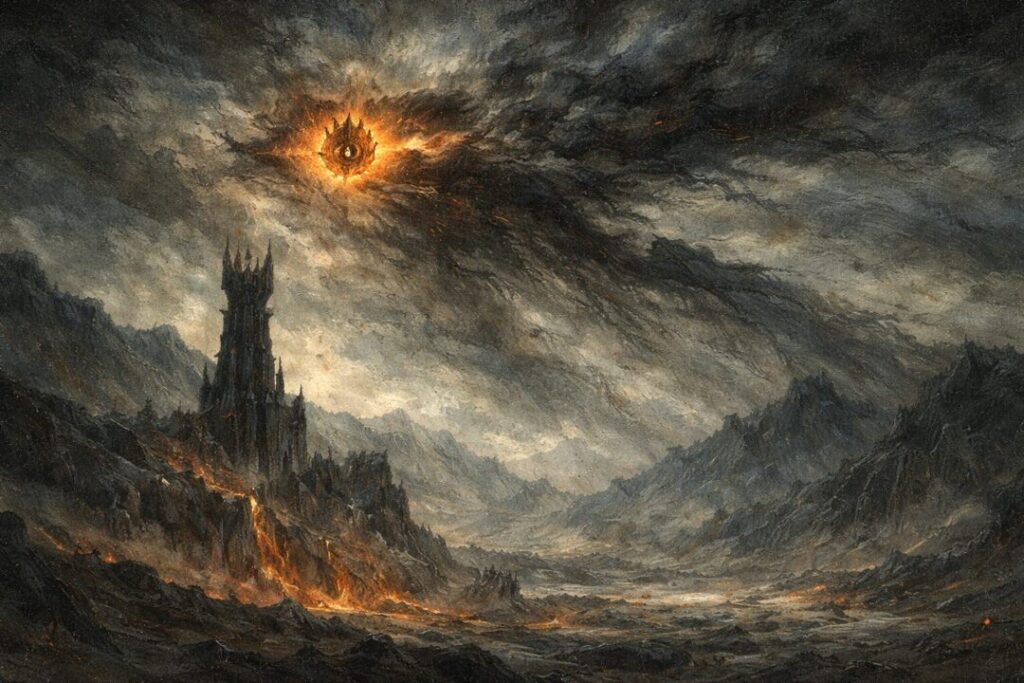
By the end of The Lord of the Rings, Sauron appears to exist only as a vast, searching Eye—watchful, oppressive, and terrible, yet never embodied. He is felt everywhere but seen nowhere. No throne. No crown. No Dark Lord striding openly across the battlefield.
This has led many readers to assume that Sauron is permanently trapped in a formless state, reduced to a shadow of what he once was—an evil that can menace the world but never again fully enter it.
But the legendarium tells a different story.
Sauron’s lack of a physical body in the Third Age is not the result of an irreversible transformation. It is the result of repeated defeat. And if those defeats had been undone—if the Ring had returned to him—there is strong textual evidence that Sauron would not have remained an Eye forever.
He would have taken shape again.
Sauron Has Taken Physical Form Before
Sauron is not a being who naturally lacks a body.
As a Maia, he belongs to the same order of beings as the Wizards and the Balrogs: spirits who can assume physical form in the world. A body is not alien to him. It is something he has worn many times—and lost many times.
This distinction matters.
Sauron’s problem is not inability. It is condition.
During the Second Age, Sauron ruled openly in Middle-earth. Later, he appeared in Númenor in a fair and persuasive form—wise, beautiful, and convincing enough to corrupt an entire civilization from within. That body was destroyed when Númenor was overthrown and swallowed by the sea.
This moment marks a permanent change.
After the Downfall, Sauron could no longer assume a fair shape. The loss was not cosmetic—it was spiritual. Something essential had been stripped away.
But this did not end his ability to take physical form.
Sauron returned to Middle-earth, rebuilt his strength, and ruled once more from Barad-dûr. He was embodied again when he faced the Last Alliance. And when Isildur cut the Ring from his hand, that body was destroyed as well.
Which brings us to the crucial point.
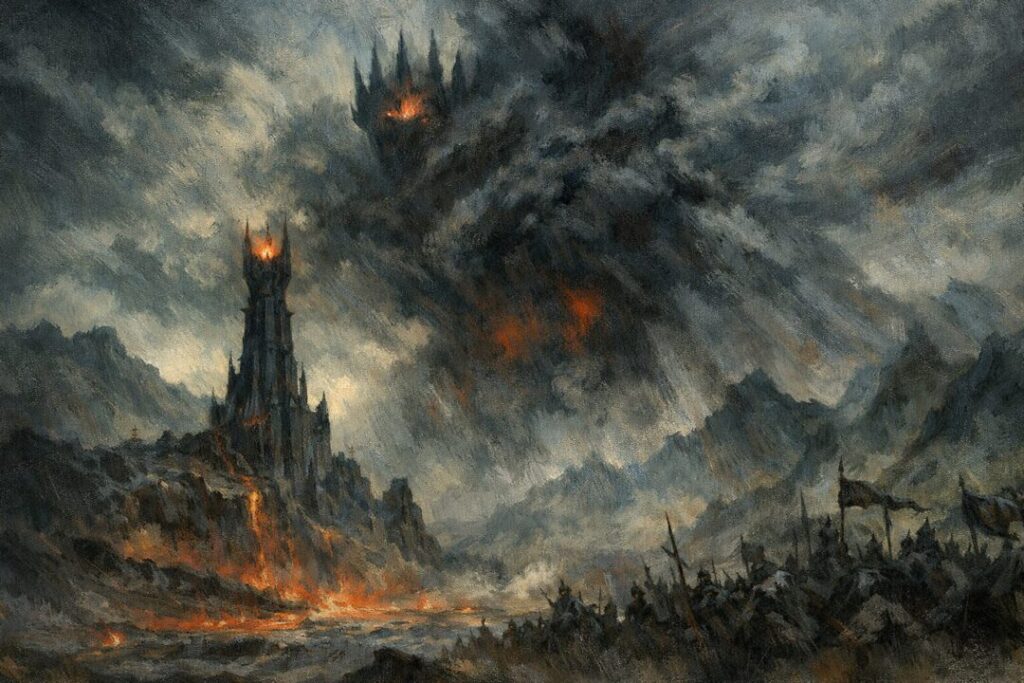
What “Defeat” Means for Sauron
When Sauron loses a body, he does not die.
His spirit endures. His will persists. His malice remains intact.
But his power is scattered.
Each destruction of his physical form leaves him weakened, diminished, slower to recover. Reincorporation is not automatic. It requires time, strength, and concentration of power.
This is why Sauron’s presence in the Third Age feels different from earlier ages. He is not striding openly across the world. He is gathering himself.
The Eye is not his preferred state.
It is a temporary one.
The Ring and the Problem of Embodiment
The One Ring is not merely a weapon or a focus of domination. It contains a substantial portion of Sauron’s native power—power deliberately transferred so that he could control the other Rings.
This act gave Sauron immense reach, but it also made him uniquely vulnerable.
As long as the Ring exists outside his possession, Sauron is incomplete.
He can command armies.
He can corrupt minds.
He can bend wills from afar.
But he cannot fully reform himself.
His being is divided.
This explains one of the most misunderstood aspects of the War of the Ring: why Sauron does not simply overwhelm Middle-earth by force from the beginning.
His power is vast—but not whole.
Without the Ring, he risks everything by acting too openly. Another catastrophic defeat could reduce him even further, perhaps beyond recovery.
So he waits.
He searches.
He gathers strength.
And above all, he seeks the Ring.
Because possession of the Ring would not merely grant him victory—it would allow him to become complete again.
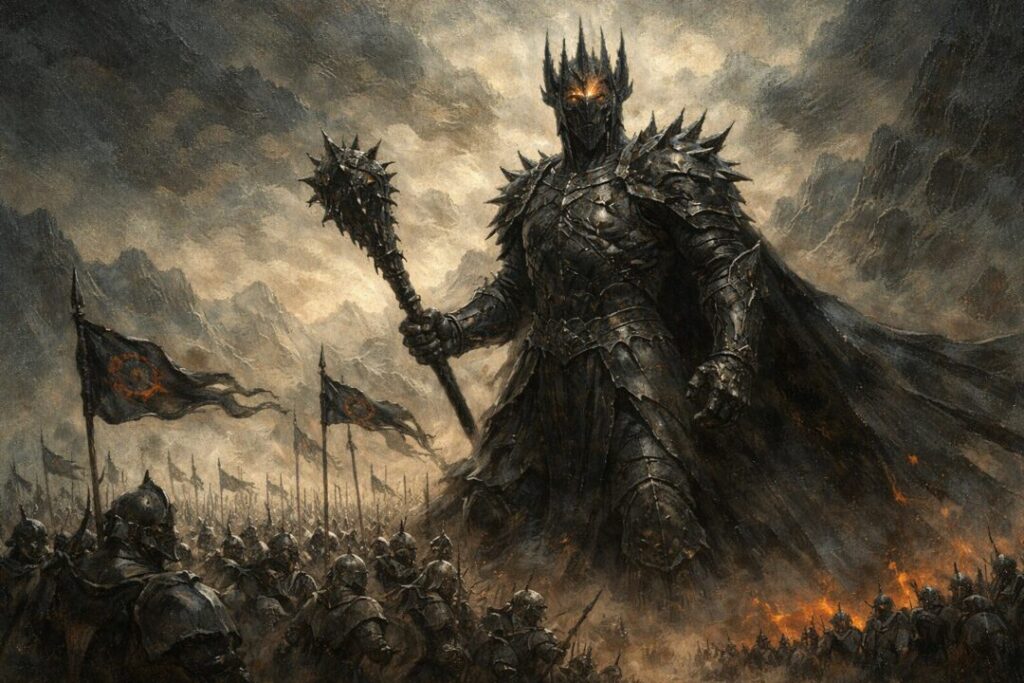
Would Sauron’s New Body Be the Same?
Here the texts are clear—and unsettling.
Sauron would not have returned in a fair or beautiful form. That ability was permanently lost in the ruin of Númenor. He could deceive no longer through appearance alone.
But loss of beauty does not mean loss of embodiment.
If Sauron had regained the Ring, he would have been able to consolidate his power and fashion a physical form suited to domination: terrible, overwhelming, and unmistakably tyrannical.
Not a shadow.
Not a symbol.
A Dark Lord made flesh.
Such a body would not exist for persuasion or subtlety. That phase of Sauron’s history had ended. This form would exist to rule—and to endure.
A visible tyrant is more dangerous than an unseen one, because fear becomes constant rather than imagined.
Why Sauron Delays Open Victory
This understanding reframes Sauron’s strategy during the War of the Ring.
He is not hesitant because he lacks confidence.
He is cautious because he cannot afford another failure.
Sauron fears one thing above all else: permanent diminishment.
Every previous defeat has cost him something he can never fully recover. If he commits too much power too soon and is thwarted again, he risks becoming something less than he already is.
Victory, for Sauron, is not simply conquest.
It is restoration.
He does not want Middle-earth burned to ash if it costs him the chance to rule it forever.
The True Stakes of the Ring’s Destruction
This is why the destruction of the Ring is final in a way no previous defeat ever was.
When the Ring is destroyed, the power invested in it is lost forever. It does not return to Sauron. It does not disperse back into the world.
It is unmade.
For the first time, Sauron’s spirit is reduced beyond recovery.
He is not destroyed in the sense of annihilation—but he is rendered incapable of ever taking shape again, incapable of growth, incapable of coherent action.
He becomes a powerless will, unable to dominate, unable to incarnate, unable to rise.
Had the Ring been reclaimed, the opposite would have occurred.
Sauron would not have remained an Eye watching from afar. He would have returned as a ruling presence—physical, commanding, and permanent.
The Eye is not Sauron’s final form.
It is the shape of a Dark Lord waiting to be completed.
Why This Matters
Understanding this changes how we read the entire War of the Ring.
The danger was never just military defeat.
It was not simply slavery or darkness or fear.
It was permanence.
If Sauron had won, the age of free peoples would not merely have ended—it would never have returned. There would be no fading of evil, no slow healing, no chance for renewal.
A bodiless Sauron can be resisted.
A restored Sauron would have ruled.
And that is why the Ring could not be used.
Why it could not be claimed.
Why it had to be destroyed.
Not to stop an Eye—but to prevent a Dark Lord from walking the world again.
Sources & Notes
- J.R.R. Tolkien, The Silmarillion, “Akallabêth” — Sauron’s body perishes in Númenor, and afterward he can no longer take a fair form.
- J.R.R. Tolkien, The Silmarillion, “Of the Rings of Power and the Third Age” — Sauron returns to Mordor after Númenor, is overthrown by the Last Alliance, and loses the Ring from his hand.
- J.R.R. Tolkien, The Lord of the Rings, Book I, Chapter 2, “The Shadow of the Past” — Gandalf explains that Sauron let a great part of his former power pass into the One Ring.
- J.R.R. Tolkien, The Lord of the Rings, Book V, Chapter 9, “The Last Debate” — Gandalf says destroying the Ring would reduce Sauron so low that none can foresee his arising again.
- J.R.R. Tolkien, Letters, no. 131 — Tolkien frames Sauron’s Ring as the chief instrument and repository of his dominating power, clarifying why its recovery would restore his mastery.