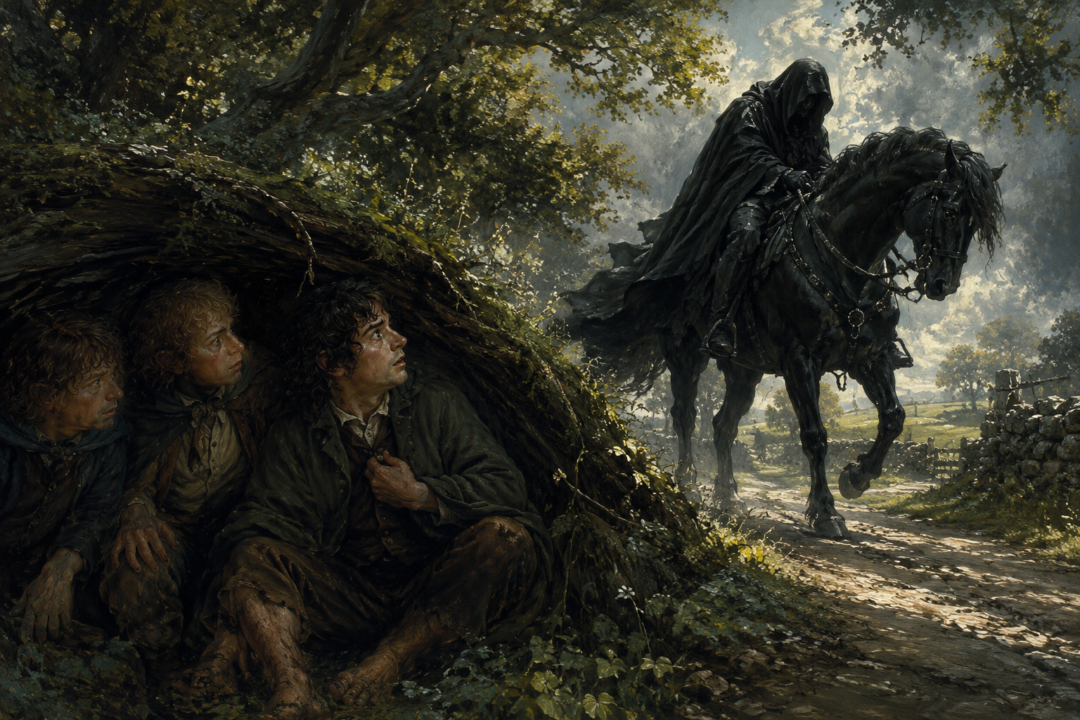
When Frodo Baggins first hides from a Black Rider in the Shire, he does not know what is hunting him.
He does not yet know the word Nazgûl. He does not know that the dark figure on the black horse is one of the Nine, ancient Men enslaved through Rings of Power and now servants of Sauron. He has never seen Minas Morgul, heard the terrible cries that will later accompany the Ringwraiths, or felt a Morgul-knife enter his flesh.
What Frodo knows is much smaller—and immediately more useful.
A stranger dressed in black is searching the Shire. He is asking about Baggins. He behaves unnaturally. And wherever the ordinary road makes Frodo easiest to find, the safest choice seems to be somewhere else.
That is why one of the earliest decisions in The Fellowship of the Ring matters so much. Frodo begins avoiding the road before he understands the true nature of his pursuers.
It is not knowledge that saves him.
It is caution under uncertainty.
Frodo Begins His Journey With Incomplete Information
Gandalf has already given Frodo frightening knowledge before the journey begins. Frodo knows that Bilbo's Ring is the One Ring and that Sauron is seeking it. He understands that remaining at Bag End is dangerous and that his departure should be concealed.
But there is a crucial gap between understanding Sauron in the abstract and recognizing Sauron's servants when they appear on a country lane.
Frodo leaves Bag End with Sam and Pippin while still expecting Gandalf to join him. His journey begins inside the familiar geography of the Shire: lanes, fields, woods, farms, inns, and paths that should belong to ordinary hobbit life.
Then a rider appears.
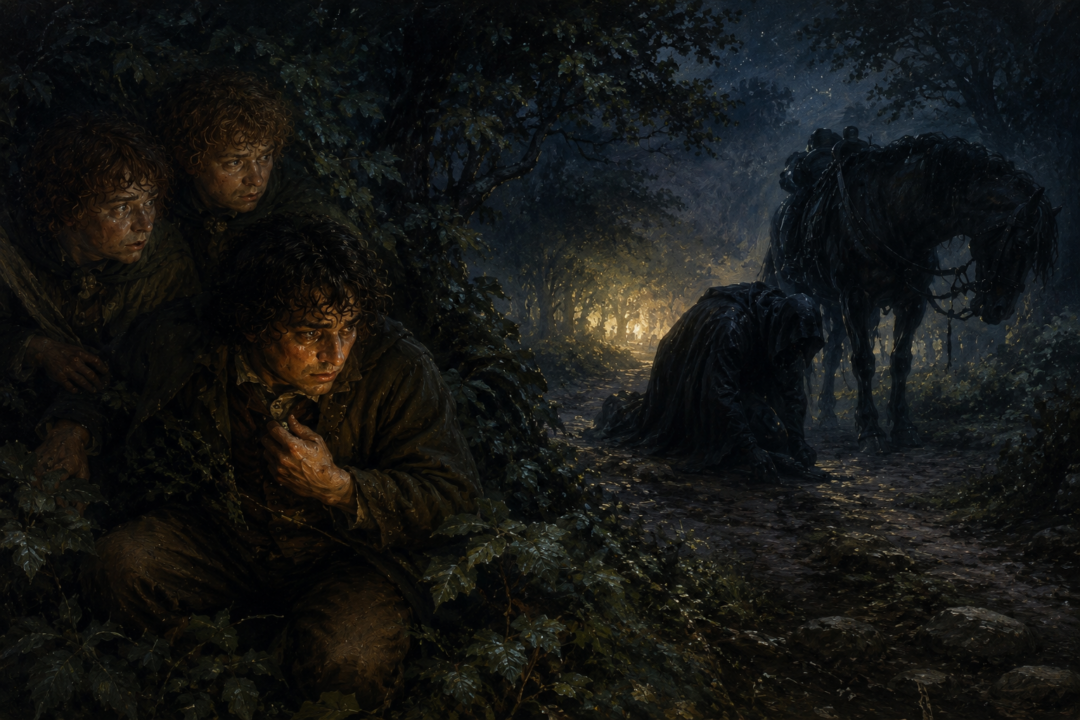
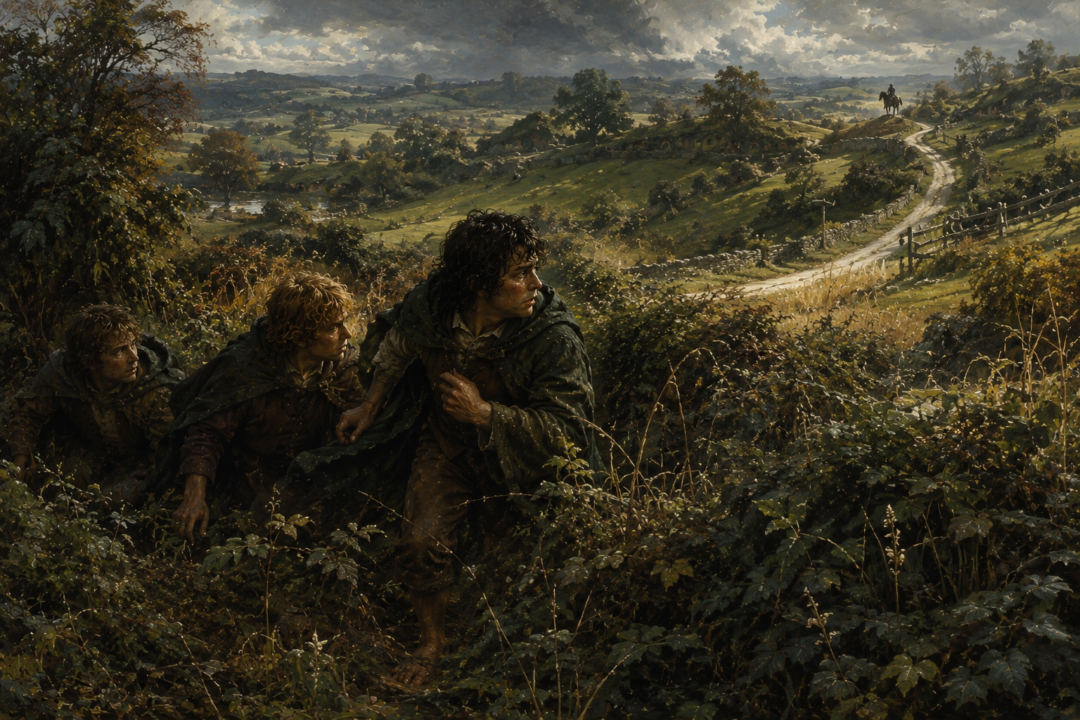
At first, Frodo's instinct to avoid being seen is not based on supernatural knowledge. When hoofbeats approach behind the hobbits in Woody End, he decides they should get out of sight. The arriving stranger is wrapped in black, with his face concealed beneath his hood.
More disturbing is his behavior.
The Rider stops near the hiding hobbits and appears to search by scent. Frodo experiences a powerful temptation to put on the Ring.
He does not understand what that means.
But he understands enough to be afraid.
Sam Provides the Missing Piece
The encounter becomes more alarming when Sam connects the Rider with news from home.
Sam reports that his father had encountered a strange person asking after a Baggins. That transforms the Rider from an unsettling traveler into something much more specific.
Frodo is being searched for.
He still cannot identify the searcher, but identification is no longer necessary for the immediate decision. A concealed stranger has been asking questions about his family name, and now a similarly described rider has appeared directly behind him on the road.
Frodo therefore begins treating the road itself as a liability.
That distinction is important.
He does not reason his way to the conclusion that the stranger must be one of Sauron's Nine Ringwraiths. He cannot. He lacks the information.
Instead, he makes the narrower conclusion the evidence supports: someone dangerous may be tracking him, and predictable travel makes that person's task easier.
It is a remarkably sensible response to a threat he cannot yet explain.
The Ring Makes Ignorance More Dangerous
There is another reason Frodo's early encounters are so perilous.
The enemy does not merely have to find him.
The Ring itself is already exerting pressure on its bearer.
During the encounters with the Riders, Frodo feels a strong desire to put on the Ring. At this point he does not understand the full relationship between the Ring and the wraith-world. Later events, especially at Weathertop, will reveal how catastrophically dangerous putting it on in the presence of the Nazgûl can be.
But in the Shire, Frodo knows none of that.
This creates a frightening contradiction.
The object that seems capable of hiding him from an ordinary pursuer is precisely the object he should not casually use against these pursuers.
To a hobbit accustomed to thinking of the Ring as a means of invisibility, slipping it on might appear to be the perfect escape.
Yet Frodo resists the impulse.
That resistance matters as much as leaving the road. He survives these first encounters partly by refusing to act on a temptation whose consequences he cannot yet comprehend.
The danger is therefore operating on two levels: the Riders are searching outwardly, while the Ring is pulling inwardly.
Frodo is caught between them without understanding either mechanism completely.
The Second Rider Confirms That This Is No Accident
After the first encounter, the hobbits continue their journey while becoming more cautious about the road.
Then another Rider appears.
This time the pattern is harder to dismiss. Again there is the black horse. Again the hidden figure searches. Again Frodo experiences the desire to use the Ring.
The Rider's strange method of searching makes the threat feel less human even before Frodo knows what the creature actually is.
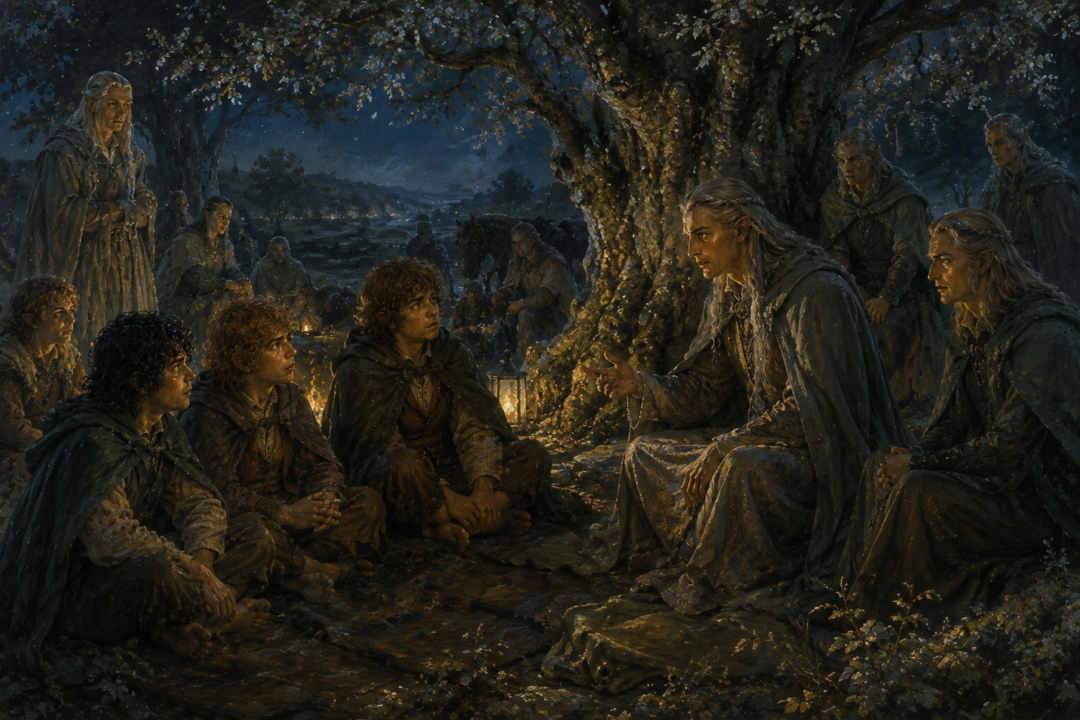
Then the arrival of Gildor Inglorion and his wandering Elves drives the Rider away.
The contrast could hardly be sharper.
Frodo has stepped out of ordinary Shire life and suddenly finds himself between powers he barely understands. On one side is a black-clad pursuer whose presence produces dread and temptation. On the other are High Elves whose knowledge reaches far beyond his own.
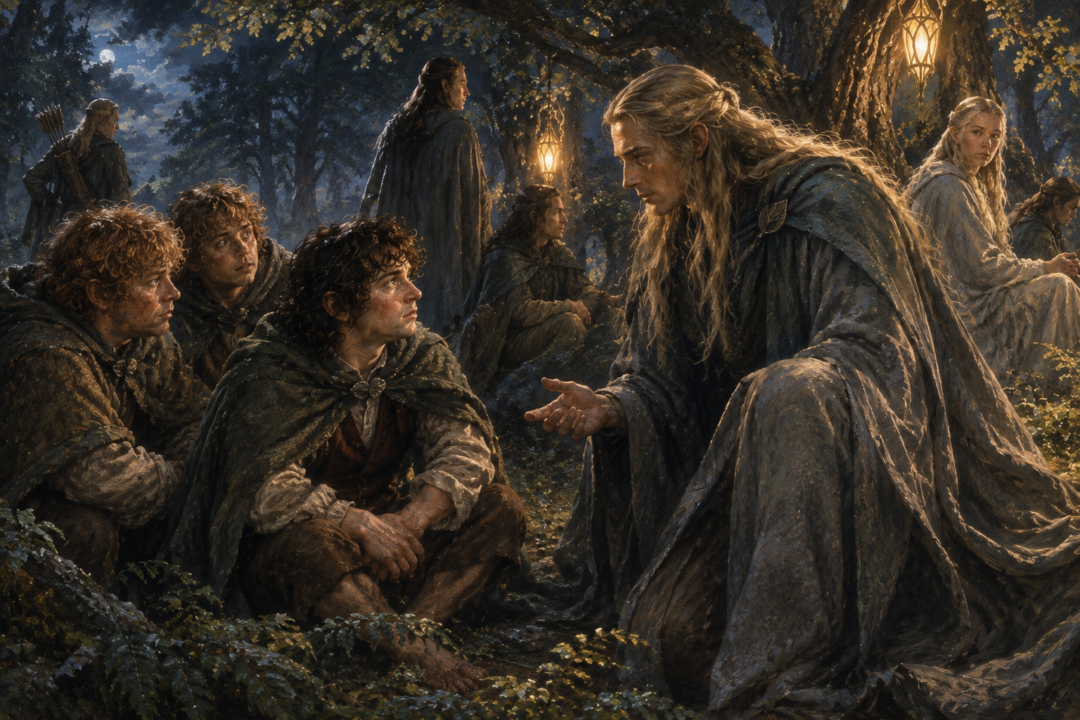
Frodo asks Gildor about the Riders.
Gildor recognizes that the matter is serious, but he is reluctant to explain everything. He does warn Frodo against them and urges him not to wait for Gandalf indefinitely.
Frodo leaves the encounter with greater confirmation of the danger, but still without a complete explanation.
That is significant because the story does not reward Frodo with perfect knowledge before requiring action.
He must continue choosing while much remains hidden.
Why Leaving the Road Makes Practical Sense
The road offers speed and convenience, but it also offers predictability.
A pursuer searching for travelers has an obvious advantage if those travelers remain on established routes. Frodo does not need sophisticated knowledge of the Enemy to understand this.
After the Riders appear, moving across country becomes a form of concealment.
The next day, Frodo, Sam, and Pippin attempt a cross-country route toward Bucklebury Ferry. Pippin famously objects to Frodo's idea of a short cut, and the resulting journey becomes inconvenient enough to justify his skepticism. They struggle through difficult country and eventually enter Farmer Maggot's land.
Yet Frodo's underlying reason for avoiding the road is serious.
The road has become associated with pursuit.
This is one of the subtle transitions in the opening of The Fellowship of the Ring. The Shire itself has not suddenly become Mordor. Its fields still grow crops. Hobbits still gossip. Farmer Maggot still has mushrooms, dogs, a family, and a wagon.
But the safe way to move through that familiar landscape has changed.
The Enemy has entered the roads.
Farmer Maggot Shows How Close the Hunt Has Come
The visit to Bamfurlong provides further evidence that Frodo's fear is justified.
Farmer Maggot has already encountered one of the black-clad strangers. The Rider came asking about Baggins and offered payment for information.
Maggot refused to cooperate and ordered the stranger away.
For Frodo, this is crucial confirmation. The pursuit is no longer something he can attribute to nerves or coincidence. The mysterious horsemen are deliberately questioning people along his route.
They know his name.
They are searching ahead.
And they are willing to approach ordinary inhabitants of the Shire to obtain information.
Maggot then helps the hobbits by carrying them toward the Bucklebury Ferry in his wagon. What begins as Frodo's attempt to leave the road therefore ends by revealing something larger: local knowledge, secrecy, and unexpected friendship can provide protection that the obvious route cannot.
The Shire is vulnerable, but Frodo is not entirely alone within it.
Frodo's Fear Is Ahead of His Knowledge
There is a tendency to imagine courage as the product of understanding: learn exactly what the danger is, determine its weakness, and then act.
Frodo's first flight from the Black Riders works differently.
His understanding repeatedly trails behind events.
He knows the Ring is dangerous before he understands everything it can do. He knows the Riders are hunting him before he knows what they are. He knows the road has become unsafe before he understands the scale of the hunt.
His decisions therefore depend upon judgment rather than certainty.
This is not presented as infallible instinct. Frodo makes mistakes, accepts inconvenient routes, and often needs information or assistance from others. The short cut across country creates problems of its own.
But he does not make the potentially fatal mistake of demanding complete proof before responding to danger.
The evidence he possesses is limited, yet it points consistently in one direction.
So he changes his behavior.
The Road Becomes One of the Story's First Lost Certainties
There is also something thematically important about the location of these encounters.
A road normally represents connection.
For Bilbo, roads lead outward toward adventure. For hobbits, Shire roads connect villages, inns, farms, friends, and markets. Frodo himself begins his journey with memories of Bilbo's songs about roads running onward.
But almost immediately, the road acquires another meaning.
A road can be followed in both directions.
It connects the traveler to his destination, but it also connects the hunter to the traveler.
The Black Riders turn that familiar structure against Frodo. They search settlements, question inhabitants, and patrol the routes along which their quarry is likely to move.
Leaving the road is therefore more than a tactical adjustment.
It is one of Frodo's first lessons that familiar things can no longer be trusted in familiar ways.
The Ring has changed the meaning of his world.
He Does Not Need to Know Their Names
Only later does Frodo learn the true identity of the Black Riders and the terrible history behind them.
By then, however, the essential lesson has already been learned.
Something connected to the Enemy is hunting him. It can inspire unnatural dread. It is drawn toward him and the Ring. Ordinary concealment may not always be enough. Predictable movement is dangerous. And survival may depend upon listening to warnings before every mystery has been solved.
Frodo's early decision to leave the road is therefore not evidence that he somehow understands the Nazgûl before the story explains them.
The opposite is more interesting.
He acts because he does not understand them.
He recognizes the limits of his knowledge and responds cautiously to what the evidence does tell him.
That pattern will follow him far beyond the Shire. Again and again, Frodo will enter places where he lacks the knowledge, strength, or certainty possessed by the great figures around him. His task rarely permits him to wait until every danger is explained.
The first Black Rider teaches that lesson almost immediately.
A hooded stranger comes down a peaceful Shire road.
Frodo does not know his name.
He does not know what lies beneath the cloak.
He does not yet understand why reaching for the Ring is so dangerous.
But he knows enough to get off the road.
For the moment, that is enough to keep the Ring-bearer free.
Sources & Notes
- The Encyclopedia of Arda — Black Riders: reference entry on the Nine’s mounted pursuit of the Ring-bearer through the Shire and their search for the name Baggins — https://www.glyphweb.com/arda/b/blackriders.php
- The Encyclopedia of Arda — Woody End: geographic account of the Shire woodland where Frodo, Sam, and Pippin hid from a Black Rider and later encountered Gildor’s Elves — https://www.glyphweb.com/arda/w/woodyend.php
- The Encyclopedia of Arda — Frodo Baggins: biographical chronology covering Frodo’s concealed departure from Bag End, early encounters with the Riders, and journey toward Buckland and Rivendell — https://www.glyphweb.com/arda/f/frodobaggins.php
- The Encyclopedia of Arda — Nazgûl: background on Sauron’s nine enslaved Ringwraiths, their perception of the Ring-bearer, and the danger they posed during the hunt — https://www.glyphweb.com/arda/n/nazgul.php
Sources establish the Riders’ search, the geography and sequence of Frodo’s early evasions in Woody End, and what Frodo could not yet know about the Nazgûl.