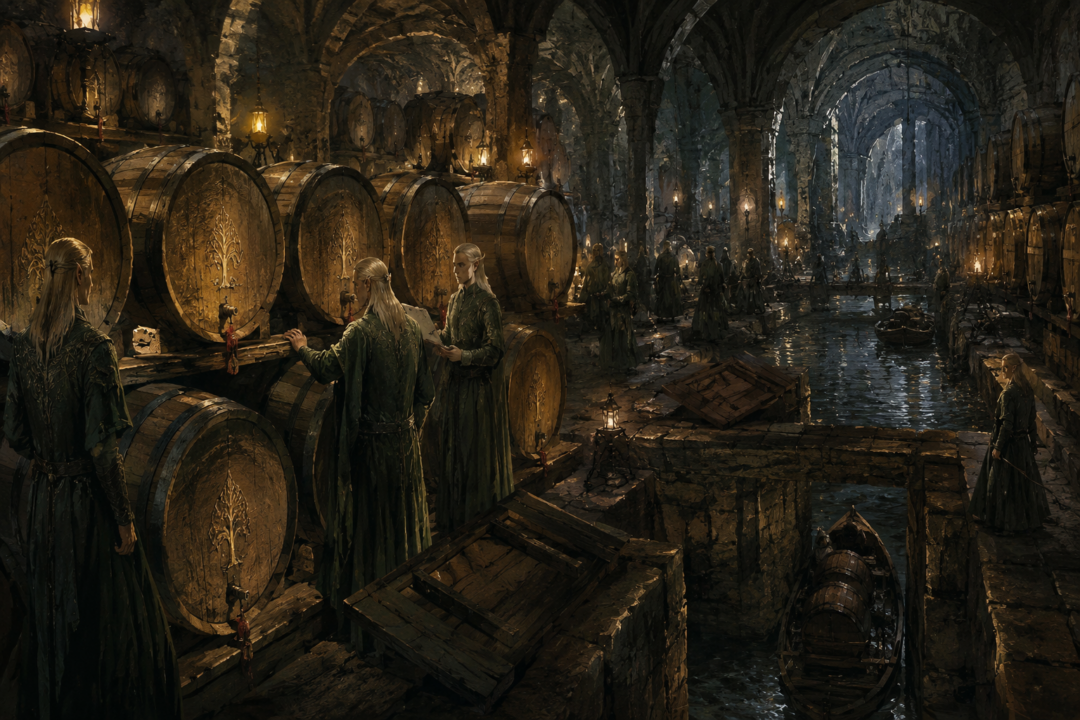
A barrel of wine seems like a small thing beside dragons, enchanted rings, and armies. Yet in The Hobbit, a few barrels in the Elvenking’s cellars quietly reveal something remarkable about northern Middle-earth.
The Wood-elves live beneath the trees of Mirkwood, in a realm that can feel isolated from the wider world. Their king rules from underground halls. The forest around them is dangerous. Great distances separate them from the better-known kingdoms of the West.
And yet the wine served at the king’s feasts comes from Dorwinion.
That detail matters because Dorwinion was associated with lands far to the east, near the Sea of Rhûn. A luxury product had somehow crossed a huge stretch of Wilderland and reached the underground cellars of the Woodland Realm.
The famous wine that puts the Elvenking’s butler and the captain of the guards to sleep therefore does more than make Bilbo’s escape possible. It opens a window onto a trade network connecting Mirkwood with distant regions most readers barely see.
The Wine That Makes Bilbo’s Escape Possible
The immediate importance of Dorwinion wine appears in “Barrels Out of Bond.”
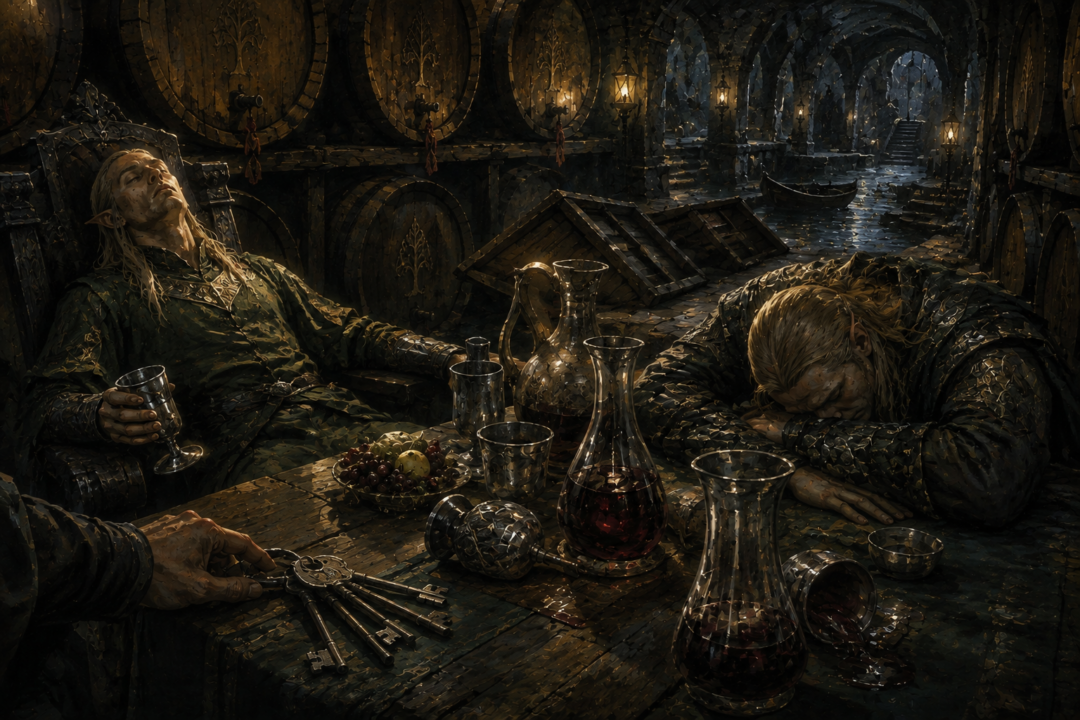
Bilbo needs to rescue Thorin and the other Dwarves from the Elvenking’s prisons. His opportunity arrives when the king’s butler and the chief guard begin drinking wine intended for the royal table.
The narrator identifies it as a particularly powerful vintage from the “great gardens of Dorwinion.” It was meant for the king’s feasts and was supposed to be consumed more moderately than the enormous quantities the two Elves drink.
That explains their extraordinary drowsiness and gives Bilbo the opening he needs.
But the surrounding description is even more revealing.
The Wood-elves are fond of wine despite the fact that vines do not grow in their part of the forest. Their wine and other goods therefore have to be imported. Some come from their southern Elven kindred, while others come from vineyards belonging to Men in distant lands.
This is not an isolated bottle carried home by an adventurous traveler.
It is organized commerce.
The Woodland Realm Was Not Economically Isolated
Mirkwood encourages the impression of isolation. The forest is vast, shadowed, and dangerous, and the Elvenking’s people have deliberately withdrawn into its northern reaches.
Economically, however, they are connected to outsiders.
The cellars contain many barrels, and the barrel system itself is part of a repeating logistical process. Goods arrive, their containers are emptied, and the empty barrels are sent back toward Lake-town.
That is one of the most overlooked details in the chapter.
The barrels are not disposable packaging. They belong to a functioning supply chain.
From the Elvenking’s halls, empty barrels are dropped through trapdoors into the underground stream. The water carries them into the Forest River and eventually toward the Long Lake. At Lake-town, they can re-enter the wider commercial world.
Bilbo exploits an established trade route rather than inventing a new means of escape.
The Dwarves survive because the Woodland Realm already possesses a transport system connecting its subterranean halls with communities beyond the forest.
Lake-town Was the Crucial Middleman
The geography makes Esgaroth especially important.
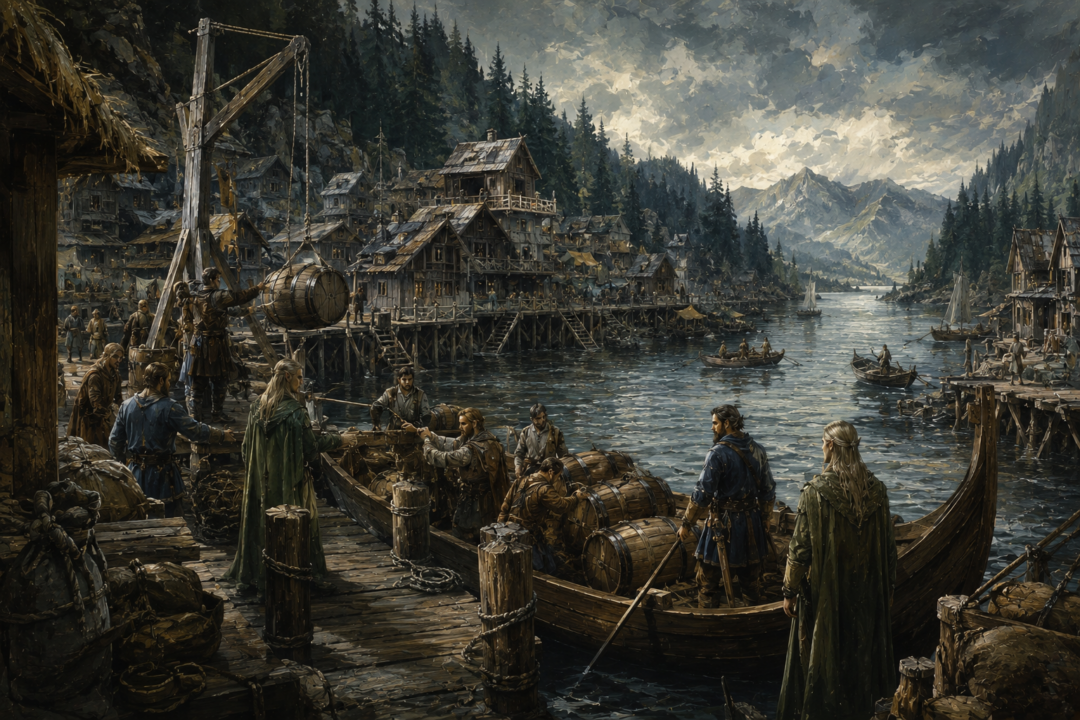
Lake-town stands on the Long Lake, connected northward with the River Running and westward with the Forest River. That position makes it a natural exchange point between the Woodland Realm and lands farther east and south.
The Hobbit explicitly describes the Lake-men as traders.
Their prosperity had declined from earlier days, especially while Smaug occupied Erebor, but commerce had not disappeared. They still dealt with the Wood-elves and maintained connections along the waterways.
When the empty barrels carrying Bilbo and the Dwarves reach Lake-town, the process is familiar enough that barrels floating down from the Elvenking’s halls are not themselves extraordinary.
That tells us something important about northern commerce.
The Woodland Realm did not necessarily need its own merchants to travel every league to the vineyards producing its wine. Goods could move through intermediaries. Lake-town could function as a commercial hinge connecting forest, lake, river, and distant producers.
The wine therefore demonstrates not simply travel, but economic interdependence.
How Far Away Was Dorwinion?
Here the evidence needs careful handling.
The Hobbit names Dorwinion but does not provide a precise geographical description of it. Later geographical evidence associated with the legendarium places Dorwinion on or near the northwestern shores of the Sea of Rhûn.
That makes the distance from northern Mirkwood considerable.
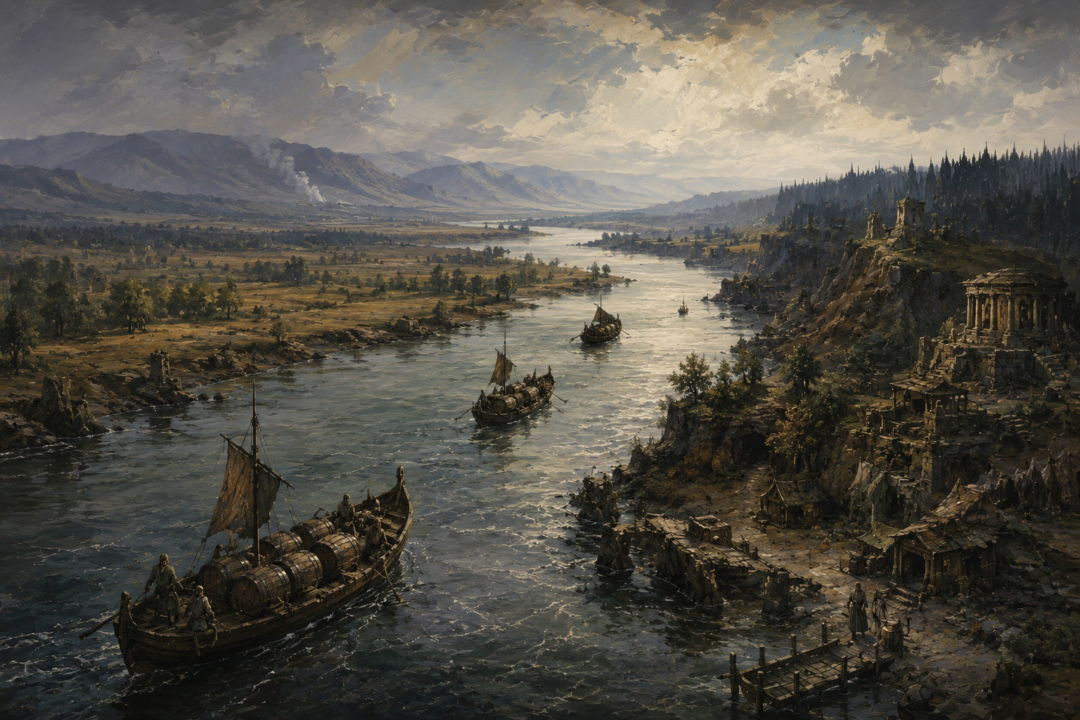
The River Running, or Celduin, flows from the Lonely Mountain through the Long Lake and then eastward across Wilderland toward the Sea of Rhûn. A wine-producing region near the lower Celduin or the northwestern Sea of Rhûn would therefore have access to a natural commercial corridor leading toward Lake-town.
We should not pretend that the texts provide a detailed itinerary for every barrel of Dorwinion wine. They do not.
But the broader picture is strong: Dorwinion was associated with the distant East, while The Hobbit explicitly tells us that imported goods reached the Wood-elves through routes connected with the Long Lake.
The wine in the Elvenking’s cellar therefore represents the far end of a remarkably long chain.
A Trade Route Hidden Inside the Adventure
Imagine the journey implied by a single barrel.
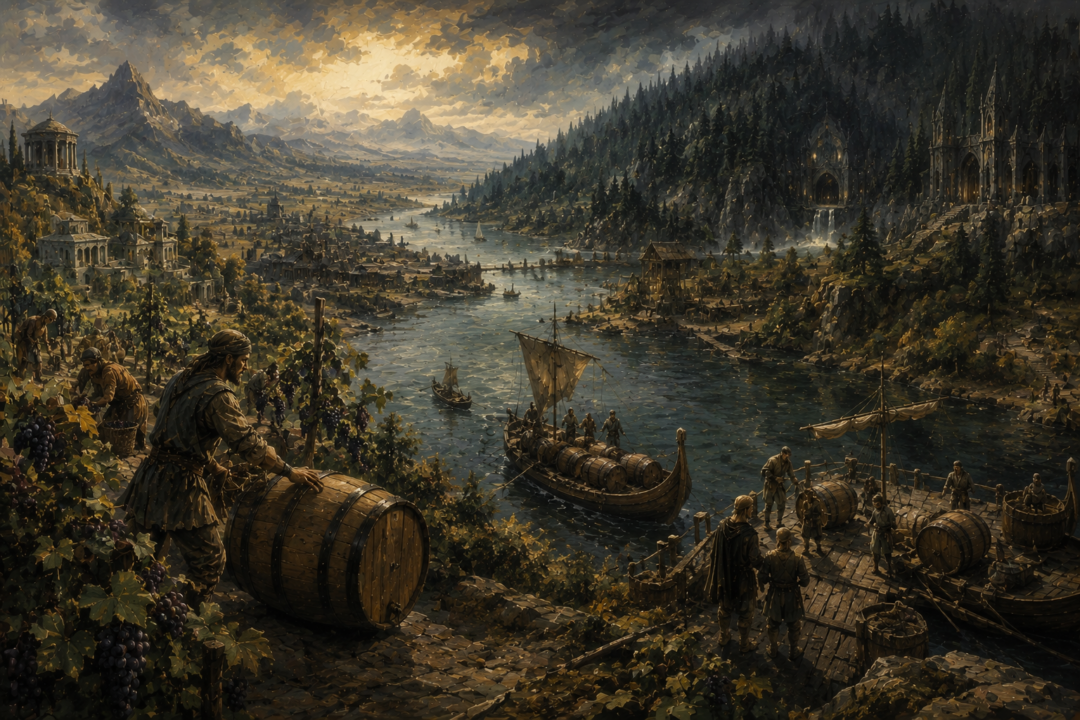
Grapes are harvested in Dorwinion’s famous gardens. Wine is produced and prepared for transport. The barrel enters a commercial network connected with the lands around the River Running. It moves westward or northwestward toward the Long Lake, whether directly or through multiple hands.
At Lake-town, the cargo enters the network supplying the Woodland Realm.
From there it travels along the Forest River toward the Elvenking’s halls, where it is stored underground and eventually served at royal feasts.
Afterward, the empty barrel is sent back downstream.
Not every step is described explicitly, so the exact commercial procedure remains uncertain. But The Hobbit gives enough information to show that the system is recurring and organized.
That matters because it changes how we picture Wilderland.
The map between Mirkwood and the Sea of Rhûn is not simply empty space separating famous locations. Rivers connect settlements. Merchants move goods. Distant communities produce things desired by people they may rarely, if ever, meet directly.
Middle-earth contains economies as well as quests.
Luxury Goods Reveal More Than Necessities
Wine is especially useful evidence because it is not an essential survival good.
The Elves could live without Dorwinion wine.
Their king wants it anyway.
The Woodland Realm is therefore willing and able to obtain a prestigious product from far beyond its own borders. The particularly strong vintage is reserved for royal feasting, suggesting that imported wine could carry social value as well as practical value.
This is long-distance luxury commerce.
And luxury commerce requires more than simple geographic contact. Someone has to know that the product exists. Producers need buyers. Merchants or intermediaries need dependable routes. Transport must be worthwhile despite distance and danger.
We cannot reconstruct prices, tolls, contracts, or merchant organizations from the text. None are described.
But the existence of repeated imports is evidence that enough stability survived in Wilderland for valuable goods to cross substantial distances.
The Forest Was Dangerous, but Not Sealed
This makes the political geography of The Hobbit more interesting.
Northern Mirkwood is threatened by spiders and the spreading shadow of the Necromancer farther south. The lands around Erebor have been devastated by Smaug. Old kingdoms and roads have declined.
Yet trade continues.
That contradiction is characteristic of late Third Age Middle-earth.
The world is diminished, but it is not dead.
Lake-town still trades. The Wood-elves still import goods. Men still inhabit distant regions. Rivers remain commercial arteries even when great political powers have weakened.
The wine from Dorwinion is therefore a small sign of resilience.
Even in a world of ruined kingdoms, people continue producing, exchanging, transporting, and consuming goods across borders.
What the Wine Does Not Prove
There is a temptation to push the evidence too far.
Dorwinion wine does not prove that the Woodland Realm controlled territory near the Sea of Rhûn. It does not prove a formal alliance between the Elvenking and Dorwinion. It does not tell us that Elven merchants personally traveled all the way there.
Nor do the main narrative texts give us a detailed description of Dorwinion’s population, government, cities, or commercial institutions.
Those gaps should remain gaps.
What the evidence does support is more modest and more interesting: the Woodland Realm participated in a network capable of bringing products from distant lands into northern Mirkwood.
Lake-town almost certainly mattered enormously to that network because The Hobbit directly establishes its commercial relationship with the Elves and its strategic position on the connected waterways.
Dorwinion shows the possible reach of that system.
Bilbo Escapes Through Middle-earth’s Economy
The final irony is that Bilbo’s escape succeeds because of ordinary commerce.
He does not defeat the Elvenking’s guards in battle. He does not break the prison doors with magic. Instead, he notices how the kingdom functions.
Wine comes in.
Empty barrels go out.
The guards drink too much of an unusually powerful royal vintage.
Bilbo turns that mundane rhythm into an escape route.
The barrels carrying Thorin and his companions toward Lake-town are therefore part of the same commercial system that brought the Dorwinion wine into the Woodland Realm in the first place.
A distant vineyard helps create the conditions for the Dwarves’ escape.
And once we notice that connection, the Woodland Realm stops looking like a hidden kingdom sealed inside Mirkwood. Beneath the trees ran commercial links stretching through Lake-town and along the great waterways of Wilderland toward lands close to the Sea of Rhûn.
The great gardens of Dorwinion may barely appear in the story.
Their wine tells us how large the world beyond the story really was.
Sources & Notes
- The Encyclopedia of Arda — Dorwinion: reference entry covering Dorwinion's potent wine, its shipment to the Elvenking's halls, and the name's association with the lands around the Sea of Rhûn — https://www.glyphweb.com/arda/d/dorwinion.php
- The Encyclopedia of Arda — Forest River: geographic reference tracing the river from northern Mirkwood past the Elvenking's halls to the Long Lake, the route used by the barrels — https://www.glyphweb.com/arda/f/forestriver.php
- The Encyclopedia of Arda — Esgaroth: reference entry describing Lake-town's trading role and its commercial connections with both the Wood-elves and lands to the south — https://www.glyphweb.com/arda/e/esgaroth.php
Sources document Dorwinion wine, the barrel transport system, and the river-and-lake trading geography connecting the Woodland Realm with Esgaroth and lands farther east.