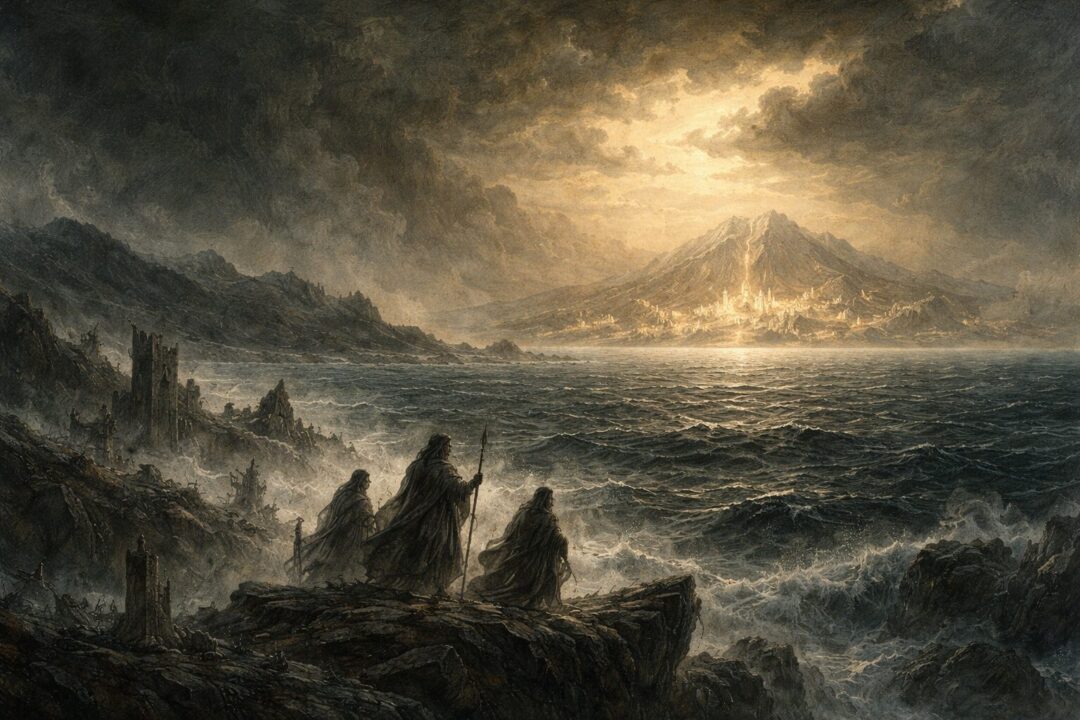
At first glance, the absence of the Valar during the War of the Ring feels deeply unsettling.
These are not distant legends or forgotten gods. They are real powers, dwelling in the West beyond the Sea, who once shaped the very substance of the world. They imprisoned Morgoth, shattered mountains, changed the course of seas, and ended wars that defined entire ages of history.
And yet, when Sauron rises again—when darkness spreads across Middle-earth and the fate of all Free Peoples hangs by a thread—the Valar do not appear.
There is no thunder from the heavens.
No hosts crossing the Sea.
No final judgment falling upon Mordor.
For many readers, this silence feels like abandonment. If the Valar once intervened to defeat evil on a cosmic scale, why do they remain distant now, when the danger seems just as dire?
To understand why, we must look not only at the War of the Ring—but at what the Valar learned from their own past.
The Cost of Direct Intervention
The last time the Valar intervened openly in Middle-earth, the consequences were catastrophic.
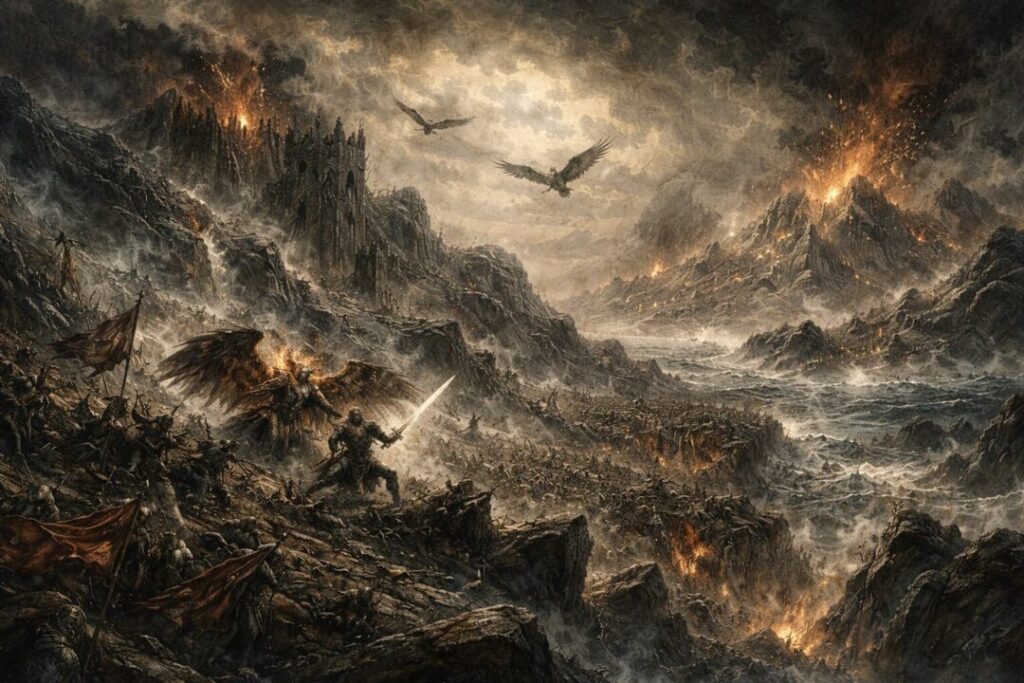
The War of Wrath ended Morgoth’s reign at last. His fortresses were broken, his armies destroyed, and his power cast out of the world. But victory came at a terrible cost. The land of Beleriand was shattered and drowned. Mountains were torn apart. Coastlines vanished beneath the sea. Entire peoples were displaced or erased from history.
Evil was defeated—but the world itself was permanently scarred.
This was not collateral damage in the modern sense. It was the unavoidable result of divine power acting directly within the physical world. The Valar are not surgeons; they are forces of creation and shaping. When they move openly, the world bends—or breaks—under the weight of their will.
That war taught them a hard truth: their power is not precise.
By the Third Age, Middle-earth is no longer a mythic battlefield of gods and titans. It is a fragile world of farms and roads, of villages and hearth-fires, of mortal lives that cannot endure another reshaping of the world itself.
Another war like the War of Wrath would not save Middle-earth.
It would end it.
A World No Longer Meant for Divine Rule
There is a deeper reason for the Valar’s restraint—one that goes beyond fear of destruction.
Middle-earth was never meant to remain forever under divine correction.
The Children of Ilúvatar—Elves and Men—were given free will. That freedom includes not only the capacity for good, but also the possibility of failure, corruption, and suffering. If the Valar stepped in to solve every great crisis, Middle-earth would never truly belong to its peoples.
It would remain a world forever managed from afar.
Sauron’s defeat had to mean something.
It had to be earned through resistance, sacrifice, and moral choice—not imposed by overwhelming power descending from the West. A victory handed down from above would remove the symptom of evil, but not test the hearts of those who lived beneath its shadow.
This is why the Valar did not simply remove Sauron, even though they could have.
Such an act would leave Middle-earth unchanged at its core—dependent, fragile, and untested. Evil would be defeated, but the peoples of the world would remain children, not stewards of their own fate.
The Shift from Power to Permission
The Valar did not abandon Middle-earth.
They changed their method.
In the early ages, they acted directly. In the later ages, they learned restraint. Instead of ruling openly, they allowed history to unfold within boundaries—guiding rather than commanding, influencing rather than enforcing.
This shift is subtle but deliberate.
Instead of armies, they sent emissaries.
Instead of commands, they offered counsel.
Instead of domination, they worked through hope.
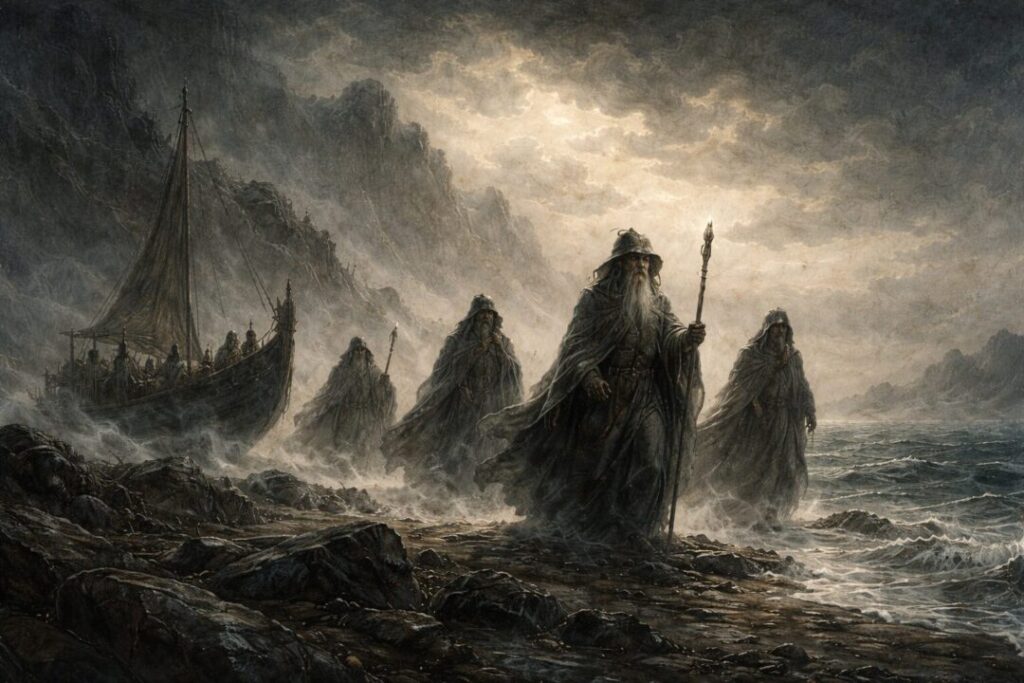
The sending of the Istari reflects this philosophy perfectly. These were not conquerors or divine enforcers. They were teachers and guides, deliberately limited in power and forbidden from matching Sauron with force.
Their task was not to win the war for Middle-earth.
It was to help Middle-earth win it for itself.
Even then, the Valar accepted risk. The Istari were free beings, capable of failure. One fell into treachery. One turned aside from his purpose. One abandoned it entirely. Only one remained faithful to the end.
That, too, was part of the cost of freedom.
Why the Ring Could Not Be Overpowered
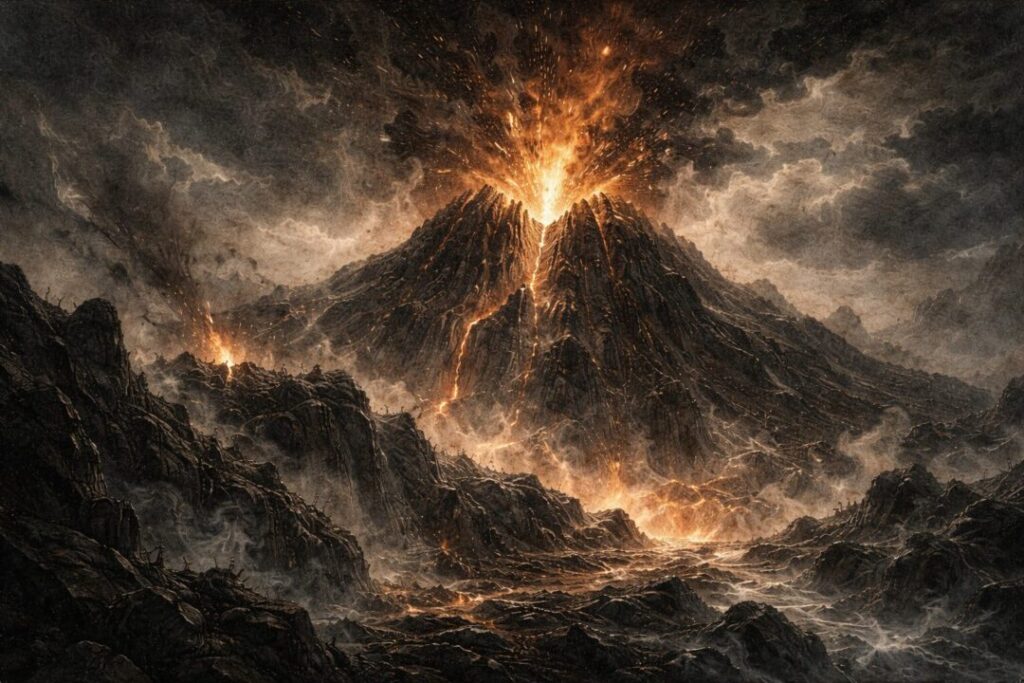
The nature of the One Ring itself reveals why direct intervention was impossible.
The Ring is not defeated by strength.
It cannot be conquered by armies, nor undone by raw power without catastrophic consequences. To claim it—even with good intentions—is to risk repeating the very tyranny it was meant to destroy. This is why the greatest figures of the age refuse it, even when they understand its danger.
Its destruction requires humility, endurance, and a willingness to suffer without glory.
This is why Hobbits matter.
They are not overlooked by accident; they are essential by design. Their smallness is not weakness, but insulation. They do not seek dominion. They do not dream of reshaping the world in their own image.
The Valar understood something that many readers miss: the smallest wills are often the hardest to corrupt, not because they are purer, but because they desire less power over others.
The War of the Ring is not a contest of force against force.
It is a moral trial.
It asks whether anyone—great or small—can carry unbearable responsibility without turning it into domination.
Why the Valar Remain Unseen at the End
When the Ring is destroyed, the Valar do not descend in triumph.
There is no proclamation from the West.
No divine reward bestowed before cheering crowds.
No visible sign that higher powers were ever involved at all.
And that silence is intentional.
The victory belongs to Middle-earth.
The Age of visible divine power fades, making room for a world shaped increasingly by mortal hands—flawed, fragile, but free. The Elves begin their long departure. Wonders diminish. Magic becomes rare. History moves forward not through intervention, but through memory and choice.
The Valar do not intervene because this war was never meant to be theirs to fight.
It was a final test of whether Middle-earth could stand without being held upright by the powers that once shaped it.
A Victory That Had to Be Earned
The War of the Ring ends not with divine judgment, but with exhaustion, loss, and quiet relief. Evil is defeated, but scars remain. The world is saved—but not preserved unchanged.
And that is precisely the point.
The Valar did not stay away out of indifference or fear. They stayed away because true victory required restraint—not from the peoples of Middle-earth alone, but from the powers who loved it most.
In the end, Middle-earth does not survive because it is protected forever.
It survives because, at last, it learns to choose its own future.
And that choice—fragile, costly, and incomplete—is what makes the victory real.
Sources & Notes
- J.R.R. Tolkien, The Silmarillion, “Of the Voyage of Eärendil and the War of Wrath” — the overthrow of Morgoth is followed by the breaking of Beleriand, grounding the article’s point about the cost of direct Valarin intervention.
- J.R.R. Tolkien, Unfinished Tales, “The Istari” — the Wizards are sent as emissaries and counsellors, forbidden to dominate Elves or Men by force or to match Sauron with open power.
- J.R.R. Tolkien, The Lord of the Rings, Book II, ch. 2 “The Council of Elrond” — the Wise reject using the Ring against Sauron, because victory by that means would become another form of domination.
- J.R.R. Tolkien, The Lord of the Rings, Book I, ch. 2 “The Shadow of the Past” — Gandalf explains why even good intentions cannot safely wield the Ring and why its destruction depends on pity, endurance, and unlikely bearers.
- J.R.R. Tolkien, Letter 131 — Tolkien frames the Third Age as a time of fading Elvish power, the hidden guidance of the Istari, and the transition toward the dominion and responsibility of Men.