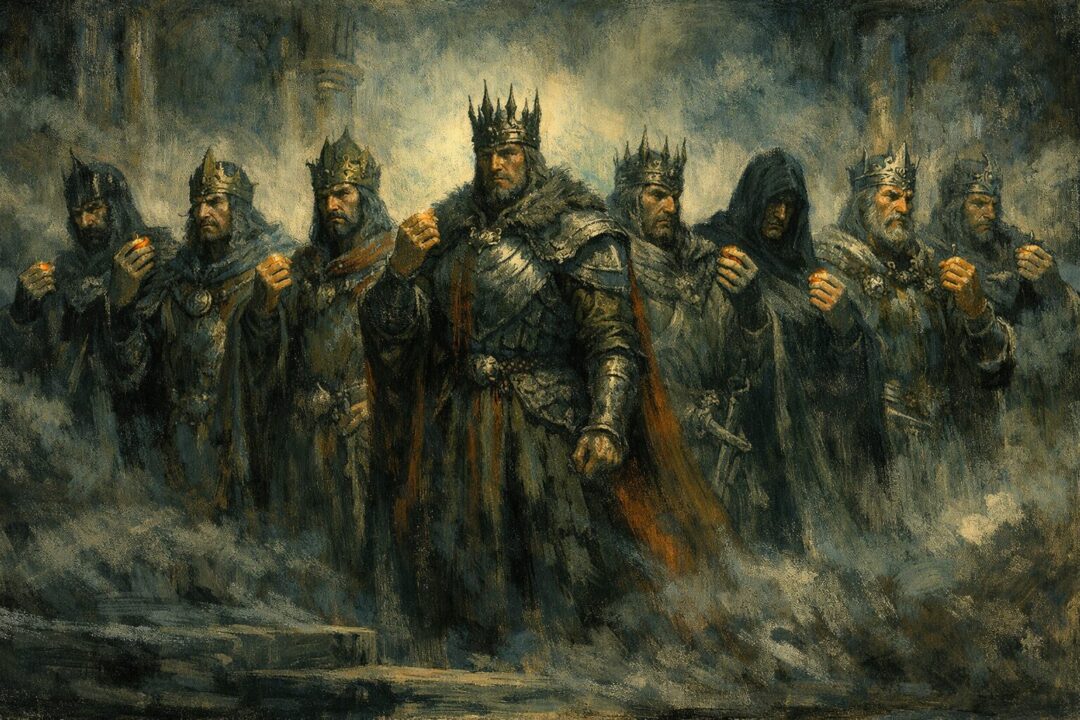
Few figures in Middle-earth inspire as much dread as the Ringwraiths.
They move without rest.
They speak rarely, if at all.
They exist to serve one will alone.
When they appear, the air itself seems to thin. Courage falters. Even seasoned warriors feel an instinctive urge to flee. Horses panic. Fires dim. Hope recedes.
By the time The Lord of the Rings begins, they are no longer known by their former names. They are simply the Nine. Shadows beneath black cloaks. Weapons shaped not only to kill, but to terrify.
Yet Tolkien leaves one deeply unsettling question unanswered—one that becomes more disturbing the longer you consider it:
Do the Ringwraiths understand what has been done to them?
Are they empty husks, stripped of identity and awareness?
Or are they something far worse—conscious beings trapped inside a fate they can no longer escape?
They Were Once Fully Human
The Nazgûl were not created as monsters.
They were Men.
Kings, warriors, and sorcerers of great renown who lived long before the events of The Lord of the Rings. Tolkien is explicit about this. These were not weak or insignificant figures. They were powerful rulers, each commanding authority in their own lands.
And most importantly:
They accepted the Rings of Power willingly.
They were not deceived in the moment.
They were not enslaved immediately.
They desired power—and they received it.
The Rings granted them longevity, influence, and an unnatural endurance beyond mortal limits. For a time, they flourished. They ruled as great lords among Men, their authority expanding as their lifespans stretched unnaturally onward.
But the cost was slow and merciless.
“They had, as it were, unending life, yet life became unendurable to them.”
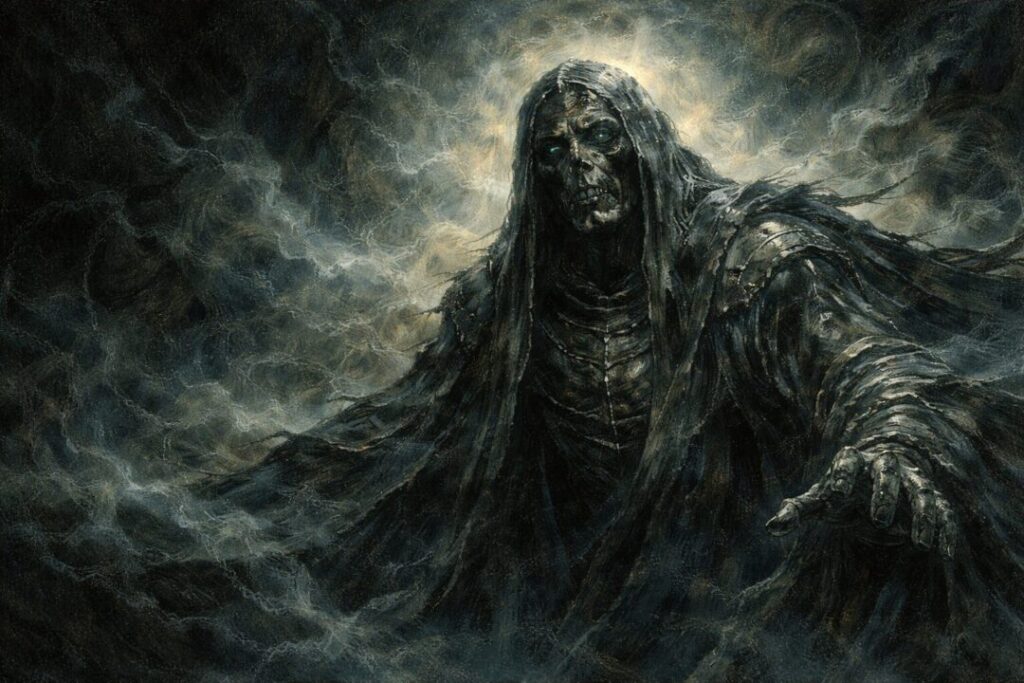
They did not die.
They faded.
Their physical bodies passed gradually into the unseen world, leaving behind only shadows—sustained by the Rings they bore, and ultimately by the One Ring that governed them all.
This was not sudden domination.
It was spiritual erosion.
Enslavement Without Oblivion
If the Ringwraiths were merely mindless thralls, this question would end here.
But Tolkien’s text does not support that interpretation.
The Nazgûl demonstrate perception, judgment, and memory. They recognize power when they encounter it. They react differently to different threats. They experience fear—not instinctive panic, but something closer to dread.
At the Ford of Bruinen, the Witch-king does not charge blindly. He hesitates. He assesses. He responds not to physical danger alone, but to authority.
He understands what stands against him.
He recognizes Glorfindel for what he is, and he recoils from names spoken in command. That reaction cannot exist without awareness. It implies memory, recognition, and judgment shaped by long experience.
Even more revealing is their relationship to the One Ring itself.
The Ringwraiths hunt it relentlessly. They pursue it across Middle-earth. They can sense its presence. And yet—despite countless opportunities—they never attempt to claim it for themselves.
They do not even consider it.
They know it is not theirs.
That knowledge implies an understanding of hierarchy, loss, and absolute subjugation. They are not confused servants. They know precisely where they stand.
The Witch-king: A Mind Still Intact
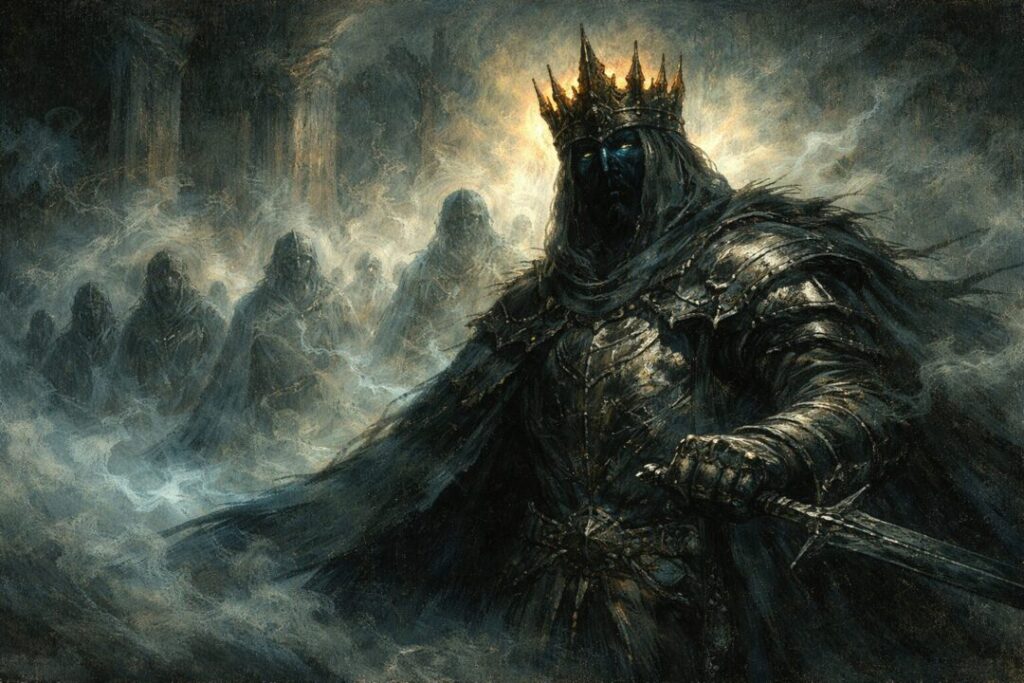
Among the Nine, one figure stands unmistakably apart: the Witch-king of Angmar.
He commands armies.
He plans campaigns.
He breaks kingdoms.
The fall of Arnor, the long terror of Angmar, and the corruption of entire regions of Middle-earth all bear his mark. These are not the actions of a mindless slave.
He reasons.
He taunts.
He adapts.
And yet, for all his apparent autonomy, he cannot act beyond the boundaries set by another will.
When he confronts Gandalf at the gates of Minas Tirith, the Witch-king does not challenge Sauron’s authority. He does not claim power for himself. He does not attempt rebellion.
He knows exactly who he serves.
That knowledge is what makes his existence far crueler than simple possession. He is not ignorant of his bondage. He is conscious of it—and unable to escape it.
Why They Cannot Rebel
Could the Ringwraiths resist if they wished to?
Tolkien’s writings strongly suggest they cannot.
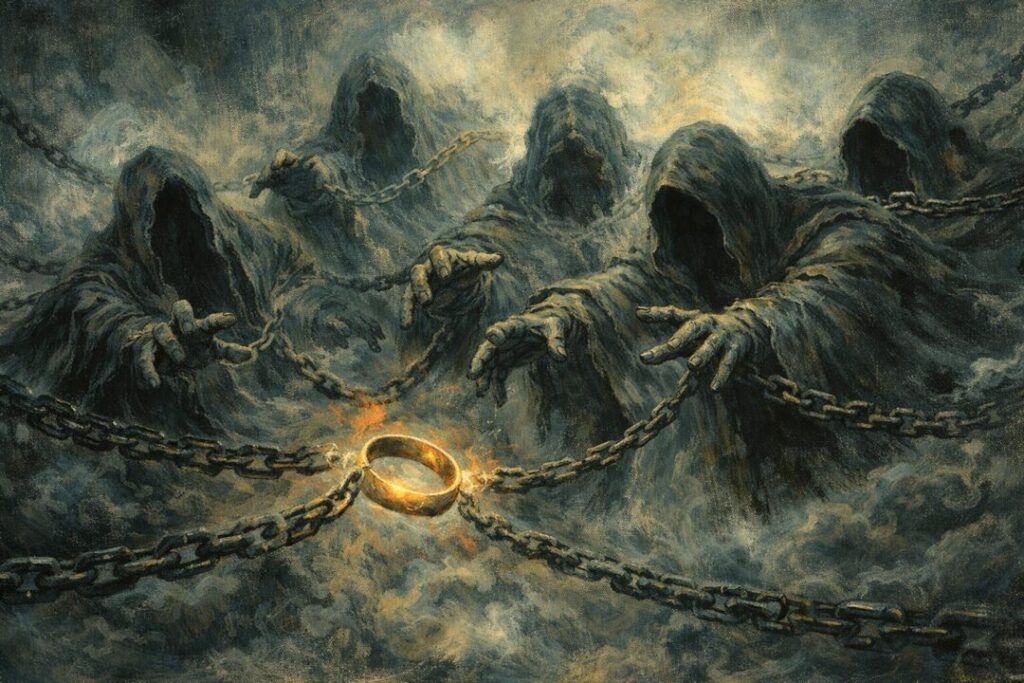
Their Rings bind them directly to the One Ring, and through it to Sauron. Their wills are not overridden moment by moment like puppets on strings. Instead, their very existence has become structurally dependent on that power.
To oppose Sauron would be to unravel themselves.
They are sustained by the same force that enslaves them.
This is not political domination.
It is ontological bondage—enslavement at the level of being.
Their fear, obedience, and limitations are not learned behaviors. They are conditions of existence imposed by the Rings themselves.
Awareness Without Escape
Tolkien often portrays evil not as ignorance, but as trapped will.
Gollum knows the Ring destroys him—but cannot let it go.
Saruman knows his betrayal—but cannot stop justifying it.
The Ringwraiths represent the final stage of this process.
They are not unaware.
They are not unconscious.
They are not empty.
They are aware—and unable to change.
Their silence is not emptiness. It is the absence of choice.
And that is why they inspire not only fear, but a strange, distant pity. They are cautionary figures: what happens when power is chosen over freedom again and again, until freedom itself is gone.
Why This Is Never Explained Directly
Tolkien never enters the inner thoughts of the Ringwraiths.
This is deliberate.
The story is filtered primarily through Hobbits—creatures who feel terror, not philosophy, when the Nazgûl appear. From that perspective, the Ringwraiths are not meant to be understood. They are meant to be experienced.
Their tragedy is not narrated.
It is felt.
They do not speak often because speech would humanize them—and Tolkien wants their horror to remain intact. Understanding comes later, quietly, after reflection.
The Most Terrifying Possibility
So were the Ringwraiths aware they were enslaved?
All signs point to yes.
Not clearly.
Not fully.
But enough.
Enough to remember what they were.
Enough to recognize what they have lost.
Enough to fear powers they once might have challenged.
Enough to obey—without hope of refusal.
They are not monsters born of darkness.
They are kings who surrendered themselves piece by piece…
until only the chains remained.
And that is what makes them one of the most tragic creations in all of Middle-earth.
Sources & Notes
- J.R.R. Tolkien, The Silmarillion, “Of the Rings of Power and the Third Age” — describes the Nine as once-great Men who became Ringwraiths, bound under the dominion of the One Ring.
- J.R.R. Tolkien, The Lord of the Rings, Book I, Chapter 2, “The Shadow of the Past” — Gandalf explains how the Rings ensnared mortal bearers until they became shadows under Sauron’s Shadow.
- J.R.R. Tolkien, The Lord of the Rings, Book I, Chapter 12, “Flight to the Ford” — the Nazgûl hesitate, command, perceive Frodo’s resistance, and recoil before opposing spiritual authority rather than acting as mindless bodies.
- J.R.R. Tolkien, Unfinished Tales, “The Hunt for the Ring” — presents the Ringwraiths as Sauron’s most terrible servants: intelligent hunters, but constrained by fear, orders, and dependence on his will.
- J.R.R. Tolkien, The Letters of J.R.R. Tolkien, Letter 246 — Tolkien’s discussion of a claimed Ring shows the Nazgûl would remain bound within Sauron’s hierarchy, unable simply to seize freedom or mastery for themselves.