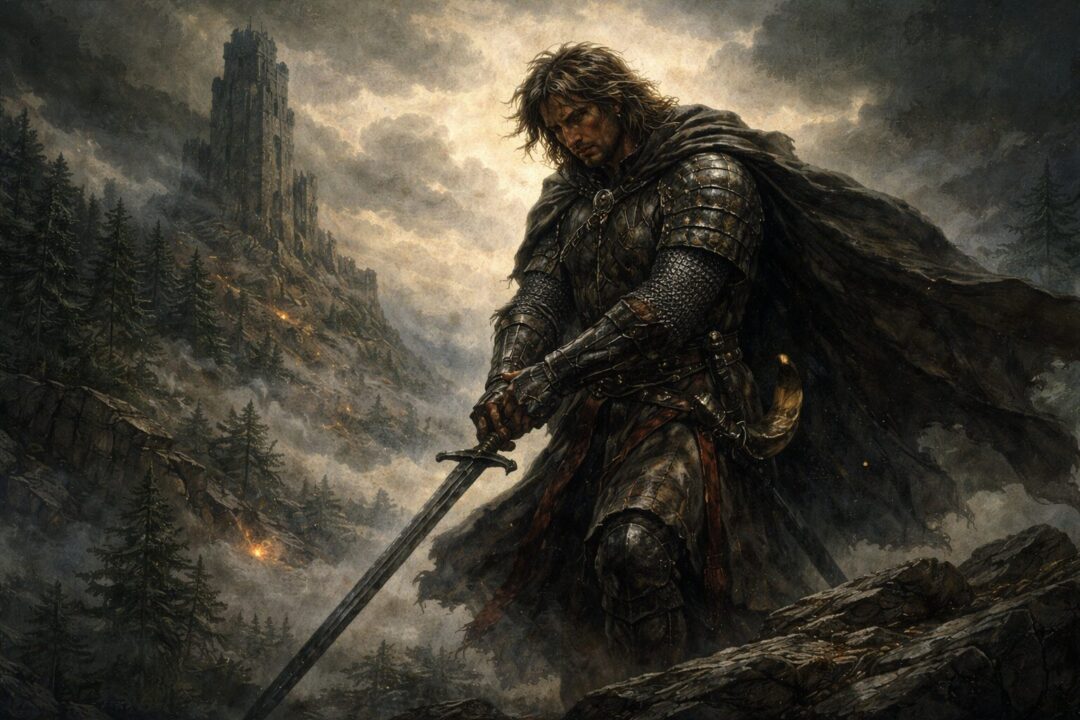
Boromir’s death is often framed as a tragedy—and it is—but in Tolkien’s world, tragedy rarely exists without purpose.
When Boromir falls defending Merry and Pippin at the edge of Amon Hen, readers are left with a haunting question: What if he had lived? What if the Fellowship had not broken? What if Boromir had remained loyal, resisted the Ring, and continued the journey?
At first glance, Boromir’s survival seems like an obvious advantage. He is brave, disciplined, and utterly committed to protecting others. Unlike many who desire the Ring, his motives are not selfish. He does not want to rule the world. He wants to save Gondor. He wants to end the war before it consumes everything he loves.
But Tolkien’s legendarium is deeply skeptical of that kind of desire.
Not because it is evil—but because it is dangerous.
Boromir Was Never “Corrupted” — He Was Tested
Boromir does not fall because he is wicked. He falls because he is human.
From the moment the Fellowship leaves Rivendell in The Fellowship of the Ring, Boromir struggles with a single idea: that refusing to use the Ring is wasteful. To him, allowing such power to go unused while Gondor burns feels like a moral failure.
This is crucial.
Boromir does not crave domination for its own sake. He believes domination can be justified if the cause is righteous. And that belief places him directly in the Ring’s grasp.
The Ring does not tempt everyone in the same way. It adapts. It speaks to each bearer through their deepest fears and strongest virtues. To Galadriel, it offers preservation. To Gandalf, mastery. To Boromir, it offers victory.
Not glory.
Not immortality.
Victory.
In Boromir’s mind, the Ring is not a curse—it is a weapon withheld at the very moment it is most needed. This makes him uniquely vulnerable. His struggle is not against selfish ambition, but against despair mixed with duty.
That is a far subtler temptation—and far harder to resist.

If Boromir Had Resisted… What Then?
Suppose Boromir never tried to seize the Ring at Amon Hen.
Suppose he mastered himself in that moment.
Would the danger have passed?
Almost certainly not.
The pressure would not have faded. It would have intensified.
As the Fellowship moved closer to Mordor, danger would increase, hope would diminish, and the cost of inaction would feel unbearable. Every loss—each Orc attack, each ruined land, each rumor of Gondor’s suffering—would reinforce Boromir’s conviction that the Ring must be used.
Time works against restraint.
Tolkien shows this repeatedly. The closer one comes to the source of evil, the harder moral clarity becomes. Frodo himself does not grow stronger as the quest continues—he grows more exhausted, more isolated, and more vulnerable.
Boromir, traveling alongside him, would have felt that weight differently.
Unlike Aragorn, Boromir does not descend from a line taught to fear power. He is a soldier raised to believe that strength exists to be wielded. Where Aragorn is trained to wait, Boromir is trained to act.
That difference matters more than skill or courage ever could.
The Fellowship Needed to Break
One of the most overlooked truths of The Lord of the Rings is that the Fellowship’s unity is not meant to last.
The story presents the Fellowship as noble, hopeful, and inspiring—but also temporary. Its purpose is not to arrive intact at Mordor. Its purpose is to carry the Ring safely out of the world of armies.
The Ring-quest requires secrecy, vulnerability, and moral obscurity. A large group—especially one containing a powerful, desperate warrior—draws attention both physically and spiritually.
Boromir’s presence anchors the Fellowship to the logic of war.
Frodo’s task requires escape from that logic entirely.
As long as Boromir remains, the Ring remains framed as a potential solution. A tool. An option. And as long as that option exists, Frodo cannot truly commit to the path of renunciation the quest demands.
Without Boromir’s fall, Frodo may never have chosen solitude.
And without solitude, the Ring may never have been destroyed.
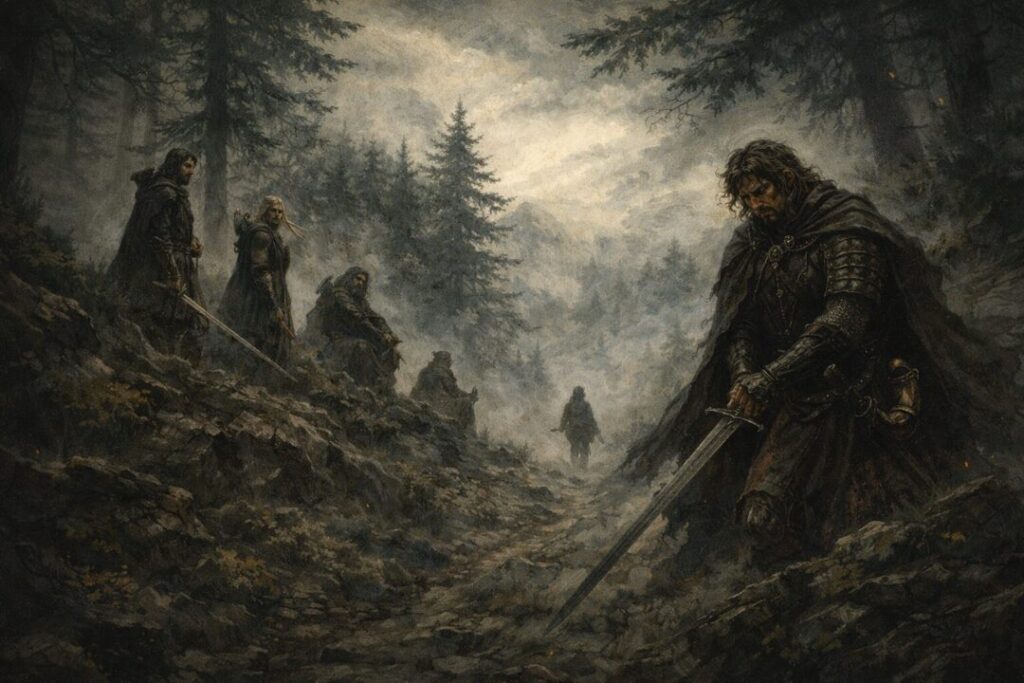
Why Boromir Could Not Walk Frodo’s Road
This is not a judgment of Boromir’s character.
It is a recognition of his nature.
Boromir is decisive. He believes problems are meant to be solved. He measures success by outcomes. These traits make him an exceptional captain—but they are incompatible with the Ring’s destruction.
The Ring is not undone by solutions.
It is undone by endurance.
Frodo does not “win.” He survives long enough to fail at the very end—and even that failure is redeemed only because the Ring’s power has been slowly eroded by humility, mercy, and exhaustion.
Boromir, had he lived, would always have sought an ending.
The Ring required someone willing to endure without resolution.
Boromir’s Death as a Turning Point, Not a Failure
Boromir dies doing what he always did best: protecting others.
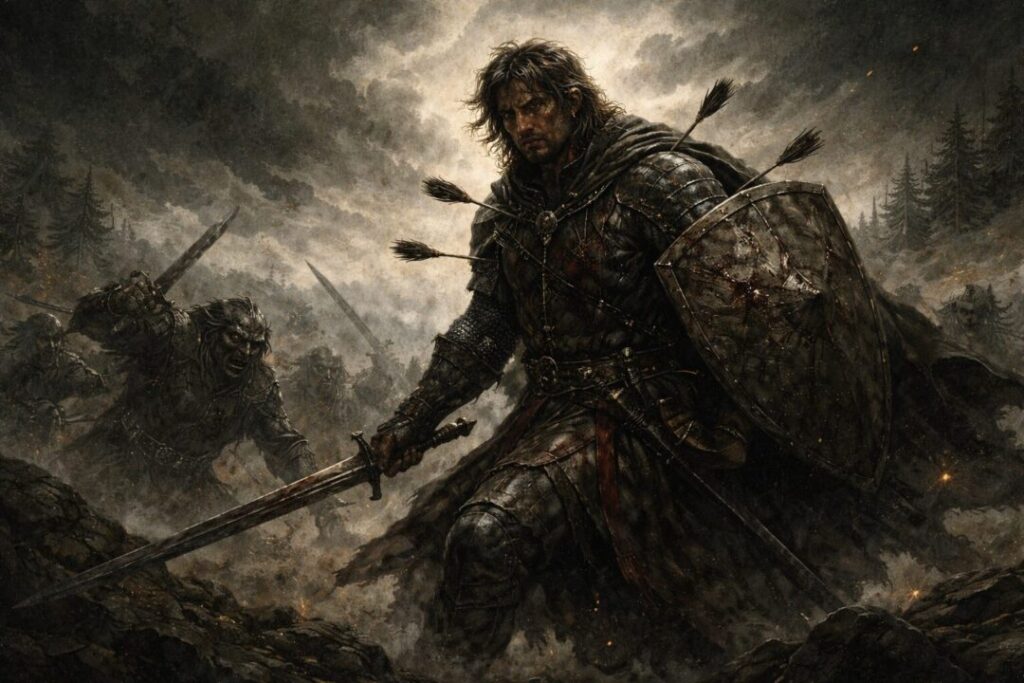
His final stand against the Uruk-hai is not a defeat—it is an affirmation of who he truly is when stripped of temptation. He does not die grasping for power. He dies defending the helpless, buying time, holding the line.
In his final moments, he accepts that some victories cannot be won by strength.
His repentance is quiet, sincere, and complete. It restores him—but it also ends his role in the Ring’s story.
This is not punishment.
It is resolution.
Boromir’s arc teaches one of Tolkien’s most difficult truths: that even the noblest intentions can become obstacles when paired with power.
Sometimes the greatest good is done not by pressing forward—but by stepping out of the way.
Why the Ring Needed Hobbits—Not Heroes
The Ring is not destroyed by courage, armies, or kings. It is destroyed because it is carried by those who do not seek to master it.
Hobbits are not immune to temptation—but they are slow to desire domination. They do not imagine themselves as saviors of the world. This makes them uniquely suited to a task that requires invisibility of spirit as much as secrecy of movement.
Boromir is too present. Too resolved. Too visible in the moral landscape of Middle-earth.
His survival would not have strengthened the quest.
It would have changed its nature.
And once that happens, the Ring wins—not through force, but through intention.
The Tragedy That Makes Victory Possible
In that sense, Boromir’s death is not the Fellowship’s greatest loss.
It is what allows the quest to continue at all.
His fall removes the last illusion that the Ring can be used. It forces Frodo to choose renunciation fully. It dissolves the Fellowship not in despair, but in necessity.
Boromir does not fail Middle-earth.
He completes his part in saving it.
And that is why, in Tolkien’s world, his death is not merely tragic.
It is essential.
Sources & Notes
- J.R.R. Tolkien, The Fellowship of the Ring, "The Council of Elrond" — Boromir argues that the Ring should be used as a weapon for Gondor, while Elrond and Gandalf reject that hope.
- J.R.R. Tolkien, The Fellowship of the Ring, "The Breaking of the Fellowship" — Boromir tries to take the Ring from Frodo, repents, and Frodo resolves to go on alone.
- J.R.R. Tolkien, The Two Towers, "The Departure of Boromir" — Boromir’s final defence of Merry and Pippin and his confession to Aragorn complete his redemptive arc.
- J.R.R. Tolkien, Letter 131 — Tolkien frames the Ring as a temptation to power and domination, supporting why even noble motives become perilous when joined to it.