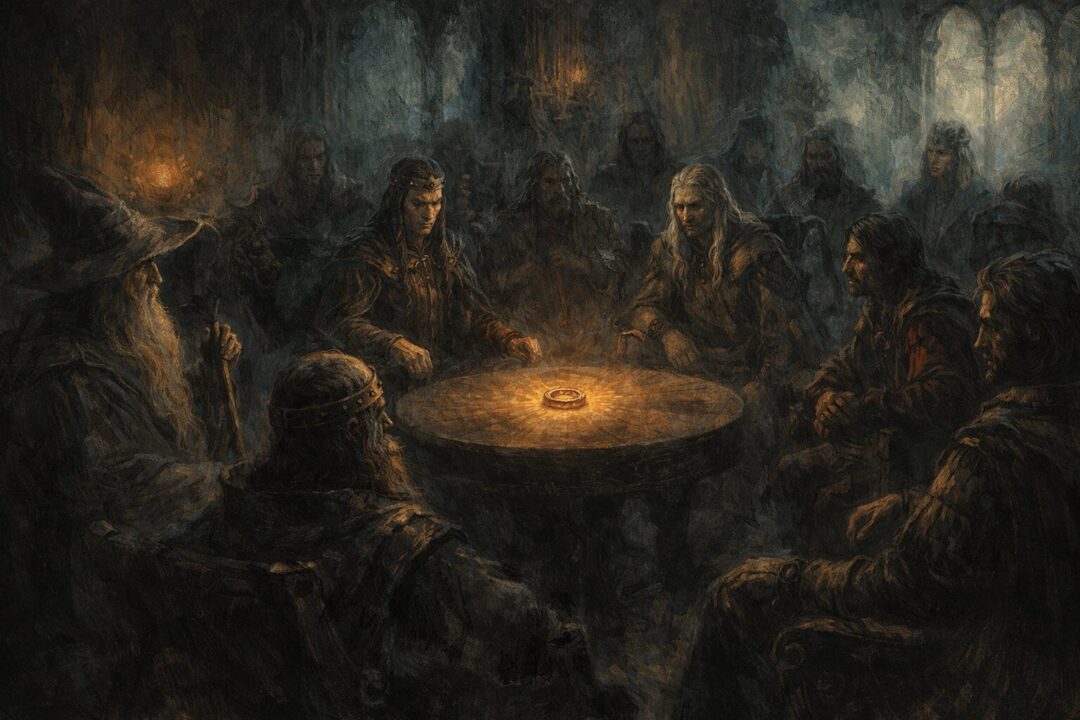
The destruction of the One Ring feels inevitable in hindsight.
It is forged in fire.
It is unmade in fire.
Specifically, in the fires of Mount Doom—the same place where Sauron bound much of his own power into it.
The symmetry feels absolute. Mythic. Final.
The story seems to tell us that the Ring could only be destroyed there—and nowhere else.
And yet Tolkien’s world is rarely governed by simple physical rules.
The Ring resists destruction not because it is made of indestructible metal, but because it is an extension of a will—designed not merely to endure, but to return. It is not just an object of power. It is a claim, made tangible.
So the real question is not whether Mount Doom was the only place where the Ring could be destroyed…
…but whether it was the only place where it should be.
What Makes the One Ring “Indestructible”?
The One Ring survives forces that destroy almost everything else in Middle-earth.
Dragon fire—which melts lesser Rings of Power—fails to harm it.
Weapons shatter or turn aside.
Time itself does nothing to it.
This endurance often leads to the assumption that the Ring is magically armored—protected by spells or some kind of unbreakable substance.
But Tolkien never describes it that way.
The Ring’s strength does not lie in its material. It lies in what it contains.
Sauron did not merely enchant the Ring. He invested it with a portion of his own being. His will, his malice, and his desire to dominate are bound into it. As long as that will endures, the Ring endures with it.
To destroy the Ring, then, is not simply to break an object.
It is to unravel a claim of authority—a domination imposed upon the world itself.
This is why the Ring resists destruction so completely. Not because it cannot be broken, but because it is constantly asserting itself.
That is why Gandalf refuses to touch it for long.
That is why the Wise will not use it—even against Sauron.
That is why even good intentions bend toward tyranny in its presence.
The Ring does not merely corrupt.
It commands.
Why Other Physical Methods Were Never Pursued
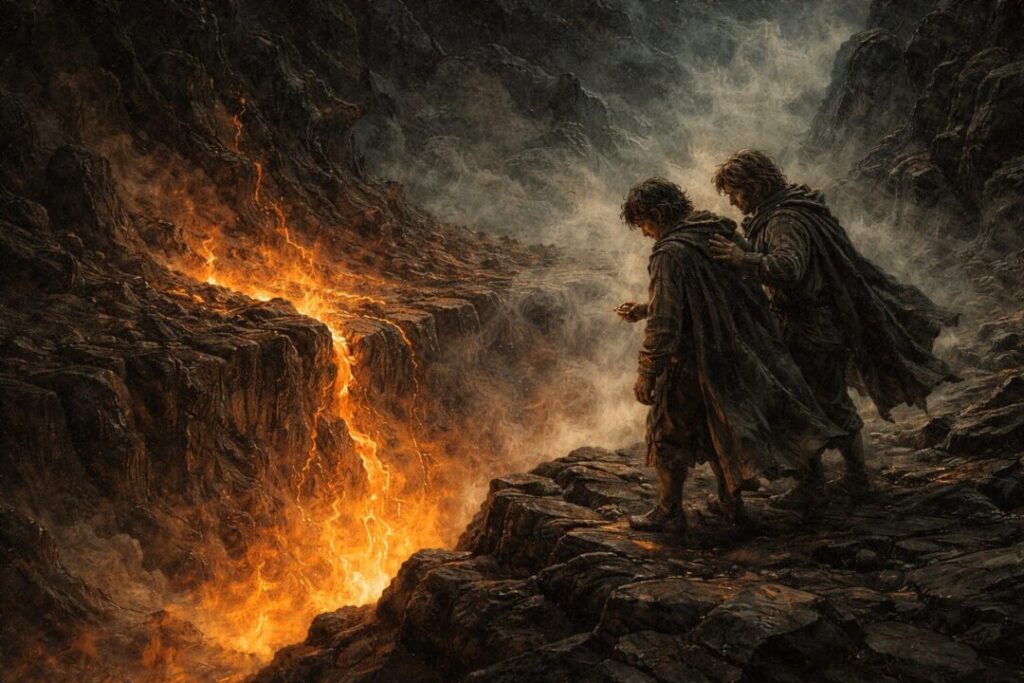
At the Council of Elrond, several alternatives are mentioned—and quietly dismissed.
Not because they are physically impossible, but because they fail in a deeper sense.
Could the Ring be buried?
It would endure—and eventually be found.
Could it be cast into the Sea?
It would not be lost forever. Tolkien is explicit on this point: evil does not vanish simply because it is hidden. Time, chance, or the movement of the world would one day bring it back into reach.
Could the Wise destroy it themselves?
This is where the question stops being mechanical and becomes moral.
Any being powerful enough to challenge the Ring’s maker would also be powerful enough to claim the Ring. And that claim would not end Sauron’s evil—it would merely change its name.
This includes Gandalf.
This includes Galadriel, who openly acknowledges what she would become if she accepted it.
This includes Saruman, who proves the danger by falling without ever touching the Ring itself.
The Ring does not require possession to corrupt.
It only requires ambition.
What About Dragon Fire or Ancient Powers?
It is sometimes suggested that a dragon greater than Smaug—or some relic of the Elder Days—might have been able to destroy the Ring.
Tolkien never confirms this.
And that absence is not accidental.
The legendarium contains many opportunities where such clarification could have been made—and Tolkien consistently avoids it. The implication is not that the question is irrelevant, but that it misses the point.
Even if some ancient force could unmake the Ring, such an act would bypass the very trial the Ring was designed to impose.
The Ring is not a test of strength.
It is a test of restraint.
It is not defeated by superiority.
It is defeated by refusal.
That is why the smallest figures in the story—Hobbits, overlooked and underestimated—are the only ones capable of carrying it far enough.
They do not seek power.
They do not imagine themselves rulers.
They do not desire to reshape the world.
And so the Ring has little to work with—until the very end.
Why Mount Doom Is Different
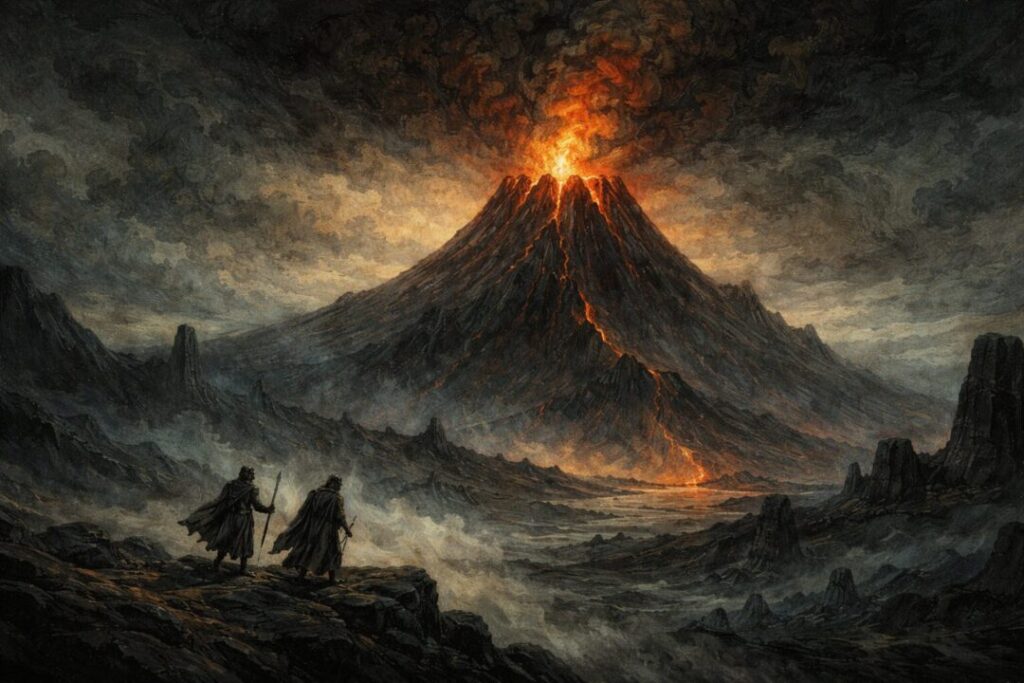
Mount Doom is not merely hot enough.
It is relevant.
The Ring is undone where it was made—not because of heat alone, but because the act of domination is reversed at its source. The will that shaped the Ring is unbound in the very place it was bound.
This is not coincidence. It is moral symmetry.
Mount Doom is the heart of Sauron’s power, not just geographically, but spiritually. It is where his claim over Middle-earth was first made concrete. To destroy the Ring there is to return that claim—and reject it.
This is why the Ring resists Frodo most fiercely at the Cracks of Doom.
It is not afraid of destruction.
It is afraid of renunciation.
The closer Frodo comes to the end, the louder the Ring’s voice becomes—because it knows this is the one place where its authority can be undone without replacement.
The Deeper Pattern Tolkien Repeats
This structure appears again and again across Tolkien’s world.
Evil is not defeated by overwhelming force.
It is allowed to collapse under the weight of its own contradictions.
Morgoth is not slain in a final duel. He is cast out, diminished, and rendered incapable of ruling the world he sought to dominate.
Sauron is not struck down in single combat at the end of the Third Age. His power evaporates when the Ring—his anchor—ceases to exist.
The Ring itself is not shattered by strength.
It is undone by surrender.
Mount Doom is not a loophole in the rules of the world.
It is a reckoning.
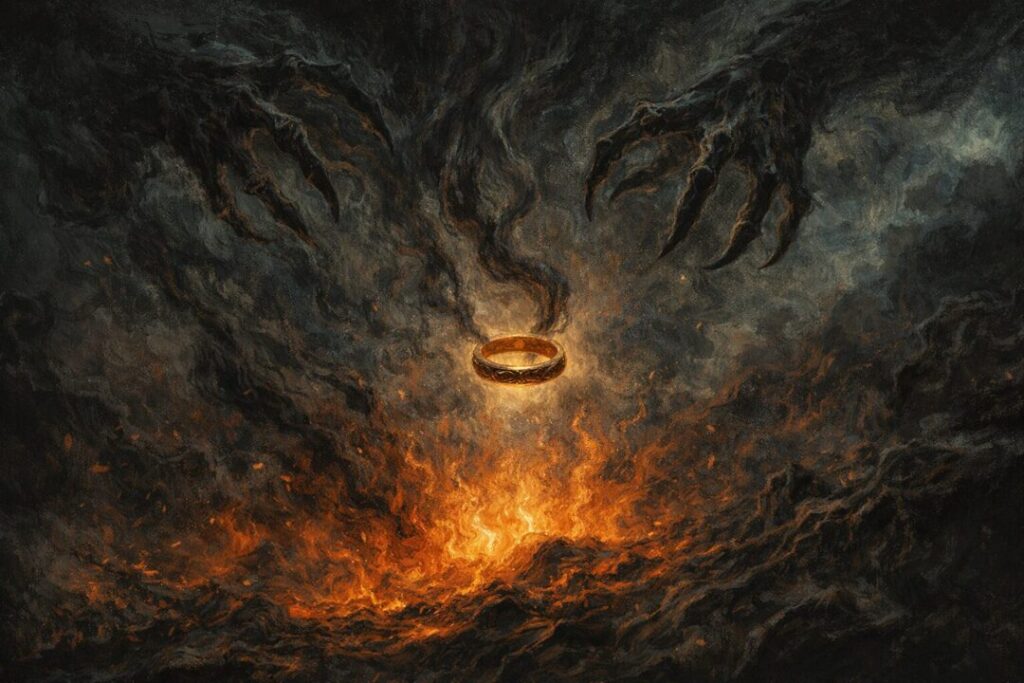
So Was There Any Other Way?
In a narrow, technical sense—perhaps.
But Tolkien is not writing a manual for victory.
He is writing a moral history.
The destruction of the Ring requires more than power, more than courage, more than wisdom. It requires someone willing to carry absolute power without claiming it… to walk into the center of darkness without imagining themselves its master… and, crucially, to fail at the final moment—yet still succeed.
Because Frodo does fail.
He claims the Ring.
And the world is saved anyway—not through his strength, but through mercy shown long before, when he spared Gollum’s life.
That paradox is not a flaw in the story.
It is the point.
The Ring was never meant to be destroyed by the mighty.
It was meant to expose the limits of might itself.
And Mount Doom was not chosen because it was the only place where destruction was possible—but because it was the only place where destruction could occur without replacing one tyranny with another.
In that sense, Mount Doom was not the only option.
It was the only answer.
Sources & Notes
- J.R.R. Tolkien, The Lord of the Rings, Book I, Ch. 2, “The Shadow of the Past” — Gandalf says the One Ring could not be harmed by any dragon-fire then existing, and that it was made in Orodruin and could be unmade there.
- J.R.R. Tolkien, The Lord of the Rings, Book II, Ch. 2, “The Council of Elrond” — the Council rejects hiding, casting away, or wielding the Ring, and resolves that it must be destroyed rather than used.
- J.R.R. Tolkien, The Lord of the Rings, Book VI, Ch. 3, “Mount Doom” — at the Cracks of Doom Frodo claims the Ring, Gollum intervenes, and the Ring is destroyed in the fire where it was forged.
- J.R.R. Tolkien, The Silmarillion, “Of the Rings of Power and the Third Age” — Sauron makes the One Ring in Orodruin and passes much of his own power into it to rule the other Rings.
- J.R.R. Tolkien, Letters, no. 131 — Tolkien explains Sauron’s domination through the One Ring and the consequence that destroying it would leave him permanently diminished.